July 30

What was advertised in a revolutionary American newspaper 250 years ago this week?
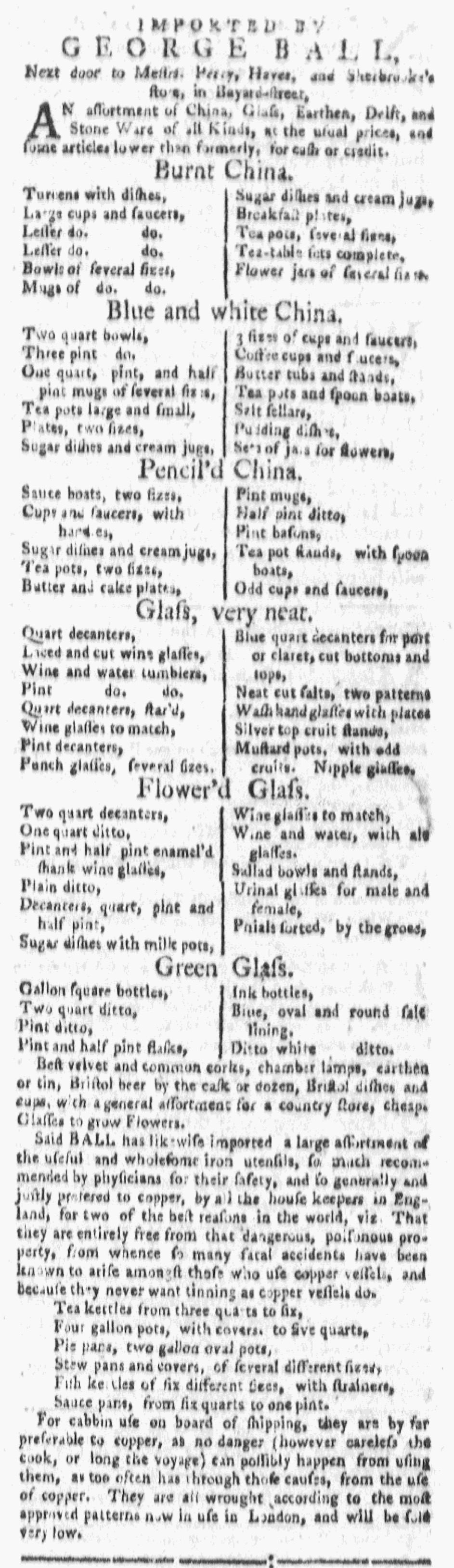
Rivington’s New-York Gazetteer (July 27, 1775).

“Iron utensils, so much recommended by physicians for their safety.”

As July 1775 came to a close, George Ball advertised an “assortment of China, Glass, Earthen, Delft, and Stone Ware of all Kinds” in Rivington’s New-York Gazetteer.  He conveniently did not mention when he acquired his merchandise, whether it arrived in the colonies before the Continental Association went into effect, though the headline did proclaim “IMPORTED BY GEORGE BALL” rather than “JUST IMPORTED BY GEORGE BALL.”

Most of Ball’s advertisement consisted of a list of the various items he stocked, divided into categories that included “Burnt China,” “Blue and white China,” “Pencil’d China,” “Glass, very neat,” “Flower’d Glass,” and “Green Glass.”  In the final third of the advertisement, however, Ball highlighted “iron utensils” and made a pitch to convince consumers to demand iron tea kettles, iron pots, iron saucepans, iron pie pans, and iron stew pans with iron covers instead of copper ones.  Those “useful and wholesome iron utensils,” Ball asserted, were “so much recommended by physicians for their safety” and, accordingly, “so generally and justly prefered to copper, by all the house keepers in England.”  Ball made health and safety the centerpiece of his marketing, citing “the best reasons in the world.”  He emphasized that cookware made of iron was “entirely free from that dangerous, poisonous property, from whence so many fatal accidents have been known to arise amongst those who use copper vessels.”  As a bonus, consumers could save money over time since “iron utensils” did not need the same maintenance: “they never want tinning as copper vessels do.”  In addition to the “house keepers” of New York, Ball promoted his wares to readers responsible for outfitting ships.  “For cabbin use on board shipping,” he declared, iron items “are by far preferable to copper, as no danger (however careless the cook, or long the voyage) can possibly happen from using them, as too often has through those causes, from the use of copper.”  Ball concluded by noting that his “iron utensils” were “all wrought according to the most approved patterns now in use in London,” but that nod to fashion and taste merely supplemented his primary marketing strategy.  For consumers concerned about health and safety in the kitchen, he carried the cookware that they needed to use instead of taking chances with copper kettles, pots, and pans.

July 10

What was advertised in a revolutionary American newspaper 250 years ago today?

New-York Gazette and Weekly Mercury (July 10, 1775).

“Children educated … at a distance from probable, sudden danger and confusion.”

In July 1775, Andrew Wilson, a schoolmaster in Morristown, New Jersey, attempted to leverage current events to enroll students in his school “about twenty-seven miles from Powles-Hook, and eighteen miles from Elizabeth-Town.”  In the late spring and early summer, colonizers in New York followed the news about the battles at Lexington and Concord, the siege of Boston, and the Battle of Bunker Hill.  In addition to updates from Massachusetts, they read and discussed actions taken by the Second Continental Congress, meeting in Philadelphia, and provincial congresses throughout the colonies.  While the fighting had been confined to Massachusetts so far, colonizers anticipated that it would spread.

In such an environment, Wilson saw an opportunity to market his school to parents and guardians in New York City and other coastal towns.  “IN these dangerous and alarming times,” he declared, “the inhabitants of large cities, and other places on the sea coast, may wish to have their children educated in the interior parts of the country, at a distance from probably, sudden danger and confusion.”  He acknowledged that they likely weighed tuition and the quality of instruction against the prospects of danger, suggesting that they would send their children to such a school “if the expence was reasonable, and they could depend on the fitness of the teacher.”  Wilson confidently stated that he could alleviate both concerns.  He claimed that he “was recommended by Dr. Witherspoon, of New-Jersey College, and the Rev. Mr. Mason, in New-York.”  Furthermore, he had experience.  When he ran his advertisement in the July 10, 1775, edition of the New-York Gazette and Weekly Mercury, he had “taught [in Morristown] upwards of ten months, to the satisfaction of his employers.”  When it came to expenses, lodging and board amounted to “much less money than is generally given for the same in other places.”  His pupils did not reside at the school; instead, Wilson placed them in the homes of “good families.”  In addition, the schoolmaster described Morristown and a “healthy place” as well as an accessible one.  “[O]n three different days of the week,” he noted, “a stage goes from it to New-York.”

As resistance to imperial overreach became a revolution, the crafty schoolmaster portrayed Morristown, New Jersey, as a relatively safe place to send children to school.  Parents and guardians could remove their charges from danger while still attending to their education and development, alleviating at least some of the worry they experienced during uncertain times.

December 17

What was advertised in a colonial American newspaper 250 years ago today?

Supplement to the Massachusetts Gazette and Boston Weekly Mercury (December 17, 1772).

“Stirrups … immediately disengaged.”

Richard Sharwin placed an advertisement for “the new invented SPRINGS For the Stirrups of Ladies and Gentlemens Saddles” in the December 17, 1772, edition of the Massachusetts Gazette and Boston Weekly News-Letter.  In an advertisement he placed in another newspaper a year and a half earlier, Sharwin described himself as a “Sadler and Jockey Cap-Maker, from LONDON.”  He did not list his occupation or origins in his new advertisement, perhaps believing that he had so sufficiently established his reputation among local consumers that he no longer needed to do so.  Instead, he simply directed prospective customers to “the White Horse in King-Street, BOSTON.”

With the exception of a nota bene that provide a general overview of Sharwin’s services that followed his signature, the saddler devoted his advertisement to those “new invented SPRINGS,” using the word “springs” in capital letters as a headline for the notice.  Sharwin explained that when a rider fell from a horse, the springs “immediately disengaged” from the stirrups and “prevented the Danger of being drag[g]ed.”  In offering assurances about quality, the saddler asserted that his springs “are made as compleat as from the Patentee in London.”  In addition, they “may be fixed to any Lady’s or Gentleman’s Saddle.”  Sharwin could make riding safer for any client.

He was not the only saddler in New England emphasizing safety as a marketing strategy in the final months of 1772.  Three weeks earlier, John Sebring, “Sadler, Chaise and Harness Maker, from London,” inserted an advertisement that included detachable stirrups in the Providence Gazette.  He advised prospective customers that he “makes Men and Womens Saddles on such a Construction, that if the Horse should throw his Rider, and the Foot should hang in the Stirrup, the Stirrup will leave the Saddle before the Horse takes three steps.”  Given that colonial newspaper circulated far beyond the cities and towns where they were printed, both Sharwin and other residents of Boston may have seen Sebring’s advertisement in the Providence Gazette.  Sharwin certainly wanted prospective customers to know that they did not need to order saddles with that feature from artisans in Providence or London.

In marketing their saddles, Sharwin and Sebring combined appeals to safety and innovation, a strategy that became increasingly common as advertising continued to develop in the nineteenth and twentieth centuries.  The saddlers encouraged consumers to acquire new inventions with enhanced safety features rather than settle for products that may have seemed more familiar but lacked such important elements.

November 28

What was advertised in a colonial American newspaper 250 years ago today?

Providence Gazette (November 28, 1772).

“He has had the Advantage of several Years Experience in some of the principal Shops in London.”

John Sebring, a “Saddler, Chaise and Harness Maker,” used solely his last name, “SEBRING,” as the headline for his advertisement that ran in the Providence Gazette in November 1772.  Occasionally advertisers deployed that strategy, perhaps intending to suggest to prospective customers that their reputations were already so well established that they did not need to give their full names.  That did not prevent Sebring from providing plenty of information about his business to refresh the memories of prospective customers who could not quite place him by last name alone.

The saddler listed all sorts of saddles and accoutrements that he made “in the newest Fashion” at his shop.  He also provided details about some of the specialized merchandise that he produced, including “Men and Womens Saddles on such a Construction, that if the Horse should throw his Rider, and the Foot should hang in the Stirrup, the Stirrup will leave the Saddle before the Horse takes three Steps.”  Sebring emphasized safety in marketing his saddles, indicating that his concern for his customers extended beyond the point of sale.

He also highlighted the experience he gained in London, using an appeal often made by artisans who migrated across the Atlantic.  In addition to introducing himself as “from London,” Sebring declared that he “has had the Advantage of several Years Experience in some of the principal Shops in London.”  Artisans often believed that such declarations served as testimonials to their skill and experience, pledging that they would deliver the same quality workmanship to prospective customers in their new towns as they did for former customers in the cosmopolitan center of the empire.  Sebring stated that he “hopes to merit the Approbation of all that may please to favour him with their Custom” by fulfilling their expectations for the saddles, harnesses, and other items he made and sold at his shop.

Sebring’s advertisement contained a lengthy list of his wares, a common element in newspaper advertisements of the era, but the saddler also incorporated elements intended to distinguish him for his competitors.  He used a flashy headline, emphasized his experience in “principal Shops” in London, and featured a saddle with detachable stirrups for the safety of his customers.  Any of those strategies could have piqued the interest of prospective customers, inciting them to visit the saddler’s shop to satisfy their curiosity.