February 16

What was advertised in a colonial American newspaper 250 years ago today?
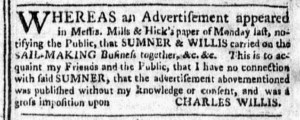
Massachusetts Spy (February 16, 1775).

“I have no connection with said SUMNER.”

Charles Willis needed to correct an error.  An advertisement in the February 13, 1775, edition of the Massachusetts Gazette and Boston Post-Boy proclaimed that “SUMNER and WILLIS … CARRY on the Sail-Making Business in all its Branches.”  It gave their location and listed prices.  Yet Willis had no knowledge of this partnership.  Rather than wait for the next issue of the Massachusetts Gazette and Boston Post-Boy on February 20, he submitted his own advertisement to the Massachusetts Spy for inclusion in its February 16 edition.

“WHEREAS an Advertisement appeared in Messrs. Mills & Hick’s paper of Monday last, notifying the Public, that SUMNER & WILLIS carried on the SAIL-MAKING business together,” the aggrieved Willis asserted, “This is to acquaint my Friends and the Public, that I have no connection with said SUMNER, that the advertisement abovementioned was published without my knowledge or consent, and was a gross imposition upon CHARLES WILLIS.”  The sailmaker was angry as he set the record straight.  Readers of the Massachusetts Spy, on the other hand, may have been mildly amused by the drama that unfolded in the public prints.  After all, a dispute between sailmakers could have been a welcome distraction from the hardships they encountered while the harbor remained closed to commerce because of the Boston Port Act.

Willis likely visited or contacted Mills and Hicks’s printing office about the offensive advertisement.  It did not appear a second time, though the standard fee for advertisements provided for inserting them in three consecutive issues.  Willis’s advertisement, for instance, ran in the Massachusetts Spy twice more before it was discontinued.  Willis opted not to run a similar notice in the Massachusetts Gazette and Boston Post-Boy, the newspaper that carried the original “SUMNER and WILLIS” advertisement.  That could have been because he did not wish to invest any more money on such notices in the public prints, yet it also suggests his confidence in the circulation of the Massachusetts Spy and ensuing conversations inspired by its contents, both news and advertisements.  Advertising in just one newspaper sufficiently clarified that “SUMNER and WILLIS” were not indeed partners in the “Sail-Making Business.”

January 18

What was advertised in a colonial American newspaper 250 years ago today?

Georgia Gazette (January 18, 1769).

“WILLIAM SAUNDERS, Sailmaker, … flatters himself with the hopes of their commands.”

In an advertisement placed in the January 18, 1769, edition of the Georgia Gazette, William Saunders, a sailmaker, lead former and prospective customers through a dance in which each move achieved some purpose related to running his business. First, he expressed gratitude to those who had ordered sails from him in the past, stating that he “TAKES this opportunity of returning his sincere thanks to the gentlemen merchants and others of the town of Savannah, for the kind encouragement he has met with at their hands since his arrival at this place.”

The wording suggested that he might have been a relative newcomer to the colony’s most significant port. If that was the case, acknowledging that some “gentlemen merchants and others” in Savannah had already expressed their support for his venture or perhaps even engaged his services would have been particularly important in setting up his next move. He pivoted from a note of appreciation into calling on those same boosters to submit more orders. He pledged that “they may be assured of the strictest dispatch imaginable” when they contracted with him and his partner, Callighan McCarthy, for sails. For prospective customers who had not previously purchased sails from him, Saunders signaled that he was a capable artisan, as demonstrated by his interactions with those “gentlemen merchants and others.”

Only then did the sailmaker become more vigorous. In a final paragraph his called on “those gentlemen who are indebted to him” to settle accounts by the first of March. If they did not, he would “be under the disagreeable necessity of putting their accounts into the hands of an attorney at law.” That was a last resort, a step that Saunders wished to avoid. Compared to another advertisement in the same issue, his initial movements softened the warning that followed. Thomas Morgan inserted a notice for the sole purchase of informing his debtors “that they will find their accounts in the hands of an attorney at law to be sued for without distinction” if they did not pay by the first of March. Saunders and Morgan issued the same threat, but Saunders did so only after nurturing his rapport with customers and other readers of the Georgia Gazette.