September 6

What was advertised in a revolutionary American newspaper 250 years ago today?
Pennsylvania Journal (September 6, 1775).

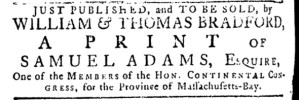
“A PRINT OF SAMUEL ADAMS, ESQUIRE, One of the MEMBERS of the HON. CONTINENTAL CONGRESS.”

The Second Continental Congress convened in Philadelphia after the battles of Lexington and Concord.  It met through most of the summer of 1775, took a recess during August, and started meeting again in September.  The delegates had just resumed their deliberations when William Bradford and Thomas Bradford, the printers of the Pennsylvania Journal, ran an advertisement promoting “A PRINT OF SAMUEL ADAMS, ESQUIRE, One of the MEMBERS of the HON. CONTINENTAL CONGRESS, for the Province of Massachusetts-Bay.”

Even though their advertisement stated, “JUST PUBLISHED, and TO BE SOLD, by WILLIAM & THOMAS BRADFORD,” this seems to have been another instance of printers treating those two phrases separately.  “TO BE SOLD” did indeed refer to the Bradfords stocking and selling the print at their printing office, but “JUST PUBLISHED” did not indicate that they had published the published the print, only that someone had recently published it and made it available for sale.  The Bradfords did not previously attempt to incite demand or gauge interest in a print of Adams among residents of Philadelphia with a subscription notice or other advertisement.

They most likely acquired and sold copies of the print that Charles Reak and Samuel Okey advertised in the Newport Mercury, the Massachusetts Spy, and the Boston-Gazette several months earlier.  In February, Reak and Okey took to the pages of the Newport Mercury to announce their intention to print a “striking likeness of that truly staunch Patriot, the Hon, SAMUEL ADAMS, of Boston.”  Near the end of March, a truncated advertisement in the Massachusetts Spy and the Boston-Gazette advised that “[i]n a few days will be published … A FINE mezzotinto print of that truly worthy Patriot S. A. … executed and published by and for Charles Reak and Samuel Okey, in Newport, Rhode-Island.”  The version in the Massachusetts Spy indicated that more information would appear in the next issue, but the printer, Isaiah Thomas, did not supply additional details in the last few issues printed in Boston before he suspended the newspaper for several weeks and relocated to Worcester just before hostilities commenced at Lexington and Concord.  Those events gave Reak and Okey an expanded market for a print of a Patriot leader already famous in New England.  Their advertisements in Boston’s newspapers listed local agents who would sell their print there.  The Bradfords likely became local agents in Philadelphia rather than publishers of another print of Adams.
March 23

What was advertised in a colonial American newspaper 250 years ago today?

Massachusetts Spy (March 23, 1775).

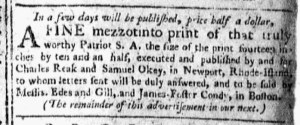
“A FINE mezzotinto print of that truly worthy Patriot S.A.”

When Charles Reak and Samuel Okey set about publishing a “FINE mezzotinto print of that truly worthy Patriot” Samuel Adams in the spring of 1775, they believed that they could generate interest in their project in Boston.  Accordingly, they placed advertisements in the March 23 edition of the Massachusetts Spy and the March 26 edition of the Boston-Gazette. Reak and Okey chose among the five newspapers published in Boston at the time, selecting the two that consistently took the strongest stance in favor of the American cause during the imperial crisis that eventually became a war for independence.  The savvy entrepreneurs knew which publications would put their notice before the eyes of readers most likely to form a market for a print of the influential and vocal advocate for American liberties.

The advertisement did not go into much detail about the print.  It did not even name Adams, trusting that prospective customers would recognize him from the description and his initials, “S.A.”  They did give the size, “fourteen inches by ten and an half,” so readers could envision framing and displaying the print.  A note at the end of Reak and Okey’s notice in the Massachusetts Spy suggested that they had provided more information to the printing office and “[t]he remainder of this advertisement [will appear] in our next [issue].”  The Boston-Gazette, however, carried the same copy without any additions.  The Massachusetts Spy did not run any version of the advertisement again, neither the original nor an updated variation.  Isaiah Thomas, the printer, published only two more issues in Boston before the political situation got too hot for him to remain there.  He re-established the Massachusetts Spy in Worcester, safely away from British authorities, in May.  The Boston-Gazette did run Reak and Okey’s advertisement one more time, on April 3, but Benjamin Edes and John Gill, the printers (and local agents designated to sell the print of Adams) suspended the newspaper after publishing the April 17 edition.  Following the skirmishes at Lexington and Concord on April 19, they dissolved their partnership.  Edes moved to Watertown and continued publishing the newspaper from there in June.  The outbreak of hostilities almost certainly disrupted Reak and Okey’s plans for advertising and distributing their print of Samuel Adams.

February 6

What was advertised in a colonial American newspaper 250 years ago today?

Newport Mercury (February 6, 1775).

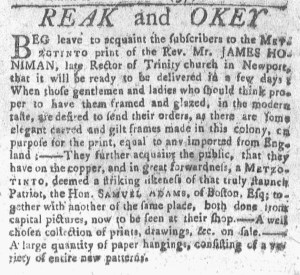
“A METZOTINTO … of that truly staunch Patriot, the Hon. SAMUEL ADAMS.”

On February 6, 1775, Charles Reak and Samuel Okey took to the pages of the Newport Mercury to advise “subscribers to the METZOTINTO print of the Rev. JAMES HONIMAN … that it will be ready to be delivered in a few days.”  As printers often did for books, Okey, a British printmaker who migrated to Rhode Island, gauged the market by seeking subscribers to his print of James Honyman, the former rector of Trinity Church in Newport, before executing it.  That allowed him to determine whether the project would be viable and how many prints to produce to meet the demand of subscribers who reserved copies.

The print has been dated November 2, 1774, based on a line beneath the title that reads, “Printed by Reak & Okey, Newport Rhode Island, Novr. 2 1774,” yet the newspaper advertisement suggests that even though the engraving may have ready on that day that Reak and Okey printed the portrait in the following months before distributing it in February 1775.  The advertisement gives further evidence that was the case.  The partners informed readers of a forthcoming print depicting “that truly staunch Patriot, the Hon, SAMUEL ADAMS, of Boston.”  Reak and Okey explained that they “have on copper, and in great forwardness” that mezzotint.  The engraving was complete, but printing took time.

When they did deliver copies of the Honyman mezzotint to subscribers, Reak and Okey offered more than just the print to “those gentlemen and ladies who should think proper to have them framed and glazed in the modern taste.”  They promoted “some elegant carved and gilt frames, made in this colony, on purpose for the print, equal to any imported from England.”  With the Continental Association in effect, Reak and Okey gave their customers access to frames without departing from that nonimportation agreement.  The copy in the collections of the Preservation Society of Newport County is “housed in a black painted wood frame with an interior gilt gesso border,” though the description does not give the provenance of the frame.

In their choices about their latest subject, John Adams, and the frames for the James Honyman mezzotint, Reak and Okey courted customers who supported the American cause as the imperial crisis intensified.  They joined other artists and publishers who commemorated the American Revolution even before the war began at Lexington and Concord, doing so with both an image of a “staunch Patriot” and frames imbued with political as well as artistic significance.