February 8

What was advertised in a colonial American newspaper 250 years ago today?
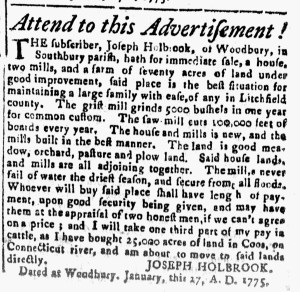
Connecticut Journal (February 8, 1775).

Attend to this Advertisement!

When Joseph Holbrook sought to sell a house, two mills, and a farm in Woodbury in the winter of 1775, he placed an advertisement in the Connecticut Journal and New-Haven Post-Boy.  In it, he assured prospective purchasers that “said place is the best situation for maintaining a large family with ease.”  The house and mills were new.  The gristmill “grinds 5000 bushels in one year for common custom,” while the sawmill “cuts 100,000 feet of boards every year.”  They operated throughout the year because the mills “never fail of water [during] the driest season,” nor did they flood at other times.  The land included “good meadow, orchard, pasture and plow land.”

Holbrook’s notice looked much like other advertisements in colonial newspapers except for a headline that proclaimed, “Attend to this Advertisement!”  That headline almost certainly drew the attention of readers, making them curious about what appeared in the notice.  Such a command distinguished Holbrook’s advertisement from others, not only because it gave instructions but because it had a headline at all.  Several notices in the February 8 edition of the Connecticut Journaldid not have headlines, just the first word in capital letters with a dropped capital for the first letter.  Some had the first line in larger font, such as one that began, “Pursuant to a Request made to,” and another that started, “This is to give notice to all.”  Among those with headlines, the name of the advertiser usually served that purpose.  One headline announced, “Jacob Dagget” in a larger font than anything else on that page.  Another used “JOSEPH HOWELL” as the primary headline with two secondary headlines, “Choice good Train & blubber Oil” and “Dry’d and pickled COD-FISH.”  Holbrook, however, did not resort to the usual wording and format for advertisements.  The headline for his advertisement, in italics and a larger font than its body, suggested that something of consequence followed the edict to “Attend to this Advertisement!”  The advertiser and the compositor deployed both copy and design to encourage readers to peruse what otherwise would have been an ordinary real estate notice.
November 7

GUEST CURATOR: Carolyn Crawford

What was advertised in a colonial American newspaper 250 years ago today?

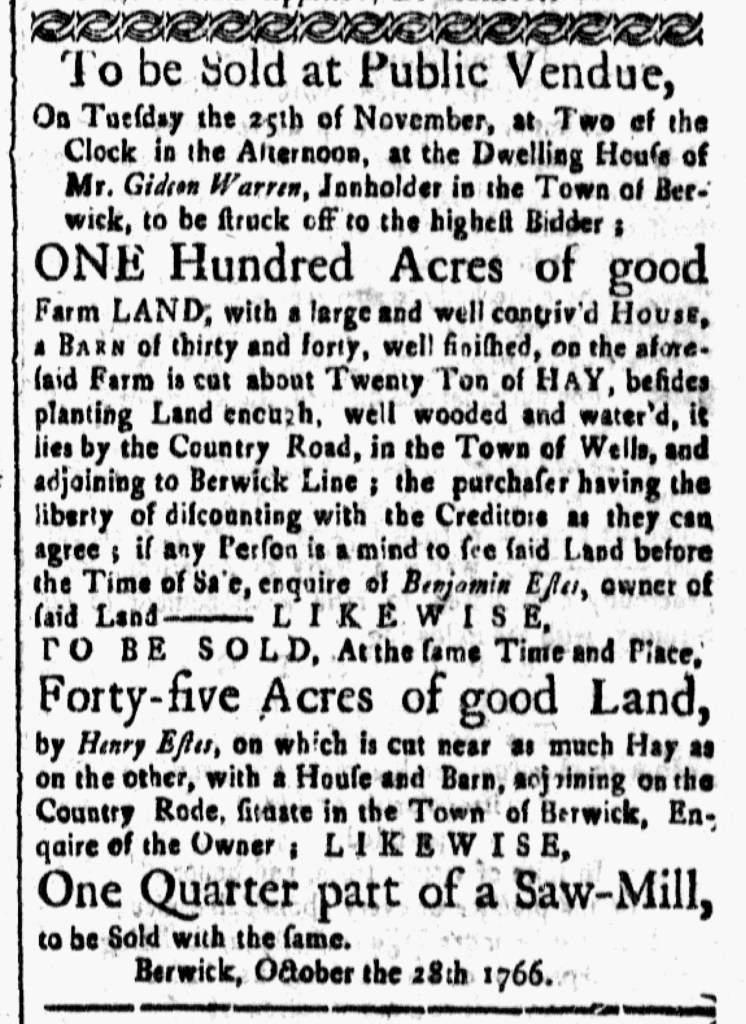
New-Hampshire Gazette (November 7, 1766).

“To Be Sold at Public Vendue … One Quarter part of a Saw-Mill.”

In this advertisement, Benjamin Estes and Henry Estes, two landowners, promoted the sale of “ONE Hundred Acres of good farm LAND” and “Forty-five Acres of good Land” at a “Public Vendue,” otherwise known as an auction. Both of the landowners stated that their land would be sold to the highest bidder at the inn owned by Gideon Warren, in the town of Berwick. Benjamin Estes was the owner of the hundred acres, which included a house, a barn and “Twenty Ton of HAY.” On the other hand, Henry Estes was selling forty-five acres that included a house, a barn, large bundles of hay, and perhaps, most importantly, a sawmill, an important piece of technology.

Over time, technology has dramatically changed. According to the historians at the Ledyard Up-Down Sawmill, “the first water-powered sawmills in New England were built near Berwick, Maine, in the 1630s.” For the next two centuries or so these sawmills used “a wooden waterwheel with a crank connected by the ‘pitman’ arm to a wooden sash (frame) in which was mounted a straight saw blade.” According to Barnes Riznik, “This so-called pitman arm was propelled by an iron crank fixed into the end of the waterwheel shaft.”

During the colonial period, water was used as a source transportation and power. These sawmills “needed to have a dam and millpond to impound water for dry periods and to regulate flow; a millrace to carry water to the wheel itself; a sluice with a gate called a penstock to put the water onto the wheel; and a tailrace to carry off the spent water.” It wasn’t until the 1830s that the sawmills transitioned to circular saws which improved the size and sharpness of the blades. By doing so, the blades were able to produce a larger amount of equal pieces at a rapid rate. Overall, the sawmill technology was beneficial because it allowed for expansion and production to continue and grow.

**********

ADDITIONAL COMMENTARY: Carl Robert Keyes

Although the Adverts 250 Project focuses primarily on advertisements for consumer goods and services, each guest curator may select one advertisement that explores some other aspect of life in colonial America. Real estate advertisements seem to be among the most popular. Carolyn has chosen one today, just a few days after Ceara Morse examined a real estate advertisement from the Georgia Gazette. The tracts of land offered for sale in the two advertisements were located about as distant from each other as was possible within the thirteen colonies that became the United States. Despite their differences, advertisers from Berwick, Maine, and Sunbury, Georgia, crafted advertisements that underscored the profits that buyers could earn from the land offered for sale. The dwellings seemed secondary to the resources and ability to earn a livelihood associated with each piece of land.

Benjamin Estes offered “good Farm LAND” that produced significant amounts of hay that could generate revenue for the new owner. Likewise, Henry Estes indicated that his “good Land” yielded nearly as much hay, even though his tract was slightly less than half the size. The hay, however, was not the only resource Henry Estes planned to auction. He also advertised “One Quarter part of a Saw-Mill.” In other words, Estes sold a share of a sawmill; the purchaser would become the new partner alongside one or more other owners. This presented a different sort of opportunity than farming, but one that Henry Estes considered attractive.

The graphic design elements of the advertisement suggest that the seller believed the sawmill merited as much attention as the farmland. Four lines of the advertisement were set in larger type, one announcing the “Public Vendue,” two listing the acreage of the land, and one devoted to the sawmill. Each of these underscored resources associated with the property for sale and the ability to convert those resources into financial security.

July 11

What was advertised in a colonial newspaper 250 years ago today?

Jul 11 - 7:11:1766 Virginia Gazette
Virginia Gazette (July 11, 1766).

To be SOLD, or RENTED, with to without NEGROES, A NEW SAW MILL.”

This advertisement seeking someone to buy or rent “A NEW SAW MILL” on the Chowan River listed a variety of amenities, including the option of “NEGROES” being included in the deal. This differs significantly from commercial and industrial real estate advertisements today. Indeed, before even mentioning any of the other amenities associated with the property, Cullen Pollok announced that the sawmill could be sold or rented “with or without NEGROES.” The enslaved workers were treated like any other part of the infrastructure of the mill.

That slaves could be included in the purchase of this sawmill reveals something about how it operated. While the slaves certainly contributed their labor, the mill’s owner also benefited from the knowledge that slaves brought to the enterprise. Operating a sawmill required specific skills and a routine designed for efficiency. Experience was important as well. A new owner or overseer could certainly train slaves to take on these responsibilities over time, but the advertisement provided the option of a skilled workforce already intact. Reading this advertisement from a twenty-first-century perspective might privilege the labor provided by the enslaved workers, but eighteenth-century readers would have also factored in other advantages – skill and expertise – that those workers provided. Their familiarity with this particular mill would have been invaluable.

Even if a buyer or renter did not wish to set the slaves to work in the sawmill, they were available to work “a small plantation cleared on the river side,” just one of the many amenities listed with the house with “one brick chimney, and a very fine orchard.”

This advertisement seeking someone to buy or rent “A NEW SAW MILL” on the Chowan River listed a variety of amenities, including the option of “NEGROES” being included in the deal. This differs significantly from commercial and industrial real estate advertisements today. Indeed, before even mentioning any of the other amenities associated with the property, Cullen Pollok announced that the sawmill could be sold or rented “with or without NEGROES.” The enslaved workers were treated like any other part of the infrastructure of the mill.

That slaves could be included in the purchase of this sawmill reveals something about how it operated. While the slaves certainly contributed their labor, the mill’s owner also benefited from the knowledge that slaves brought to the enterprise. Operating a sawmill required specific skills and a routine designed for efficiency. Experience was important as well. A new owner or overseer could certainly train slaves to take on these responsibilities over time, but the advertisement provided the option of a skilled workforce already intact. Reading this advertisement from a twenty-first-century perspective might privilege the labor provided by the enslaved workers, but eighteenth-century readers would have also factored in other advantages – skill and expertise – that those workers provided. Their familiarity with this particular mill would have been invaluable.

Even if a buyer or renter did not wish to set the slaves to work in the sawmill, they were available to work “a small plantation cleared on the river side,” just one of the many amenities listed with the house with “one brick chimney, and a very fine orchard.”