April 30

What was advertised in a colonial American newspaper 250 years ago today?
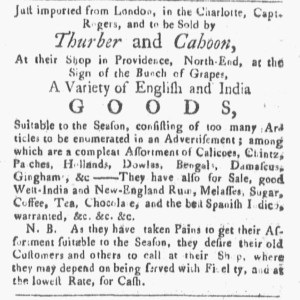
Providence Gazette (April 30, 1774).

“They desire their old Customers and others to call at their Shop.”

In the spring of 1774, Thurber and Cahoon advertised a “Variety of English and India GOODS” available at their shop “at the Sign of the Bunch of Grapes,” a familiar sight in Providence’s North End.  They stocked items “Just imported from London, in the Charlotte, Capt. Rogers.”  Merchants and shopkeepers often provided such information about the origins of their merchandise, allowing consumers to determine for themselves when they received their wares and whether items had been lingering on the shelves or in storerooms.  Thurber and Cahoon, veteran advertisers, first placed this notice in the April 30, 1774, edition of the Providence Gazette.  One of their competitors, Thomas Green, also received a shipment via the Charlotte.  His advertisement for a “large and general Assortment of English and India GOODS” opened with similar copy: “Just imported in the Charlotte, Capt. Rogers, from London.”

Thurber and Cahoon asserted that their new selection was “Suitable to the Season” and “consist[ed] of too many Articles to be enumerated in an Advertisement.”  Merchants and shopkeepers often made such claims, encouraging prospective customers to view the merchandise for themselves.  They promised an array of choices without going into details (and costing a lot more money for purchasing space in the newspaper).  In contrast, “HILL’s ready Money Variety Store” continued running an advertisement that filled an entire column because it “enumerated” so many of the items for sale there, yet the proprietor could not claim that his wares just arrived.  Thurber and Cahoon did spare a couple of lines for textiles, noting that they carried a “compleat Assortment of Calicoes, Chintz, Patches, Hollands, Dowlas, Bengals, Damascus, Gingham, &c.”  The common abbreviation for et cetera suggested even more textiles that Thurber and Cahoon considered “too many” for their advertisement.  They also mentioned several grocery items, including “Melasses, Sugar, Coffee, Tea, [and] Chocolate,” but did not specify when they received those items.  In particular, they did not give specifics about when and how they received their tea, leaving it to prospective customers to determine if they wished to purchase that item even after reading about the politics of tea elsewhere on the same page of that issue of the Providence Gazette.

In a nota bene, Thurber and Cahoon made a final appeal, one intended especially for their existing clientele.  “As they have taken great Pains to get their Assortment suitable to the Season” by acquiring goods consumers wanted or needed for late spring and the summer, the merchants declared, “they desire their old Customers and others to call at their Shop.”  They pledged good customer service, stating that visitors to Sign of the Bunch of Grapes “may depend on being served with Fidelity.”  They could also depend on finding bargains, paying the “lowest Rate” for goods, provided they paid in cash rather than credit.  Thurber and Cahoon incorporated a variety of marketing appeals into an advertisement that occupied a single “square” of space in the Providence Gazette.

December 11

What was advertised in a colonial American newspaper 250 years ago today?

Providence Gazette (December 11, 1773).

“WEST’s ALMANACK for the year 1774.”

For more than a decade, Benjamin West, an astronomer and mathematician, collaborated with the printers of the Providence Gazette in publishing “THE NEW-ENGLAND ALMANACK, OR Lady’s and Gentleman’s DIARY.”  In 1773, John Carter worked with West, but other printers previously entered into partnership with him before Carter became the proprietor of the Providence Gazette.  Advertisements promoting the New-England Almanack became a familiar sight in that newspaper each fall, continuing into the winter.  Some notices provided extensive details about the contents of the new edition for the next year.  A shorter advertisement in the December 11 edition of the Providence Gazette promoted “the usual astronomical Calculations,” “a brief historical Account of the Rise and Settlement of RHODE-ISLAND Government,” and “some Anecdotes of the celebrated Mr. ROGER WILLIAMS, Founder of this Colony” in the almanac for 1774.

Carter sold the almanac in “large or small Quantities.”  Consumers could purchase individual copies for use in their own households, while merchants and shopkeepers could obtain multiple copies to sell in their own stores and shops.  Thurber and Cahoon, for instance, acquired copies to sell in their shop “at the Sign of the Bunch of Grapes.”  They stocked a “great Variety of English and India GOODS” imported via “the last Vessel from London” as well as the almanac produced in their own town.  To entice prospect customers to visit their shop, Thurber and Cahoon listed many of those items, concluding with “WEST’s ALMANACK for the year 1774.”  They had done so the previous year as well.  Apparently, Thurber and Cahoon considered the New-England Almanack such a draw that it would help get customers into their shop, though it may have been Carter, rather than the merchants, who decided that the title should appear in capital letters, thus drawing attention to it over the rest of the merchandise in the advertisement.  Regardless of who made that decision, Carter and West certainly welcomed the assistance in marketing the almanac beyond their own advertisements.

May 16

What was advertised in a colonial American newspaper 250 years ago today?

Providence Gazette (May 16, 1772).

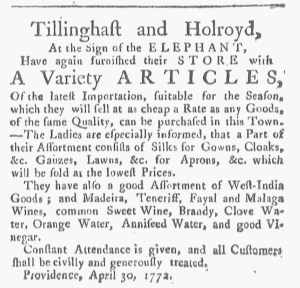
“They will sell at as cheap a Raste as any Goods … can be purchased in this Town.”

Nathaniel Jacobs advised prospective customers that he stocked a “compleat Assortment of European and East-India GOODS” that he “sold at the lowest Prices” at his shop on the west side of the Great Bridge in Providence.  Other merchants and shopkeepers who also placed notices in the May 16, 1772, edition of the Providence Gazette placed even greater emphasis on the bargains they offered.

At their shop at the Sign of the Elephant, for instance, Tillinghast and Holroyd stocked a “Variety [of] ARTICLES … which they will sell at as cheap a Rate as any Goods, of the same Quality, can be purchased in this Town.”  In other words, their competitors did not have lower prices.  To underscore the point, they made an additional appeal to female consumers.  “The Ladies are especially informed,” Tillinghast and Holroyd declared, “that a Part of their Assortment consists of Silks for Gowns, Cloaks, &c. Gauzes, Lawns, &c. for Aprons, &c. which will be sold at the lowest Prices.”  According to the advertisement, women could acquire these goods without paying extravagant prices.

Jones and Allen also emphasized low prices in their lengthy notice that listed scores of “ENGLISH and INDIA GOODS” recently imported.  The headline for their advertisement proclaimed, “The greatest Pennyworths,” alerting prospective customers to bargain prices.  Not considering that sufficient to entice customers into their shop at the Sign of the Golden Ball, they concluded with a note that they “think it needless to say any thing more to the public, than that they deal for ready money, and are determined to be undersold by no retailer in Providence.”  Jones and Allen encouraged comparison shopping, confident that customers would ultimately buy their goods.

Thurber and Cahoon made similar promises concerning their “compleat Assortment of English and India GOODS” at the Sign of the Bunch of Grapes.  They suggested that they already had a reputation for good deals at their store, stating that they were “determined to sell at their usual low Prices.”  In addition, they challenged consumers to make their own assessments, confiding that they “doubt not but all, who will call and examine for themselves, will be convinced [their prices] are as low, if not lower, than are sold by any Person, or Persons, whatever.”  Their advertisement advanced yet another claim to setting the best prices in town.

Tillinghast and Holroyd, Jones and Allen, and Thurber and Cahoon did not merely tell prospective customers that they offered low prices.  They did not make offhand appeals to price.  Instead, they crafted short narratives about the bargains at their shops, pledging consumers would not find better deals elsewhere.  They believed that such narratives would entice customers to visit their shops even if they encountered low prices in other stores.