April 25

What was advertised in a revolutionary American newspaper 250 years ago today?

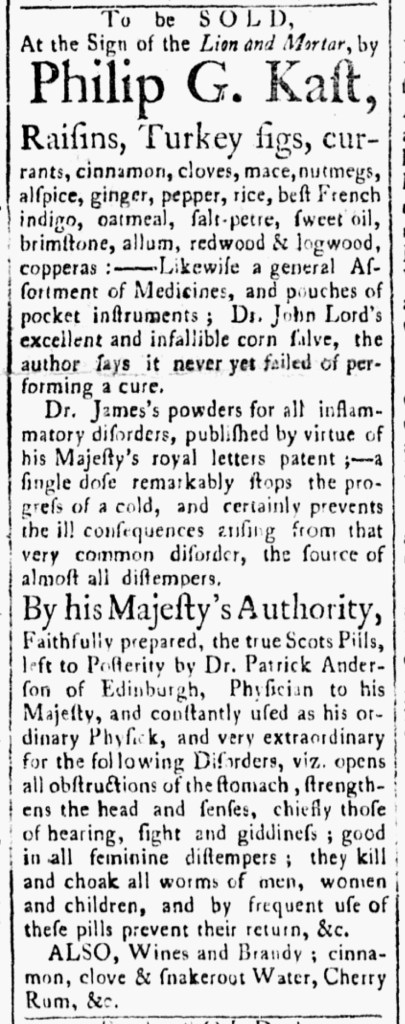
Essex Gazette (April 25, 1775).

“MEDICINES … at the Sign of the Lion and Mortar.”

Jonathan Waldo placed an advertisement for imported “DRUGS and MEDICINES” available at his shop on King Street in Salem, Massachusetts, in the Essex Gazette on April 11, 1775.  He presumably paid a fee that included setting the type and running the notice in three consecutive issues before discontinuing it, a standard arrangement according to the pricing schemes in the colophons of several early American newspapers.  That meant that his advertisement appeared again on April 18, the eve of the skirmishes at Lexington and Concord that started the Revolutionary War, and finally on April 25.  That issue included coverage of “the Troops of his Britannick Majesty commenc[ing] Hostilities upon the People of this Province.”  Samuel Hall and Ebenezer Hall would print only one more issue of the Essex Gazette in Salem before moving to Cambridge and continuing the newspaper as the New-England Chronicle.  What happened to Waldo during the war?  According to Donna Seger, the apothecary served as a major in the Salem Militia and his business “survived through the Revolution through a dual strategy of continuing to import apparently-contraband British medicine and concocting his own American substitutions.”

Seger describes Waldo as a savvy entrepreneur who diversified his business after the war, noting that “the Revolution seems to have inspired ‘innovation’ and reaped more profits” for the apothecary once he began marketing less expensive American versions of popular British patent medicines.  His advertisement from the spring of 1775 indicates that he also made shrewd decisions before the war began, including setting up shop “at the Sign of the Lion and Mortar, lately improved by Dr. KAST.”  Philip Godrid Kast was a well-known and successful apothecary who had marked his shop with “the Sign of the Lyon and Mortarfor many years.  It almost certainly became a familiar sight for residents of Salem as they traversed the streets of the town and attracted notice from visitors.  Kast even included an image of the sign on an engraved trade card dated to 1774, further associating the “Sign of the Lyon & Mortar” with his business when he distributed it to current and prospective customers.  Waldo apparently took possession of the sign when he moved into the shop previously occupied by Kast.  He could have commissioned a new device to represent his business.  Nathaniel Dabney, for instance, sold medicines “at the Head of HIPPOCRATES, in Salem,” and included an illustration of the bust of the physician from ancient Greece in some of his advertisements.  Yet the “Sign of the Lion and Mortar” was both appropriate for Waldo’s occupation and had a reputation associated with it that he wished to leverage.  Waldo likely hoped to gain some of Kast’s customers when he took over the shop.  Keeping the “Sign of the Lion and Mortar” on display testified to the continuity of service that he provided.

March 16

What was advertised in a colonial American newspaper 250 years ago today?

Essex Gazette (March 16, 1773).

“At his APOTHECARY SHOP, at the Sign of the LION and MORTAR, in SALEM.”

Several advertisements in the March 16, 1773, edition of the Essex Gazette included references to visual devices that aided customers in identifying businesses as well as residents and visitors in navigating the streets of Salem.  Abraham Safford, for instance, advised readers that he recently opened a tavern “rendered conspicuous by an elegant Sign of KING GEORGE THE THIRD.”  Philip Godfrid Kast promoted medicines available at his apothecary shop “at the Sign of the LION and MORTAR.”  An advertisement for Jacob Hemet’s Essence of Peral and Pearl Dentifrice listed Nathaniel Dabney’s apothecary shop “at the Head of Hippocrates” as the local vendor for those products.  Even entrepreneurs who did not have their own signs made reference to well-known devices, as Stephen Higginson did when he directed prospective customers to his shop “opposite the King’s Arms Tavern.”  Newspapers published in other towns also carried advertisements that incorporated signs for the purposes of both marketing businesses and marking locations.

Most such visual markers disappeared long ago.  In many instances, newspaper advertisements provide the sole testimony to their presence in eighteenth-century cityscapes.  Some of those advertisements, however, also included depictions of the signs and other devices that marked the locations of shops and stores.  Dabney, for example, ran several advertisements that featured the Head of Hippocrates, a bust of the ancient Greek physician atop a column, that identified his shop.  Kast distributed another kind of advertisement, a trade card engraved by Nathaniel Hurd, that prominently displayed his shop sign, a lion grasping a large mortar, hanging from an ornate signpost.  Those images hint at some of the sights seen in Salem in the eighteenth century.  Given the number of signs and other devices mentioned in newspapers and depicted on trade cards, billheads, handbills, and other marketing materials, colonizers encountered a rich environment of visual images as they traversed the streets of their towns, especially in busy ports.

November 27

What was advertised in a colonial American newspaper 250 years ago today?

Essex Gazette (November 27, 1770).

“At the Sign of the Lion and Mortar.”

In the fall of 1770, Philip Godfrid Kast, an apothecary, placed an advertisement in the Essex Gazette to inform potential customers that he carried “a general Assortment of Medicines” at his shop “At the Sign of the Lion and Mortar” in Salem, Massachusetts.  Purveyors of goods and services frequently included shop signs in their newspaper advertisements in the eighteenth century, usually naming the signs that marked their own location but sometimes providing directions in relation to nearby signs.  On occasion, they included woodcuts that depicted shop signs, but few went to the added expense.  Eighteenth-century newspaper advertisements provide an extensive catalog of shop signs that colonists encountered as they traversed city streets in early America, yet few of those signs survive today.

Kast did not incorporate an image of the Sign of the Lion and Mortar into his newspaper advertisements in the fall of 1770, but four years later he distributed a trade card with a striking image of an ornate column supporting a sign that depicted a lion working a mortar and pestle.  Even if the signpost was exaggerated, the image of the sign itself likely replicated the one that marked Kast’s shop.  Nathaniel Hurd’s copperplate engraving for the trade card captured more detail than would have been possible in a woodcut for a newspaper advertisement.  Absent the actual sign, the engraved image on Kast’s trade card provided the next best possible option in terms of preserving the Sign of the Lion and Mortar given the technologies available in the late eighteenth century.  Trade cards, however, were much more ephemeral than newspapers and the advertisements they contained.  That an image of the Sign of the Lion and Mortar survives today is due to a combination of luck, foresight (or accident) on the part of Kast or an eighteenth-century consumer who did not discard the trade card, and the efforts of generations of collectors, librarians, catalogers, conservators, and other public historians.  Compared to woodcuts depicting shop signs in newspaper advertisements, trade cards like those distributed by Kast even more accurately captured the elaborate details.  Those shop signs contributed to a rich visual landscape of marketing in early America.

Philip Godfrid Kast’s Trade Card, Engraved by Nathaniel Hurd, Boston, 1774 (American Antiquarian Society).

August 14

What was advertised in a colonial American newspaper 250 years ago today?

Aug 14 - 8:14:1767 New-Hampshire Gazette
New-Hampshire Gazette (August 14, 1767).

“Now open’d for Sale, at the Sign of the LION and MORTER.”

Little and Jackson sold “A large and fresh Assortment of genuine Medicines” at their apothecary shop near the Crown Coffee House in Portsmouth. The sign the druggists displayed made it easier for residents and visitors to the port to locate their shop. Its device, the “LION and MORTER,” testified to the type of merchandise they carried, including popular patent medicines imported from England as well as ingredients for compounding remedies on the spot.

The mortar alone, a symbol widely recognized among potential customers, would have sufficiently described Little and Jackson’s business. Adding the lion, a regal symbol, imbued their business with more prestige, but that was not all it accomplished. It also replicated a shop sign already in use by one of their counterparts in Salem, Massachusetts. As early as January 1764, Philip Godfrid Kast advertised in the Boston Post-Boy that he imported and sold “a very large Assortment of DRUGS and MEDICINES” at his shop “at the Sign of the Lyon and Mortar.” In 1774, Kast even distributed a trade card that featured his sign, a rare visual image of what would have been a ubiquitous sight in colonial cities.

In choosing to pair a lion with a mortar, had Little and Jackson infringed on Kast’s efforts to brand his business? Not by the standards of the eighteenth century. The devices depicted on many shop signs had long been in use in England, first appearing in an earlier period with lower literacy rates. Just as the mortar and pestle were associated with druggists, other symbols denoted specific occupations. For instance, a sign showing a dog with its head in a bucket indicated that a smith practiced his trade at that location. Leather dressers who made all sorts of clothing, including James and Matthew Haslett, did so at the “Sign of the BUCK and GLOVE.”

Throughout London and the provinces and, eventually, the colonies, the consistent use of these and other easily recognized symbols conveniently marked where shopkeepers and artisans carried on specific activities. To some extent they could be deployed as branding in a certain area, but they did not tend to be the sole domain of entrepreneurs and advertisers beyond their local markets.