May 9

What was advertised in a revolutionary American newspaper 250 years ago today?
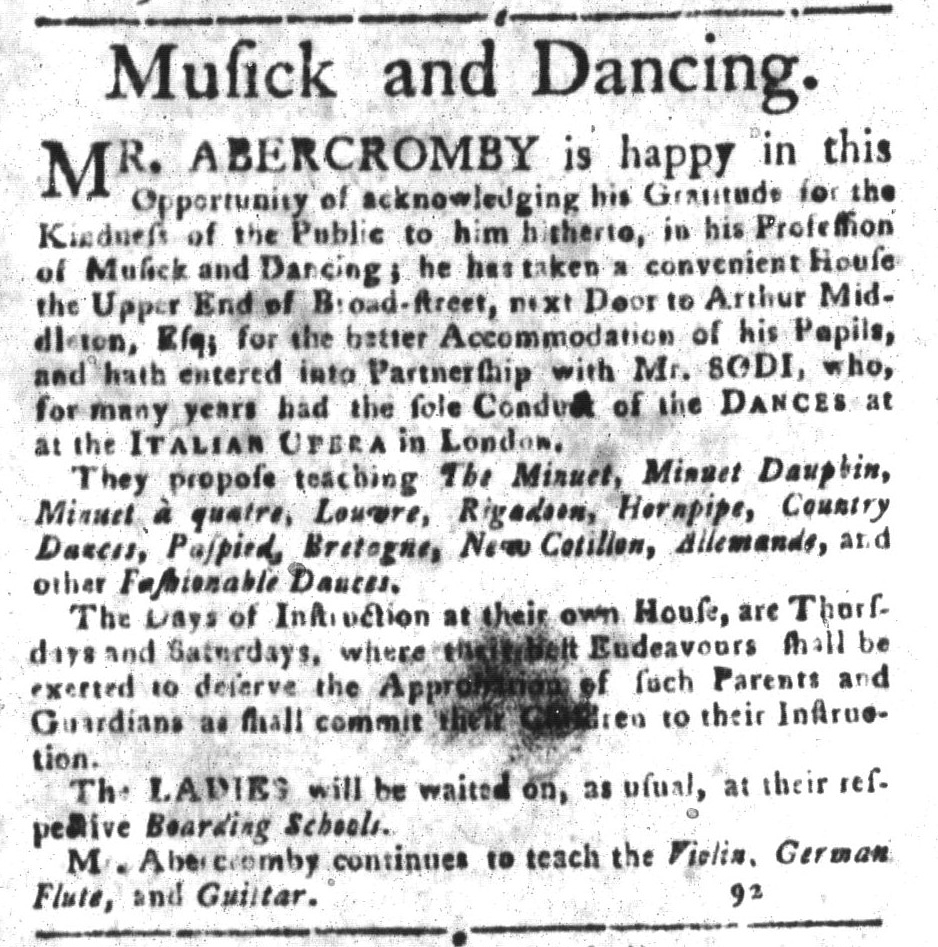
South-Carolina Gazette and Country Journal (May 9, 1775).

“Musick and Dancing.”

Among the advertisements for textiles, patent medicines, vessels preparing to depart for distant ports, and enslaved people for sale in the May 9, 1775, edition of the South-Carolina Gazette and Country Journal, Mr. Abercromby promoted lessons in “Musick and Dancing.”  He started by expressing his appreciation for the support he already received, stating that he was “happy in this Opportunity of acknowledging his Gratitude for the Kindness of the Public to him hitherto, in his Profession.”  Doing so bolstered his reputation; readers not previously familiar with Abercromby, especially genteel readers who knew that their social standing depended in part on their ability to demonstrate that they had mastered the steps of various dances or could play a musical instrument, may have asked themselves why they did not know Abercromby and whether they should make his acquaintance.

Abercromby next made two important announcements.  First, he moved to a new location, a “convenient House [in] the Upper End of Broad-street” in Charleston, that offered “better Accommodation of his Pupils.”  In addition, he “entered into Partnership with Mr. SODI, who, for many years had the sole Conduct of the DANCES at the ITALIAN OPERA in London.”  Signior Sodi, as he styled himself, previously advertised his services in the Pennsylvania Journal in the summer and fall of 1774, but by the spring of 1775 he had migrated from Philadelphia to Charleston.  Just as Sodi had done in his own advertisements, Abercromby emphasized the cachet of learning to dance from an instructor with connections to such an illustrious institution.

Abercromby listed nearly a dozen dances that he and Sodi taught, including “The Minuet, Minuet Dauphin, Minuet à quatre, Louvre, [and] Rigadoon,” as well as “other Fashionable Dances.”  Their pupils could learn new dances or refine their steps for those they already knew.  In addition to the lessons they gave at their “convenient House,” Abercromby and Sodi visited boarding schools in Charleston.  Parents and guardians could arrange to enhance the curriculum that their young “LADIES” studied, trusting that the schoolmistresses provided appropriate supervision of the dancing masters and their pupils.  Such services may have been especially attractive to the gentry in one of the largest and most cosmopolitan urban ports in the colonies.  Abercromby and Sodi did not merely teach dancing, after all, but instead sold status to those who succeeded at their lessons.
September 7

What was advertised in a colonial American newspaper 250 years ago today?

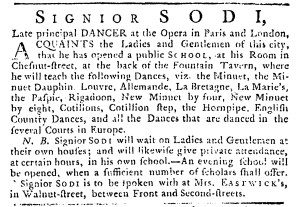
Pennsylvania Journal (September 7, 1774).

“He will teach … all the Dances that are danced in the several Courts in Europe.”

It could have been a coincidence that dancing masters Mr. Pike and Signior Sodi placed advertisements in Dunlap’s Pennsylvania Packet, the Pennsylvania Gazette, and the Pennsylvania Journal at the same time.  When Pike arrived in the Pennsylvania after teaching fencing and dancing in Charleston for a decade, he introduced himself to prospective pupils and the rest of the public with an advertisement in the September 5, 1775, edition of Dunlap’s Pennsylvania Packet.  He placed the same advertisement in the Pennsylvania Gazette two days later.

Sodi ran his own advertisement in the same issue of Dunlap’s Pennsylvania Packet.  The two notices appeared on the same page, Sodi’s at the bottom of one column and Pike’s at the top of the next one.  Two days later, Sodi inserted his advertisement in the Pennsylvania Journal.  Perhaps the “Late principal DANCER at the Opera in Paris and London” had previously intended to advertise in early September.  After all, he stated in his newspaper notice about a “GRAND CONCERT & BALL” in June that he “proposes to open a School publicly next September.”  He did not, however, commence advertising that school before Pike was on the scene.  Sodi may have heard that a new competitor would soon offer lessons to the local gentry, prompting him to advertise in the city’s newspaper published on Mondays and one of the two published on Wednesdays.

While Pike touted his experience as an instructor and a reputation that could be confirmed by “many respectable gentlemen” from South Carolina “present in this city,” likely including delegates to the First Continental Congress, Sodi emphasized his connections to some of the most cosmopolitan and refined places in Europe.  In addition to describing himself as the “Late Principal DANCER at the Opera in Paris and London,” he declared that he assisted students in learning “all the Dances that are dance in the several Courts in Europe.”  He also gave French names for several dances, suggesting the sophistication associated with the steps he taught at the Fountain Tavern and at private lessons in the homes of his pupils.

The advertisements that ran in Philadelphia’s newspapers outlined the choices available to prospective students and their families.  They could engage the services of a newcomer with endorsements from prominent men visiting the city or an Italian dancing master with experience in Paris, London, and European courts.  No matter which one they chose, the presence of these advertisements in the public prints reminded readers that dancing proficiently and gracefully was an important part of demonstrating gentility and status.

June 15

What was advertised in a colonial American newspaper 250 years ago today?

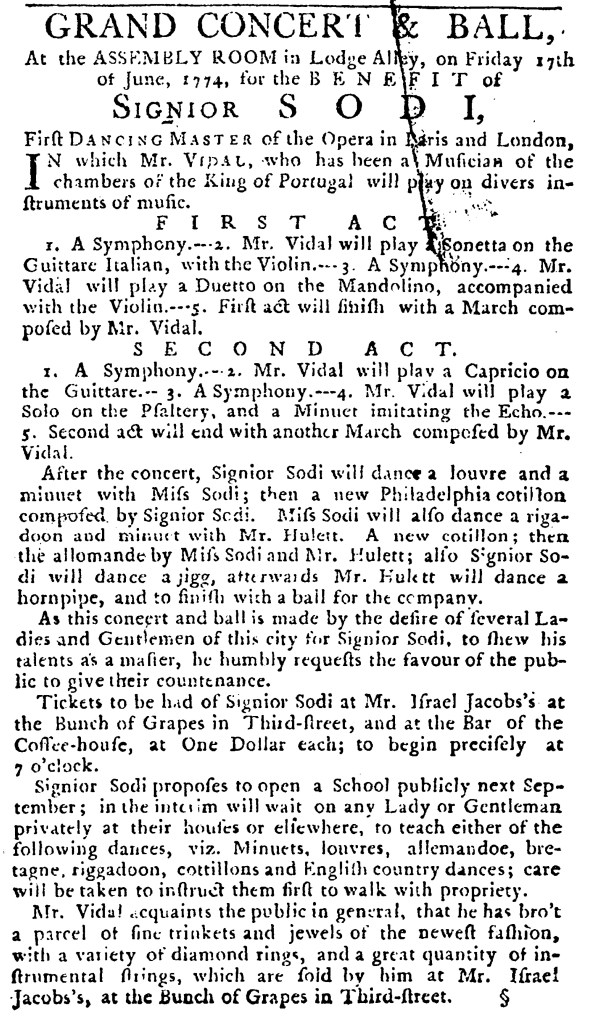
Pennsylvania Journal (June 15, 1774).

“This concert and ball is made by the desire of several Ladies and Gentlemen of this city.”

Genteel residents of Philadelphia did not want to miss the “GRAND CONCERT & BALL, At the ASSEMBLY TOOM in Lodge Alley” on June 17, 1774.  At least that was the intention of Signior Sodi, “First DANCING MASTER of the Opera in Paris and London,” when he advertised the event in the Pennsylvania Journal.  Sodi worked with “Mr. VIDAL, who has been a Musician of the chambers of the King of Portugal,” in putting together a program that included ten musical performances in two acts followed by demonstrations of Sodi’s dancing.  He claimed that he hosted the event “by the desire of several Ladies and Gentlemen of this city” who wished for him “to shew his talents as a master.”  For his part, he “humbly requests the favour of the public to give their countenance.”  To do that, the audience needed to purchase tickets, either from Sodi “at the Bunch of Grapes” on Third Street or “at the Bar” at the London Coffee House, a popular place for socializing and conducting business.

Whether or not “Ladies and Gentlemen of this city” encouraged Sodi to host a concert and ball, he used the opportunity to market other endeavors to support himself beyond ticket sales for that event.  He used the occasion to announce that he planned to “open a School” in September.  Until then, he “will wait on any Lady or Gentleman privately at their houses or elsewhere” to give lessons.  In addition to learning the steps for several dances, his students would also receive instruction “to walk with propriety.”  His pupils, Sodi suggested, would demonstrate more grace both on and off the dance floor, an important goal for colonizers anxious about so many aspects of their comportment.  Indeed, those interested in lessons from Sodi may have also taken note of lessons that Francis Daymon, “Master of the French and Latin Languages,” advertised in the same column in the Pennsylvania Journal.  Yet Sodi did not stake his entire livelihood on teaching the genteel and those aspiring to join their ranks to dance.  He also “acquaints the public in general” that he “bro’t a parcel of fine trinkets and jewels of the newest fashion, with a variety of diamond rings, and a great quantity of instrumental strings.”  He offered those items for sale at the Bunch of Grapes.  His “GRAND CONCERT & BALL” presented an opportunity for merchandising, not unlike the modern entertainment industry.