May 10

What was advertised in a revolutionary American newspaper 250 years ago today?
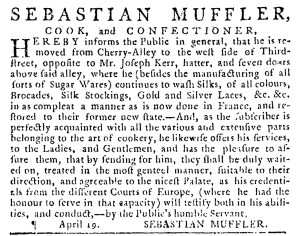
Pennsylvania Journal (May 10, 1775).

“The manufacturing of all sorts of Sugar Wares.”

In the spring of 1775, Sebastion Muffler, “COOK, and CONFECTIONER,” ran a newspaper notice to promote his “manufacturing of all sorts of Sugar Wares” at a new location on Third Street in Philadelphia.  Customers would no longer find him in Cherry Alley.  Muffler joined the ranks of confectioners who advertised their services in American port cities, including Peter Lorent in Boston, Frederick Kreitner in Charleston, and P. Lenzi in New York.  Like most of his counterparts, he touted his prior experience on the other side of the Atlantic.  To that end, Muffler proclaimed that he earned “his credentials from the different Courts of Europe, (where he had the honour to serve …)”  That experience, he asserted, “will testify both in his abilities, and conduct.”  The cook and confectioner hoped that would entice “Ladies, and Gentlemen” to hire him.  Upon doing so, they could depend on being “duly waited on, [and] treated in the most genteel manner, suitable to their direction.”  Furthermore, Muffler declared himself “perfectly acquainted with all the various and extensive parts belonging to the art of cookery.”  Accordingly, his clients should anticipate dining “agreeable to the nicest Palate.”

Despite this depiction of his mastery of “the art of cookery” and “manufacturing of all sorts of Sugar Wares,” Muffler apparently depended on a side hustle to earn his livelihood.  He advised readers of the Pennsylvania Journal that he “continues to wash Silks, of all colours,” and other items “in as compleat a manner as is now done in France, and restored to their former new state.”  That was an impressive feat, but not a service directly related to his primary occupation.  In the largest and most cosmopolitan city in the colonies, Muffler needed to supplement the income he earned as a cook and confectioner by providing unrelated services.  Perhaps he hoped that he could eventually establish himself well enough to cultivate a market for his culinary services that made cleaning fabrics unnecessary.  Until then, he included his other occupation in his advertisements.  He hoped that his secondary headline, “COOK and CONFECTIONER,” would attract attention, using it to direct prospective customers to both related and unrelated services.
September 7

What was advertised in a colonial American newspaper 250 years ago today?

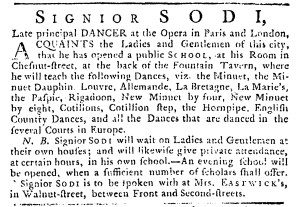
Pennsylvania Journal (September 7, 1774).

“He will teach … all the Dances that are danced in the several Courts in Europe.”

It could have been a coincidence that dancing masters Mr. Pike and Signior Sodi placed advertisements in Dunlap’s Pennsylvania Packet, the Pennsylvania Gazette, and the Pennsylvania Journal at the same time.  When Pike arrived in the Pennsylvania after teaching fencing and dancing in Charleston for a decade, he introduced himself to prospective pupils and the rest of the public with an advertisement in the September 5, 1775, edition of Dunlap’s Pennsylvania Packet.  He placed the same advertisement in the Pennsylvania Gazette two days later.

Sodi ran his own advertisement in the same issue of Dunlap’s Pennsylvania Packet.  The two notices appeared on the same page, Sodi’s at the bottom of one column and Pike’s at the top of the next one.  Two days later, Sodi inserted his advertisement in the Pennsylvania Journal.  Perhaps the “Late principal DANCER at the Opera in Paris and London” had previously intended to advertise in early September.  After all, he stated in his newspaper notice about a “GRAND CONCERT & BALL” in June that he “proposes to open a School publicly next September.”  He did not, however, commence advertising that school before Pike was on the scene.  Sodi may have heard that a new competitor would soon offer lessons to the local gentry, prompting him to advertise in the city’s newspaper published on Mondays and one of the two published on Wednesdays.

While Pike touted his experience as an instructor and a reputation that could be confirmed by “many respectable gentlemen” from South Carolina “present in this city,” likely including delegates to the First Continental Congress, Sodi emphasized his connections to some of the most cosmopolitan and refined places in Europe.  In addition to describing himself as the “Late Principal DANCER at the Opera in Paris and London,” he declared that he assisted students in learning “all the Dances that are dance in the several Courts in Europe.”  He also gave French names for several dances, suggesting the sophistication associated with the steps he taught at the Fountain Tavern and at private lessons in the homes of his pupils.

The advertisements that ran in Philadelphia’s newspapers outlined the choices available to prospective students and their families.  They could engage the services of a newcomer with endorsements from prominent men visiting the city or an Italian dancing master with experience in Paris, London, and European courts.  No matter which one they chose, the presence of these advertisements in the public prints reminded readers that dancing proficiently and gracefully was an important part of demonstrating gentility and status.