December 15

What was advertised in a revolutionary American newspaper 250 years ago today?
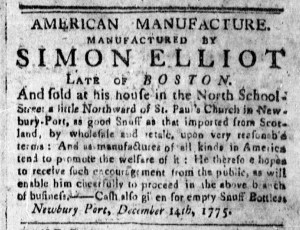
Essex Journal (December 15, 1775).

“Manufactures of all kinds in America tend to promote the welfare of it.”

In December 1775, Simon Elliott took to the pages of the Essex Journal, printed in Newburyport, Massachusetts, to promote the snuff that he made in that town.  He published his advertisement as the siege of Boston continued, much of the copy testifying to the imperial crisis that had become a war with the skirmishes at Lexington and Concord the previous April.

The advertisement featured an elaborate headline.  Indeed, it had a primary headline and a secondary headline, like many other newspaper advertisements.  Elliot’s name, centered and all in capital letters of a larger font than anything else in that issue of the Essex Journal except the name of the newspaper in the masthead, demanded attention.  It was the second line of three, the other two also centered and in capital letters but smaller fonts: “MANUFACTURED BY / SIMON ELLIOT / LATE OF BOSTON.”  A secondary headline, “AMERICAN MANUFACTURE,” appeared above the headline that made Elliot’s name so prominent.

Like so many other artisans when they moved to new towns and introduced themselves to prospective customers, Elliot mentioned his origins.  Usually, “OF BOSTON” sufficed, but in this instance “LATE OF BOSTON” likely indicated that he had been displaced from that city recently.  Many residents chose to leave following the outbreak of hostilities.  In the early days of the siege of Boston, the Sons of Liberty and General Gage negotiated an exchange that allowed Loyalists to enter and others to depart.  In the following months, newspapers throughout New England carried advertisements by entrepreneurs “from Boston,” a diaspora of refugees displaced at the beginning of the Revolutionary War.

In addition to signaling the hardships he recently faced, Elliot also promoted the quality of the snuff that he made in Newburyport, asserting it was “as good Snuff as that imported from Scotland.”  That was no small claim since tobacco processed into snuff in Scotland had a superior reputation at the time.  Yet Elliot had more to say about his “AMERICAN MANUFACTURE” and why consumers should favor it over others.  Echoing the Continental Association, a nonimportation agreement devised by the First Continental Congress, and popular discourses of the last decade, Elliot declared that “as manufactures of all kinds in America tend to promote the welfare of it: He therefore hopes to receive such encouragement from the public” to support his new enterprise.  Supporters of the American cause, he suggested, had a civic duty to purchase the snuff that he made in Newburyport as well as support other entrepreneurs who produced domestic manufactures.
August 22

What was advertised in a revolutionary American newspaper 250 years ago today?

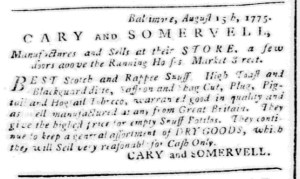
Dunlap’s Maryland Gazette (August 22, 1775).

BEST Scotch and Rappee Snuff … warranted good in quality and as well manufactured as any from Great Britain.”

The partnership of Cary and Somervell stocked and sold “a general Assortment of DRY GOODS” at their store in Baltimore in the summer of 1775, but that was not their primary reason for running an advertisement in the August 22 edition of Dunlap’s Maryland Gazette.  Instead, they wished to advise the public that their firm “Manufactures and Sells … BEST Scotch and Rappee Snuff, High Toast and Blackguard [snuff], Saffron and Shag Cut, Plug, Pigtail and Hogtail Tobacco.”  Cary and Somervell offered tobacco users an array of choices of familiar products.  They also paid “the highest price for empty Snuff Bottles,” encouraging prospective customers to offset the cost of their purchases by trading in bottles that they no longer needed.

In promoting the tobacco products that they made in Baltimore, Cary and Somervell published promises about their wares: “warranted good in quality and as well manufactured as any from Great Britain.”  That was a familiar aspect of “Buy American” advertisements prior to the American Revolution, yet it had greater resonance once the Continental Association went into effect on December 1, 1774, and, especially, following the battles at Lexington and Concord on April 19, 1775.  The Continental Association, a nonimportation agreement devised by the First Continental Congress in response to the Coercive Acts, called for “encourag[ing] Frugality, Economy, and Industry; and promot[ing] Agriculture, Arts, and the Manufactures of this Country” as alternatives to imported goods.  Thus, the nonimportation agreement also outlined the responsibilities of both producers and consumers in the colonies.  Such civic duties gained even greater urgency in the wake of battles fought in Massachusetts.

Even without taking current events into consideration, Cary and Somervell issued a familiar challenge when they asserted that their tobacco products were as “good in quality and as well manufactured as any from Great Britain.”  How would consumers know unless they tested Cary and Somervell’s snuff and tobacco for themselves?  The partners used a bold assertion to entice prospective customers to sample their products and become the final arbiters of whether they, the consumers, agreed with the claims made in the newspaper advertisement.

June 29

What was advertised in a revolutionary American newspaper 250 years ago today?

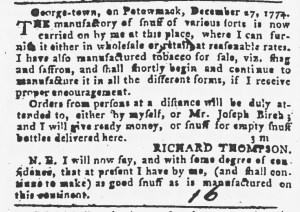
Maryland Gazette (June 29, 1775).

“THE manufactory of snuff of various sorts is now carried on by me at this place.”

On the eve of the American Revolution, Richard Thompson attempted to establish a market for snuff produced in Virginia.  In “The Beginnings of Tobacco Manufacture in Virginia,” Jacob M. Price argues that “there is not even a hint of a local manufacture” of snuff in Virginia from the middle of the 1730s through the late 1760s.  Most of the snuff came from Great Britain with  occasional “bottles, boxes, and kegs of snuff … appear from time to time in notices of arriving cargoes from Antigua, Boston, New York, and Salem.”  According to Price, Thompson “moved his business from Bladensburg [Maryland] to the falls of the Potomac and tried to crash the Virginia market in 1772,” placing a lengthy advertisements in the October 8 edition of William Rind’s Virginia Gazette.  “Little more is known,” Price continues, “of this early Maryland industrial pioneer and of his seemingly premature efforts to introduce a ‘patriotic’ tobacco and snuff manufacture into the Chesapeake.”[1]

An advertisement in the June 29, 1775, edition of the Maryland Gazette, published in Annapolis, reveals that Thompson continued to produce snuff at “George-town, on the Potowmack” at that time.  The “manufactory of snuff of various sorts is now carried on by me at this place,” Thompson proclaimed, “where I can furnish it either in wholesale or retail, at reasonable rates.”  In addition, Thompson had “manufactured tobacco for sale, viz. shag and saffron, and shall shortly begin and continue to manufacture it in all the different forms, if I receive proper encouragement.”  According to the date on the advertisement, Thompson first asked for that encouragement on December 27, 1774, no doubt hoping that the Continental Association, a nonimportation agreement devised by the First Continental Congress in response to the Coercive Acts, created favorable conditions for snuff produced in the colonies.  Patriotic colonizers had an obligation to support his enterprise, to give him that “proper encouragement,” but they did not have to settle for a product inferior to snuff produced elsewhere in the colonies.  In a nota bene, Thompson declared, “I will now say, and with some degree of confidence, that at present I have by me, (and shall continue to make) as good snuff as is manufactured on this continent.”  Even if his business got off to a rocky start, as Price suggests, Thompson asserted that he made improvements over time.  He composed his advertisement less than a month after the Continental Association went into effect (and a notation, “3m,” indicated that it would appear in the Maryland Gazette for three months), yet apparently decided that the time was right to revive it more than six months later after learning of the battles at Lexington and Concord.  Those battles and the events that followed meant that friends of the American cause, after all, had even more reason to support his endeavor.

**********

[1] Jacob M. Price, “The Beginnings of Tobacco Manufacture in Virginia,” Virginia Magazine of History and Biography 64, no. 1 (January 1956): 9, 12, 14.

June 13

What was advertised in a colonial American newspaper 250 years ago today?

Supplement to the Newport Mercury (June 13, 1774).

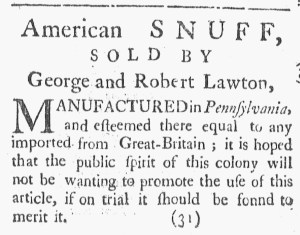
“American SNUFF … MANUFACTURED in Pennsylvania.”

George Lawton and Robert Lawton advertised “American SNUFF” in the Newport Mercury as colonizers from New England to Georgia discussed how to respond to the Boston Port Act, legislation that closed the harbor as punishment for the destruction of tea in December 1773.  Simultaneously, newspapers covered other abuses perpetrated by Parliament.  The June 13, 1774, edition of the Newport Mercury, for instance, featured “A BILL for better regulating the Government of the Province of the Massachusetts-Bay, in North-America” and “A BILL for the impartial Administration of Justice in the Cases of Persons questioned for any Acts, done by them in the Execution of the law, or for the Suppression of Riots & Tumults in the Province of the Massachusetts-Bay, in New-England.”  Although neither had yet been passed when the ship that carried them departed from Bristol more than five weeks earlier, the printer, Solomon Southwick, noted “there is no doubt of their having passed before this time.”  In colorful commentary, he added that “the — [devil] himself can suggest nothing too horrid to be expected from the present administration.”  Another note followed the second bill: “God save the PEOPLE from such Laws!

It was in that context that the Lawtons marketed “American SNUFF … MANUFACTURED in Pennsylvania” as an alternative to snuff imported from Great Britain.  They asserted that consumers in Pennsylvania “esteemed” this snuff “equal to any imported,” so customers did not have to sacrifice quality in their support of “domestic manufacturers,” goods produced in the colonies.  The Lawtons presented trying this snuff as the patriotic duty of consumers who had concerns about current events.  “[I]t is hoped,” they implored, “that the public spirit of this colony will not be wanting to promote the use of this article, if on trial it should be fo[u]nd to merit it.”  In other words, the Lawtons encouraged prospective customers to try the snuff, taking into account the endorsements from colonizers in Pennsylvania, and see for themselves if they liked it as much as imported snuff.  If they did, their subsequent purchases could serve two purposes: acquiring a product they enjoyed while putting political principles into practice.  In many places, colonizers already discussed another round of nonimportation agreements, drawing on a strategy deployed in response to the Stamp Act and the Townshend Acts.  Immediately above the Lawtons’ advertisement, the resolutions from “a town meeting held at Providence” called for “an universal stoppage of all trade with Great-Britain, Ireland, Africa, and the West-Indies” until Parliament opened Boston Harbor once again.  Colonizers sought to use commerce for political leverage.  Similarly, decisions about which products to consume had political implications.  Even with no boycott currently in place, the Lawtons encouraged consumers to think about how they could support the colonies in their contest against Parliament.

October 10

What was advertised in a colonial American newspaper 250 years ago today?

New-York Journal (October 10, 1771).

“America is not necessarily obliged to import these articles.”

Many entrepreneurs launched “Buy American” campaigns before the thirteen colonies declared independence from Great Britain.  Advertisements that encouraged consumers to purchase “domestic manufactures” became a common sight in newspapers during the imperial crisis, increasing in number and frequency when the conflict intensified and receding, but not disappearing, when relations cooled.  During the Stamp Acts crisis, for instance, advertisers encouraged consumers to buy goods produced in the colonies.  They did so again while the nonimportation agreements adopted in response to the Townshend Acts remained in effect.  Even when merchants resumed importing merchandise from England following the repeal of all of the duties except the one on tea, some advertisers continued their efforts to convince consumers to buy goods produced in the colonies.

Such was the case for snuff “MADE AND SOLD By GEORGE TRAILE” on Bowery Lane in New York.  Traile proclaimed that his snuff was “equal to any imported from Europe” and then outlined “the advantages which would evidently result to the Colonies from this branch of business, was it to meet proper encouragement.”  In other words, prospective customers had a duty to make good decisions that took into account the common good for the colonies when they purchased snuff.  He estimated that one in ten of the “three millions of people in British America” spent twenty shillings on snuff annually, calculating that amounted to “three hundred thousand pounds.”  Traile supposed that one-fifth of that amount represented profits for the importers, with the remainder “remitted yearly form this country never to return.”  That imbalance harmed the colonies and, especially, the livelihoods of colonists.  Traile concluded with a “Query” for consumers.  “Would it not be better,” he asked, “to save such an immense sum to the colonies, than to put sixty thousand pounds in the pockets of a few individuals by making that remittance?”  Here he identified another problem, at least from the perspective of an artisan who created goods for the market.  A relatively small number of merchants who imported snuff garnered the profits.  Consumers who purchased tobacco products funneled their money to merchants and the mother country rather than supporting colonists like Traile trying to make an honest living.

Traile declared that “America is not necessarily obliged to import” snuff “from any other country.”  Readers of the New-York Journal had it in their power as consumers to make other choices that would accrue benefits to the colonies and residents who supported local economies by producing domestic manufactures.

August 6

What was advertised in a colonial American newspaper 250 years ago today?

Aug 6 - 8:6:1770 New-York Gazette and Weekly Mercury
New-York Gazette and Weekly Mercury (August 6, 1770).

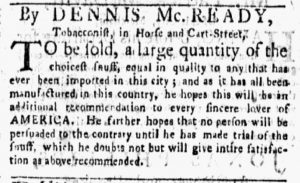
“He hopes this will be an additional recommendation to every sincere lover of AMERICA.”

In the summer of 1770, Dennis McReady, a tobacconist on Horse and Cart Street in New York, advertised that he had for sale “a large quantity of the choicest snuff.”  To convince prospective customers to buy his product, he made a “Buy American” argument and proclaimed that his snuff was “equal in quality to any that has ever been imported in this city.”  The city’s merchants had withdrawn from their nonimportation agreement a few months earlier, shortly after receiving word that most of the duties imposed on imported goods in the Townshend Acts had been repealed.  With only the tax on tea remaining, New York’s merchants chose to resume trade with their counterparts in Britain.

Not all New Yorkers universally approved of that decision.  For those who had pursued “domestic manufactures” or local production of alternatives to imported goods, the boycott enhanced their ability to market their wares as symbols of patriotism and support for the American cause.  McReady cautioned prospective customers against turning back to imported goods too hastily, challenging them to try his snuff “manufactured in this country.”  In addition to declaring that his product was equal to snuff that had been processed from tobacco on the other side of the Atlantic, he issued a political challenge to “every sincere lover of AMERICA.”  That “AMERICA” was the only word in all capitals in the body of his advertisement made it easy for readers to spot and underscored the emphasis McReady placed on this particular appeal to consumers.  The tobacconist doubled down on his claims about the quality of his snuff and his challenge to choose it over imported snuff; he expressed his “hopes that no person will be persuaded to the contrary until he has made trial of [McReady’s] snuff.”  At least try this product once to test its quality, McReady demanded, rather than assume that “imported” meant “better quality.”  Instead of purchasing imported snuff just because they could, McReady sought to persuade consumers to support domestic manufactures and the patriotic ideals associated with them.

April 17

What was advertised in a colonial American newspaper 250 years ago today?

Apr 17 - 4:17:1770 South-Carolina Gazette and Country Journal Supplement
Supplement to the South-Carolina Gazette and Country Journal (April 17, 1770).

“NEW Bourdeaux RAPPEE.”

In an effort to launch a new product Henry Margue inserted an advertisement in the supplement that accompanied the April 17, 1770, edition of the South-Carolina Gazette and Country Journal.  Margue announced that he sold rappee, a coarse snuff made from dark strong-smelling tobacco leaves, “made by the French Protestants, at New Bourdeaux.”  Since this product was as yet unfamiliar to most consumers, Margue offered assurances of its quality, asserting that the snuff “is allowed, by Connisseurs, to be very good.”  In a nota bene, he suggested that rappee from New Bordeaux could become very popular, “a considerable Manufacture,” if the French Protestants encountered “any Encouragement” in their endeavor.  Margue challenged consumers to find out for themselves if they agreed with the “Connisseurs” and be among the first to demonstrate their good taste.

Even if “NEW Bourdeaux RAPPEE” met with immediate success, it did not last long.  The new settlement, established in 1764, ceased to exist during the American Revolution.  On behalf of the Huguenot Society of South Carolina, Cheves Leland offers a brief history of New Bordeaux as well as six other towns settled by French Protestants who migrated to the colony.  New Bordeaux was the destination of the “last large group of French Protestants to arrive and settle in South Carolina.  Led by the Rev. Jean Louis Gibert and the Rev. Jacques Boutiton, some 371 French, Swiss and German immigrants sailed into Charlestown harbor” on April 12, 1764.  Leland indicates that their efforts to cultivate grapes for wine and silkworms for silk “did well until financial considerations, political intrigues in England and France and the coming American Revolution ended them,” but does not mention the Huguenots cultivating tobacco or producing snuff.  However, Owen Stanwood contends that residents of New Bordeaux “seemed more interested in tobacco” than wine, citing Margue’s advertisement in the April 5, 1770 edition of the South-Carolina Gazette.[1]  On behalf of the French Protestants, Margue promoted snuff from New Bordeaux in more than one newspaper.

Margue and the Huguenots introduced new products to consumers in South Carolina at a time when the “governor had dedicated himself to diversifying the colonial economy, something that he saw as especially important in an era of rising tensions between colonists and Parliament.”[2]  The governor placed far more emphasis on viniculture, but Margue’s advertisement for snuff suggests that some Huguenot settlers had other ideas when it came to which enterprise they wished to develop.

**********

[1] Owen Stanwood, “From the Desert to the Refuge:  The Saga of New Bordeaux,” French Historical Studies 40, no. 1 (February 2017):  26.

[2] Stanwood, “From the Desert to the Refuge,” 26.

April 12

What was advertised in a colonial American newspaper 250 years ago today?

Apr 12 - 4:12:1770 Maryland Gazette
Maryland Gazette (April 12, 1770).

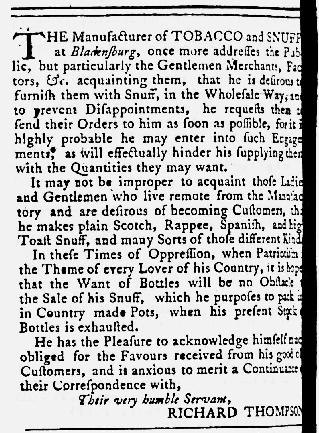
“He purposes to pack it in Country made Pots.”

Richard Thompson, “the Manufacturer of TOBACCO and SNUFF at Blackensburg,” placed an advertisement for his ware in the April 12, 1770, edition of the Maryland Gazette.  He invited “Gentleman Merchants,” factors, and others to submit orders for wholesale purchases quickly or else risk missing out since “it is highly probable he may enter into such Engagements, as will effectually hinder his supplying them with the Quantities that may want.”  He also listed his various products for the benefit of both wholesale and retail customers: “plain Scotch, Rapee, Spanish, and high Toast Snuff, and many Sorts of those different Kinds.”

Thompson also devoted a portion of his advertisement to the packaging for his snuff, noting that out of necessity it might deviate from what consumers expected.  He anticipated that his “present Stock” of snuff bottles would run out, forcing him to “pack [his snuff] in Country made Pots.”  Although that was not the usual or preferred form of packaging, Thompson argued that it should not dissuade customers from acquiring his snuff.  He invoked current events to make his case to principled prospective customers.  “In these Tomes of Oppression, when Patriotism is the Theme of every Lover of his County,” he declared, “it is hoped that the Want of Bottles will be no Obstacle in the Sale of his Snuff.”  Thompson suggested that consumers should accept or even welcome a minor inconvenience if it meant purchasing goods produced in the colonies rather than imported from Britain.

On the other side of the Atlantic, the king gave royal assent to repealing duties on imported glass, paper, paint, and lead on the same day that Thompson’s advertisement first appeared in the Maryland Gazette, but colonists would not learn that news for many weeks.  For the moment, nonimportation agreements adopted in protest of the duties imposed in the Townshend Acts remained in effect, a powerful symbol for both merchants and consumers.  Like others who advertised domestic manufactures as alternatives to imported goods, Thompson offered yet another avenue for practicing politics in the marketplace by purchasing his snuff packed “in Country made Pots.”

October 5

What was advertised in a colonial American newspaper 250 years ago today?

Oct 5 - 10:5:1769 Pennsylvania Gazette
Pennsylvania Gazette (October 5, 1769).

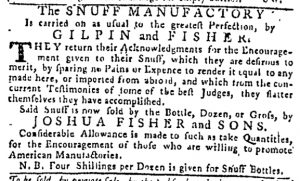
“For the Encouragement of those who are willing to promote American Manufactories.”

While the Townshend Acts remained in effect, imposing duties on paper, glass, lead, paint, and tea imported in the American colonies, the number and frequency of newspaper advertisements promoting “American manufactories” increased. The partnership of Gilpin and Fisher joined the chorus of advertisers encouraging colonists to “Buy American” in the late 1760s. In an advertisement for their “SNUFF MANUFACTORY” in the October 5, 1769, edition of the Pennsylvania Gazette, Gilpin and Fisher extolled the quality of their product. They proclaimed that they “spar[ed] no Pains or Expence to render” their snuff “equal to any made here” or, more significantly, “imported from abroad. That was not merely their own puffery but rather the assessment of “some of the best Judges,” though Gilpin and Fisher did not publish their “concurrent Testimonies” nor name those “Judges.” Still, they made their point: consumers did not have to sacrifice quality when purchasing from Gilpin and Fisher’s “SNUFF MANUFACTORY” instead of buying imported alternatives.

Elsewhere in the advertisement, they incorporated another popular element of the “Buy American” motif that emerged in response to an imbalance of trade with Britain, the Townshend Acts, and nonimportation agreements adopted in cities and towns in several colonies. According to many editorials and advertisements, American consumers had a moral imperative to purchase goods produced in the colonies. Doing so would correct the trade imbalance while simultaneously exerting economic resistance to Parliament’s attempts to tax the colonies via import duties. Joshua Fisher and Sons sold the snuff “by the Bottle, Dozen, or Gross,” offering discounts to those who bought in bulk. To convince both consumers and retailers to take advantage of such deals, the tobacconists called on those “willing to promote American manufactories.” The two appeals buttressed each other: purchasing “domestic manufactures” was good politics but also savvy business when getting a bargain for doing so. The “Considerable Allowance” promised to those who purchased by volume likely made products from Gilpin and Fisher’s “SNUFF MANUFACTORY” even more enticing for prospective customers who wanted to practice politics through their decisions in the marketplace.

The imperial crisis and American reactions to it did not unfold solely in the news items and editorials in colonial newspapers. Instead, merchants, shopkeepers, artisans, and others addressed the political issues of the day in their advertisements. The appeals they made to consumers helped to shape American resistance to Parliament’s attempts to raise revenues and regulate commerce in the colonies.

August 21

What was advertised in a colonial American newspaper 250 years ago today?

Aug 21 - 8:21:1769 New-York Gazette Weekly Mercury
New-York Gazette and Weekly Mercury (August 21, 1769).

“These are Manufactures America can have within herself.”

When George Traile advertised his “Manufactory of Snuff and Tobacco” in the New-York Gazette and Weekly Mercury in August 1769, he provided a short history of his business. Formerly located in New Rochelle, the manufactory had recently moved “to the Snuff Mills in the Bowery” in New York. Traile promoted the quality of his snuff, but he also had an eye for current tastes that ventured far beyond the American colonies. He proclaimed that he made and sold “all Sorts of Rappee now in Vogue in Great-Britain and Ireland, France and Holland.” Local consumers could acquire the varieties of snuff currently in fashion in some of the most cosmopolitan places in the Atlantic world without having to import it!

That assertion served as the backbone of Traile’s advertisement. After making brief comments about quality and fashion, he devoted most of his advertisement to a lesson in politics. He likely assumed this strategy would resonate with colonists currently participating in nonimportation agreements as economic acts of resistance to the taxes on paper, glass, lead, paint, and tea levied by the Townshend Acts. As far as his Traile’s tobacco was concerned, “These are Manufactures America can have within herself, as good and as cheap as they can be imported.” Customers did not need to sacrifice quality or pay higher prices when they allowed politics to guide their purchases.

Traile charged true patriots with a duty to buy his snuff: “the Encouragement of this Branch of Business in the Colonies, will be found an Object highly worth the Attention of every real Patriot.” Furthermore, “as the popular Prejudices to the Snuff of this Country, are pretty much subsided all over the Colonies, he flatters himself he will meet with that Encouragement the Quality of his Commodities shall deserve, from every well Wisher to America.” In other words, colonists near and far preferred snuff produced in the colonies, provided it was quality merchandise, so anybody who had the best interests of the colonies at heart should eagerly purchase Traile’s snuff since he endeavored to provide the best product available. This was not an insignificant matter. Traile asked prospective customers who counted themselves among “the thinking Part of Mankind” to consider the annual expenses for snuff incurred by “Three Millions of People now computed to be upon this Continent.” Traile presented a vision of each consumer acting separately yet contributing to a collective action in defense of the rights and liberties of the colonies. He encouraged concerned colonists to practice politics through their participating in the marketplace, purchasing the right tobacco from his manufactory in New York City.