January 10

What was advertised in a colonial American newspaper 250 years ago today?
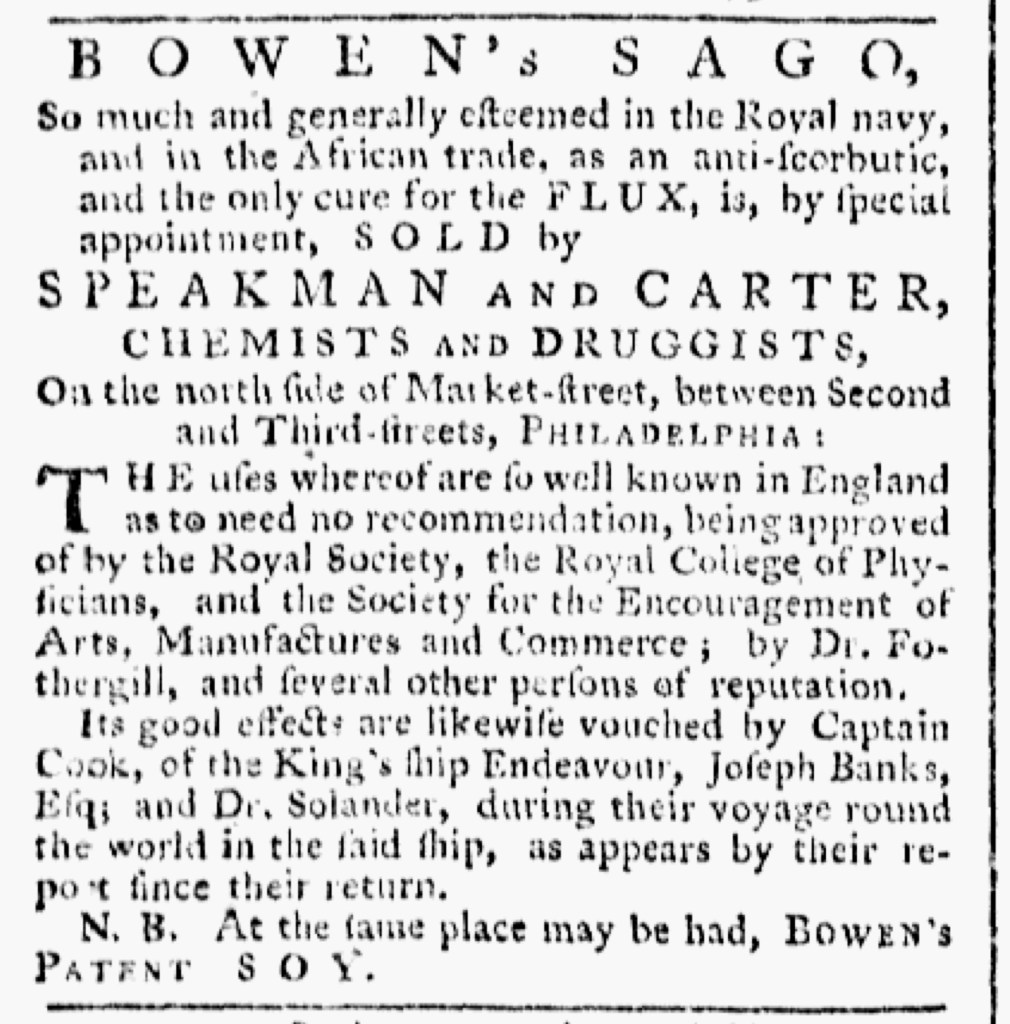
Dunlap’s Pennsylvania Packet (January 10, 1774).

“BOWEN’s SAGO … the only cure for the FLUX.”

Townsend Speakman and Christopher Carter, “CHEMISTS AND DRUGGISTS” in Philadelphia, took to the pages of Dunlap’s Pennsylvania Packet to advertise “BOWEN’s SAGO,” a medicine for preventing and curing scurvy.  The apothecaries did not, however, appear to generate their own copy.  Instead, they seemed to borrow heavily from advertisements that Zepheniah Kingsley placed in the South-Carolina Gazette and Country Journal and other newspapers published in Charleston several months earlier.

The headline differed only slightly, “BOWEN’s patent SAGO” in the original shortened to “BOWEN’s SAGO” in Speakman and Carter’s advertisement.  The introductory remarks remained the same, describing the product as “So much and generally esteemed in the Royal navy, and in the African trade, as an anti-scorbutic, and the only cure for the FLUX.”  In the original, the retailer then announced, “SOLD By Z. KINGSLEY,” and directed customers to his store in Beadon’s Alley.  The apothecaries in Philadelphia altered that portion slightly, declaring that the medicine “is, by special appointment, SOLD by SPEAKMAN AND CARTER, CHEMISTS AND DRUGGISTS,” and then gave directions to their shop.  The main body of both advertisements included an overview of endorsements by “the Royal Society, the Royal College of Physicians, and the Society for the Encouragement of Arts, Manufactures and Commerce.”  Speakman and Carter added additional endorsements: “by Dr. Fothergill, and several other persons of reputation.”  Another paragraph described how Captain James Cook and botanists who sailed with him during the Endeavour’s “voyage round the world” also “vouched” for the “good effects” of Bowen’s Sago in the report they published upon their return.  It appeared almost word-for-word, substituting “Joseph Banks, Esq” for “Mr. BANKES.”  A brief note appeared at the end, “SOLD at same Place, BOWEN’s patent SOY” in the original and “At the same place may be had, BOWEN’S PATENT SOY.”

Speakman and Carter created their advertisement at a time that most people thought little of reprinting what others had written or published, at least in certain contexts.  Colonial printers liberally reprinted content from one newspaper to another, often attributing their sources but sometimes not doing so.  Printers and booksellers who advertised books frequently copied the extensive subtitles or contents that appeared on the title page, treating those as advertising copy. Apothecaries, shopkeepers, and others who sold patent medicines sometimes published newspaper advertisements that drew heavily from the directions or promotional materials provided by the producers.  In this instance, Speakman and Carter may have used Kingsley’s advertisement as a model, revising it slightly for their purposes, or both the apothecaries in Philadelphia and the merchant in Charleston may have adapted handbills, newspaper advertisements, or other marketing materials sent to them by their suppliers.  Whatever the explanation, consumers in two major ports encountered nearly identical marketing for a product sold by local vendors.

November 3

What was advertised in a colonial American newspaper 250 years ago today?

Pennsylvania Journal (November 3, 1773).

“Dr. Keyser’s Pills … warranted genuine.”

Townsend Speakman and Christopher Carter, “CHYMISTS and DRUGGISTS,” advertised widely in October and November 1773.  They placed advertisements simultaneously in the Pennsylvania Chronicle, the Pennsylvania Gazette, the Pennsylvania Journal, and the Pennsylvania Packet.  Each of those advertisements promoted raisins, figs, and currants as well as “an Assortment of the freshest DRUGS and PATENT MEDICINES.”  They offered the “most saleable Articles in large Quantities” to shopkeepers and others who planned to retail them.  Printers, for instance, often supplemented revenues from other sources by peddling patent medicines.

On November 1, the Pennsylvania Packet ran an abbreviated version of Speakman and Carter’s advertisement.  In notices in the other three newspapers during that week, the apothecaries highlighted a “Parcel of Keyser’s famous Pills, from the Importer in London, with full Directions for their Use.”  They pledged that “the Public may be assured these Pills are the genuine Sort,” and to demonstrate that was indeed the case “they have inserted the Copy of a Certificate received with [the pills], the Original of which may be seen by any Purchaser.”  The copy of that certificate comprised the final third of the advertisement.  In it, James Cowper, “Doctor of Physic,” declared himself “the only legal Proprietor of a Medicine, called KEYSER’S PILLS, in England.”  Furthermore, he certified that Speakman and Carter, “Chymists and Druggists, in Philadelphia, are my only Correspondents to whom I send the above Pills in that Part of the World.”  Consumers did not need to worry about purchasing counterfeit pills if they acquired them from Speakman and Carter.

According to another advertisement in the Pennsylvania Journal, however, customers in Philadelphia had another option for obtaining Keyser’s Pills without worrying about getting duped by unscrupulous sellers.  That advertisement appeared immediately below Speakman and Carter’s advertisement, a rather cheeky placement considering that it listed William Bradford and Thomas Bradford, printers of the Pennsylvania Journal, as local agents who sold the pills.  Speakman and Carter paid the Bradfords to run their advertisement, complete with the certificate, and they may have expected competition but not efforts to outright undermine their marketing strategy.  The advertisement replicated James Rivington’s “Every One their own Physician” notice from Rivington’s New-York Gazetteer, along with a few additions.  In addition to listing the Bradfords as local agents, a letter from Rivington to the Bradfords followed the testimonials.

Just as Speakman and Carter reprinted Cowper’s certificate in its entirety, the Bradfords published Rivington’s entire letter.  He noted that he saw “an advertisement in the Philadelphia Papers, relating to Dr. Keyser’s Pills, importing that they were procured from Dr. Cowper, of London, and warranted genuine.”  Rivington could do one better.  “I think it very proper the Public should be assured,” he trumpeted, “that the Pills, which you have had from me, and now advertize for sale, were imported by me, immediately from Mr. Keyser himself, at Paris.”  In addition, Rivington offered to show Keyser’s “letters and correspondence for some years past … to any person, who may require a sight of them.”  Furthermore, Rivington was also vigilant about counterfeits, reporting that he “detected a counterfeit sort, exposed to sale in New-York, of which Mr. Keyser has sent me a written declaration.”  Rivington concluded by inviting the Bradfords to insert his letter in their newspaper so “the Public may be once more informed you have the Pills sent directly from Mr. Keyser” to New York and then forwarded to Philadelphia.

It was not the first time that printers who sold Keyser’s Pills became embroiled in disputes over who stocked authentic medicines.  In the summer of 1772, printers in South Carolina pursued a feud in their newspapers, sometimes alluding to notices placed by their competitors and sometimes responding to them directly.  Among the many purveyors of Keyser’s Pills, a great many claimed that they carried genuine medicines and possessed some sort of exclusive right to market them in their town.

September 22

What was advertised in a colonial American newspaper 250 years ago today?

Pennsylvania Journal (September 22, 1773).

“They have lately erected a commodious Elaboratory for the preparing Chemical and Galenical Medicines.”

In the fall of 1773, Speakman and Carter, “CHEMISTS and DRUGGISTS” in Philadelphia, advertised widely in their efforts to capture their share of the market for the “freshest DRUGS and genuine Patent MEDICINES, Surgeons INSTRUMENTS[,] Shop Furniture,” and other merchandise sold by apothecaries in the city.  They competed with other apothecaries, including several who ran their own notices in newspapers published in the city.  Robert Bass advertised in the Pennsylvania Chronicle.  William Smith inserted notices in both the Pennsylvania Journal and the Pennsylvania Packet.  John Watson, “DOCTOR, SURGEON, and APOTHECARY, at NEWCASTLE on Delaware,” competed for customers outside Philadelphia with an advertisement in the Pennsylvania Chronicle.

Speakman and Carter sought customers in the Philadelphia as well as “Orders from the country,” including New Castle and the surrounding area, and welcomed both wholesale and retail sales.  On September 22, they ran advertisements with identical copy (but variations in format) in the Pennsylvania Gazette and the Pennsylvania Journal.  In addition to hawking the drugs and patent medicines they recently imported from London, Speakman and Carter advised “Wholesale Dealers and Practitioners in Medicine” that they “erected a commodious Elaboratory for the preparing Chemical and Galenical Medicines in large quantities.”  The apothecaries asserted that they could compound medicines “in large quantities” of the same quality “on as low terms [or prices] as they can be imported from England.”

Pennsylvania Chronicle (September 20, 1773).

The industrious apothecaries simultaneously ran a more elaborate advertisement in the September 20 edition of the Pennsylvania Chronicle.  It included all of the material that appeared in the advertisements in the other two newspapers as well as a list of some of their inventory.  Divided into two columns with one item per line, that list included “Jesuits bark,” “Purging salts,” “Lancets single or in cases,” “Neat mahogany medicine chests for gentlemen’s families,” and “Keyser’s pills, warranted genuine from the only importer in London.”  In addition, Speakman and Carter inserted an abbreviated version of the advertisement in the Pennsylvania Packet on the same day.  It featured just a small portion of the notices that appeared in the other newspapers, promoting “A LARGE assortment of the freshest Drugs and Patent Medicines, the most saleable articles in large quantities, which will be sold on reasonable terms.”  Though relatively brief compared to the others, publishing that advertisement meant that Speakman and Carter placed notices in all four English-language newspapers published in Philadelphia at the time.  (They did not pursue Henry Miller’s standing offer to translate any and all advertisements for the Wöchentliche Pennsylvanische Staatsbote.)  The apothecaries apparently considered it worth the investment to achieve market saturation with advertisements in so many newspapers.