April 13

What was advertised in a colonial American newspaper 250 years ago today?
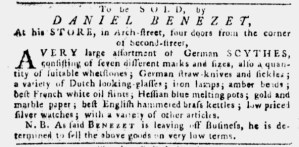
Pennsylvania Gazette (April 13, 1774).

“Said BENEZET is leaving off Business.”

Daniel Benezet increased the likelihood that prospective customers would see his advertisements by placing them in every newspaper published in Philadelphia the spring of 1774.  Notices with identical copy appeared in Dunlap’s Pennsylvania Packet, the Pennsylvania Gazette, and the Pennsylvania Journal.  Benezet even took advantage of the offer that Henry Miller made in the masthead of each issue of the Wöchentliche Pennsylvanische Staatsbote: “All ADVERTISEMENTS to be inserted in this Paper, or printed single by HENRY MILLER, Publisher hereof, are by him translated gratis.”  That newspaper carried Benezet’s notice to German settlers.  No matter which newspaper colonizers in Pennsylvania read, they would encounter Benezet’s advertisement.
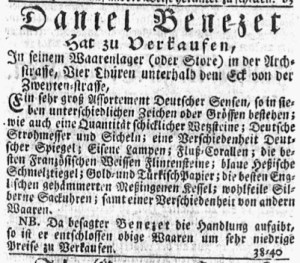
Wöchentliche Pennsylvanische Staatsbote (April 12, 1773).

Like many other entrepreneurs, Benezet listed some of his merchandise in hopes of enticing prospective customers.  He stocked “A VERY large assortment of German SCYTHES,” “a variety of Dutch looking-glasses,” “gold and marble paper,” “best English hammered brass kettles,” “low priced silver watches,” and “a variety of other articles” that consumers would discover when they visited “his STORE, in Arch-street, four doors from the corner of Second-street.”  Yet Benezet did not rely on appeals to choice alone to market his wares.  He also emphasized price and offered a reason for prospective customers to trust that he did indeed offer bargains.  In a nota bene, Benezet advised that since he “is leaving off Business, he is determined to sell the above goods on very low terms.”  In other words, he was holding an eighteenth-century version of a “going out of business” sale.  His desire to liquidate his merchandise justified not only low prices but also investing in advertising in four newspapers to make sure as many prospective customers as possible saw his notice.  Benezet saturated the local media market with his advertisements, signaling that he was serious about the deals at his store as he prepared for “leaving off Business.”

September 22

What was advertised in a colonial American newspaper 250 years ago today?

Pennsylvania Journal (September 22, 1773).

“They have lately erected a commodious Elaboratory for the preparing Chemical and Galenical Medicines.”

In the fall of 1773, Speakman and Carter, “CHEMISTS and DRUGGISTS” in Philadelphia, advertised widely in their efforts to capture their share of the market for the “freshest DRUGS and genuine Patent MEDICINES, Surgeons INSTRUMENTS[,] Shop Furniture,” and other merchandise sold by apothecaries in the city.  They competed with other apothecaries, including several who ran their own notices in newspapers published in the city.  Robert Bass advertised in the Pennsylvania Chronicle.  William Smith inserted notices in both the Pennsylvania Journal and the Pennsylvania Packet.  John Watson, “DOCTOR, SURGEON, and APOTHECARY, at NEWCASTLE on Delaware,” competed for customers outside Philadelphia with an advertisement in the Pennsylvania Chronicle.

Speakman and Carter sought customers in the Philadelphia as well as “Orders from the country,” including New Castle and the surrounding area, and welcomed both wholesale and retail sales.  On September 22, they ran advertisements with identical copy (but variations in format) in the Pennsylvania Gazette and the Pennsylvania Journal.  In addition to hawking the drugs and patent medicines they recently imported from London, Speakman and Carter advised “Wholesale Dealers and Practitioners in Medicine” that they “erected a commodious Elaboratory for the preparing Chemical and Galenical Medicines in large quantities.”  The apothecaries asserted that they could compound medicines “in large quantities” of the same quality “on as low terms [or prices] as they can be imported from England.”

Pennsylvania Chronicle (September 20, 1773).

The industrious apothecaries simultaneously ran a more elaborate advertisement in the September 20 edition of the Pennsylvania Chronicle.  It included all of the material that appeared in the advertisements in the other two newspapers as well as a list of some of their inventory.  Divided into two columns with one item per line, that list included “Jesuits bark,” “Purging salts,” “Lancets single or in cases,” “Neat mahogany medicine chests for gentlemen’s families,” and “Keyser’s pills, warranted genuine from the only importer in London.”  In addition, Speakman and Carter inserted an abbreviated version of the advertisement in the Pennsylvania Packet on the same day.  It featured just a small portion of the notices that appeared in the other newspapers, promoting “A LARGE assortment of the freshest Drugs and Patent Medicines, the most saleable articles in large quantities, which will be sold on reasonable terms.”  Though relatively brief compared to the others, publishing that advertisement meant that Speakman and Carter placed notices in all four English-language newspapers published in Philadelphia at the time.  (They did not pursue Henry Miller’s standing offer to translate any and all advertisements for the Wöchentliche Pennsylvanische Staatsbote.)  The apothecaries apparently considered it worth the investment to achieve market saturation with advertisements in so many newspapers.

July 23

What was advertised in a colonial American newspaper 250 years ago today?

Jul 23 - 7:23:1768 Providence Gazette
Providence Gazette (July 23, 1768).

“A most neat and general Assortment of SPRING and SUMMER GOODS.”

It would have been practically impossible for regular readers of the Providence Gazette not to know something about the commercial activities of Joseph Russell and William Russell in the late 1760s. The Russells were prolific advertisers. They saturated the pages of their local newspaper with a series of notices that made their names and merchandise familiar to prospective customers.

For instance, the Russells placed three advertisements in the July 23, 1768, edition of the Providence Gazette. One promoted their “most neat and general Assortment of SPRING and SUMMER GOODS.” Another offered a house for rent, but concluded with an announcement concerning textiles, tea, and spices they sold. The third called on fellow colonists to deliver potash to the Russells.

The three appeared in a single column on the final page of the July 23 issue. It was the fifth issue that featured all three advertisements and the third consecutive issue in which they appeared one after another, though their position on the page changed from week to week depending on the needs of the compositor. By placing so many advertisements and so frequently, the Russells made it difficult to overlook their activities in the colonial marketplace.

The first of their advertisements was especially notable for its longevity. The “(23)” inserted on the final line indicated that it first ran in issue number 223, published April 16. Since then, it had maintained a constant presence in the Providence Gazette, appearing every week for fifteen consecutive weeks before being discontinued. Throughout most of that time the Russells simultaneously published at least one other advertisement in the Providence Gazette. The notice concerning a house for rent and assorted goods for sale first appeared on July 25, replacing another advertisement that exclusively promoted consumer goods that ran for seven weeks beginning in May.

Most advertisers usually ran notices for only three or four weeks in newspapers published in other cities. Those who advertised in the Providence Gazette tended to run their advertisements for even longer (which may suggest the publishers offered discounted rates in order to generate content and revenue). Still, the Russells’ “SPRING and SUMMER GOODS” notice enjoyed an exceptionally long run, signaling that they wanted to be certain that readers saw and remembered their advertisement. Combining it with other notices further increased the name recognition they achieved.