April 7

What was advertised in a revolutionary American newspaper 250 years ago this week?
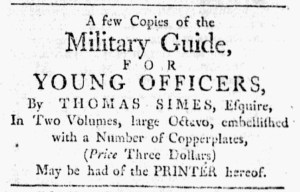
Pennsylvania Ledger (April 6, 1776).

“A few Copies of the Military Guide, FOR YOUNG OFFICERS.”

James Humphreys, Jr., the printer of the Pennsylvania Ledger, was so eager to sell surplus copies of Thomas Simes’s “Military Guide FOR YOUNG OFFICERS” that he inserted two advertisements in the April 6, 1776, edition of his newspaper.  A shorter notice appeared on the third page and a longer one on the fourth page.

Humphreys previously collaborated with Robert Aitken and Robert Bell in circulating subscription proposals for a local edition of the military manual originally published in London.  In an advertisement in the December 2, 1775, edition of the Pennsylvania Ledger, the printers declared that they took on the project “By Desire of some [of] the Members of the Honourable the American Continental CONGRESS, and some of the Military Officers of the Association.”  A few months later, they repeated that assertion in the longer advertisement that listed all three of their names and locations. That notice also featured other details from the subscription proposals, noting that the work was “a large and valuable Compilation from the most celebrated Military Writers” that included “an excellent Military, Historical and Explanatory DICTIONARY.”  The proposals had not, however, mentioned illustrations, but the advertisement that announced the two-volume set was “Printed and Published” informed readers that the “whole is illustrated with Eleven Copperplates.”  It concluded with a nota bene that instructed subscribers who had reserved copies in advance “to call or send for their Books.”  Aitken, Bell, and Humphreys had been running that advertisement in the Pennsylvania Evening Post and the Pennsylvania Ledger since late February.

Once the subscribers collected their books, Humphreys apparently had extra copies that he hoped to sell.  As long as they remained at his printing office they cut into any profits he earned on the venture.  In a streamlined advertisement, he announced that “A few Copies of the Military Guide, FOR YOUNG OFFICERS, By THOMAS SIMES, Esquire, In Two Volumes, large Octavo, embellished with a Number of Copperplates, (Price Three Dollars) May be had of the PRINTER hereof.”  Between the advertisement on the following page and the notices that already circulated widely, Humphreys assumed that prospective customers were already familiar with the local edition of Simes’s military manual.  It was one of many such works among “a flood of printings” in Philadelphia “to meet the demand for military texts,” according to the American Revolution Institute of the Society of the Cincinnati, yet that demand did not necessarily mean that copies sold themselves.  Aitken, Bell, and Humphreys carefully crafted a marketing campaign to enlist subscribers and then Humphreys still had “A few Copies” he hoped to sell.  He may have hoped that news that British troops evacuated Boston on March 17 would incite new demand for Simes’s manual.
February 13

What was advertised in a revolutionary American newspaper 250 years ago today?

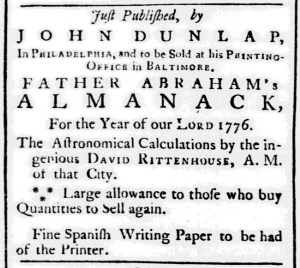
Dunlap’s Maryland Gazette (February 13, 1776).

“FATHER ABRAHAM’s ALMANACK, For the Year of our LORD 1776.”

John Dunlap, the printer of Dunlap’s Maryland Gazette, apparently had surplus copies of “FATHER ABRAHAM’s ALMANACK, For the Year of our LORD 1776,” that he hoped to sell in the middle of February of that year.  Although the “Astronomical Calculations by the ingenious DAVID RITTENHOUSE” for the first six weeks of the year were no longer of use to readers, the rest of the contents still had value.  Hoping to move some or all the remaining copies out of his printing office in Baltimore, Dunlap once again placed an advertisement that had first appeared in Dunlap’s Maryland Gazette in October, well before the new year began and readers would refer to the calendars and astronomical calculations in the handy reference manual.  Prospective customers knew that the phrase “Just Published” at the beginning of the advertisement merely meant that copies were available to purchase, not that the almanacs just came off the press.

In addition to operating a printing shop and publishing a newspaper in Baltimore, Dunlap also ran a printing shop in Philadelphia.  It was there, according to his advertisement, that he had printed the almanac and then sent copies to his printing office in Baltimore.  He had also advertised the almanac in the newspaper he published in Philadelphia, Dunlap’s Pennsylvania Packet.  He did not, however, continue running advertisements for the almanac in that newspaper in February 1776.  Perhaps he sold out of copies in Philadelphia.  After all, he established his printing office and newspaper there before his second printing office and newspaper in Baltimore.  Consumers in Philadelphia and its hinterlands had greater familiarity with Dunlap, the printer, and Rittenhouse, the astronomer and mathematician who did the calculations for the almanac.  Alternately, Dunlap may not have continued advertising the almanac in the newspaper published at his printing office in Philadelphia because that location received a heavier volume of advertisements.  The printer may have determined that the revenue generated from advertisements submitted by customers outweighed any potential revenue from advertising the almanac once again.  With limited amount of space in each issue, delivering news also took precedence over yet another advertisement for the almanac.  Dunlap and those who labored in his printing offices may have had other reasons for continuing to advertise the almanac in Baltimore but not in Philadelphia.  Whatever the explanation, the advertisement in Dunlap’s Maryland Gazette became a familiar sight to readers over the course of several months.

March 6

What was advertised in a colonial American newspaper 250 years ago today?

New-Hampshire Gazette (March 6, 1772).

“A few of the New-Hampshire Registers … may be had at the Printing-Office.”

The “Civil, Military & Ecclesiastical REGISTER of the Province of New-Hampshire, for the YEAR 1772” apparently did not sell as well as the printers, Daniel Fowle and Robert Fowle, hoped.   They first advertised the volume in their newspaper, the New-Hampshire Gazette, on December 13, 1771.  That notice included a lengthy list of the contents.  A week later, they supplemented the original copy with an explanation intended to convince colonizers to purchase a copy of their own.  “Every Gentleman who holds an Office,” the Fowles declared, “and has the Honor of having it recorded in the above Register, undoubtedly ought and will furnish himself with one.”  Furthermore, “other Persons should have them, in order rightly to know their Superiors.”  From the “Governor, Council and House of Representatives” to “Justices of the Peace through the Province and for each County,” the Register listed officials throughout the colony.

Nearly three months after first advertising the Register, the Fowles inserted a shorter notice (but in much larger type) to alert prospective customers that “A few of the New-Hampshire Registers, very necessary for all sorts of People, may be had at the Printing-Office.”  They continued to insist that they sold an invaluable resource for colonizers to consult in a variety of circumstances, but they no longer devoted as much space to making that assertion.  Prospective customers likely needed more convincing.  The Fowles did not publish an updated register in 1773 nor in any subsequent year.  Other printers did so in 1779 and 1787, but the Fowles seemingly did not encounter enough success with the project in 1772 to justify making another attempt.  Perhaps more extensive advertising might have helped to create a more robust market, but the Fowles may have determined that no amount of marketing would so significantly improve sales to make another edition worthy of the time and expense necessary to produce it.  Even with their access to the press and ability to run as many advertisements as they wished, the Fowles had surplus copies of the register that cut into any profits they might have earned.