January 27

What was advertised in a colonial American newspaper 250 years ago today?

Massachusetts Spy (January 27, 1774).

“NO TEA.”

More than a month after colonizers disguised as Indians dumped tea into Boston Harbor to protest the duties imposed by Parliament in the Tea Act, the subject of purchasing and consuming tea continued to animate conversations around town and in the public prints.  On January 27, 1774, the Massachusetts Spy published a letter from “DEBORAH DOUBTFUL,” who may have been a concerned woman or, in the spirit of Benjamin Franklin’s Silence Dogood, may have been a man masquerading as a woman.  The message mattered more than the messenger.  In this case, Deborah Doubtful issued a warning to anyone who sold or purchased tea.

The writer claimed that colonizers in Boston “hear and read so much of indulging the sale of undutied teas through comparatively a small number of the citizens countenance the use of any tea.”  That disparity prompted “a number of the female friends to liberty” to “agree to enquire into the number of those who still continue the use of that detestable drug.”  Terminology for tea had shifted.  Rather than a pleasure to imbibe, it became something worse than any of the patent medicines so widely advertised in early American newspapers.  Deborah Doubtful warned that unless those who still consumed tea “very speedily reform,” her committee would “resolve to take such measures with them, as will perhaps cause them to repent their love to their country runs so low in so trying a season.”  Those measure could include public shaming, but both men and women sometimes resorted to other forms of protest.

Deborah Doubtful made it clear that colonizers needed to be very careful about what they chose to sell or drink.  “Dealers in Dutch tea are informed form the same society,” she cautioned, “that a strict watch will be kept over them, and the smugglers exposed as they deserve.”  Her committee extended their purview beyond just those teas imported from Britain and subject to the Tea Act, refusing to accept smuggled tea as an alternative.  “The only sure way to avoid being imposed upon by dutied tea,” Deborah Doubtful proclaimed, “being to oppose the trade in all tea.”  That the author so obviously used a pseudonym put readers on notice that anyone, both men and women, could participate in surveillance of their friends and neighbors, report them to a committee composed of “friends of liberty,” and cause problems for them as result of the choices they made in the marketplace.

Joseph P. Palmer did not need to read Deborah Doubtful’s letter to reach that conclusion.  He already arrived there when he submitted his advertisement for “GRENADA RUM” and various groceries to the printing office.  It concluded with a list of “Cheese, Coffee, Chocolate, &c. as usual,” but something was missing.  In a nota bene, centered and in a larger font to make it all the more visible, Palmer declared “NO TEA.”  Merchants, shopkeepers, grocers, and other who carried coffee and chocolate usually stocked tea as well, but given the climate in Boston at the time, including Deborah Doubtful’s letter and other items about tea in that issue of the Massachusetts Spy, Palmer stayed away from the problematic commodity.  He may have done so as a matter of his own political principles, but that might not have been his only motivation.  At that moment, conducting business and remaining in the good graces of the community meant going along with prohibitions on selling and drinking tea.
December 28

What was advertised in a colonial American newspaper 250 years ago today?

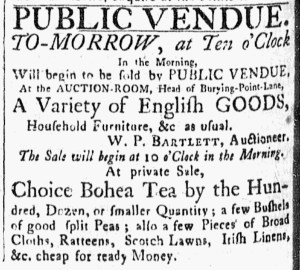
Essex Gazette (December 28, 1773).

“At private Sale, Choice Bohea Tea.”

Tea, tea, tea.  Everyone was talking about tea after Parliament passed the Tea Act in 1773.  That legislation allowed the East India Company to sell tea directly in colonies without paying export taxes in London.  This reduced the cost of tea for American consumers, but many colonizers resisted because this arrangement included paying duties when the tea was unloaded from the vessels once they arrived in American ports.  If they paid those duties, colonizers would implicitly recognize Parliament’s right to tax them.  They had rejected such assertions when they protested the Townshend Acts and, as a matter of principle, rejected them once again, even when presented with the prospect of buying tea at lower prices.  Many also worried about greater enforcement to prevent smuggling, realizing that they illicit trade also yielded bargain prices.

The talk about tea continued as colonizers anticipated the arrival of ships carrying tea belonging to the East India Company.  The talk about tea continued when three of ships arrived in Boston and residents prevented them from unloading their cargo.  The talk about tea continued after the destruction of that tea during a protest now known as the Boston Tea Party.  The December 28, 1773, edition of the Essex Gazette, for instance, featured plenty of talk about tea.  Two of the three columns on the first page covered the “Proceedings of the PEOPLE, previous to the Destruction of the Tea at Boston.”  The final column followed up with “the following Particulars respecting that HAPPY EVENT, the Destruction of the East-India Company’s ministerial Tea,” reprinted from the December 23 edition of the Massachusetts Gazette and Boston Weekly News-Letter.  At the bottom of that column, a short item with a dateline from “NEWPORT, December 13,” reported that “[b]y a letter from Boston, it seems as though our brethren there had some fears that we should receive the India Company’s detestable Tea; but we think it may be safely affirmed, that it will not be suffered to be sold here.”  Furthermore, there would be consequences “if landed, which is scare possible.”  The article proclaimed that such tea “will be reshipped on board the LIBERTY, and sent to GASPEE, the first favourable wind or weather,” invoking memories of another significant protest, the burning of the Gaspee in June 1772.  Elsewhere in that issue, news articles of varying lengths summarized talk about tea in New York, Philadelphia, and Portsmouth.

Among all that talk about tea, W.P. Bartlett, an auctioneer, advertised “Choice Bohea Tea” available “At private Sale.”  In Salem as in Boston, advertising, selling, buying, and drinking tea did not cease immediately as a rection to the Boston Tea Party.  Tea remained on the market as colonizers continue to debate what to do about tea and how to continue protesting against the Tea Act.

December 23

What was advertised in a colonial American newspaper 250 years ago today?

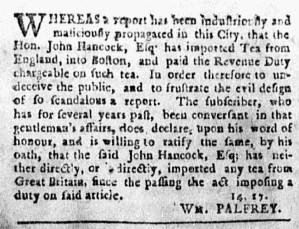
New-York Journal (December 23, 1773).

“John Hancock, Esq; has neither directly, or indirectly, imported any tea from Great Britain.”

As news of the Boston Tea Party reached New York and appeared in the December 23, 1773, edition of the New-York Journal, an advertisement in that newspaper took on new significance.  Starting on December 9 and continuing for four weeks, William Palfrey inserted an advertisement that addressed a “report [that] has been industriously and maliciously propagated in this City, that the Hon. John Hancock, Esq. has imported Tea from England, into Boston, and paid the Revenue Duty chargeable on such tea.”  Such rumors had the potential to tarnish the reputation of one of the merchants who had been most vocal in opposition to the provisions of the Tea Act, decrying Parliament’s attempts to meddle in affairs that he believed rightly belonged to colonial legislatures.

Palfrey, one Hancock’s clerks, took to the public prints to “undeceive the public, and to frustrate the evil design of so scandalous a report.”  He noted that he had “been conversant in that gentleman’s affairs” for “several years past” and, as a result, could vouch for Hancock.  In late 1773, many readers of the New-York Journal may not have been as familiar with the merchant as residents of Boston, though Hancock regularly appeared in articles reprinted from newspapers published in Massachusetts.  Five months before Palfrey’s advertisement appeared, the New-York Journal printed one of Governor Thomas Hutchinson’s letters from June 1768 that described the seizure of the Liberty, “a sloop belonging to Mr. Hancock, a wealthy merchant, of great influence over the populace,” for “a very notorious breach of the acts of trade.”  (The July 8, 1773, edition of the New-York Journal carried the entire letter and other private correspondence by the governor.)  Contrary to abiding by Parliament’s attempts to regulate colonial commerce and tax imported goods, Hancock had a history of smuggling tea and other items to avoid paying duties.  According to Palfrey, neither Hancock’s public position nor his private actions had changed.  The clerk declared “upon his word of honour” (and expressed his willingness to “ratify the dame, by his oath”) that Hancock had “neither directly, or indirectly, imported any tea from Great Britain, since the passing the act imposing a duty on said article” and most certainly had not paid import duties on tea.  As Jordan E. Taylor has recently demonstrated in Misinformation Nation: Foreign News and the Politics of Truth in Revolutionary America (2022), Patriots and Loyalists vied to establish narratives that fit their politics and their purposes, whether in newspapers, other printed materials, letters, or conversation.  That contest over the truth extended to advertisements, including Palfrey’s notice in the New-York Journal.