December 28

What was advertised in a revolutionary American newspaper 250 years ago today?
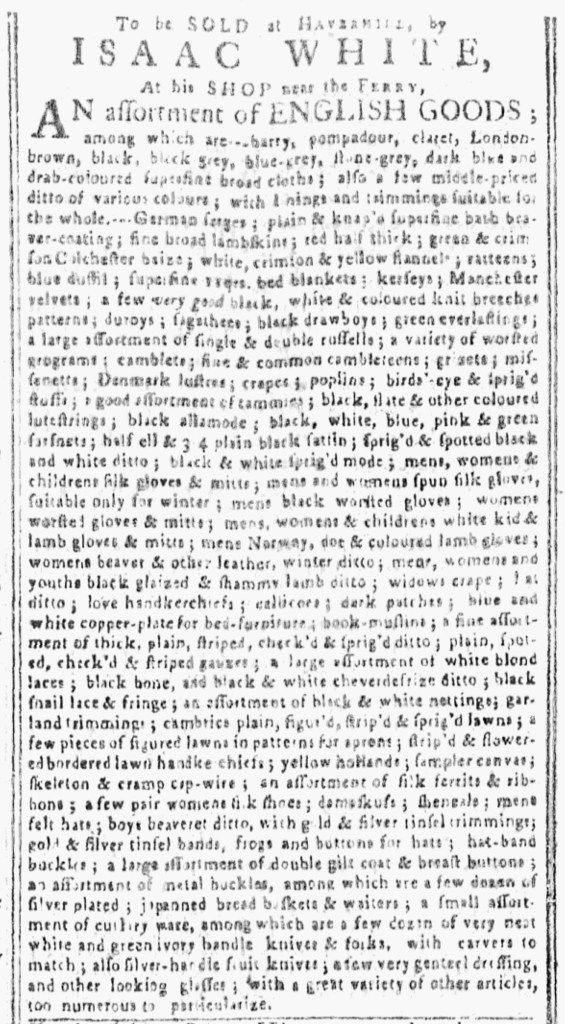
New-England Chronicle (December 28, 1775).

“AN assortment of ENGLISH GOODS … too numerous to particularize.”

Isaac White placed an advertisement for an “assortment of ENGLISH GOODS” available at “his SHOP near the FERRY” in Haverhill, Massachusetts, in the December 28, 1775, edition of the New-England Chronicle.  Despite the outbreak of hostilities at Lexington and Concord eight months earlier and the Continental Association remaining in effect, his advertisement looked much like those that so frequently appeared in American newspapers at times when colonizers did not attempt to use nonimportation agreements as political leverage in their contest with Parliament.  White listed dozens of items, including many varieties and colors of textiles, ribbons, “a large assortment of double gilt coat & breast buttons,” “a few very genteel dressing, and other looking glasses,” and “a small assortment of cutlery ware, among which are a few dozen of very neat white and green ivory handle knives & forks, with carvers to match.”  As if that was not enough, White concluded his catalog with a promise of “a great variety of other articles, too numerous to particularize.”

The shopkeeper did not mention when he acquired his merchandise, whether all those items arrived in the colonies before the Continental Association went into effect, yet he did rely on a familiar marketing strategy by presenting readers with an array of choices and inviting them to imagine themselves visiting his shop, examining his inventory, selecting the goods they desired, and displaying their style and taste to others after they made their purchases.  Consumption certainly had political dimensions during the imperial crisis, but even after the Revolutionary War began habits that had developed (and that advertisers like White had helped in cultivating) did not easily fade.  In the same issue of the New-England Chronicle, Martin Bicker ran an advertisement about a “fresh supply” of “ENGLISH GOODS … just received from New-York and Philadelphia … now selling off at his store in Cambridge.”  Though not as extensive as White’s notice, Bicker’s advertisement listed several kinds of textiles and handkerchiefs.  It concluded with “&c. &c. &c.”  Repeating the common abbreviation for et cetera made the same promise of even more items as White’s assertions about “a great variety of other articles, too numerous to particularize.”  In addition, Bicker declared, “Those that intend to purchase must speedily apply, otherwise they will be disappointed.”  He expected to do brisk business.

That colonizers continued consuming during the Revolutionary War does not necessarily merit attention.  After all, people needed goods.  Then as now, warfare disrupted commerce but did not eliminate it.  Yet the advertisements placed by White and Bicker did not suggest that they served customers who merely sought to purchase necessities.  Instead, they continued to cater to the desires of consumers who continued to shop for many of the reasons they did before the war began.  Some may have had a new purpose, seeking distractions from current events.  How readers responded, these advertisements do not reveal, yet they do indicate that White and Bicker saw opportunities for business as usual.
August 20

What was advertised in a colonial American newspaper 250 years ago today?

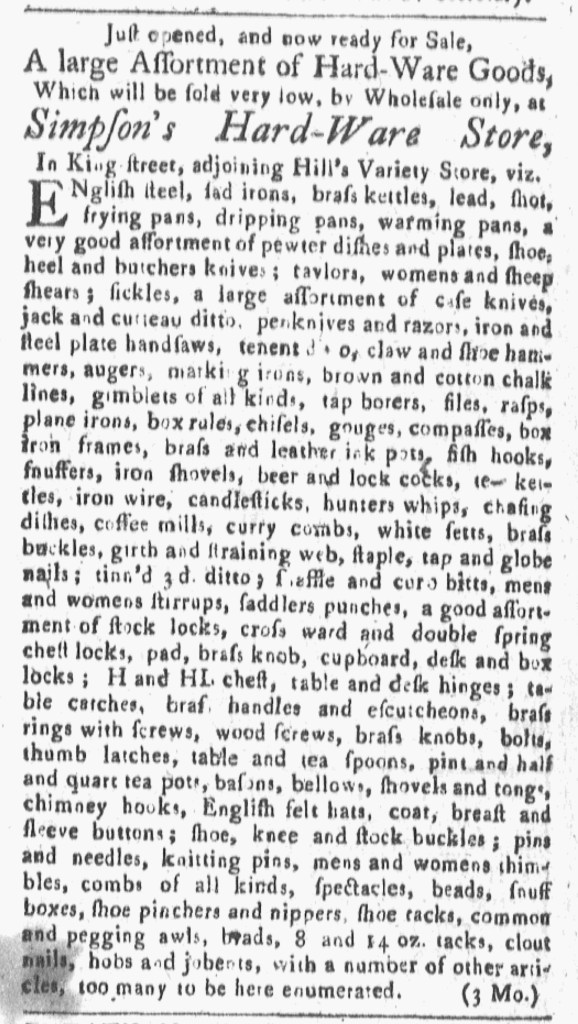
Providence Gazette (August 20, 1774).

Simpson’s Hard-Ware Store.”

As fall approached in 1774, a new advertisement in the Providence Gazette alerted the public that “Simpson’s Hard-Ware Store” had “Just opened” and offered a “large Assortment of Hard-Ware Goods” for “Wholesale only.”  Shopkeepers seeking to replenish their inventories could acquire merchandise there rather than place orders with merchants who would then import those goods.  The speed and convenience may have been especially attractive considering that many colonizers anticipated a general boycott on importing textiles, hardware, and all sorts of other items from England in response to the Coercive Acts passed by Parliament.  Delegates were already enroute to Philadelphia or arrived there to discuss a united response at what would become known as the First Continental Congress.

Simpson did not make explicit mention of politics, but doing so would not have been necessary for readers to understand the context in which he marketed his wares.  Several articles in the August 20 edition of the Providence Gazette provided coverage, in addition to the conversations, debates, and anxious musings taking place in private and public spaces throughout town.  Simpson instead focused on demonstrating the many choices he made available, just as his neighbor, Hill’s Variety Store, had done for many months.  His “Hard-Ware Store” stocked everything from “claw and shoe hammers” to “a good assortment of stock locks, cross ward and double spring locks” to Taylors, womens and sheep shears” to “a very good assortment of pewter dishes and plates,” far more than just hardware.  In addition to the items included in the extensive catalog in his advertisement, Simpson also carried “a number of other articles, too many to be here enumerated.”  If prospective customers could not find what they desired at Hill’s Variety Store they needed to check the shelves right next door at the hardware store.

A notation that read “(3 Mo.)” appeared at the end of Simpson’s advertisement, indicating that he intended for it to run for three months from its first insertion in the August 12 edition of the Providence Gazette.  He hoped to part with as much merchandise as possible by then, yet the anticipated longevity of his advertisement also testified to his confidence in its effectiveness.  After all, he would not have agreed to pay to run the notice so many times if he did not expect a return on his investment.  Perhaps he had been inspired by his neighbor, Hill, or even received advice from him after seeing his advertisement week after week for six months.

April 30

What was advertised in a colonial American newspaper 250 years ago today?

Providence Gazette (April 30, 1774).

“They desire their old Customers and others to call at their Shop.”

In the spring of 1774, Thurber and Cahoon advertised a “Variety of English and India GOODS” available at their shop “at the Sign of the Bunch of Grapes,” a familiar sight in Providence’s North End.  They stocked items “Just imported from London, in the Charlotte, Capt. Rogers.”  Merchants and shopkeepers often provided such information about the origins of their merchandise, allowing consumers to determine for themselves when they received their wares and whether items had been lingering on the shelves or in storerooms.  Thurber and Cahoon, veteran advertisers, first placed this notice in the April 30, 1774, edition of the Providence Gazette.  One of their competitors, Thomas Green, also received a shipment via the Charlotte.  His advertisement for a “large and general Assortment of English and India GOODS” opened with similar copy: “Just imported in the Charlotte, Capt. Rogers, from London.”

Thurber and Cahoon asserted that their new selection was “Suitable to the Season” and “consist[ed] of too many Articles to be enumerated in an Advertisement.”  Merchants and shopkeepers often made such claims, encouraging prospective customers to view the merchandise for themselves.  They promised an array of choices without going into details (and costing a lot more money for purchasing space in the newspaper).  In contrast, “HILL’s ready Money Variety Store” continued running an advertisement that filled an entire column because it “enumerated” so many of the items for sale there, yet the proprietor could not claim that his wares just arrived.  Thurber and Cahoon did spare a couple of lines for textiles, noting that they carried a “compleat Assortment of Calicoes, Chintz, Patches, Hollands, Dowlas, Bengals, Damascus, Gingham, &c.”  The common abbreviation for et cetera suggested even more textiles that Thurber and Cahoon considered “too many” for their advertisement.  They also mentioned several grocery items, including “Melasses, Sugar, Coffee, Tea, [and] Chocolate,” but did not specify when they received those items.  In particular, they did not give specifics about when and how they received their tea, leaving it to prospective customers to determine if they wished to purchase that item even after reading about the politics of tea elsewhere on the same page of that issue of the Providence Gazette.

In a nota bene, Thurber and Cahoon made a final appeal, one intended especially for their existing clientele.  “As they have taken great Pains to get their Assortment suitable to the Season” by acquiring goods consumers wanted or needed for late spring and the summer, the merchants declared, “they desire their old Customers and others to call at their Shop.”  They pledged good customer service, stating that visitors to Sign of the Bunch of Grapes “may depend on being served with Fidelity.”  They could also depend on finding bargains, paying the “lowest Rate” for goods, provided they paid in cash rather than credit.  Thurber and Cahoon incorporated a variety of marketing appeals into an advertisement that occupied a single “square” of space in the Providence Gazette.

January 22

What was advertised in a colonial American newspaper 250 years ago today?

Providence Gazette (January 22, 1774).

“Every other Article usually imported, too many to be enumerated in this Week’s Paper.”

The proprietor of “HILL’s Variety Store” at “the Sign of the ELEPHANT” advertised a “compleat Assortment of English, Scotch and India GOODS” in the January 22, 1774, edition of the Providence Gazette.  To incite interest in his wares, Hill proclaimed that he set prices “as low as can be purchased at any Shop or Store in Boston,” provided that customers paid cash rather than buying on credit.  Boston was a larger port that welcomed a greater number of vessels carrying imported goods, but that did not mean that shoppers there benefitted from better bargains than Hill made available in Providence.  The shopkeeper also listed several items, including several textiles, “new-fashioned Galloshes,” and “low-priced scarlet Broadcloths for Ladies Cloaks,” and promised “every other Article usually imported, too many to be enumerated in this Week’s Paper.”

That suggested that perhaps the printer, John Carter, abbreviated an advertisement received in the printing office due to lack of space.  Though that happened rarely, printers sometimes exercised such editorial discretion, especially when merchants and shopkeeper submitted their notices just before the newspaper went to press.  Alternately, Hill may not have prepared a longer advertisement intended for the January 22 edition but instead wanted to alert local consumers that his “Variety Store” was open for business, planning to compose an advertisement with a more complete inventory in time for the next issue.  On January 29, however, a slightly revised notice ran in the Providence Gazette.  The list of merchandise now concluded: “with every other Article usually imported, Wholesale and Retail.”  The same copy appeared on February 5.

It was not until February 12 that a longer advertisement ran in the Providence Gazette.  That one featured a far greater number of items, divided into two columns, that extended nearly an entire column.  In addition to listing dozens of items, it revised the name of the business to “HILL’s ready Money Variety Store,” underscoring that the proprietor did not allow credit.  The sequence of these advertisements suggests that it was not lack of space that resulted in the note about “too many [items] to be enumerated in this Week’s Paper” the first time the notice ran.  Hill may have had grand designs for updating his advertisement soon after it first appeared, but did not do so.  Once he submitted the copy, however, the longer advertisement ran for six consecutive weeks before he updated it once again on March 26, that time adding a woodcut depicting an elephant to match the sign that marked the location of the “ready Money Variety Store.”  The Adverts 250 Project will feature that advertisement in a future entry.