December 5

What was advertised in a revolutionary American newspaper 250 years ago today?

New-Hampshire Gazette (December 5, 1775).

“Shopkeepers are cautioned, not to advance on their Goods, which is contrary to the Resolves of the Continental Congress.”

The December 5, 1775, edition of the New-Hampshire Gazette consisted of only two pages rather than the usual four.  That limited the amount of news and advertising that the printer, Daniel Fowle, could disseminate to readers, yet that issue carried good news that the “Printing Press is now again removed from Greenland to Portsmouth.”  Fowle had moved his press to Greenland, about six miles from Portsmouth, to protect it from an anticipated British attack on New Hampshire’s most important port.  In early December, he moved his press back to Portsmouth, “into an old Building adjoining the late Printing-Office … where it is hop’d the Types will remain undisturb’d, as this Harbour is so well fortified that any Enemy must pass thro’ a Hell of Fire, intermix’d with Brimstone, Pitch Tar, Turpentine, and almost every Sort of Combustible Matter to make the Passage dreadful.”

Yet enemies to the American cause did not approach Portsmouth solely by sea.  Some enemies resided in the port and nearby towns, undermining efforts to resist British tyranny through their actions in the marketplace rather than on the battlefield.  At the bottom of the last column on the last page, Fowle concluded that issue of the New-Hampshire Gazettewith a warning published “By desire” of a correspondent that “Shopkeepers are cautioned, not to advance on their Goods, which is contrary to the Resolves of the Continental Congress.”  The correspondent invoked the ninth article of the Continental Association, a nonimportant agreement devised by the First Continental Congress that went into effect on December 1, 1774.  That article stated that “such as are Venders of Goods or Merchandise will not take Advantage of the Scarcity of Goods that may be occasioned by this Association, but will sell the same at the Rates we have been respectively accustomed to do for twelve months past.”  Some shopkeepers in and near Portsmouth apparently considered charging an “Advance” (or markup) on their wares, prompting the patriotic correspondent to remind them of the Continental Association and the consequences they faced.  That would be their only warning because “if they do [raise prices], their Names will be return’d to the Congress ad publish’d, without further Notice.”  Once that happened, the ninth article specified that “if any Venders of Goods or Merchandise shall sell any such Goods on higher Terms … no Person ought, nor will any of us deal with any such Person … at any Time thereafter, for any Commodity whatever.”  That issue carried only two advertisements from local retailers, yet the address applied to all the shopkeepers in the vicinity.
August 31

What was advertised in a colonial American newspaper 250 years ago today?

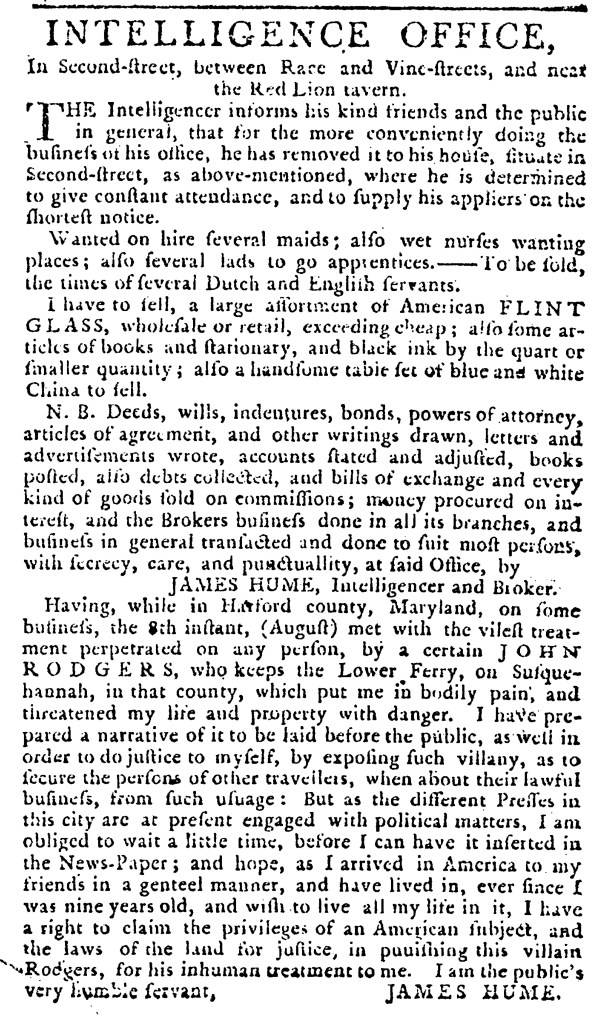
Pennsylvania Journal (August 31, 1774)

“The vilest treatment perpetrated on any person … threatened my life and property with danger.”

Eighteenth-century advertisers often used the space they purchased in newspapers to pursue multiple purchases.  Merchants and shopkeepers, for instance, frequently devoted most of their advertisements to promoting goods for sale and then pivoted to calling on former customers to settle accounts.  Sometimes the aims of the different portions of advertisements did not seem related at all.  J. Musgrave devoted half of his advertisement in the August 31, 1774, edition of the Pennsylvania Gazette to leasing his “Wet and Dry Goods Houses and Stores” to merchants and the other half to buying and selling horses.

On the same day, James Hume published a lengthy advertisement with two very different purposes in the Pennsylvania Journal.  The headline declared, “INTELLIGENCE OFFICE.”  The broker described the various services he provided, including drawing up “Deeds, wills, indentures, bonds, powers of attorney, [and] articles of agreement.”  He had “wet nurses wanting places” as well as “several lads to go apprentices.”  He recorded and settled accounts, sold goods on commission, and even wrote advertisements on behalf of his clients.  Rather than focus exclusively on his work as an “Intelligencer and Broker,” Hume used his access to the public prints to air a grievance against John Rodgers, “who keeps the Lower Ferry on Susquehannah” in Harford County, Maryland.  According to the Hume, he was the victim of “the vilest treatment perpetrated on any person … which put me in bodily pain, and threatened my life and property with danger.”  Following that ordeal, he “prepared a narrative of it to be laid before the public,” which he depicted as a service to the public.  By “exposing such villainy” and warning others about Rodgers, he hoped to “secure the persons of other travellers, when about their lawful business, from such usage.”

Yet his intentions had been thwarted so far because “the different Presses in this city are at present engaged with political matters.”  Hume had apparently shopped around to Dunlap’s Pennsylvania Packet, the Pennsylvania Gazette, and the Pennsylvania Journal, but none of the printers chose to accept his narrative for publication in their newspapers.  Whatever their reasons for rejecting it, they invoked current events as justification.  In recent months the imperial crisis intensified as the colonies received word of the Boston Port Act, the Massachusetts Government Act, and the other Coercive Acts passed as punishment for the Boston Tea Party.  Parliament sought to restore order, but many colonizers believed their liberties as English subjects were under attack.  For his part, Hume had his own concerns about his “right to claim the privileges of an American subject, and the laws of the land for justice, in punishing this villain Rodgers, for his inhuman treatment to me.”  That incident, however, did not rise to the level that printers in Philadelphia gave priority to publishing it.  Hume circumvented their editorial decisions, at least in part, by including his allegations against Rodgers in a paid notice, thus raising an alarm that others needed to be cautious when interacting with the ferry operator.

March 11

What was advertised in a colonial American newspaper 250 years ago today?

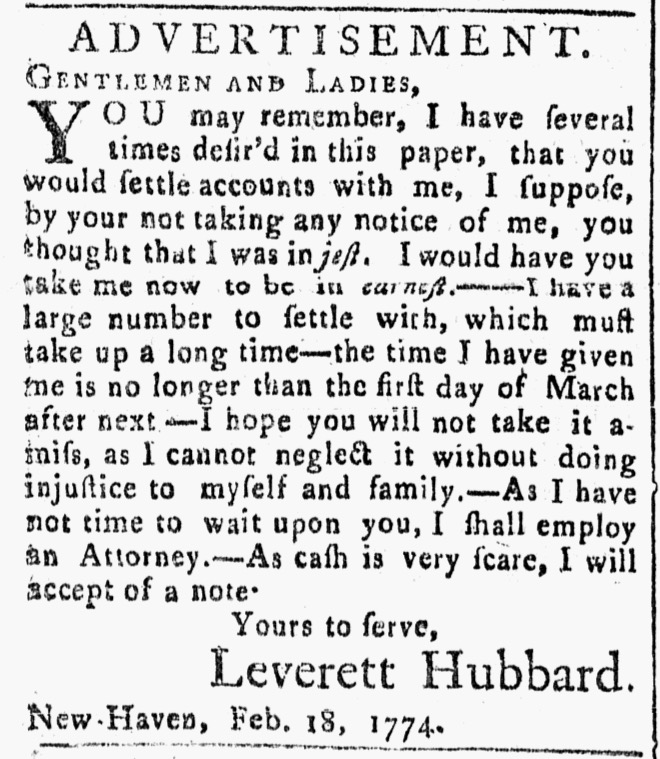
Connecticut Journal (March 11, 1774).

“You thought that I was in jest.  I would have you take me now to be in earnest.”

Leverett Hubbard was not amused.  He made his displeasure known in an advertisement that first appeared in the Connecticut Journal on February 18, 1774, and continued for several weeks.  Perhaps he grew even more frustrated each time that it appeared and those he addressed continued to ignore his call for them to settle accounts.

Hubbard used “ADVERTISEMENT” as a headline for his notice, an unusual opening line.  In this instance, he likely deployed the word according to one of its earliest meanings, one largely obsolete as use of “advertisement” has evolved.  The Oxford English Dictionary gives this definition: “the action or an act of calling the attention of someone; (an) admonition, warning, instruction.”  In a few sentences, Hubbard delivered an admonition, issued a warning, and gave instructions.

“YOU may remember,” he confided to the “GENTLEMEN AND LADIES” he addressed, “I have several times desir’d in this paper, that you would settle accounts with me.”  Such notices regularly appeared in newspapers throughout the colonies, but Hubbard composed lively copy for this “ADVERTISEMENT.”  Sarcastically, he opined, “I suppose by your not taking any of me, you thought that I was in jest.  I would have you take me now to be in earnest.”  Following that admonition, Hubbard gave instructions to settle accounts by “the first day of March.”  He concluded with a warning to his “large number [of colonizers] to settle with,” declaring that since he did not have “time to wait upon you, I shall employ an Attorney.”  Others who placed similar notices sometimes resort to that threat.

Hubbard departed from the formulaic language reiterated from one advertisement to another, perhaps hoping that a more emphatic approach, demonstrating that made his appeal “in earnest” rather than “in jest,” would convince those with open accounts who had ignored his previous notices that it was indeed in their best interests to heed this advertisement with its admonition, instructions, and warning.

July 26

What was advertised in a colonial American newspaper 250 years ago today?

Jul 26 - 7:26:1769 Georgia Gazette
Georgia Gazette (July 26, 1769).

“Who has for sale, all sorts of garden seeds and flower roots.”

Colonists placed advertisements in newspapers for a variety of reasons. Some marketed consumer goods and services. Many published legal notices. Others made announcements and shared news. In the July 26, 1769, edition of the Georgia Gazette, for instance, John Martin and James Martin advertised rum, wine, and sugar available at their store on Habersham’s Wharf in Savannah. Morgan and Roche also addressed consumers, informing them that they pursued “the TAYLOR BUSINESS in all its branches.” Among the legal notices, the executors of John Luptan’s estate announced that they would conclude settling accounts and “pay out what remains … to the heirs” on January 1. Another from the Commissioners of his Majesty’s Customs warned about the consequences of smuggling and doctored ship manifests that did not make “true reports of their cargoes.” James Wilson declared that his wife, Jane, “eloped” from him and since she placed herself beyond the authority of his household he would not pay “any debts of her contracting.” Among advertisements that also delivered news, the Trustees for the Presbyterian Meeeting House advised those who pledged to make contributions that “one fifth of the subscription money is immediately wanted” and requested payment. Another stated that “SIX NEGROES … three men, two women, and one girl” escaped from Thomas Young and might be headed towards some of the Sea Islands.

Each of those advertisers had a specific purpose in mind when placing their notices in the public prints, but other advertisers used the space they purchased to pursue more than one goal. Robert Hunter, for example, asserted that recently “several trespasses” occurred at Good Hope and Spring Gardens. To prevent further disturbances and theft, Hunter advised the public that intruders could expect to encounter “guns, dogs, or other snares.” Only after delivering this warning did Hunter briefly promote “all sorts of garden seeds and flower roots” that he offered for sale, a secondary purpose for his advertisement. A similar advertisement ran in the Georgia Gazette a year earlier, that one also lamenting trespassers and theft at Spring Gardens and signed by Robert Winter. It also concluded with a brief note that “Said Winter has all sorts of garden seeds to dispose of.” (Perhaps either “Robert Hunter” or “Robert Winter” was a misprint in one of the advertisements.) In both instances, the advertiser seized an opportunity to encourage sales of seeds, drawing attention to that enterprise after first rehearsing an interesting story about trespassers and threats of “guns, dogs, or other snares.” Stories of intruders and theft implicitly testified to the value of the plants at Good Hope and Spring Gardens, making the seeds all the more attractive to prospective buyers. Hunter leveraged unfortunate events in his efforts to encourage sales.