
What was advertised in a colonial American newspaper 250 years ago today?
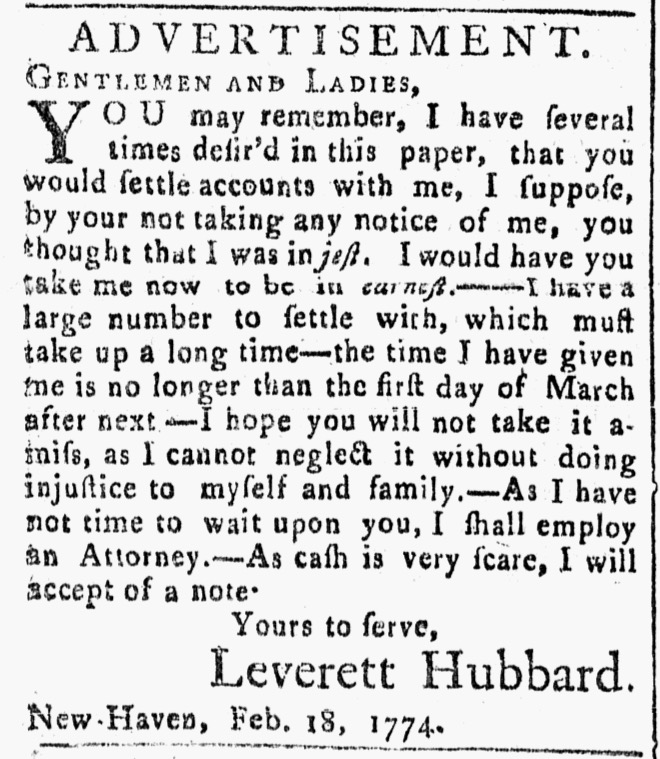
“You thought that I was in jest. I would have you take me now to be in earnest.”
Leverett Hubbard was not amused. He made his displeasure known in an advertisement that first appeared in the Connecticut Journal on February 18, 1774, and continued for several weeks. Perhaps he grew even more frustrated each time that it appeared and those he addressed continued to ignore his call for them to settle accounts.
Hubbard used “ADVERTISEMENT” as a headline for his notice, an unusual opening line. In this instance, he likely deployed the word according to one of its earliest meanings, one largely obsolete as use of “advertisement” has evolved. The Oxford English Dictionary gives this definition: “the action or an act of calling the attention of someone; (an) admonition, warning, instruction.” In a few sentences, Hubbard delivered an admonition, issued a warning, and gave instructions.
“YOU may remember,” he confided to the “GENTLEMEN AND LADIES” he addressed, “I have several times desir’d in this paper, that you would settle accounts with me.” Such notices regularly appeared in newspapers throughout the colonies, but Hubbard composed lively copy for this “ADVERTISEMENT.” Sarcastically, he opined, “I suppose by your not taking any of me, you thought that I was in jest. I would have you take me now to be in earnest.” Following that admonition, Hubbard gave instructions to settle accounts by “the first day of March.” He concluded with a warning to his “large number [of colonizers] to settle with,” declaring that since he did not have “time to wait upon you, I shall employ an Attorney.” Others who placed similar notices sometimes resort to that threat.
Hubbard departed from the formulaic language reiterated from one advertisement to another, perhaps hoping that a more emphatic approach, demonstrating that made his appeal “in earnest” rather than “in jest,” would convince those with open accounts who had ignored his previous notices that it was indeed in their best interests to heed this advertisement with its admonition, instructions, and warning.