April 3

What was advertised in a revolutionary American newspaper 250 years ago today?

“M‘Knight’s Harmony of the
Duhamel’s Husbandry     (Gospel.”
Connecticut Journal (April 3, 1776).

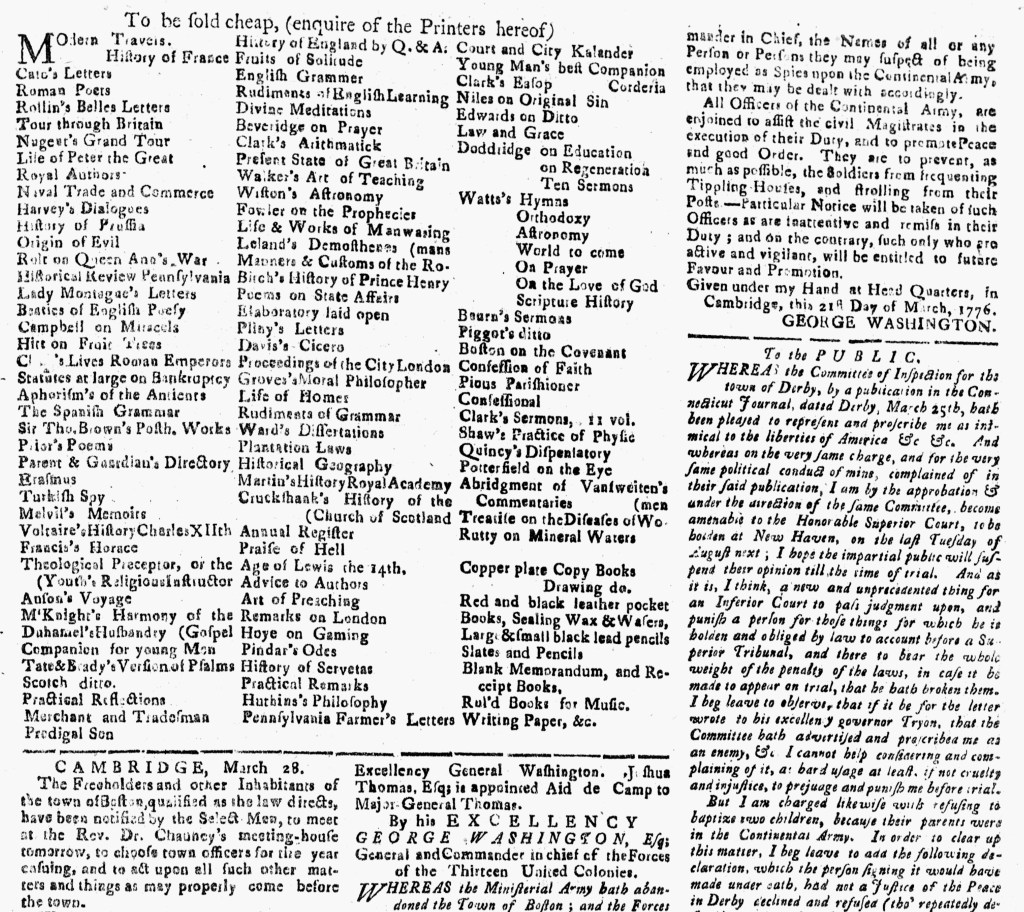
Like other printers throughout the colonies, Thomas Green and Samuel Green, the printers of the Connecticut Journal, stocked and sold an array of imported books, pamphlets, and other merchandise.  Beyond newspaper subscriptions and advertisements and job printing, they cultivated other revenue streams.  As newspaper printers, the Greens had ready access for promoting their wares, doing so, for instance, with an oversized advertisement in the April 3, 1776, edition of the Connecticut Journal.
Connecticut Journal (April 3, 1776).

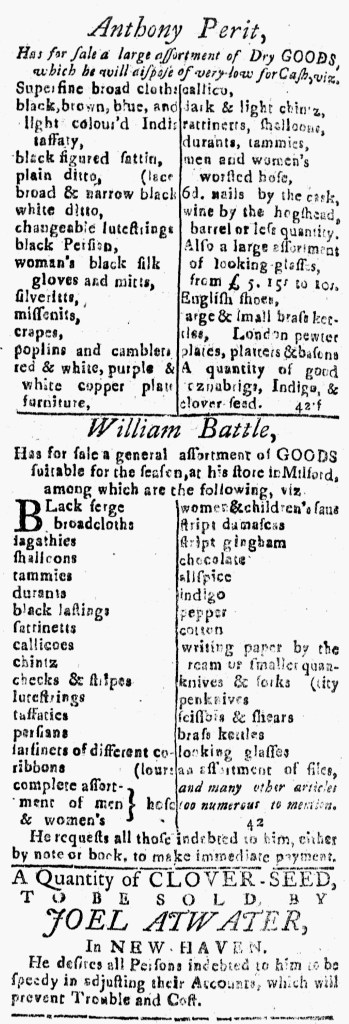
Listing dozens of titles, that advertisement dominated the third page.  The format distinguished it from any other, extending across two columns in the upper left corner, yet the columns within the advertisement did not align with the rest of the columns in the newspaper.  Rather than the standard width, the Greens used three narrow columns.  They listed one title per line, leaving white space that made it easier for readers to navigate their notice than if they had resorted to a paragraph of dense text.  A couple of advertisements on the facing page received similar treatment.  Anthony Perit’s advertisement for a “large assortment of Dry GOODS” and William Battle’s advertisement for a “general assortment of GOODS suitable for the season” each had their inventory arranged in two columns with a line running down the center, but those notices did not exceed the standard width for the newspaper.  On the other hand, either the Greens or a compositor who set the type realized that one title per line in the catalog of books and pamphlets available at their printing office in New Haven would leave too much white space.  As a matter of both efficiency and design, their advertisement thus featured a format that distinguished it from others.

That efficiency included limiting the number of lines and the overall space required for the advertisement.  Near the bottom of the first column, an incomplete entry for “M‘Knight’s Harmony of the” concluded at the end of the next entry for “Duhamel’s Husbandry” with “(Gospel.”  The complete entry listed M‘Knight’s Harmony of the Gospel.”  The “(” signaled to readers that “Gospel” belonged with either the previous or the following entry.  Similarly, about one third of the way down the second column, an incomplete entry for “Manners & Customs of the Ro-” concluded with “(mans” on the line above and an incomplete entry for “Treatise on the Diseases of Wo-” near the bottom of the final column concluded with “(men” at the end of the previous line.  While not always elegant, the format enhanced the visibility of the advertisement the printers ran to promote book sales.
March 6

What was advertised in a revolutionary American newspaper 250 years ago today?

Pennsylvania Gazette (March 6, 1776).

“Whoever doth him safely secure, / Of a reward they may be sure.”

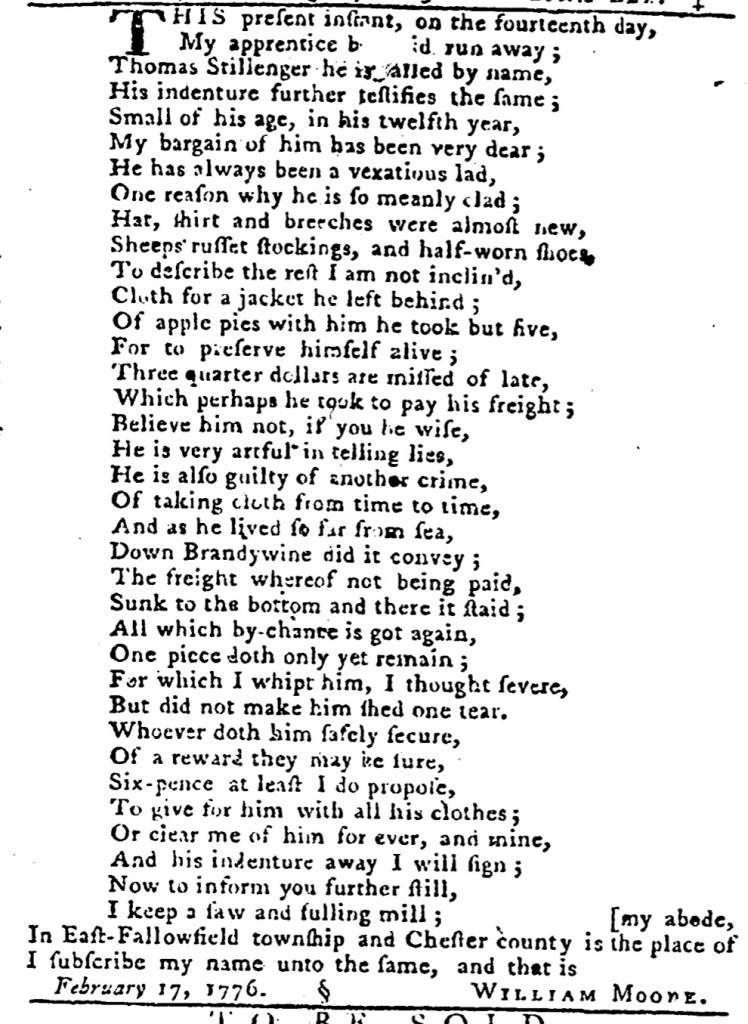
William Moode wanted to increase the chances that his advertisements about his runaway apprentice attracted attention when he ran it in the March 6, 1776, edition of the Pennsylvania Gazette.  Instead of the usual paragraph of dense text he composed more than a dozen rhyming couplets that told the story of the young rascal: “Thomas Stillenger he is called by name, / His indenture further testifies the same.”

As Moode told it, Stillenger had never been an ideal apprentice (“He has always been a vexatious lad, / One reason he is so meanly clad”) but instead a troublemaker who told lies (“Believe him not, if you be wise, / He is very artful in telling lies”) and stole goods from the fulling mill that Moode operated (“He is also guilty of another crime, / Of taking cloth from time to time”).  Punishing him, Moode claimed, had no effect (I whipt him, I thought severe, / But did not make him shed one tear”), though perhaps it played a part in Stillenger’s decision to run away.  Like other aggrieved masters of runaway apprentices and indentured servants, Moode offered a reward for capturing and returning the boy (“Whoever doth him safely secure, / Of a reward they may secure”), though he also indicated his willingness to be rid of Stillenger if anyone would purchase his remaining time (“Or clear me of him for ever, and mine, / And his indenture away I will sign”).

When setting the type, the compositor indented all but the last two lines of the poem, creating a significant amount of white space along the left side of the advertisement.  Most lines ended far short of the right side of the column rather than being justified too it like other advertisements.  That allowed for even more white space that distinguished Moode’s advertisement from all the other news and notices in that issue of the Pennsylvania Gazette.  That likely drew attention.  Readers may have become even more intrigued when they saw the rhyming couplets.  Although the Pennsylvania Gazettewas not one of them, some newspapers had a regular feature, the “Poet’s Corner” on the final page, with poems of no better quality than the one Moode wrote.  Readers may have taken note of the advertisement for its novelty and entertainment value.  For his part, Moode may have derived more pleasure from writing this poem than from any of his interactions with Stillenger when the apprentice worked in his mill.

July 10

What was advertised in a colonial American newspaper 250 years ago this week?

Rivington’s New-York Gazetteer (July 10, 1774).

“Fashionable silver, and metal shoe buckles.”

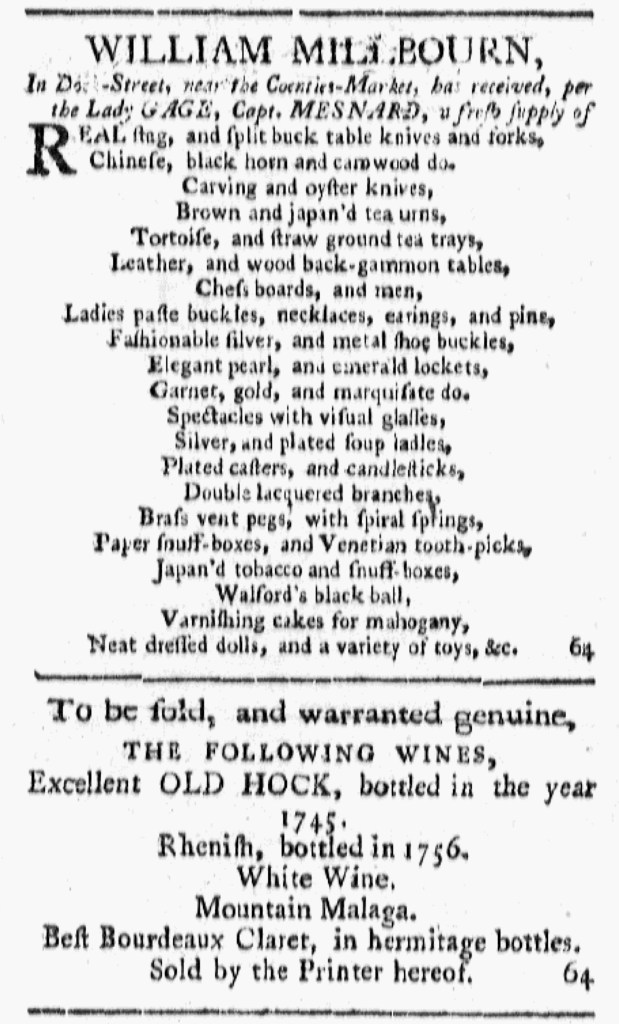
Like other merchants and shopkeepers who advertised imported goods for sale in the July 7, 1774, edition of Rivington’s New-York Gazetteer, William Millbourn listed many of his wares to give consumers a sense of the array of choices available to them.  Yet Millbourn’s advertisement had a different format than most others in that issue.  In the process of giving an inventory of everything from “Carving and oyster knives” to “Chess boards, and men” to “Paper snuff-boxes, and Venetian tooth-picks” to “neat dressed dolls, and a variety of toys,” he named only two or three related items on each line and centered each line.  That gave Millbourn’s advertisement a distinctive appearance with white space on the left and right, ebbing and flowing depending on the length of each line.

Other advertisers deployed other design elements to draw attention to their notices.  James Webb adorned his advertisement for “FRENCH BURR MILL-STONES” with a woodcut depicting a millstone.  Others used headlines in much larger font than the rest of their copy, such as “MUSIC,” “BULL-BAITING,” “NEW RICE,” and “CHINA, GLASS, AND Earthen Ware.”  Below their headline for “IRISH LINENS,” Woodward and Kip gave descriptions in two columns, including “Purple, blue and red copperplate furniture calicoes” and “Black, blue, brown, green, yellow, straw-colour, crimson, garnet, pink and purple moreens.”  Most entries ran two or more lines, with the second and subsequent lines indented and all lines justified on the right.  The indentations introduced some white space into what would have been a dense paragraph, the method that John Haydock used for listing his wares.  Still, the format of Millbourn’s advertisement included much more white space than most others.  He likely submitted instructions concerning how he wished his advertisement to appear along with the copy.

The compositor, either James Rivington himself or someone working in his printing office, apparently liked the look of Millbourn’s advertisement and decided to apply it to a notice about “THE FOLLOWING WINES … Sold by the Printer hereof.”  Both had their initial appearance in the July 7 edition, the advertisement for wine running immediately below Millbourn’s notice.  That suggests that the compositor set the type for one right after the other.  Rather than competing with Millbourn’s advertisement, the second advertisement may have helped focus attention on both notices by extending the unusual use of white space, especially since paragraphs with little white space ran on the right and left as well as above and below.  The distinctiveness of the format had the potential to incite curiosity, increasing the chances that readers engaged with Millbourn’s advertisement.