March 25

What was advertised in a colonial American newspaper 250 years ago today?
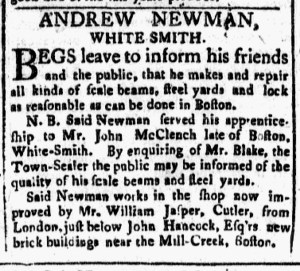
Massachusetts Spy (March 25, 1773).

“By enquiring of Mr. Blake, the Town-Sealer the public may be informed of the quality of his scale beams and steel yards.”

Andrew Newman offered his services as a whitesmith in an advertisement in the March 25, 1773, edition of the Massachusetts Spy.  In addition to the usual sort of work undertaken by that trade, such as filing, lathing, burnishing, and polishing iron and steel, Newman declared that he “makes and repair[s] all kinds of scale beams, steel years and lock[s].”  Furthermore, he confidently stated that customers would find the quality and prices for such work “as reasonable as can be done in Boston.”

Many artisans included some sort of reference to their credentials, whether formal training or long experience, in their newspaper notices.  Newman did so in a nota bene.  He advised the public that he “served his apprenticeship to Mr. John McClench late of Boston, White-Smith.”  Newman likely hoped that colonizers who previously patronized McClench or were familiar with his reputation would consider hiring McClench’s former apprentice.  Even for those who did not know of McClench, Newman figured that giving information about completing an apprenticeship in the city recommended him to prospective customers.

He also encouraged them to consult “Mr. Blake, the Town-Sealer,” for an endorsement.  According to Newman, “the public may be informed of the quality of his scale beams and steel yards” when speaking with that local official.  Prospective customers did not have to rely on Newman’s word alone; instead, they could learn more and ask questions of a third party that they might consider neutral and thus more trustworthy when it came to assessing the materials that Newman produced and sold.  Short of a testimonial inserted in his advertisement, Newman likely considered such referrals the next best option.

Throughout the colonies, artisans often highlighted their credentials in their advertisements.  In his efforts to bolster his business, Newman did so, incorporating two strategies.  First, he gave details about his apprenticeship, hoping that his training with McClench would resonate with prospective customers familiar with his former master’s work.  Then, he directed the public to a local official who could provide an endorsement of Newman’s own skill and the quality of the items he made in his workshop.  Invoking both McClench and Black enhanced Newman’s assertions about the quality of his work.

July 13

What was advertised in a colonial American newspaper 250 years ago today?

New-York Gazette and Weekly Mercury (July 13, 1772).

“All sorts of knives and forks, pocket and penknives.”

Lucas and Shephard, “WHITESMITHS and CUTLERS, From BIRMINGHAM and SHEFFIELD,” enhanced their advertisement in the July 13, 1772, edition of the New-York Gazette and Weekly Mercury with a woodcut that depicted many of the items they made and sold at their new location in “the shop lately occupied by Messrs. Bailey and Youle.” Lucas and Shephard provided an extensive list of their wares, making the combination of words and image an eighteenth-century precursor to the illustrated catalogs that so significantly shaped consumer culture in the second half of the nineteenth century.

Lucas and Shephard followed the lead of other cutlers in New York.  Previously, Bailey and Youle adorned their own advertisements with a woodcut that depicted more than a dozen items they produced in the shop.  When the partnership dissolved, James Youle retained the woodcut, modified it to remove his former partner’s name, and inserted it in advertisements in the New-York Gazette and Weekly Mercury in June and July 1772.  Lucas and Shepard began running their advertisement two weeks after Youle’s notice ran on June 29.  It was not the first time that the woodcut that accompanied one of Youle’s advertisements may have inspired imitation.  In April 1771, Richard Sause ran advertisements with a woodcut that showed all sorts of cutlery items that he made at his shop just a few weeks after Bailey and Youle’s notice appeared in the public prints.  A sword and a table knife even bore his name, suggesting that he marked his work in some manner.

Like those cutlers who placed advertisements before them, Lucas and Shephard deployed a variety of appeals to entice prospective customers.  They emphasized their skill, promising “great accuracy” in their work, and a “reasonable price.”  They also made a nod to customer services, pledging to “carry on their business with dispatch” in order “to give satisfaction to all who may please to employ them.  The image increased the likelihood that readers would take note of their advertisement, especially considering Youle continued running his own advertisements with depictions of his cutlery ware.  Lucas and Shephard may have considered their own woodcut imperative for competing with Youle, a necessary investment when they chose to advertise in a newspaper in which he already established visibility for his shop.