January 31

What was advertised in a colonial American newspaper 250 years ago today?
South-Carolina Gazette and Country Journal (January 31, 1775).

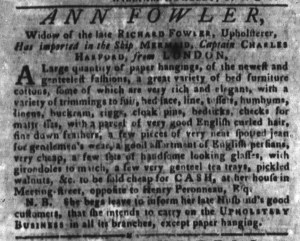
“She intends to carry on the UPHOLSTERY BUSINESS in all its branches, except paper hanging.”

Ann Fowler, “Widow of the late RICHARD FOWLER, Upholsterer,” took to the pages of the South-Carolina Gazette and Country Journal to advertise a variety of merchandise that she sold out of her house on Meeting Street in Charleston.  She indicated that she imported her wares “in the Ship MERMAID, Captain CHARLES HARFORD, from LONDON,” a vessel that arrived in port on December 29, 1774, according to the list of “ENTRIES INWARDS” at the custom house published in the January 3, 1775, edition of the South-Carolina Gazette and Country Journal.  Those goods should have fallen under the jurisdiction of the Continental Association.  Nevertheless, Fowler hawked a “Large quantity of paper hangings, of the newest and genteelest fashions, a great variety of bed furniture cottons, some of which are very rich and elegant, with a variety of trimmings to suit, [and] a few sets of handsome looking glasses, with girandoles to match.”  The widow was not the only advertiser who placed notices about imported goods that looked the same as those published before the Continental Association went into effect.

Fowler appended a nota bene to “inform her late Husband’s good customers, that she intends to carry on the UPHOLSTERY BUSINESS in all its branches, except paper hanging.”  Widows often took over the family business in colonial America, sometimes doing the same tasks their husbands had done and sometimes supervising employees.  Even though Ann had not been the public face of the enterprise while Richard still lived, she likely had experience assisting him in his shop and interacting with any assistants that he hired.  She hoped that she and her husband had cultivated relationships that would allow her to maintain their clientele, though they would have to look elsewhere when it came to “paper hanging” or installing wallpaper.  Fowler sold papers hangings “of the newest and genteelest fashions,” but her customers needed to contract with someone else to paste them up.  That may have been because she lacked experience with that aspect of the family business, her role having been primarily in the shop.  On the other hand, perhaps she felt comfortable doing all sorts of upholstery work in the shop, a semi-public space that now belonged to her, but she did not consider it appropriate to enter the private spaces of her customers, especially male clients who lived alone.  As a female entrepreneur, Fowler may have attempted to observe a sense of propriety that the public would find acceptable.  Whether or not Fowler had prior experience installing paper hangings, she constrained herself in discontinuing that service following the death of her husband.
December 11

What was advertised in a colonial American newspaper 250 years ago this week?

Supplement to the New-York Journal (December 8, 1774).

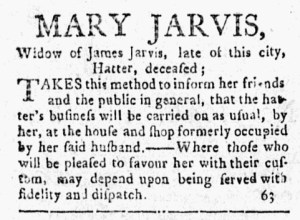
“The hatter’s business will be carried on as usual, by her.”

Mary Jarvis assumed responsibility for the family business following the death of her husband, James, a hatter.  In an advertisement that ran in the New-York Journal for several weeks in November and December 1774, she “inform[ed] her friends and the public and general, that the hatter’s business will be carried on as usual, by her, at the house and shop formerly occupied by her said husband.”  Like many others who advertised goods and services in colonial newspapers, she promised that “those who will be pleased to favour her with their custom, may depend upon being served with fidelity and dispatch.”  Jarvis may have consulted with John Holt, the printer, on the wording for her notice when she made arrangements for its publication, though that may not have been necessary.  Considering that she knew enough about the enterprise to continue its operations following the death of her husband, she may very well have been familiar enough with the usual contents of newspaper advertisements to compose it herself.  In addition, she could have perused similar notices many times as a consumer and learned for herself what they should contain.

The widow’s role in the business changed following the death of her husband, yet she likely had experience with many of the tasks from assisting him over the years.  When she declared that “the hatter’s business will be carried on as usual, by her,” she suggested that she did the work herself rather than managing employees previously affiliated with the business or hired after her situation changed.  Although James had been the public face of the venture, Mary no doubt made valuable contributions and learned much about the trade.  She sought to leverage that knowledge to support herself through her own industry, joining many other women – milliners and seamstresses – in the garment trades.  Historian Laurel Thatcher Ulrich distinguishes between what was probable for women and what was possible for women in early America.  In this case, Jarvis embodied both.  It was probable that she assisted James in his business as a “deputy husband” (a concept developed by Ulrich) and that made it possible for her to work as a hatter in her own right when circumstances demanded.

January 17

GUEST CURATOR:  David Alexander

What was advertised in a colonial American newspaper 250 years ago today?

Boston Evening-Post (January 17, 1774).

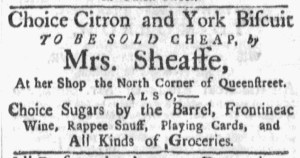
TO BE SOLD CHEAP, by Mrs. Sheaffe.”

Mrs. Sheaffe placed this advertisement in the Boston Evening-Post.  She ran a shop where she sold a variety of items, including choice citron (referring to citrus fruits), sugar, wine, and “All Kinds of Groceries.” Mrs. Sheaffe ambitiously invested to integrate herself into life as a businessowner as her advertisements appear twice in Massachusetts newspapers during the week of January 14-20, 1774, appearing in both the Boston Evening-Post and the Boston-Gazette. According to Gloria Main in “Gender, Work, and Wages in Colonial New England,” most women in retailing were widows who had taken over a deceased husband’s shop.”[1]  As this woman went by “Mrs. Sheaffe” it is likely that she was a widow and opened her shop to support herself and her family. Mrs. Sheaffe’s investments in advertising her shop in multiple newspapers demonstrates her industriousness and desire to establish herself as a businessowner of Boston. During the Revolutionary Era, the role of women in business extended far beyond just buying goods, many of them acting as retailers themselves.

**********

ADDITIONAL COMMENTARY:  Carl Robert Keyes

David convincingly suggests that Mrs. Sheaffe may have been a widow responsible for supporting herself and perhaps others in her household.  When other female entrepreneurs placed advertisements in newspapers published in Boston, they tended to use their full names, just as their male counterparts did.  Mrs. Sheaffe’s decision to go by “Mrs. Sheaffe” may have been intended to remind those who knew her of her circumstances as a widow.  She may have also meant for that to justify her role in the marketplace as a shopkeeper rather than as a consumer.  Although some women ran businesses, as their advertisements attest, doing so was often depicted as a masculine endeavor, one better suited to men than women.

Mrs. Sheaffe attained a certain level of visibility in Boston, thanks in part to her frequent advertisements.  Other women certainly assisted in running family businesses, even when they were not considered proprietors or mentioned in advertisements.  When Herman Brimmer and Andrew Brimmer advertised “An Assortment of Mens, Womens & Childrens Hose” and other garments in the same edition of the Boston Evening-Post that Mrs. Sheaffe promoted her wares, they sought female customers, recognizing the role that women played as consumers.  Their advertisement, like so many others, may have hidden the role that wives, daughters, and other female relations played in helping to run their shop “next Door to the Sign of the Lamb.”

Other female entrepreneurs did not achieve the same visibility in the marketplace as Mrs. Sheaffe because women were less likely to place newspaper advertisements compared to men who ran businesses.  That same issue of the Boston Evening-Post included a notice calling on “All Persons indebted to the Estate of the late Mrs. Ruth Sinclair, Shopkeeper,” to settle accounts.  According to a list of recent deaths in the December 27, 1773, edition of the Boston Evening-Post, she was the “Widow of the late Capt. Sinclair.”  He died thirteen years earlier, a notice about settling his estate in the August 25, 1760, edition of the Boston-Gazette listing his widow as “sole Executrix.”  Although she was apparently known to residents of Boston as a shopkeeper, Ruth Sinclair did not publish any advertisements.  Instead, she may have relied on foot traffic and recommendations from loyal customers.

Mrs. Sheaffe was not alone as a proprietor of her own business during the era of the American Revolution.  Other women ran businesses and an even greater number participated in the marketplace as more than consumers, assisting in shops run by husbands, fathers, brothers, and others.  Yet Mrs. Sheaffe did make her role as a female entrepreneur much more visible in the public prints than most other women.  Her advertisements testify to what was possible for women, though not usual.

**********

[1] Gloria L. Main, “Gender, Work, and Wages in Colonial New England,” William and Mary Quarterly, 3rd ser., 51, no. 1 (January 1994): 58.

August 12

What was advertised in a colonial American newspaper 250 years ago today?

Massachusetts Gazette and Boston Post-Boy (August 12, 1771).

“Mary Smith … will be obliged to the friends of her Husband for their Custom.”

Following the death of her husband Thomas, a twine spinner, Mary Smith operated the family business on her own.  In the summer of 1771, she placed an advertisement in the Massachusetts Gazette and Boston Post-Boy to inform “the Public, that the Business is continued at the usual Place.”  She likely made a variety of contributions to the enterprise while her husband still lived, but became the proprietor and public face of the business upon becoming a widow.

In that regard, she joined other colonial women who gained greater visibility as entrepreneurs when they ran newspaper advertisements after their husbands died.  Mary Ogden, for instance, inserted an advertisement in the New-York Gazette and Weekly Mercury that “ACQUAINTS the Public, that the Business of Shoe-making is carried on as usual.”  It appeared immediately below the estate notice she placed in collaboration with the other executors.  Similarly, Mary Crathorne, administratix of her husband Nathan’s estate, advised readers of the Pennsylvania Gazette that the “mustard and chocolate business is carried on as usual.”  Cave Williams adopted a similar strategy, following the estate notice concerning her husband Thomas in the Maryland Gazette immediately with an update that the “Smith’s Shop is carried on, by the Subscriber, with the same Care and Dispatch as was in her Husband’s Lifetime.”

Other widows who placed similar advertisements placed greater emphasis on some combination of sympathy and assistance from their communities.  In the South-Carolina and American General Gazette, Elisabeth Russel stated that her deceased husband’s “SHIPWRIGHT BUSINESS is carried on as heretofore, under the Direction of a proper Person.”  Even though she did not oversee the business directly, the advertisement noted that “Mrs. Russel will be much obliged to those that will employ her Hands.”  Elizabeth Mumford was more overt in her effort to gain sympathy from prospective customers.  She explained to readers of the Newport Mercury that “the Shoe-making Business is still carried on at her Shop in the New-Lane, for the Benefit of her and her Children, by JOHN REMINGTON, who has work’d with her late Husband several Years.”  Mary Smith may have been making a similar bid for sympathy and assistance when she declared that she “will be obliged to the friends of her Husband for their Custom” and that “the smallest favours will be greatfully Acknowledged.”

In the advertisements they composed and inserted in the public prints, each of these widows made choices about how to present themselves and their businesses.  Some more actively participated in the continued operations of those enterprises than others, but each probably had some previous experience from assisting their husbands in a variety of ways.  They strove to convince prospective customers that they could depend on the same quality and skill without interruption.

April 10

What was advertised in a colonial American newspaper 250 years ago today?

South-Carolina and American General Gazette (April 10, 1771).

“Mrs. Russel will be much obliged to those that will employ her Hands.”

Elisabeth Russel, John Giles, and William Russel, the executors of Alexander Russel’s estate, harnessed the power of the press in fulfilling their duties.  In the spring of 1771, they ran an advertisement in the South-Carolina and American General Gazette, calling on “ALL Persons indebted to the Estate … to make immediate Payment, and all Persons having Demands thereon to bring them in.”

The estate notice also attended to the continuation of the business that Alexander operated before his death.  “THE SHIPWRIGHT BUSINESS,” the executors announced, “is carried on as heretofore, under the Direction of a proper Person.”  Furthermore, “Mrs. Russel will be much obliged to those that will employ her Hands.”  In similar circumstances, some widows took over managing the family’s business, continuing responsibilities they previously pursued and expanding others.  After all, they made significant contributions before their husbands died, even if their names never appeared in advertisements.  Husbands tended to be the public face, but wives provided various kinds of labor, including keeping ledgers and interacting with customers, that did not receive the same recognition and notice.

When it came to the managing the Russels’ “SHIPWRIGHT BUSINESS,” however, the widow did not assume all of the responsibilities previously undertaken by her husband.  Instead, the executors assured prospective clients that “a proper Person” oversaw the day-to-day operations.  Yet they did not erase the widow.  They made clear that “Mrs. Russel” was now the proprietor.  The employees were “her Hands.”  She appreciated customers who continued to hire their services.  This formulation positioned the widow as both a proprietor who took appropriate steps in maintaining the business and an object of sympathy who merited consideration following the death of her husband.  Her livelihood depended, at least in part, on the family’s business remaining a viable enterprise.  In the interests of both her customers and herself, the executors suggested, the widow made responsible decisions.  Prospective customers could have confidence that the Russel family’s business, now headed by Elisabeth, maintained the same quality and continued uninterrupted in the wake of Alexander’s death.

February 4

What was advertised in a colonial American newspaper 250 years ago this week?

Feb 4 - 2:1:1770 Maryland Gazette
Maryland Gazette (February 1, 1770).

“The Smith’s Shop is carried on … with the same Care and Dispatch as was in her Husband’s Lifetime.”

When Thomas Williams, a blacksmith in Prince George’s County, Maryland, passed away, his widow, Cave, served as administratrix of his estate, joined by another Thomas Williams, perhaps an adult son, as administrator. They jointly placed an advertisement in the February 1, 1770, edition of the Maryland Gazette, deploying standard language calling on “ALL Persons having any just Claims” against the estate to present them. At the same time they requested that anyone “indebted to the said Estate” settle accounts or else face legal action.

That advertisement featured an addendum that revealed the widow did not serve as administratrix of the estate merely in a ceremonial capacity. She assumed responsibility for her husband’s business and pledged to maintain it after his death. “The Smith’s shop,” she informed readers, “is carried on, by the Subscriber, with the same Care and Dispatch as was in her Husband’s Lifetime.” The widow most likely did not work as a blacksmith herself, though historians have identified some women who did pursue that trade in colonial America. She much more likely managed the business, continuing and expanding on contributions she made to the family business while her husband was still alive. She may have previously served in a role that Laurel Thatcher Ulrich has described as “deputy husband,” taking on tasks most often associated with men but undertaken by their wives when necessary. Those tasks might have included interacting with customers and ordering supplies on behalf of the business, exercising authority presumed to belong to her husband but seamlessly transferred to her as his representative. The widow certainly had a sense of what needed to be done for the “Smith’s Shop” to serve customers and succeed. She vowed that “all Gentlemen and others may depend on their Work being done faithfully.” She also asserted that she kept on hand “a Sufficiency of Coal and Iron, so as not to disappoint any Customer.” Even if Cave Williams did not pump the bellows or pound a hammer herself, she understood the operations of her family’s blacksmith shop. She aimed to convince previous clients of that, asking for “the Continuance of their Favours,” while simultaneously attracting new customers.

July 31

What was advertised in a colonial American newspaper 250 years ago today?

Jul 31 - 7:31:1769 Newport Mercury
Newport Mercury (July 31, 1769).

“The Shoe-making Business is still carried on at her Shop.”

Elizabeth Mumford did not insert herself into the public prints until necessity forced her to do so. When her husband Samuel, a cordwainer, passed away in the summer of 1769, she ran advertisements in the Newport Mercury calling on “her late Husband’s Friends and Customers” to continue to patronize the family business. She referred to the shop on New Lane as “her Shop” and reported that she employed John Remmington, “who has work’d with her late Husband several Years.” Former customers may have been familiar with Remmington already, having interacted with him in the shop in the past. Whether or not they had previously made the acquaintance, Mumford underscored that the “Shoe-making Business” continued without disruption and that customers could “depend on being served with as good Work of every Sort as in her Husband’s Life-time.” Remmington’s presence provided continuity in the production of shoes, but Mumford likely made other contributions, such as waiting on customers and keeping accounts.

Mumford, however, downplayed any role that she had played or continued to play in the family business as partner, supervisor, or assistant. Instead, she presented herself as a widow who happened to own the shop yet otherwise depended on the good will of others. She reported that Remmington continued working at her Shop “for the Benefit of her and her Children,” making her appeal to “her late Husband’s Friends and Customers” all the more poignant. Without husband and provider, the widow and children found themselves in a vulnerable new position. Mumford crafted her advertisement to encourage sympathy and a sense of collective responsibility for her family among friends and patrons. She took what steps she could in engaging Remmington’s continued employment at her shop, but that did not matter if their former customers did not return in the wake of Samuel’s death. In other circumstances, the quality of the shoes produced in the shop on New Lane may have been sufficient promotion in newspaper advertisements, but Mumford did not consider that enough following the death of her husband. She crafted a narrative with greater urgency even as she noted the continuities in the shop. As a widow she enjoyed new financial and legal powers, but she tempered her portrayal of herself as an independent entrepreneur in her efforts to retain her husband’s clientele and “the Continuance of their Favours.”

January 9

What was advertised in a colonial American newspaper 250 years ago today?

New-York Gazette and Weekly Mercury (January 9, 1769).

“The Business of Shoe-making is carried on as usual.”

Mary Ogden likely never appeared in the public prints prior to the death of her husband, but in the wake of that event she placed two advertisements in the New-York Gazette and Weekly Mercury. The first was a standard estate notice for Moses Ogden of Elizabethtown, New Jersey, that listed her as executrix along with executors Robert Ogden, Jr., and John Cousens Ogden. It called on “ALL Persons having any Demands upon the Estate of Moses Ogden” as well as “those who are any wise indebted to the said Estate” to settle their accounts as quickly as possible. The Ogdens also threatened legal action or “further Trouble” for those who did not heed the notice.

Although Mary worked in collaboration with the executors, presumably relatives, in the first advertisement, the second invoked her name alone. Appearing immediately below the estate notice, it deployed her name as a headline in a font much larger than the rest of the advertisement. The widow announced “that the Business of Shoe-making is carried on as usual.” Furthermore, “orders for any Articles in that Way, shall be complied with in the best and most expeditious Manner.” In other words, the death of her husband Moses did not bring an end to the family business. Mary sought to support herself by continuing the endeavor “as usual.”

The widow Ogden did not provide further details about the operations of the business. She may have made shoes herself, or she may have overseen one or more employees who previously worked for her husband. Like many other wives of shopkeepers and artisans, she likely played an important role in maintaining the family business while her husband still lived, although his would have been the most prominent public face associated with their shared enterprise. Still, she may have interacted with customers, helped with bookkeeping, and assisted in making shoes. All of these roles prepared her for running the business on her own after the loss of her husband. At that time, her name became the one associated with the business. Her name achieved much greater prominence in the marketplace and, especially, in print, even if her contributions to the family business did not much change after the death of her husband.

October 4

What was advertised in a colonial American newspaper 250 years ago this week?

Oct 4 - 10:1:1767 Pennsylvania Gazette
Pennsylvania Gazette (October 1, 1767).

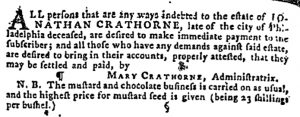
“The mustard and chocolate business is carried on as usual.”

Mary Crathorne, a widow, placed an advertisement in the Pennsylvania Gazette calling on “ALL persons that are any ways indebted to the estate of JONATHAN CRATHORNE … to make immediate payment.” She also requested that “all those who have any demands against said estate” to submit them so she could settle accounts. As administratrix (or executor) of her husband’s estate, she followed the standard protocols for placing newspaper advertisements.

Yet she also appended a nota bene to inform readers, regardless of whether they had unfinished business with her husband’s estate, that “The mustard and chocolate business is carried on as usual, and the highest price for mustard seed is given.” Like many other widows, Crathorne carried on her husband’s business after his death. Although she shouldered some new responsibilities, much of what went into the daily operations of the “mustard and chocolate business” may have been quite familiar to her already. Especially in busy port cities like Philadelphia, colonial wives often assisted their husbands who ran businesses. They served customers and provided other labor when necessary, yet their contributions usually remained hidden or unacknowledged.

Mary Crathorne may not have taken over all of her husband’s former duties. Her role may have been restricted to managing and overseeing male relatives and employees who continued the business on her behalf, leaving the specialized work to them. Still, she now held a position as the proprietress who represented the business to the public. Her name appeared in the public prints, not only peddling mustard produced at her shop but also negotiating for the supplies necessary for continuing the endeavor. She announced that she paid “23 shillings per bushel,” proclaiming it the “highest price for mustard seed” paid in the colony.

This advertisement does not tell Mary Crathorne’s entire story, but it does suggest that women played a more substantial role in the colonial marketplace as entrepreneurs – producers, suppliers, and retailers – than advertisements placed by their husbands might otherwise indicate. At least temporarily, Mary Crathorne operated her husband’s business after his death, perhaps continuing and expanding on activities that she previously performed.