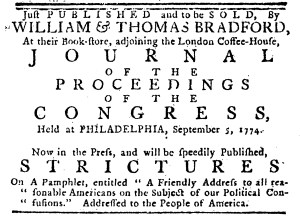
What was advertised in a revolutionary American newspaper 250 years ago today?
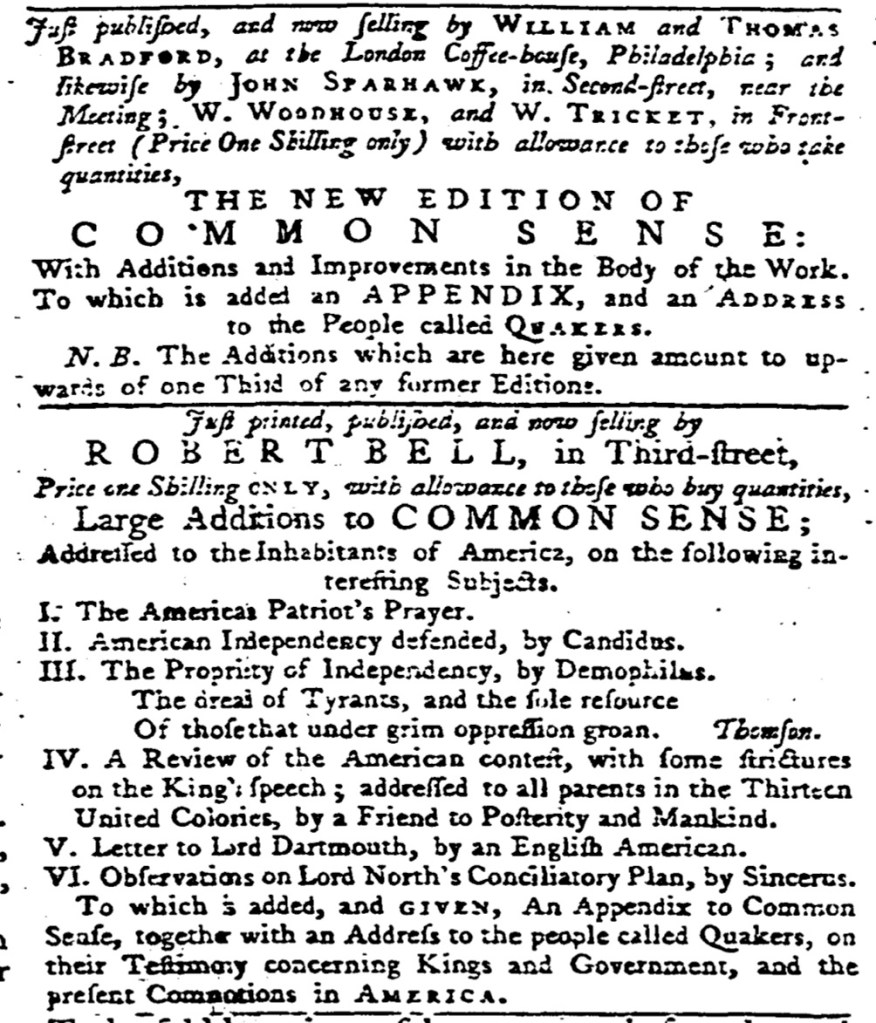
“THE NEW EDITION OF COMMON SENSE.”
“Large Additions to COMMON SENSE.”
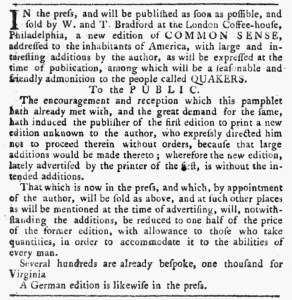
Although Benjamin Towne most frequently published advertisements for Thomas Paine’s Common Sense in his Pennsylvania Evening Post, he was not the only printer in Philadelphia to generate revenue from advertisements for competing editions of the pamphlet. Other newspapers also carried advertisements for Common Sense. After Paine and Robert Bell, the publisher of the first edition, had a falling out, Bell went forward with an unauthorized second edition and Paine worked with William Bradford and Thomas Bradford, the printers of the Pennsylvania Journal, on an expanded edition that featured new material. Not to be outdone, Bell advertised, published, and sold other supplementary material that he billed as “Large Additions to COMMON SENSE,” though Paine was not the author of those pieces that Bell instead reprinted from newspapers. Bell and Paine and then Bell and the Bradfords engaged in bitter exchanges in their advertisements in the Pennsylvania Evening Post.
They also placed more subdued notices in other newspapers. In the February 21, 1776, edition of the Pennsylvania Gazette, for instance, their advertisements ran one after the other. In the first, the Bradfords announced that they “Just published … THE NEW EDITION OF COMMON SENSE: With Additions and Improvements in the Body of the Work.” To entice readers to select their pamphlet, they added a nota bene that stated that the “Additions … amount to upwards of one Third of any former Editions.” Customers could acquire this new edition from the Bradfords “at the London Coffee-house” and from associates in the book trades, including John Sparhawk, William Trickett, and William Woodhouse. Immediately below that advertisement, Bell hawked his “Large Additions.” He listed the contents, just as he had done in his first advertisements for the first edition of Common Sense. He also declared that he added Paine’s “Address to the people called Quakers,” pirated from the Bradfords’ new edition. Like Towne, the printers of the Pennsylvania Gazette, William Hall, David Hall, and William Sellers, did not need to sell a single copy of the pamphlet to generate revenue from it. They made their money on Common Sense from the competing advertisements placed by Bell and the Bradfords!