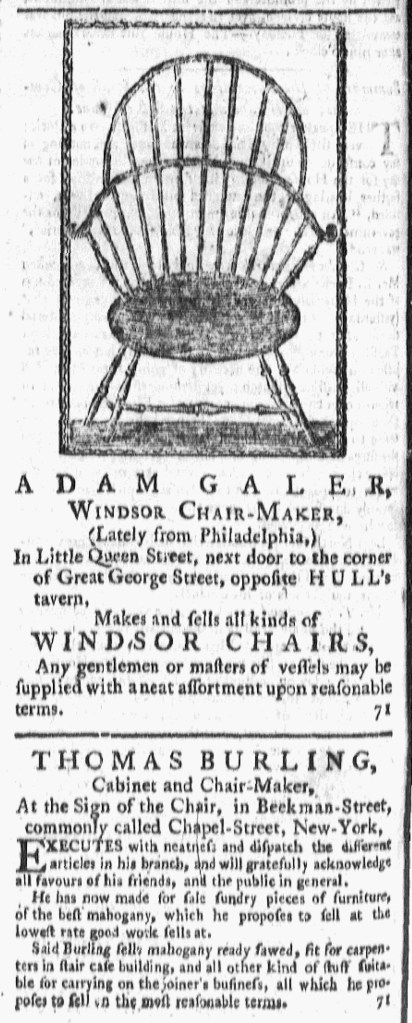
What was advertised in a colonial American newspaper 250 years ago today?
Rivington’s New-York Gazetteer (August 25, 1774).
“Sundry pieces of furniture, of the best mahogany.”
Both Adam Galer and Thomas Burling made and sold furniture in New York in the mid 1770s, yet they took different approaches when they advertised in Rivington’s New-York Gazetteer. Their advertisements appeared one after the other in the August 25, 1774, edition, not by design but rather by coincidence since printers and compositors did not classify or organize paid notices by genre or purpose. The proximity of the advertisements made the differences in their marketing efforts even more stark.
For his part, Galer, a “WINDSOR CHAIR-MAKER,” made an image of a Windsor chair within a decorative border the focal point of his advertisement. That device filled about two-thirds of the space, immediately drawing attention. Having recently arrived in New York from Philadelphia, Galer may have considered it worth the extra expense of commissioning the woodcut to enhance his visibility in the public prints. In the copy, he gave his location and advised “gentlemen” and “masters of vessels” that they could acquire Windsor chairs “upon reasonable terms.”
Thomas Burling, on the other hand, relied exclusively on advertising copy without any images. In that regard, his notice resembled the vast majority of newspapers advertisements. He informed readers that they could find him “At the Sign of the Chair, in Beekman-Street, commonly called Chapel-Street,” indicating that he deployed visual images in other formats to promote his nosiness. Burling, a “Cabinet and Chair-Maker,” produced a wider array of furniture than Galer, declaring that he “EXECUTES with neatness and dispatch the different articles in his branch.” He reinforced his appeal to quality when he described the material, “the best mahogany,” and his own skill as an artisan. He linked the latter to the price: “he proposes to sell at the lowest rate good work sells at.”
Burling may have benefited from the proximity of the two advertisements if readers took note of the image in Galer’s notice and then happened to continue reading the notice that followed. Still, both artisans likely felt that they were in a better position than if they had not advertised at all. Their direct competition in the public prints gave them an advantage over other competitors who did not advertise at all.
What was advertised in a colonial American newspaper 250 years ago today?
Pennsylvania Journal (January 19, 1774).
“JEDIDIAH SNOWDEN … carries on his business of Cabinet and Windsor Chair-Making … The MILLINARY BUSINESS is carried on as usual, by ANN SNOWDEN.”
Jedidiah Snowden and Ann Snowden pursued different lines of business, but they placed a joint advertisement in the January 19, 1774, edition of the Pennsylvania Journal. Jedidiah informed the public that he moved from Market Street to Front Street, “where he carries on his business of Cabinet and Windsor Chair-Making, and sells them at the most reasonable rates.” For her part, Ann declared that the “MILLARY BUSINESS is carried on as usual” and she “has imported a large and general assortment of MILLINARY.” She then listed dozens of items among her inventory, including “a genteel assortment of figured and plain ribbands,” “mens, womens, boys and girls white and coloured gloves,” “pearl, French and English white wax necklaces,” and “India, ivory, bone, and black fans.”
The Snowdens did not specify their relationship to each other in their advertisement. Most likely they were husband and wife, though they could have been father and daughter, mother and son, brother and sister, cousins, or some other relations. Whatever the case, Jedidiah was the head of household, so his name and information about his business came first. Although Ann’s name ran in the same size font as Jedidiah’s name, “Cabinet and Windsor Chair-Making” appeared as a secondary headline, also in a larger font than the rest of the advertisement, while “MILLINARY BUSINESS” merely appeared in capital letters integrated into the regular copy rather than treated as another headline. Still, Ann’s portion of the advertisement occupied the most space on the page, approximately four times as much as Jedidiah’s portion. The Snowdens made a much larger investment in promoting Ann’s “MILLINARY BUSINESS” than Jedidiah’s “Cabinet and Windsor Chair-Making.” Perhaps Jedidiah believed that he had established such a reputation for his work that he did not need to provide more details beyond telling readers that he had moved and sold the furniture he made “at the most reasonable rates.” Ann, on the other hand, competed with merchants, shopkeepers, and milliners who constantly imported new wares and updated their advertisements in the several newspapers published in Philadelphia. Demonstrating that she offered the same selection of merchandise as her competitors may have been imperative to the milliner. Advertisements jointly placed by husbands and wives or other male and female relations rarely listed the female entrepreneur first, but no matter their format they did reveal that both advertisers contributed to the household economy through their participation in the marketplace.
What was advertised in a colonial American newspaper 250 years ago today?
New-York Journal (March 2, 1769).
“Windsor Chairs made in the best and neatest Manner.”
The most striking aspect of this advertisement is the use of an image to sell “A Large and neat Assortment of Windsor Chairs.” Often, illustrations were not included in eighteenth-century newspapers, neither with news nor with advertisements. It was most common to see small symbols for incoming ships or runaway slaves. Larger images for consumer goods were rare. The image of the chair in Jonathan Hampton’s advertisement catches viewers’ attention and makes them more susceptible to buying the piece of furniture.
In fact, there was a multi-step process for including an image in an advertisement. According to Colonial Williamsburg’s overview of the trade, being a printer was “among the most labor intensive” professions. In order to produce newspapers using the printing press, printers worked long days on hand-operated presses. Including an image tacked on more labor. There were two important types of employees who worked for the printer, the compositor and the pressman, William Parks, a printer in Virginia in the eighteenth century, wrote, “The Compositor is he who arranges the Letters and makes up the Forms; the Pressman only works at the Press, takes off the Impression, and requires no other Qualification than Strength and a little Practice.” Publishing newspapers called for collaboration, cooperation, and time. It is quite impressive how printers, compositors, and pressmen repeated these processes each day, in order to publish newspapers and other printed materials.
**********
ADDITIONAL COMMENTARY: Carl Robert Keyes
Chloe is correct the woodcut depicting a Windsor chair distinguished Jonathan Hampton’s advertisement from others that appeared on the same page issue. Very few visual images appeared in eighteenth-century newspapers. Even fewer unique images directly correlated to the content of advertisements appeared, in part because of the time and, especially, expense required to incorporate them. Woodcuts were also fragile; they broke or wore down over time. The missing arm on Hampton’s Windsor chair was not a printing error. The arm was also missing when the same woodcut accompanied an advertisement placed four months earlier.
To demonstrate that images like Hampton’s Windsor chair were not a standard part of advertisements or other content in eighteenth-century newspapers, consider the newspapers published on March 2, 1769. The Boston Chronicle did not include any visual images, not even in the masthead. The Boston Weekly New-Letter did not include any visual images, neither in the standard issue nor in the supplement that accompanied it. Richard Draper disseminated the Massachusetts Gazette with the Boston Weekly News-Letter, printing them on the same broadsheet. The Massachusetts Gazette did include a visual image in the masthead, the royal coat of arms of the United Kingdom, but no others elsewhere in the newspaper. The New-York Journal included six visual images spread over the six pages of the regular issue and the supplement. In addition to the royal arms in the masthead, five advertisements incorporated images: Hampston’s Windsor chair, two ships in advertisements for freight and passage, and two houses in advertisements for real estate. The Pennsylvania Gazette did not include any visual images among the news items and advertisements, but did feature the coat of arms of the Penn family in the masthead. The Pennsylvania Journal also had an image in its masthead, though it drew on different iconography than the other newspaper printers deployed. It showed a Native American and Britannia flanking a ship and the Journal itself. An advertisement for freight and passage also incorporated a woodcut of a ship.
South-Carolina Gazette (March 2, 1769).
The South-Carolina Gazette included by far the most visual images, fifteen in all. In addition to the royal arms in the masthead, an image of a ship and a man on horseback heading toward town, each representing the circulation of information, preceded the first news item. One advertisement passage and freight included an image of a ship. Three advertisements for real estate included images of houses. Three advertisements for stallions to “cover” mares included images of houses. Four advertisements describing escaped slaves included generic images of the runaways, woodcuts that could have been used interchangeably since they did not depict any particular person. In that issue of the South-Carolina Gazette, printer Peter Timothy displayed the four woodcuts that commonly supplemented type in colonial newspapers: horses, houses, ships, and runaways. The South-Carolina Gazette included one unique image that decorated an advertisement for consumer goods and services. Jonathan Sarrazin decorated his advertisement for “JEWELLERY & PLATE” with a woodcut of teapot. Sarrazin used that image so often that it became his brand. Readers of the South-Carolina Gazette likely recognized it on sight.
This census of visual images in newspapers published on March 2, 1769, further illustrates the argument that Chloe advanced in her analysis of Hampton’s advertisement. Woodcuts were indeed rare and usually limited to only a few standard symbols. Hampton’s image of a Windsor chair was certainly exceptional. He apparently considered it an important element of his marketing, continuing to use it even after it had been damaged.
What was advertised in a colonial American newspaper 250 years ago today?
Supplement to the New-York Journal (November 10, 1768).
“A Large and neat Assortment of Windsor Chairs.”
A woodcut depicting a Windsor chair dominated Jonathan Hampton’s advertisement in the Supplement to the New-York Journal published on November 10, 1768. In that regard, his advertisement deviated significantly from the vast majority of paid notices placed in newspapers throughout the colonies. Most advertisements consisted entirely of text unaccompanied by images, in part because woodcuts required an additional investment. Printers did provide some woodcuts that advertisers could insert in their notices, but they were limited to a narrow selection. The selection was usually limited to depictions of ships, houses, horses, slaves, and runaways (servants and slaves). They were used interchangeably. For instance, a real estate advertisement could incorporate any woodcut depicting a house; the details of the woodcut did not necessarily correspond to the description of the house offered in the copy.
When advertisers desired to include images that represented their shop signs or, as was the case with Hampton, their merchandise, they could not draw from stock images provided by printers. Instead, they incurred the additional expense of commissioning woodcuts that then belonged exclusively to them. Not only did those images not accompany any other advertisements in a particular publication, advertisers could collect them and submit them from the printing office and submit them for inclusion in advertisements they placed in competing newspapers.
Even though it appears to have been damaged as the result of repeated impressions on a hand-operated press, the woodcut depicting a Windsor chair in Hampton’s advertisement would have drawn attention. Except for the masthead, no images appeared in the standard issue of the New-York Journal distributed on November 10, 1768. The supplement included only two images, Hampston’s Windsor chair and the elaborate frame that enclosed Gerardus Duyckinck’s list of goods he sold “At the Sign of the Looking Glass & Druggist Pot.” That frame incorporated both a looking glass and a druggist pot.
Some advertisements deployed typography or ornamental printing to distinguish them from others, yet they still consisted entirely of text and type. Including a woodcut helped some advertisers to even further differentiate their notices as a means of drawing attention to the goods and services they offered to prospective customers.