What was advertised in a colonial American newspaper 250 years ago today?
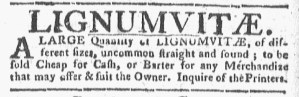
“A LARGE Quantity of LIGNUMVITAE.”
In selecting this advertisement, I collaborated with Kendra Apicella, a student in my Revolutionary America class in Fall 2023. Kendra spotted the notice when she undertook her responsibilities as guest curator for the Slavery Adverts 250 Project. She was not with familiar with lignum vitae. Neither was I. That provided an opportunity for student and professor to learn together as we looked for more information about this commodity that appeared in the pages of the January 24, 1774, edition of the Boston-Gazette. Lignum vitae, we discovered, referred to a tree indigenous to the Caribbean as well as wood and resin obtained from the tree and medicines derived from the resin.
Lignum vitae translates from Latin as “wood of life,” a name given to the tree because of its medicinal qualities. The advertisement in the Boston-Gazette did not seem to market “A LARGE Quantity of LIGNUMVITAE” as a remedy. Instead, the “different sizes, uncommon straight and sound,” suggests pieces of wood intended for furniture and decorative items. On behalf of the St. John Historical Society, Eleanor Gibney provides a history of the commodification of the tree in the early modern period in “Lignum vitae: Beauty, Strength, and the Fallibility of Medicine.” She explains that lignum vitae “is among the hardest and heaviest of all commercial woods.” Furthermore, “[w]hat makes lignum vitae wood so valuable is not the density alone, but the combination with the oily resin that permeates the wood, lubricating and making it almost indestructible.”
Gibney also notes that a Moravian missionary, C.G.A. Oldendorp, recorded some thoughts about lignum vitae during his time in the Virgin Islands. In 1767, he described the wood as “difficult to work with, both on account of its hardness and its crooked growth.” That hardness meant durability. Iron would rust away more quickly than building timbers made of lignum vitae would rot, he asserted. Oldendorp further described the wood as “expensive” and “exported to Europe in considerable quantities.” It also found its way to British colonies in North America. The anonymous seller who advertised in the Boston-Gazette acknowledged the wood’s reputation for “crooked growth” when describing the pieces available as “uncommon straight and sound.” The advertiser also banked on widespread familiarity with the wood’s “hardness” and durability, not considering it necessary to elaborate on those qualities.
Eighteenth-century readers, immersed in the language of consumer culture of the era, recognized “LIGNUMVITAE” when they saw it advertised among the notices in the Boston-Gazette, yet many modern readers do not have any immediate associations with the tree, its appearance and other qualities, and the various uses of the wood. I often tell my students that colonizers spoke their own language, no matter how much it looks like English to us, and that we have to translate the words that they wrote and published. Sometimes that is because the meanings of words have shifted over time or words commonly used in the eighteenth century are no longer part of everyday speech. In this instance, like so many others involving consumer culture (including all the different kinds of textiles listed in countless advertisements!), a once-popular commodity no longer has the demand it did in the early modern era. Kendra and I both learned more about commerce and consumption in the Atlantic World thanks to our curiosity about this advertisement for lignum vitae.