February 17

What was advertised in a colonial American newspaper 250 years ago today?
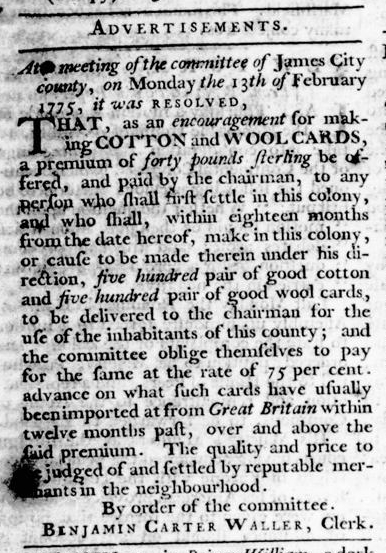
Virginia Gazette [Purdie] (February 17, 1775).

“An encouragement for making COTTON and WOOL CARDS … in this colony.”

Residents of James City County took the Continental Association seriously, especially the eighth article.  When the First Continental Congress devised that nonimportation, nonconsumption, and nonexportation agreement in response to the Coercive Acts, they included an article that called for colonizers “in our several Stations, [to] encourage Frugality, Economy, and Industry; and promote Agriculture, Arts, and the Manufactures of this Country, especially that of Wool.”  In turn, the “committee of James City county” passed a resolution for the “encouragement for making COTTON and WOOL CARDS” at its meeting in February 1775.

Within days an advertisement appeared in Alexander Purdie’s Virginia Gazette and John Dixon and William Hunter’s Virginia Gazette to inform enterprising entrepreneurs that the committee offered “a premium of forty pounds sterling … to any person who shall first settle in this colony, and who shall, within eighteen months from the date hereof, make in this colony, or cause to be made therein under his direction, five hundred pair of good cotton and five hundred pair of good wool cards … for the use of the inhabitants of this county.”

Preparing wool and cotton for spinning involved separating and straightening the fibers using two cards or paddles with fine wire teeth.  That process made wool and cotton easier to spin; it also made the cards an essential tool for producing textiles as alternatives to imported fabrics.  While the committee assumed that men would make the cards, it would be women who used them.  That gave political meaning to the activities they undertook in carding, spinning, and weaving, just as women participated in politics when they refused to purchase imported cards, imported textiles, or any other imported goods.

Making cotton and wool cards in Virginia had the potential to be a profitable venture.  In addition to the premium, the committee offered a “75 per cent. advance on what such cards have usually been imported at from Great Britain within the twelve months past.”  In other words, the committee agreed to pay nearly twice what importers had recently paid for this important tool, another incentive for producing cards in the colony.

Supporters of the American cause had already mobilized in boycotting imported goods and producing alternatives.  This advertisement suggested one more means of contributing to those efforts, making cotton and wool cards in Virginia.  A successful venture would have ripple effects as women purchased those cards and used them in processing cotton and wool to produce homespun cloth rather than buying imported textiles.  The premium offered for making cotton and wool cards was part of a larger project with significant political implications.

April 18

GUEST CURATOR: Lizzie Peterson

What was advertised in a colonial American newspaper 250 years ago today?

Postscript to the Censor (April 18, 1772).

“WOOL and TOW CARDS.”

While examining advertisements to research for this project, this one about wool and tow cards caught my eye, I wanted to learn about what “cards” and “carding” meant in early America.  According to Laurel Thatcher Ulrich in “Wheels, Looms, and the Gender Division of Labor in Eighteenth-Century New England,” women participated in “the endless work of carding, combing, spinning, reeling, doubling, dyeing, bleaching, spooling, warping, and weaving,” suggesting that “cards” and “carding” had something to do with preparing textiles, since all of the of the other verbs deal with preparing textiles or making clothes.[1]

I learned that the term “card” is not a type of card we know today like a greeting card or playing card. “Cards” and “carding” during the eighteenth century referred to the tool and process people used to spin and prepare textiles. Wool and tow are both types of fibers made into textiles. Tow comes from flax or hemp and wool is hair from animals, particularly sheep.  According to the National Museum of American History at the Smithsonian Institution, “The carding process is part of preparing will for spinning into yarn. Wool is brushed between two hand carders to align fibers in the same direction.”  Ulrich points out that women did this work.

Eighteenth-century wool card. Courtesy National Museum of American History.

**********

ADDITIONAL COMMENTARY: Carl Robert Keyes

Colonizers knew exactly what James Longden sold when they saw his advertisement for “ALL SORTS OF WOOL and TOW CARDS” in the Postscript to the Censor in the spring of 1772.  They knew the intended purpose of wool and tow cards.  Most had probably used cards themselves or observed others using them.  Colonizers encountered wool and tow cards as they went about their daily lives.  What were once such familiar items prior to the Industrial Revolution, however, no longer remain so familiar to most people, including students in my Revolutionary America classes.  That is why I do not assign advertisements to them when they serve as guest curators but instead instruct them to choose advertisements that look interesting to them.  I especially encourage them to find advertisements that confuse them because they do not know what kinds of products were being sold.  They then have to do the detective work, the historical research, to make meaning of their advertisements.  Throughout the process, we have conversations that further enhance their understanding of the historical context.

Lizzie did an exemplary job in selecting an advertisement and doing the research to understand it, even locating a photo of an eighteenth-century wool card similar to those advertised by Longden.  This certainly enhanced discussions from class, especially our focus on how women participated in politics during the era of the American Revolution even though they could not vote or hold office.  In particular, we examined women’s roles as producers and consumers.  We discussed spinning bees as public rituals as well as less visible labor that took place within households as women made homespun garments as alternatives to imported goods.  Colonizers acknowledged that women fulfilled their patriotic duty through their everyday labors.  In addition, women participated in politics through the decisions they made as consumers, especially when nonimportation and nonconsumption agreements were in effect.  Longden offered women wool and tow cards “made in this Province,” promising that they were “as cheap, or cheaper than can be imported” as well as “equal to any in Great-Britain.”  The politics of purchasing and using wool and tow cards made by Longden, however, remained just a little bit more abstract without knowing the purpose of those items.  As a result of Lizzie’s choice of advertisement, she and her classmates gained a better understanding of both women’s domestic labor and how women participated in politics.

**********

[1] Laurel Thatcher Ulrich, “Wheels, Looms, and the Gender Division of Labor in Eighteenth-Century New England,” William and Mary Quarterly, 3rd ser., 55, no. 1 (January 1998): 20.