March 24

What was advertised in a revolutionary American newspaper 250 years ago this week?

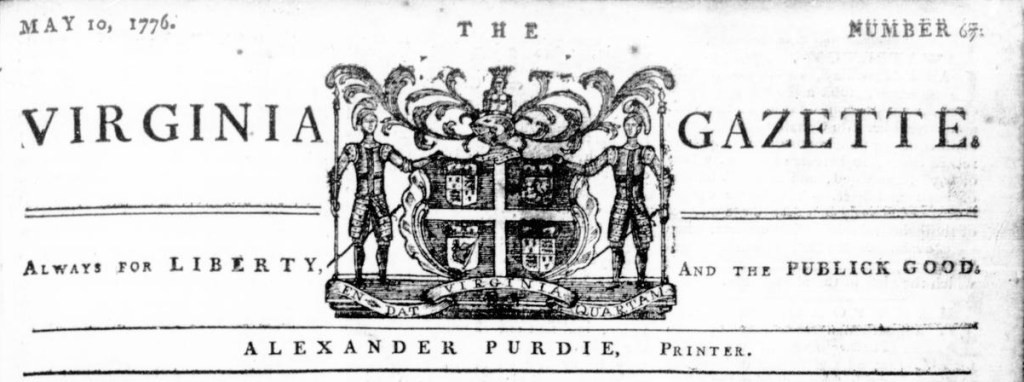
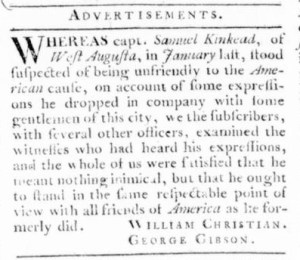
Virginia Gazette [Purdie] (March 22, 1776).

“He ought to stand in the same respectable point of view with all friends of America.”

As the imperial crisis intensified and became a war, some colonizers published newspaper advertisements intended to rehabilitate their reputations.  Many of the signers of an address to Thomas Hutchinson took to the pages of the newspapers published in New England to apologize and to explain the circumstances that led to their error.  In response to other incidents that called their support for American liberties into question, Asa Dunbar published “RECANTATIONS” in the New-England Chronicle, Lemuel Bower and Joseph Lyon both expressed regret for not showing support for nonimportation agreement in advertisements in the New-York Journal, and John Bergum promised to “conduct myself as a true friend to America” in the Pennsylvania Evening Post.

Samuel Kinkead got into similar trouble in Virginia in January 1776.  An advertisement in the March 22 edition of Alexander Purdie’s Virginia Gazette reported that Kinkead “stood suspected of being unfriendly to the American cause, on account of some expressions he dropped in company with some gentlemen” in West Augusta.  William Christian and George Gibson, and “several other officers, examined the witnesses who had heard his expressions.”  At the conclusion of their interviews, “the whole of us were satisfied that [Kinkead] meant that he ought to stand in the same respectable point of view with all friends of America as he formerly did.”  This advertisement delivered important news, at least from Kinkead’s perspective, so he may have been grateful that it ran first among the paid notices in that issue of the Virginia Gazette.  It thus served as a transition between news and editorials that kept readers informed about politics and the war and the advertisements placed for a variety of purposes.  This notice, like so many others, delivered local news to readers, bypassing the printer who made editorial decisions about what to include elsewhere in the newspaper.  Kinkead did not address readers himself as others had done, but he may have considered it more effective for Christian and Gibson to vouch for him.

March 17

What was advertised in a revolutionary American newspaper 250 years ago this week?

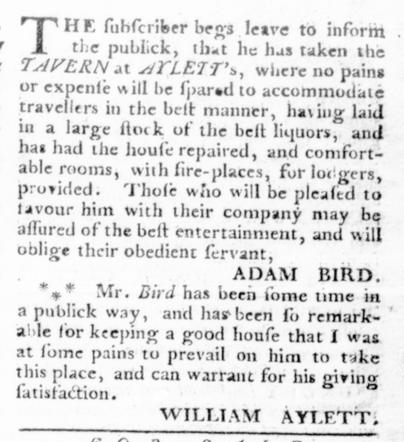
Virginia Gazette [Purdie] (March 15, 1776).

“Mr. Bird … has been so remarkable for keeping a good house.”

When Adam Bird commenced operating the “TAVERN at AYLETT’s” in the spring of 1776, he took to the pages of Alexander Purdie’s Virginia Gazette to invite patrons to his establishment.  He assured prospective customers that “no pains or expense will be spared to accommodate travellers in the best manner.”  To that end, he had “laid in a large stock of the best liquors” for their enjoyment.  In addition, he “had the house repaired, and comfortable rooms, with fire-places, for lodgers, provided.”  Whether or not readers had previously visited the tavern at that location, Bird hoped that the improvements he made would entice them to visit.  “Those who will be pleased to favour him with their company,” he pledged, “may be assured of the best entertainment” as “their obedient servant” catered to them.  Bird made common appeals that tavernkeepers and innkeepers incorporated into their advertisements.

He also included an uncommon element that distinguished his advertisement from others.  As an addendum, William Aylett gave his endorsement of Bird and his management of the tavern.  “Mr. Bird has been some time in a publick way,” Aylett explained, “and has been so remarkable for keeping a good house that I was at some pains to prevail on him to take this place.”  In other words, Aylett, who may have had experience as a tavernkeeper himself or may have been merely the proprietor of the building, was familiar with Bird’s previous experience running a public house and that prompted him to invite Bird to open an establishment at the “TAVERN at AYLETT’s.”  He intended to leverage Bird’s reputation through vouching for him, aiming to convince prospective customers that they would indeed enjoy eating, drinking, and lodging at the tavern.  Aylett nearly gave a guarantee, declaring that he could “warrant for [Bird] giving satisfaction to his patrons.  Prospective patrons who did not know Bird, the new manager at the “TAVERN at AYLETT’s,” but did know Aylett, the proprietor, may have found the endorsement more enticing than Bird’s overview of the services he provided.

March 8

GUEST CURATOR:  Massimo Sgambati

What was advertised in a revolutionary American newspaper 250 years ago today?

Virginia Gazette [Purdie] (March 8, 1776).

“I WILL give good wages for a journeyman SHOEMAKER.”

In this advertisement in the Virginia Gazette, Francis Moreland searched for a “journeyman SHOEMAKER.” The specificity of a journeyman implies that Moreland wanted to hire a shoemaker who was quite skilled rather than a young apprentice who still had much to learn. In eighteenth-century America, according to Patrick Grubbs, there was a difference in the levels of craftsmanship. The master oversaw production, owned the shops, and trained journeymen and apprentices. The journeyman was a skilled worker who had finished an apprenticeship, but did not have master status. An apprentice was a beginner learning the trade under a master.

“Cordonnier et cordonnier-bottier [Shoe and boot making]” (1765).  Courtesy Encyclopedia of Diderot & d’Alembert Collaborative Translation Project.

To help us better understand a shoemaker’s shop, Thomas Ford provides an image in The Leatherworker in Eighteenth-Century Williamsburg. In this image we see the inner workings of the customer-shoemaker relationship. Shoemaking as a craft grew across the colonies during the eighteenth century, not just in Virginia. In Philadelphia, Grubbs explains, the occupation grew from a handful in 1680 to over three hundred in 1774, due to a rise in demand and the colonists deciding it would be better to shop domestically for shoes. Craftsmanship was important in the eighteenth century, including in the market for shoes. Although some shoemakers made large quantities of shoes, colonists did not have access to mass produced shoes in the same way that modern consumers purchase Nike and Adidas, so they often relied on their local shoemakers to meet their needs.

**********

ADDITIONAL COMMENTARY:  Carl Robert Keyes

When I asked students in my senior capstone research seminar about advertising and consumer culture in early America to choose advertisements about consumer goods and services for the portfolios they created throughout the semester, I did not necessarily have employments advertisements in mind, but I allow for flexibility and creativity in selecting and interpreting newspaper notices for their portfolios and for publication via the Adverts 250 Project.  As I have written on other occasions, one of my favorite parts of enlisting my students as junior colleagues in the production of this digital humanities work is the opportunity to see sources that are so familiar to me through new eyes.  I likely would have passed over Moreland’s advertisement, but Massimo demonstrated its relevance to our readings and discussions about colonizers participating in consumer culture.  Consumption, after all, occurs in a reciprocal relationship with production and distribution of goods, as T.H. Breen highlights in The Marketplace of Revolution: How Consumer Politics Shaped American Independence, a book we read and discussed in our seminar.

Massimo chose one of three employment advertisements in the March 8, 1776, edition of Alexander Purdie’s Virginia Gazette.  In another notice, Thomas Warren sought a “BRICKLAYER, who is a good workman,” for the next season. He limited his search to those “coming well recommended.”  Robert Anderson also wanted “well recommended” applicants to respond to his advertisement for a “GOOD HOSTLER” to care for horses.  The “journeyman SHOEMAKER” would have been the only one of the three who served an apprenticeship and may have worked more closely with customers than the bricklayer and the hostler.  On the other hand, Moreland may have had other plans for a new employee. In another advertisement in that issue, William Aylett informed the public that he “WANTED, for the army, a large number of SHOES.”  Moreland may have had his journeyman shoemaker craft shoes for individual clients or he may have tasked him with producing a quantity of shoes to supply the army, a precursor to modern mass production.

February 9

What was advertised in a revolutionary American newspaper 250 years ago today?

Virginia Gazette [Purdie] (February 9, 1776).

He remains the publick’s most obedient humble servant.”

When Archibald Diddep, a tailor in Williamsburg, wanted his customers to settle accounts, he resorted to an advertisement in Alexander Purdie’s Virginia Gazette.  Merchants, shopkeepers, artisans, and even printers frequently placed advertisements calling on their customers to pay for the goods and services they purchased on credit.  Sometimes they threatened legal action against those who did not submit payment shortly after such notices appeared in the public prints.  Diddep, on the other hand, used another strategy.

The tailor devised an advertisement that expressed his appreciation to his customers and solicited further business among the readers of the Virginia Gazette, nestling his address to those who owed him money among those other aspects of his notice.  He opened by stating that he “RETURNS his employers in general, and his old customers in particular, the most cordial thanks for past services.”  He then pledged that he “shall be ready to axecute any command which they may hereafter intrust him with.”  Yet he also wanted them to be aware of his circumstances that made it especially important that they make timely payment for the good service they received from the tailor.  “As his family is extensive, journeymens wages very high, and his creditors exceedingly solicitous for their due,” Diddep explained, “he hopes those whose accounts have been long standing will not take it amiss should he earnestly entreat them to make immediate payment.”  In other words, he did wish to bother customers who owed him money, but he wanted them to understand that he had a large family to feed, employees who earned a good living to pay, and creditors who were pressuring him.  The tailor hoped such appeals, playing on sympathy, would prove more effective than threatening to sue.  He also introduced a new policy, announcing that he expected customers “will not hesitate to tender down the cash so soon as their work is done” in the future.  Diddep politely discontinued credit at his shop.  Even with that softer touch, he did not conclude by focusing on finances.  Instead, he seized one last opportunity to generate business and highlight the quality of the service he provided.  “Ladies riding habits are still made by him,” he reminded readers.  For those who would give him business, he “remains the publick’s most obedient humble servant.”  It was a much softer approach than other newspaper notices that demanded customers settle accounts.

January 5

What was advertised in a revolutionary American newspaper 250 years ago today?

Virginia Gazette [Purdie] (January 5, 1776).

“The PRINTER is reduced to the necessity of demanding half the year’s subscription money.”

In the final issue of his Virginia Gazette for 1775, Alexander Purdie called on subscribers “to pay in their subscriptions, to enable me to lay in a stock of paper for the winter,” and “all persons indebted to me for BOOKS, STATIONARY, [and] ADVERTISEMENTS” to settle their accounts.  He asserted that it was “impossible to carry on such an expensive business, to the publick’s or his own satisfaction, without punctual payment.”

A week later, Purdie expressed even more alarm in a notice in the first edition of his Virginia Gazette for 1776.  “CONSIDERING the great rise in the price of PAPER, the high expense attending the transportation of it to this place from Philadelphia, and the difficulty there is to procure it almost on any terms,” he explained, “the PRINTER is reduced to the necessity of demanding half the year’s subscription money from every new subscriber to his GAZETTE.”  Newspaper subscribers often enjoyed generous credit, but Purdie made clear that was not a viable option.  He simultaneously renewed his call “that those who owe him for the last 11 months” since he commenced publication of hisVirginia Gazette “send in their subscriptions” and “those that subscribed later … pay in to Dec. 31st … that he may begin a new account, this NEW YEAR, with all his customers.”  Like many other printers, Purdie believed that he performed a valuable service for the public, “hop[ing] to be able to furnish them always with pleasing intelligence, even in these boisterous times.”  Many readers may have considered “boisterous” an understatement as they read news and editorials about the war that commenced at Lexington and Concord the previous April.

Where Purdie placed his advertisement within the issue testifies to its urgency.  Like other newspapers of the era, his Virginia Gazette consisted of four pages printed on a broadsheet and folded in half.  Printers usually printed the first and fourth pages on one side, let it dry, and then printed the second and third pages on the other side.  That meant that the news and advertisements that arrived in the printing office most recently appeared on the second and third pages, inside the folded newspaper.  Purdie’s Virginia Gazette had a heading for “ADVERTISEMENTS” in the final column of the third page.  He could have followed the example of other printers and given his notice a privileged place as the first item under that heading.  Instead, he made it the first item in the first column on the fourth page.  He placed his notice in the upper left corner of the final page, making it the first advertisement readers encountered then they turned to that page.  That also guaranteed a spot for the printer’s notice.  Purdie made it a priority rather than risking that news he had not yet received would be of such significance to justify crowding out his notice.  Purdie made a savvy decision in choosing where to place his notice calling on subscribers and other customers to settle accounts.

December 29

What was advertised in a revolutionary American newspaper 250 years ago today?

Virginia Gazette [Purdie] (December 29, 1775).

“All persons indebted to me for BOOKS, STATIONARY, ADVERTISEMENTS …”

As 1775 drew to a close, Alexander Purdie placed a notice in his own Virginia Gazette to tend to the business of running that newspaper.  A year earlier, he and his former partner, John Dixon, ended their partnership.  Dixon took a new partner, William Hunter, and continued printing the Virginia Gazette that he and Purdie had produced together for the last nine years.  Purdie immediately announced that he would commence printing a newspaper, that one also named the Virginia Gazette.  John Pinkney printed a third Virginia Gazette in Williamsburg.

Purdie’s experience and reputation apparently earned him enough customers to make his Virginia Gazette a viable enterprise, though he had to call on them to do their part by paying for the goods and services they purchased on credit.  “The end of the year approaching,” the printer explained, “I shall be much obliged to all my kind customers to pay in their subscriptions, to enable me to lay in a stock of paper for the winter, which useful article is now exceedingly scarce, and very dear.”  A variety of factors contributed to the scarcity of paper, including disruptions in trade with England due to the Continental Association and the outbreak of hostilities at Lexington and Concord in April.

Purdie did not call on subscribers alone to settle accounts.  Instead, he declared that “all persons indebted to me for BOOKS, STATIONARY, ADVERTISEMENTS, &c. will render me a very essential service by discharging their accounts.”  Yet, he placed the greatest emphasis on subscribers, adding a note that underscored the price and scarcity of paper.  “From the very great rise in the price of PAPER, as well as the difficulty of procuring it almost on any terms,” he proclaimed, “the Printer is reduced to the necessity of demanding half the year’s subscription money from every new subscriber to his Gazette.”  Such instructions deviated from the standard narrative about how early American printers ran their businesses.

Historians have often asserted that printers extended credit for subscriptions while requiring advertisers to pay in advance, recognizing advertising as the more significant revenue stream.  Throughout the colonies, many printers did frequent place notices asking, cajoling, and even threatening legal action in their effort to get subscribers to pay.  However, many also specified that subscribers were supposed to pay for half the year “upon entering.”  Difficult times forced Purdie to make that a condition for new subscribers.  He also seems to have extended credit for advertisements, though his notice did not make clear whether he meant newspaper notices or job printing (like handbills and broadsides) or both.  Even as printers followed standard practices, how they actually applied them varied from printing office to printing office.

November 10

What was advertised in a revolutionary American newspaper 250 years ago today?

Virginia Gazette (November 10, 1775).

“JOHN BLAIR, JAMES COCKE, surviving trustees.”

An advertisement about the upcoming sale of the “attorney-general’s slaves and household furniture” in the November 10, 1775, edition of Alexander Purdie’s Virginia Gazette was signed by John Blair and James Cocke, the “surviving trustees.”  Upon learning of the death of Peyton Randolph, one of the original trustees, they had updated an advertisement that had been running in that newspaper as well as John Pinkney’s Virginia Gazette and John Dixon and William Hunter’s Virginia Gazette for several weeks.  John Randolph, the King’s Attorney General for the colony and a loyalist, had departed for England, leaving his brother, Peyton, along with Blair and Cocke as trustees to oversee and sell his estate. Peyton, a patriot and the president of the First Continental Congress, was in Philadelphia representing Virginia in the Second Continental Congress when he unexpectedly died, leaving Blair and Cocke as the “surviving trustees.”

Among the printers in Williamsburg, Purdie published the news of Randolph’s death first, nearly a week ahead of the other two newspapers.  Given that each published a new issue once a week, the news spread ahead of it appearing in print.  All the same, Purdie supplemented the brief notice that he ran in the November 3 edition with extensive coverage in the next issue on November 10.  “LAST sunday died of an apoplectick stroke,” the report began, “the hon. PEYTON RANDOLPH, Esq; of Virginia, late President of the Continental Congress, and Speaker of the House of Burgesses of that colony.”  On the following Tuesday, “his remains were removed … to Christ church, where an excellent sermon on the mournful occasion was preached … after which the corpse was carried to the burial ground, and deposited in a vault until it can be conveyed to Virginia.”  The dignitaries in the funeral procession included John Hancock, then serving as president of the Second Continental Congress, other “members of the Congress,” members of the Pennsylvania Assembly, and the mayor of Philadelphia.  Elsewhere in that issue, Purdie printed a memorial to Randolph, an eighteenth-century version of an obituary.  He also inserted a notice from Williamsburg’s Masonic Lodge: “Ordered, THAT the members of this Lodge go into mourning, for six weeks, for the late honourable and worthy provincial grand master, Peyton Randolph, esquire.”  To honor Randolph, Purdie enclosed the contents of the entire issue within thick black borders that signaled mourning.  Those borders ran on either side of the updated advertisement placed by the “surviving trustees” of John Randolph’s estate.

November 3

What was advertised in a revolutionary American newspaper 250 years ago today?

Virginia Gazette [Purdie] (November 3, 1775).

“To be SOLD … THE estate of John Randolph, esq; his majesty’s attorney-general.”

The advertisement for the “Estate of John Randolph” that ran in John Dixon and William Hunter’s Virginia Gazette in the fall of 1775 also appeared in the other newspapers published in Williamsburg, John Pinkney’s Virginia Gazette and Alexander Purdie’s Virginia Gazette.  When the Loyalist departed for England, either he left instructions to advertise widely or the trustees – Peyton Randolph (his brother), John Blair, and James Cocke – decided that they wanted news of the upcoming sale of Randolph’s house, furniture, and enslaved “family servants” to circulate as widely as possible.

Virginia Gazette [Purdie] (November 3, 1775).

When the advertisement ran on the final page in the November 3 edition of Purdie’s Virginia Gazette, it contradicted news that appeared on the second page.  Thick black borders that indicated mourning surrounded a short article that informed readers, “By letter received last night from Philadelphia, we have the melancholy intelligence of the death of our beloved Speaker, the Hon. PEYTON RANDOLPH, Esq; on the 23d of October, of an apoplexy.  His remains were interred in the family burying-place of mr. Francis, of that city.”  Randolph had served as speaker of the colony’s House of Burgesses.  He also held very different political views than his brother, having served as president of the First Continental Congress when it met in Philadelphia in the fall of 1774 and, briefly, as president of the Second Continental Congress when it convened after the battles at Lexington and Concord the following year.  He had been in Philadelphia as one of Virginia’s delegates when he died.

Blair and Cocke, the “surviving trustees,” ran an updated advertisement the following week, but there had not been time to revise the notice that had been running for several weeks.  The side of the broadsheet that carried the advertisement may even have been printed already when Purdie’s printing office received word of Randolph’s death.  In addition, the report, dated “SATURDAY, Nov. 4,” introduces some confusion about when the news arrived and when Purdie printed and distributed the November 3 edition of his newspaper.  Purdie scooped the other two newspapers.  Pinkney delivered the news in his next edition on November 9 (along with the updated advertisement).  Dixon and Hunter inserted a news report and an extensive memorial on November 11.  Either they did not have the news in time for their November 4 edition, or the type had been set and the printing already commenced when it arrived.  That still does not describe the discrepancy in the dates for Purdie’s newspaper, though he may have been a day late in publishing it but listed November 3, the anticipated date of publication for the weekly newspaper, in the masthead as a polite fiction.

Not only did Purdie publish the news first with a brief article, but the following week he ran both a news article about Randolph’s death and funeral and a memorial to Randolph in his November 10 edition.  The text matched the memorial in Dixon and Hunter’s November 11 edition, but the compositor made different choices for the format.  Purdie also honored Randolph with thick black borders around the content on all four pages, not just enclosing the memorial.  That issue included the updated notice about John Randolph’s estate sale as the first of the advertisements on the final page, though the two-page supplement that accompanied it carried the original advertisement.  The news and an advertisement continued delivering contradictory information, suggesting that Purdie and others in his printing office were not attentive to every detail in every advertisement they published.  The original advertisement may have appeared again as filler to complete the page rather than as an intentional insertion by the trustees who oversaw the sale it announced.

February 17

What was advertised in a colonial American newspaper 250 years ago today?

Virginia Gazette [Purdie] (February 17, 1775).

“An encouragement for making COTTON and WOOL CARDS … in this colony.”

Residents of James City County took the Continental Association seriously, especially the eighth article.  When the First Continental Congress devised that nonimportation, nonconsumption, and nonexportation agreement in response to the Coercive Acts, they included an article that called for colonizers “in our several Stations, [to] encourage Frugality, Economy, and Industry; and promote Agriculture, Arts, and the Manufactures of this Country, especially that of Wool.”  In turn, the “committee of James City county” passed a resolution for the “encouragement for making COTTON and WOOL CARDS” at its meeting in February 1775.

Within days an advertisement appeared in Alexander Purdie’s Virginia Gazette and John Dixon and William Hunter’s Virginia Gazette to inform enterprising entrepreneurs that the committee offered “a premium of forty pounds sterling … to any person who shall first settle in this colony, and who shall, within eighteen months from the date hereof, make in this colony, or cause to be made therein under his direction, five hundred pair of good cotton and five hundred pair of good wool cards … for the use of the inhabitants of this county.”

Preparing wool and cotton for spinning involved separating and straightening the fibers using two cards or paddles with fine wire teeth.  That process made wool and cotton easier to spin; it also made the cards an essential tool for producing textiles as alternatives to imported fabrics.  While the committee assumed that men would make the cards, it would be women who used them.  That gave political meaning to the activities they undertook in carding, spinning, and weaving, just as women participated in politics when they refused to purchase imported cards, imported textiles, or any other imported goods.

Making cotton and wool cards in Virginia had the potential to be a profitable venture.  In addition to the premium, the committee offered a “75 per cent. advance on what such cards have usually been imported at from Great Britain within the twelve months past.”  In other words, the committee agreed to pay nearly twice what importers had recently paid for this important tool, another incentive for producing cards in the colony.

Supporters of the American cause had already mobilized in boycotting imported goods and producing alternatives.  This advertisement suggested one more means of contributing to those efforts, making cotton and wool cards in Virginia.  A successful venture would have ripple effects as women purchased those cards and used them in processing cotton and wool to produce homespun cloth rather than buying imported textiles.  The premium offered for making cotton and wool cards was part of a larger project with significant political implications.

February 3

What kinds of advertisements ran in the inaugural issue of Alexander Purdie’s Virginia Gazette 250 years ago today?

Virginia Gazette [Purdie] (February 3, 1775).

“BENJAMIN BUCKTROUT, Cabinet maker, … STILL carries on that business.”

To be sold … THIRTY Virginia born negroes, consisting of men, women, boys, and girls.”

Alexander Purdie launched his Virginia Gazette on Friday, February 3, 1775.  It was the third newspaper bearing that name printed in Williamsburg at the time.  John Pinkney published his Virginia Gazette on Thursdays and John Dixon and William Hunter distributed their Virginia Gazette on Saturdays.  As the imperial crisis intensified, a third Virginia Gazetteincreased access and dissemination of news and editorials (and advertisements) in the colony.

In early December 1774, Purdie and Dixon announced the dissolution of their partnership, with Dixon indicating that he would continue to publish that iteration of the Virginia Gazette with Hunter as his new partner and Purdie asserting that he would commence publication of another newspaper as soon as he attracted a sufficient number of subscribers.  He also solicited advertisers, realizing that paid notices accounted for an important source of revenue for any newspaper.

When he published the inaugural issue of his Virginia Gazette, it included seven advertisements that filled most of the last column on the final page.  Those numbers did not rival the amount of advertising in either of the other newspapers printed in Williamsburg that week, both of which had enough notices to fill an entire page, but it was a start.  Those initial advertisers signaled to others that they might consider advertising in Purdie’s newspaper a good investment.

Benjamin Bucktrout, a cabinetmaker, did not entrust his marketing efforts solely to Purdie’s Virginia Gazette.   He placed an identical advertisement in Dixon and Hunter’s newspaper the next day.  It likely enjoyed greater circulation in the more established Virginia Gazette, yet may have garnered greater notice by readers of Purdie’s Virginia Gazette as the first of only a few advertisements in that publication.

In addition to Bucktrout’s notice, one advertisement sought an apprentice to work in a store, two noted stray horses “TAKEN up” until their owners could be identified, and three concerned enslaved people.  Abraham Smith and Henry Lochhead presented “THIRTY Virginia born negroes, consisting of men, women, boys, and girls,” for sale.  Townshend Dade offered a reward for the capture and return of “a negro fellow named HARRY” who had liberated himself by running away from his enslaver the previous August.  Peter Pelham advised readers of “a runaway negro man named Goliah” who had been “COMMITTED to the publick jail” until his enslaver claimed him.  Advertisements about enslaved people represented a significant proportion of notices in each Virginia Gazette.  They amounted to nearly half of the advertisements in the first issue of Purdie’s Virginia Gazette.