Happy Birthday, Isaiah Thomas!

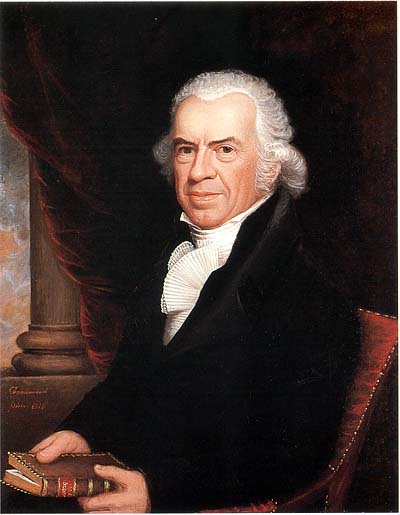
Isaiah Thomas, patriot printer and founder of the American Antiquarian Society, was born on January 19 (New Style) in 1749 (or January 8, 1748/49, Old Style). It’s quite an historical coincidence that the three most significant printers in eighteenth-century America — Benjamin Franklin, Isaiah Thomas, and Mathew Carey — were all born in January.
Isaiah_Thomas1818
Isaiah Thomas (January 30, 1749 – April 4, 1831)

The Adverts 250 Project is possible in large part due to Thomas’s efforts to collect as much early American printed material as he could, originally to write his monumental History of Printing in America.  The newspapers, broadsides, books, almanacs, pamphlets,  and other items he gathered in the process eventually became the initial collections of the American Antiquarian Society.  That institution’s ongoing mission to acquire at least one copy of every American imprint through 1876 has yielded an impressive collection of eighteenth-century advertising materials, including newspapers, magazine wrappers, trade cards, billheads, watch papers, book catalogs, subscription notices, broadsides, and a variety of other items.  Exploring the history of advertising in early America — indeed, exploring any topic related to the history, culture, and literature of early America at all — has been facilitated for more than two centuries by the vision of Isaiah Thomas and the dedication of the curators and other specialists at the American Antiquarian Society over the years.

Thomas’s connections to early American advertising were not limited to collecting and preserving the items created on American presses during the colonial, Revolutionary, and early national periods.  Like Mathew Carey, he was at the hub of a network he cultivated for distributing newspapers, books, and other printed goods — including advertising to stimulate demand for those items.  Sometimes this advertising was intended for dissemination to the general public (such as book catalogs and subscription notices), but other times it amounted to trade advertising (such as circular letters and exchange catalogs intended only for fellow printers, publishers, and booksellers).

Thomas also experimented with advertising on wrappers that accompanied his Worcester Magazine, though he acknowledged to subscribers that these wrappers were ancillary to the publication:  “The two outer leaves of each number are only a cover to the others, and when the volume is bound may be thrown aside, as not being a part of the Work.”[1]

Jan 30 - Worcerster Magazine April 1786
Detail of Advertising Wrapper, Worcester Magazine (Second Week of April, 1786)

Thomas’s patriotic commitment to freedom of the press played a significant role in his decision to develop advertising wrappers.  As Thomas relays in his History of Printing in America, he discontinued printing his newspaper, the Massachusetts Spy, after the state legislature passed a law that “laid a duty of two-thirds of a penny on newspapers, and a penny on almanacs, which were to be stamped.”  Such a move met with strong protest since it was too reminiscent of the Stamp Act imposed by the British two decades earlier, prompting the legislature to repeal it before it went into effect.  On its heels, however, “another act was passed, which imposed a duty on all advertisements inserted in the newspapers” printed in Massachusetts.  Thomas vehemently rejected this law as “an improper restraint on the press. He, therefore, discontinued the Spy during the period that this act was in force, which was two years. But he published as a substitute a periodical work, entitled ‘The Worcester Weekly Magazine,’ in octavo.”[2] This weekly magazine lasted for two years; Thomas discontinued it and once again began printing the Spy after the legislature repealed the objectionable act.

Jan 30 - Advertising Wrapper - Worcester Magazine - 4th week May 1786
Third Page of Advertising Wrapper, Worcester Magazine (Fourth Week of May, 1786)

Isaiah Thomas was not interested in advertising for its own sake to the same extent as Mathew Carey, but his political concerns did help to shape the landscape of early American advertising.  Furthermore, his vision for collecting American printed material preserved a variety of advertising media for later generations to admire, analyze, ponder, and enjoy.  Happy 267th birthday, Isaiah Thomas!

**********

[1] Isaiah Thomas, “To the CUSTOMERS for the WORCESTER MAGAZINE,” Worcester Magazine, wrapper, second week of April, 1786.

[2] Isaiah Thomas, The History of Printing in America: With a Biography of Printers, and an Account of Newspapers, vol. 2 (Worcester, MA: Isaac Sturtevant, 1810), 267-268.
 

January 19

What was advertised in a colonial newspaper 250 years ago this week?

Jan 19 - 1:17:1766 New-Hampshire Gazette
New-Hampshire Gazette (January 17, 1766)

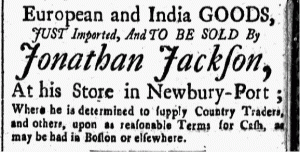
“European and India GOODS … TO BE SOLD By Jonathan Jackson, At his Store in Newbury-Port.”

Jonathan Jackson advertised his wares frequently.  Readers of the New-Hampshire Gazette would have been very familiar with his promise to sell imported goods at the same costs they would encounter in the larger port city of Boston.  Indeed, readers would have been aware of this because Jackson inserted the same advertisement in the newspaper repeatedly.  Some wholesalers and retailers that advertised regularly either revised existing notices or devised entirely new ones.  Jackson, on the other hand, repeatedly placed the same advertisement.

Nov 15 - 11:15:1765 New-Hampshire Gazette.gif
New-Hampshire Gazette (November 15, 1765)

Those who have followed the Adverts 250 Project since its origins on Twitter may recognize this advertisement and realize that I have broken one of my rules:  this advertisement was previously featured on November 15, 2015.  Why have I done this instead of providing new content?  Jackson’s (repeated) advertisement raises several issues that merit consideration when considering the history of marketing in early America.  I’ll raise two of them here.

First, did Jackson actually place this advertisement after its initial appearance?  Or was the printer responsible for each subsequent insertion?  Did it generate revenue for the printer?  Or, as a relatively short advertisement, was convenient for filling space?

In addition, did readers and potential customers pay any attention to this advertisement over time?  The promise that merchandise was “JUST Imported” certainly lost its luster over time.  The advertisement continued to prompt potential customers to visit Jackson’s shop.  Perhaps that was sufficient justification for repeating it throughout the winter months, especially since new ships were unlikely to arrive during that period.

Announcement: Adverts 250 Project Featured by Two Nerdy History Girls

I am honored and delighted that bestselling authors Loretta Chase and Susan Holloway Scott (sometimes known as Isabella Bradford) featured the Adverts 250 Project among their most recent compilation of “Breakfast Links” on their wonderful blog, Two Nerdy History Girls.  You can also find them on Twitter.  Who are Chase and Scott?  In their own words, one of them “writes historical romance” and the other “writes historical novels” and, using a nom de plume, also “writes historical romance.”

I realize that a tenure and promotion committee might not find this as impressive as being linked by the American Antiquarian Society or the Omohundro Institute of Early American History and Culture, but I am just as excited and I believe that this is just as significant.  I founded the Adverts 250 Project to be a public history and digital humanities project.  I aimed to engage wide audiences, including specialists in my field, other scholars within and beyond the academy, self-proclaimed history buffs, and the general public more broadly.  In comparing their own work to each other, Chase and Scott state, “There’s a big difference in how we use history.”  There’s also a big difference in how I use history in my career, including a very different route to publication, compared to either of them, but the most important things are that all three of us use history and all three of us want others to be as fascinated by history as we are and to learn about the past.

As I noted above, the Adverts 250 Project is a public history project.  Chase and Scott have helped to bring this project to the attention of the public, for which I am extremely grateful.  The day after they included the Adverts 250 Project among their “Breakfast Links” the site received nearly four times as many visitors and nearly five times as many page views as any previous day.  Their blog has directed visitors from twenty-two countries (Australia, Austria, Brazil, Canada, Cyprus, Denmark, Finland, Germany, India, Ireland, Israel, Luxembourg, Mexico, Myanmar (Burma), the Netherlands, New Zealand, Poland, Russia, South Africa, Sweden, the United Kingdom, and the United States) to the Adverts 250 Project, bringing this public history project to a much broader public.  (I don’t know how many people visit their blog on a daily basis, but every time they retweet an announcement that a new advertisement has been posted here — which they have already done today! — they reach more than 10,000 followers, compared to the relatively paltry 250 I have amassed during my short time on Twitter.)

Later this week students in my Public History course will be reading and discussing an essay about some of the tensions that have traditionally cropped up between historians within the academy and those who pursue history professionally beyond employment at colleges and universities, an antagonism that need not exist and that I like to think has decreased in recent years (though from my position within the academy I may have a different perspective on this than public historians do).  Though I am not aware that Chase and Scott describe themselves as public historians, their novels and their blog certainly place them somewhere within the fold.  Their spirit of generosity demonstrates the benefits of all who love history acting cooperatively rather than competitively.

Thank you, Loretta Chase and Susan Holloway Scott, for your support of the Adverts 250 Project.

January 18

What was advertised in a colonial newspaper 250 years ago this week?

Jan 18 - 1:17:1766 New-Hampshire Gazette
New-Hampshire Gazette (January 17, 1766)

“THOMAS BELL, Taylor, … has at present a very distress’d Family.”

Thomas Bell and Nathaniel Babb were competitors.  They both offered their services as tailors on the same page of the New-Hampshire Gazette.  In some aspects they made similar appeals to potential customers:  Bell promised his services “in a very genteel and punctual Manner,” while Babb indicated that he was “ready with Fidelity and Dispatch to oblige” former and new customers.

Bell, however, included a much less common appeal to entice customers:  he pulled on their heartstrings by suggesting that engaging his services would be an act of compassion toward his “very distress’d Family” since he “has no other Way or Means to support them.”  Bell did not ask for charity.  He mobilized an appeal that suggesting employing him in the trade he practiced was a means of preventing his family becoming even more destitute and a burden on others.  Consumption, he argues, could also be a means of showing concern for the welfare of others.

Jan 18 - New-Hampshire Gazette 1:17:1766 Final Page
Final Page of New-Hampshire Gazette (January 17, 1766)

Happy Birthday, Benjamin Franklin!

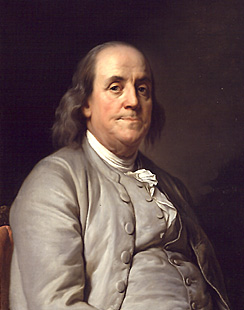
Today is an important day for specialists in early American print culture, for Benjamin Franklin was born on January 17, 1706, in Boston.  Among his many other accomplishments, Franklin is known as the “Father of American Advertising.”  Although I have argued elsewhere that this title should more accurately be bestowed upon Mathew Carey (in my view more prolific and innovative in the realm of advertising as a printer, publisher, and advocate of marketing), I recognize that Franklin deserves credit as well.  Franklin is often known as “The First American,” so it not surprising that others should rank him first among the founders of advertising in America.

Benjamin Franklin
Benjamin Franklin (Joseph Siffred Duplessis, ca. 1785).  National Portrait Gallery.

Franklin purchased the Pennsylvania Gazette in 1729.  In the wake of becoming printer, he experimented with the visual layout of advertisements that appeared in the weekly newspaper, incorporating significantly more white space and varying font sizes in order to better attract readers’ and potential customers’ attention.  Advertising flourished in the Pennsylvania Gazette, which expanded from two to four pages in part to accommodate the greater number of commercial notices.

Jan 17 - Pennsylvania Gazette 1:9-16:1736
Advertisements with white space, varying sizes of font, capitals and italics, and a woodcut from Benjamin Franklin’s Pennsylvania Gazette (December 9-16, 1736).

Many historians of the press and print culture in early America have noted that Franklin became wealthy and retired as a printer in favor of a multitude of other pursuits in part because of the revenue he collected from advertising.  Others, especially David Waldstreicher, have underscored that this wealth was amassed through participation in the colonial slave trade.  The advertisements for goods and services featured in the Pennsylvania Gazette included announcements about buying and selling slaves as well as notices offering rewards for runaways.

Jan 17 - Pennsylvania Gazette slave 1:9-16:1736.gif
An advertisement for slaves from Benjamin Franklin’s Pennsylvania Gazette (December 9-16, 1736)

In 1741 Franklin published one of colonial America’s first magazines, The General Magazine and Historical Chronicle, for all the British Plantations in America (which barely missed out on being the first American magazine, a distinction earned by Franklin’s competitor, Andrew Bradford, with The American Magazine or Monthly View of the Political State of the British Colonies).  The magazine lasted only a handful of issues, but that was sufficient for Franklin to become the first American printer to include an advertisement in a magazine (though advertising did not become a standard part of magazine publication until special advertising wrappers were developed later in the century — and Mathew Carey was unarguably the master of that medium).

General Magazine.jpg
General Magazine and Historical Chronicle, For all the British Plantations in America (January 1741).  Library of Congress.

In 1744 Franklin published an octavo-sized Catalogue of Choice and Valuable Books, including 445 entries.  This is the first known American book catalogue aimed at consumers (though the Library Company of Philadelphia previously published catalogs listing their holdings in 1733, 1735, and 1741).  Later that same year, Franklin printed a Catalogue of Books to Be Sold at Auction.

Franklin pursued advertising through many media in eighteenth-century America, earning recognition as one of the founders of American advertising.  Happy 310th birthday, Benjamin Franklin!

January 17

Who was the subject of an advertisement in a colonial newspaper 250 years ago today?

Jan 17 - 1:17:1766 New-London Gazette
New-London Gazette (January 17, 1766)

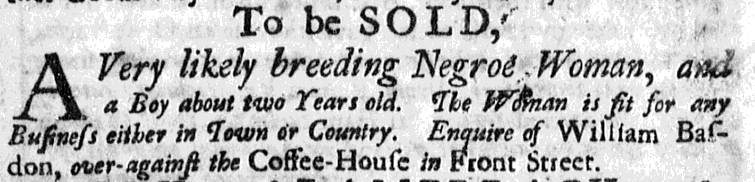
“My Wife Joanna Hebbard, hath for some time past Eloped from me.”

This advertisement does not present a commodity to be traded in the marketplace.  Unlike slaves and indentured servants, Robert Hebbard could not buy or sell his wife.  That did not necessarily make Joanna Hebbard’s position much less precarious than that of runaway indentured servant Daniel O’Mullen or the “Likely strong NEGRO GIRL” featured in recent days.  Under the laws of coverture, a woman’s legal rights and obligations — indeed, her identity as well — were subsumed under her husband upon marriage.  Joanna Hebbard, like so many other women in colonial America, was expected to abide by the will of the family patriarch, the head of household, in order to maintain good order within the family and, by extension, stable government within the colony.  Robert Hebbard’s advertisement does not reveal what sorts of domestic relations caused his wife to depart, but advertisements for runaway wives indicate that not all women were willing to be confined by the laws of coverture.  Sometimes “eloping” from their husbands became their only option.

January 16

Who was the subject of an advertisement in a colonial newspaper 250 years ago today?

Jan 16 - 1:16:1766 Massachusetts-Gazette
Massachusetts-Gazette (January 16, 1766)

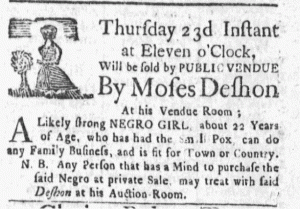
“Will be sold … A Likely strong NEGRO GIRL.”

Many, many different kinds of merchandise were bought and sold via the advertisements in eighteenth-century newspapers — certainly more than an assortment of textiles, housewares, and foodstuffs imported from London and other ports throughout the Atlantic world.  People could also be commodities in eighteenth-century America, as this advertisement demonstrates.

Advertisements for buying and selling slaves — and for runaways who sought to escape their captivity — were not uncommon in newspapers printed in New England and the Middle Atlantic and an even more familiar feature in the Chesapeake and Lower South.  This advertisement, however, is rather unique:  unlike most others peddling slaves, it includes an image, a woodcut intended to depict “A Likely strong NEGRO GIRL.”  This would have been a stock piece owned by the printer.  It could have been inserted in any number of advertisements for female slaves or even runaway wives since its features did not depict any particular woman or girl.  The “Likely strong NEGRO GIRL” remained nameless in this advertisement, just as interchangeable with other slaves, other pieces of property that could be bought and sold, as a piece of type that could be inserted in any number of advertisements.

January 15

What was advertised in a colonial newspaper 250 years ago this week?

Jan 15 - 1:13:1766 Boston- Gazette
Boston-Gazette (January 13, 1766)

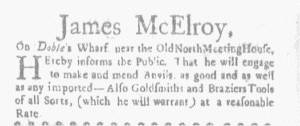
“He will engage to make and mend Anvils, as good and as well as any imported.”

In the 1760s advertisers regularly indicated that they stocked and sold imported goods.  Many advertisements deployed formulaic language or structure that included references to the origins of merchandise and explicitly used the word “imported.”  Colonial artisans found themselves in competition with shopkeepers who peddled imported wares that were often superior in quality and craftsmanship to what was produced on this side of the Atlantic.

James McElroy seems to have realized that other colonists could be skeptical about such goods.  In response, he offered a variation on the first “Buy American” campaigns that emerged during the Stamp Act protests when he assured potential customers that he could “make and mend Anvils, as good and as well as any imported.”  In addition, he forged “Goldsmiths and Braziers Tools of all Sorts” and offered a guarantee (“which he will warrant”) of their quality.

Selecting Adverts: Newspapers Published this Week 250 Years Ago

This week I would like to spend some time discussing the sources that make the Adverts 250 Project possible and my methods for selecting which advertisements to feature. Each advertisement reveals something about early American life and culture, some because they offer unique features of one kind or another and others because they are so common or formulaic that they provide a glimpse of everyday life. One of the challenges of working with some print (newspapers, broadsides, pamphlets) and manuscript (letters, diaries, journals) sources is that historical actors often considered aspects of daily life, such as their use of material culture items, so common that they did not merit comment. All too often I commiserate with fellow scholars as we wish that we could find that crucial piece of evidence, the “smoking gun,” that would tell us more about eighteenth-century attitudes and behaviors that are hidden and unknown to us today. Advertisements, however, often explicitly provide details about some of the most mundane aspects of everyday life in eighteenth-century America.

This is a project that began in my living room. Thanks to ongoing projects to photograph and digitize eighteenth-century newspapers, I am able to continue this project anywhere I have access to the Internet. To date, I have not consulted original newspapers (except to get a better quality image to accompany the link on The Octo), relying instead on the digital surrogates made available via a Readex database, “America’s Historical Newspapers.” At my request, my campus library purchased a subscription, which I use in both my own research and the classes I teach. This makes it possible for me – and my students – to access primary sources that certainly were not readily available just a couple of decades ago. There’s no need to go to an archive that houses the originals or a major research library that possesses microfilm copies. In a future post I will reflect on the benefits of both those methods. I am not trying to suggest that digital surrogates are superior to other formats. Rather, I want to acknowledge how new technologies and digital humanities projects have made this particular public history project possible.

To choose advertisements to feature I first need to identify which newspapers printed in 1766 are included in my library’s subscription to “America’s Historical Newspapers.” This amounts to fifteen newspapers from seven colonies:

New Hampshire

  • New-Hampshire Gazette (Portsmouth)

Massachusetts

  • Boston Evening-Post
  • Boston Gazette
  • Boston News-Letter
  • Boston Post-Boy

Rhode Island

  • Newport Mercury
  • Providence Gazette

Connecticut

  • Connecticut Courant (Hartford)
  • Connecticut Gazette (New London)

New York

  • New-York Gazette
  • New-York Gazette, or Weekly Post-Boy
  • New-York Journal
  • New-York Mercury

Pennsylvania

  • Wochentliche Philadelphische Staatsbote (Philadelphia)

Georgia

  • Georgia Gazette (Savannah)
Jan 15 - Masthead for 1:13:1766 New-York Mercury
Masthead for New-York Mercury (January 13, 1766)

In choosing advertisements for the past week, not all of these newspapers were viable options. The Georgia Gazette, for instance, had been suspended near the end of 1765. It did not resume publication until the third week of May 1766. Other newspapers were in a similar situation, though it is worth mentioning that even if a newspaper was in operation during this period in 1766 that does not guarantee that any copies are still extant. And, even if a copy does survive, it may not have been photographed or digitized and made available in “America’s Historical Newspapers.” Such resources are often built around the collections from a particular historical society, research library, or other institution. As a result, digital surrogates available in many databases are limited to what is physically part of the collections at the institution where the project originated. This is changing over time as those overseeing a variety of digital humanities projects seek to fill in gaps and provide more comprehensive coverage, but it remains a limiting factor that anybody pursuing research using eighteenth-century sources should take into consideration.

Similarly, consumers of their research – whether fellow scholars, self-proclaimed history buffs, or general audiences – should also be aware that many of the resources that have facilitated research over the past couple of decades are not exhaustive. Impressive, yes, but a variety of factors have determined what is actually available to modern researchers: factors that range from which documents survive from the eighteenth century to decisions made by librarians and curators in cataloging and preserving those items to practical and financial considerations of project managers and their corporate partners in the process of designing and executing databases and other projects. For the Adverts 250 Project, this means that I have relatively easy access to many eighteenth-century newspapers, but certainly not every newspaper published in 1766, nor even every newspaper from that year that happens to survive.

Another factor influences which advertisements I select to feature. I confess that I do not speak or read German. Unfortunately, the Wochentliche Philadelphische Staatsbote will not be a regular part of this project. As a result, I acknowledge that I am overlooking the particular experiences of a sizable number of settlers in Pennsylvania and other Middle Atlantic colonies.

In the end, I had access to ten newspapers from five colonies as I selected advertisements to feature this past week.

New Hampshire

  • New-Hampshire Gazette (Portsmouth)

Massachusetts

  • Boston Evening-Post
  • Boston Gazette
  • Boston News-Letter
  • Boston Post-Boy

Rhode Island

  • Newport Mercury

Connecticut

  • Connecticut Courant (Hartford)
  • Connecticut Gazette (New London)

New York

  • New-York Gazette
  • New-York Mercury
Jan 15 - Masthead for 1:13:1766 Boston Evening-Post
Masthead for Boston Evening-Post (January 13, 1766)

While this may seem like copious sources at first glance, those who regularly work with eighteenth-century newspapers realize that this is deceptive because newspapers were not published daily in colonial America. New issues were never printed on Sundays. Indeed, each of these titles appeared only once a week. So, a list that initially suggests seventy issues (or sixty, if discounting Sundays) based on modern publication practices actually yields merely ten issues. This is certainly sufficient for this project, but I believe it is important context for readers, for the consumers of my work, especially those who do not have as much familiarity with eighteenth-century newspapers.

For my extended commentary essay next week, I will explain how I chart each issue on a calendar to gain a sense of which newspapers were being published where in the colonies on any given day of the week in 1766. Centuries after these newspapers were printed, the timing of their publications exerts significant impact on the contours of the Adverts 250 Project.

January 14

Who was the subject of an advertisement in a colonial newspaper 250 years ago this week?

Jan 14 - 1:13:1766 New-York Mercury
New-York Mercury (January 13, 1766)

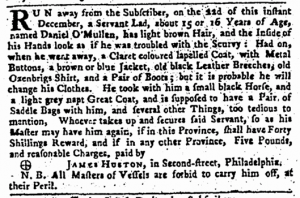
“DANIEL O’Mullen, a Run-away Servant, belonging to Mr. James Huston in Second Street, Philadelphia, was taken up in this City a few Days ago.”

This advertisement may seem a bit out of place considering that the Adverts 250 Project focuses primarily on advertisements for consumer goods and services, setting aside the other kinds of notices that colonists paid to have placed in newspapers.  This advertisement reminds us that in the eighteenth century many people were commodities themselves.  Advertisements for enslaved men and women, youths, and children provide the most compelling examples, but indentured servants were also bought and sold in colonial America — and, like other unfree laborers, their attempts to escape were often chronicled in newspaper advertisements.

Runaway Advert in PA Gaz 12:26:1765
Pennsylvania Gazette (December 26, 1765)

I also selected this advertisement from the New-York Mercury because it demonstrates the networks of newspaper distribution and readership in the 1760s.  It references “an Advertisement in the Pennsylvania Gazette, of December 26, 1765,” offering a reward to anyone who captured O’Mullen so “his Master may have him again.”  Rather than sending a letter to “James Huston, in Second-street, Philadelphia,” the original advertisement was met with an advertisement.  It appears that those seeking to collect the reward expected that Huston or one of his acquaintances would see the advertisement concerning O’Mullen’s capture.