January 13

What was advertised in a colonial newspaper 250 years ago today?

Jan 13 - 1:13:1766 Boston Evening-Post
Boston Evening-Post (January 13, 1776).

“To be sold at the STORE of John Smith … A general Assortment of GOODS.”

Advertisements like this one from John Smith make me reassess (or, at least, temper) one of the central arguments of my work on advertising in eighteenth-century America.  I contend that the consumer revolution that took place in the late colonial period, during the American Revolution, and into the era of the Early Republic was supply driven, whereas others argue that it was generated by consumer demand.  I have spent a lot of time and spilled a lot of ink making the case that newspaper advertisements and other marketing media were developed to incite demand among potential customers, that producers, suppliers, and retailers invoked a variety of appeals and devised incentives to encourage potential customers that they wanted and needed to purchase their goods and services.

Smith’s rather simple advertisement is certainly not the best example offering support for such claims.  At first glance, it seems to amount to little more than an announcement.  However, I am not willing to abandon my argument concerning the significance of supply (rather than demand) in the consumer revolution.  Consider other advertisements that appeared in the same issue.  Many make appeals to price or quality or fashion.  Some provide extensive lists to underscore the choices available to potential customers.  Indeed, even the relatively banal reference to “A general Assortment of GOODS” does make an appeal by hinting at the possibility of many choices among Smith’s merchandise.  Smith’s advertisement may not be flashy by modern standards — or the standards of the nineteenth century or even the final decades of the eighteenth century — but it does suggest that even many of the most rudimentary advertisements used language meant to engage readers and encourage them to make purchases.

Jan 13 - Boston Evening-Post - Full Page
Final Page of the Boston Evening-Post (January 13, 1766).

January 12

What was advertised in a colonial newspaper 250 years ago this week?

Jan 12 - 1:9:1766 Massachusetts Gazette
Massachusetts Gazette (January 9, 1766)

“Superfine Hyson Tea” and “Choice Bohea TEA.”

Given that Richard Clarke directed customers to his “Warehouse the lower End of King-Street” and James Jackson invited them to his “Shop in Union-Street,” it appears that the former was a wholesaler and the latter a retailer.  But they both peddled that increasingly popular eighteenth-century beverage:  tea.  Once reserved for elite consumers, tea became a staple and a necessity in eighteenth-century America.

(Update:  J.L. Bell notes, via Twitter,  that “Captain Bruce” worked for Hancock. Richard Clarke was later the lead importer during the 1773 tea crisis.)

Hyson Tea
Hyson Tea

These short advertisements, positioned next to each other on the page, offer two kinds of tea.  Hyson is a green tea that comes from the Anhui and Zhejiang provinces in China.  “Superfine Hyson” likely refers to what is today known as Young Hyson or Lucky Dragon, a finer variety with lighter flavor.  Bohea, now known as Wuyi, is a variety of black and oolong tea grown in the mountains in northwestern China.  Originally Bohea, with its smoky flavor, was considered a luxury item, but it eventually became one of the most popular varieties in colonial America.  In his Autobiography, Benjamin Franklin recorded provisioning General Edward Braddock’s forces with both “good green tea” and “good bohea tea” during the French and Indian War.

Bohea Tea
Bohea Tea

***************

Pluff Tea Collection
Teas offered for sale by Oliver Pluff & Co, Charleston, SC.

In researching this entry, I discovered quite a few twenty-first suppliers and public history institutions and organizations who use colonial imagery to market tea to modern consumers.  The cachet is in the connection to the American past, sometimes even using the Boston Tea Party to sell products by counterintuitively suggesting that Americans should now purchase and drink the very tea that their ancestors tossed into the harbor in protest.

I admire the decorative labels on Oliver Pluff & Co‘s canisters (which they call “Signature Tea Tins”).  The company, located in Charleston, South Carolina, bills itself as “A Leaf from America’s Tea Heritage” (and seems to be the supplier of tea merchandise for many public history sites).  I have not tried their tea, so I cannot testify to its quality, but I plan to make a purchase in order to obtain the canisters.  Score one for marketing!

Bonus: Edward Pole’s Advertising Campaign

Yesterday evening I discovered that the American Antiquarian Society included a newspaper advertisement in its Instagram feed earlier in the day, a delightful surprise made even better by a generous reference to the Adverts 250 Project.  Please visit the AAS Instagram feed to see the advertisement and their commentary.

I was also excited because I recognized the advertiser, Edward Pole, a “Fishing-Tackle-Maker” who also operated a wholesale and retail grocery store in Philadelphia in the 1770s and 1780s.  Unlike most newspaper advertisements featured in the Adverts 250 Project so far, Pole’s advertisement (from fifteen years later, June 1781) included a woodcut to catch readers’ attention:  a striking image of a fish, certainly appropriate for an entrepreneur who peddled fishing tackle.  Woodcuts accompanying newspaper advertisements became more common during the last third of the eighteenth century.  Some advertisers, like Pole, used them as brands for their products and businesses.

Pole’s woodcut probably looked familiar to consumers in Philadelphia in 1781.  It appeared regularly in the Pennsylvania Packet (at least as early as May 1774), but that was not the only newspaper that included a woodcut of a fish with Pole’s commercial notices.  Pole placed advertisements for fishing tackle, including a very similar fish (this time with a decorative border), in the Freemen’s Journal in 1784.

Pole Newspaper Advert
Advertisement from the Freemen’s Journal (March 24, 1784).  Historical Society of Pennsylvania.

In addition,the savvy Edward Pole made use of multiple advertising media.  He distributed an engraved billhead for his receipts as early as the 1770s.  The billhead’s elaborate engraving featured a triptych logo in the upper left corner of the sheet, complete with rococo-style frames surrounding casks, crates, and scales on the left and right and the words “Edwd Pole’s GROCERY STORE Wholesale & Retail” in the center.  This billhead, with manuscript notations from 1771, is part of the Norris Papers at the Historical Society of Pennsylvania.

Sometime in the late 1770s or early 1780s, he also distributed engraved trade cards featuring a rectangular vignette of two gentlemen fishing in a stream above a description of the wares stocked in his shop.  Pole eventually resorted to broadsides (or, in modern terms, posters) for his business ventures.

Edward Pole Trade Card
Edward Pole’s Trade Card (ca. 1780).  Historical Society of Pennsylvania.

In addition to trade cards, billheads, and broadsides, Pole most prolifically advertised in several of Philadelphia’s newspapers, often distinguishing his advertisements from others on the page by including a woodcut of a fish, as we have seen.  Pole’s use of multiple media allowed him to publicize his wares widely.  Most advertisements relied exclusively on newspapers for their marketing, but Pole took an innovative approach by experimenting with other forms as he encouraged potential customers to visit his shop.

January 11

What was advertised in a colonial newspaper 250 years ago this week?

Jan 11 - 1:10:1766 New-Hampshire Gazette
New-Hampshire Gazette (January 10, 1766)

“NATHANIEL BABB, Taylor, … informs his Customers and others, That he has removed from the Shop where he formerly Work’t to a new Shop.”

Who hasn’t heard a particular hackneyed phrase — “Location!  Location!  Location! — when contemplating buying a home or, especially, opening a business.  Nathaniel Babb understood that location was important:  he could not remain in business if former and potential customers did not know where to find him.  His advertisement offers few appeals to consumers (though he does indicate he was “ready with Fidelity and Dispatch”) in favor of instead making sure that they knew where to find him after his move to a new location.

Many shopkeepers and artisans used elaborate shop signs, such as the one seen below, to identify their places of business in eighteenth-century America (and England as well), but not everyone did so.  In an era before standardized street numbers, Babb offers convoluted directions:  his shop was “lately erected near the Corner of Clement Jackson’s, in the Street leading to the Canoe Bridge.”  Even if Babb had a sign to hang at his new shop, he still needed to direct customers to the general vicinity.

Philip Godfrid Kast Trade Card
Philip Godfrid Kast’s trade card engraved by Nathaniel Hurd in Boston in 1774 (American Antiquarian Society).

The druggist who issued this trade card included an image of his shop sign, an early form of branding that helped customers remember and locate his business.

January 10

What was advertised in a colonial newspaper 250 years ago today?

Jan 10 - 1:10:1766 New-Hampshire Gazette
New-Hampshire Gazette (January 10, 1766)

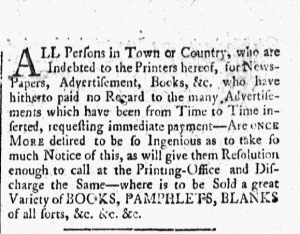
“ALL Persons … Indebted to the Printers hereof, for News-Papers, Advertisement, Books, &c. … Are ONCE MORE desired … to call at the Printing-Office.”

Historians of print culture have long contended that selling subscriptions did not make publishing newspapers profitable for colonial printers.  Instead, the real money was in charging for the advertisements!  I do not doubt the veracity of this claim, especially given how carefully so many other scholars have scrutinized the account books, ledgers, and other records of colonial printers.

However, I suspect that we sometimes overestimate the amount of revenue generated by newspaper advertising if we assume, when printers’ records are no longer extant to confirm that this was indeed the case, that each time an advertisement appeared in a new issue that the printer received payment.  In this instance, the printers of New-Hampshire Gazette placed their own advertisement to call on delinquent advertisers to pay for services rendered.  On many other occasions, some advertisements repeat for weeks or months, suggesting that printers sometimes used them for filler even without remuneration.

January 9

What was advertised in a colonial newspaper 250 years ago today?

Jan 9 - 1:9:1766 Massachusetts Gazette
Massachusetts Gazette (January 9, 1766)

“PAINTS.  White. … Reds. … Yellows. … Blues. … Greens. … Blacks. … Varnishes.”

The three columns in John Gore’s advertisement for paints and related supplies draw the eye.  Unlike the dense layout of the list advertisement featured yesterday, Gore’s notice uses varying font sizes and, especially, white space to direct potential customers’ attention to some of his wares.

I am resisting the urge to assume that it was only natural to use columns to organize this advertisement simply because doing so makes good sense, from a modern perspective, for several reasons.  It provides better organization and highlights individual products.  Such line of reasoning did not always seem to hold sway with eighteenth-century advertisers, however, as they often opted for dense paragraphs listing goods and occasionally experimented with fonts, sizes, and layout.

The longer I study early American advertising, the more strongly I become convinced that advertisers sometimes played a role in determining the appearance of their notices, but most often the printer who set the type played the most influential role.  What was the case here?  Did Gore request that his paints be divided into three columns?  Or did the printer make this decision without consulting the advertiser?

January 8

What was advertised in a colonial newspaper 250 years ago this week?

Jan 8 - 1:6:1766 Newport Mercury
Newport Mercury (January 6, 1766)

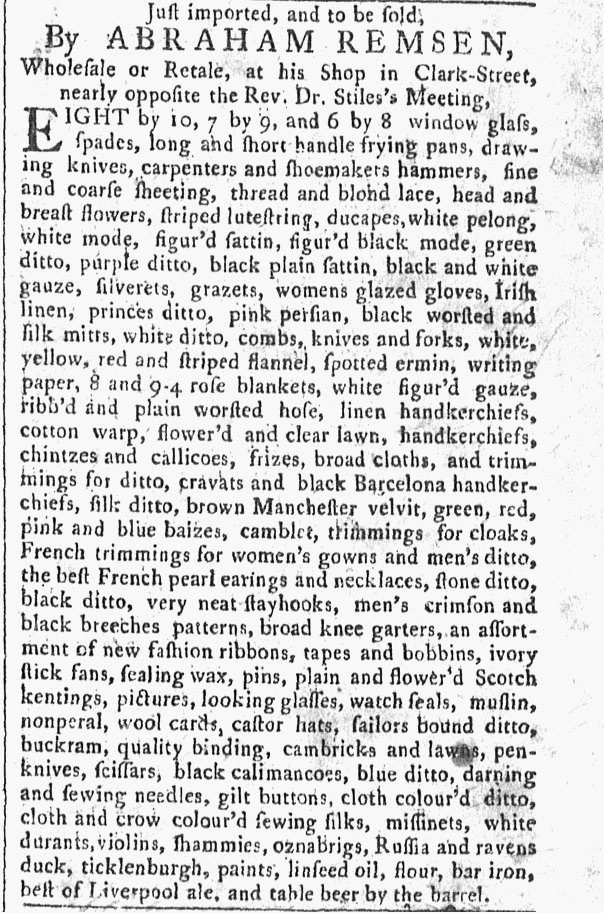
“Spades … black plain sattin … chintzes and callicoes … brown Manchester velvit … the best French pearl earings and necklaces … tapes and bobbins … pen-knives … darning and sewing needles … and table beer by the barrel.”

Abraham Remsen stocked a variety of merchandise to be sold “Wholesale or Retale, at his Shop in Clark-Street” in Newport.  Reading through his list advertisement, which certainly testifies to the assortment of goods so many shopkeepers promoted in eighteenth-century America, can be a bit disorienting.  In response to an advertisement featured a short while ago, one correspondent on Twitter remarked that colonial Americans must have had longer attention spans than their modern counterparts, considering the length, density, and lack of visual images common in many newspaper advertisements of the period.

This prompted me to think about reading habits in the eighteenth century.  Historians have long argued that early Americans read newspapers intensively, that they were read aloud in public spaces (like taverns and coffeehouses) and passed around until they became dog-eared.  Consider that American newspapers in the 1760s were published once a week.  Consider also that each issue was typically a single broadsheet, folded in half to create a four-page newspaper.  It makes sense that subscribers and others would read the news items carefully and perhaps multiple times.

But what about the advertisements?  Would they have been read as intensively as other items?  How would an early American reader have approached this advertisement?

Announcement: Adverts 250 Linked via The Octo

The Adverts 250 Project is currently featured on The Octo:  Blogging Early America.  The Octo, curated by Joseph M. Adelman, assistant editor for digital initiatives at the Omohundro Institute of Early American History and Culture, is a rotating lineup of “feeds from popular blogs.”

The Octo features eight (get it:  The Octo!) blogs.  The current cohort includes:

This is very fine company to be keeping!  The Adverts 250 Project should remain in the tentacles of The Octo for a few weeks before being released to The Octo Archive, a permanent list linking all the blogs about early American history and culture previously ensnared by The Octo.

In related news, Karin Wulf, director of the Omohundro Institute, recently included The Adverts 250 Project in a tweet about the Institute’s new #VastEarlyAmerica initiative.  You can read more about Vast Early America here.

In Which a Luddite Embraces Twitter

I mentioned in this blog’s inaugural post that the Adverts 250 Project originated on Twitter (where it still continues as part of my account, @TradeCardCarl). I have only recently been initiated in the Twitterverse, having looked at it askance for several years. Tweets seemed both ephemeral and insubstantial. What could I possibly say in 140 characters? Certainly not anything of significance! When I established my account I included “Recovering Luddite” in my short biography (since replaced with “Daily #Adverts250 Update”). I have long joked that on the spectrum of early adopter to Luddite I fell somewhere around “Printing Presses Are Cool.” (They are!)

I signed up for Twitter while participating in the American Antiquarian Society’s Digital Antiquarian Workshop (a week-long seminar designed as a companion to the Digital Antiquarian Conference), led by Molly O’Hagan Hardy (digital humanities curator, AAS) and Thomas Augst (English, New York University). I wanted to become a bit more tech savvy, hoping to pursue digital humanities projects that would further my own research as well as design others as part of the introductory public history class that I teach every second spring semester. In my application I even suggested potential book history and advertising projects I could pursue with students. I do intend to pursue those projects eventually, but for the moment I have moved them to the back burner in favor of the Adverts 250 Project. Undergraduates from Assumption College will be joining me in this endeavor during the Spring 2016 semester. I’ll certainly have more posts about that – as well as guest contributions – in the coming months.
Digital Antiquarian Banner

As I mentioned last week, the first #Adverts250 update was a whim, a bit of fun (but I am grateful that I had the foresight to include #Adverts250 as a hashtag from the start, making it possible to identify all of the entries). The first advertisement I featured garnered several “favorites” (then a star rather than the current heart icon) and retweets, some of them from friends and colleagues but others from scholars and interested members of the general public whom I did not know. I followed up with another advertisement the next day, gaining more “favorites” and retweets. I also gained new followers, which I attributed to the new series of posts about eighteenth-century advertising. It was then that two things happened: I decided to formalize the Adverts 250 Project as a daily feature of my (previously very sporadic) Twitter account and I embraced the power of Twitter.

I have long been concerned that historians at colleges and universities often engage in insular conversations among themselves and other scholars but do not always communicate more directly with the general public. This is a lament that we hear often from a variety of colleagues striving to make our work meaningful and accessible to others, so I will not rehearse all of the arguments here except to say that the digital humanities opens new doors and complements the work being done by our public history colleagues. As a methodology, digital humanities enriches our research. In providing new or alternate media or forums, digital humanities allows greater distribution of our work and invites new audiences. I quickly found this to be the case with the Adverts 250 Project in its first incarnation on Twitter. My research, previously doled out in moderate-sized chunks at conferences and public lectures or in articles and chapters, now had new audiences. I had previously dismissed Twitter for being too much of a popular culture phenomenon, but instead of nurturing such anxiety I should have realized that the mass consumption aspects of Twitter that made me disregard social media actually presented a rich opportunity for engaging multiple audiences that I long desired would take a more sustained interest in learning about the past.

I also quickly got over another prejudice: “What I have to say is too complex to express in a mere 140 characters.” While I continue to maintain that complexity and nuance – more words! – are imperative to the work we do as scholars, I have had an attitude adjustment concerning the 140 character limit on Twitter. Being succinct has never been one of my strengths, and I believe that many of us are trained to be verbose, often unnecessarily. Distilling my commentary on any eighteenth-century advertisement (explaining its context and significance) down to one or two sentences forced me to refine my thinking. What is the most important thing I want to say about this particular advertisement? What is essential for me to communicate? How can I do so for fellow eighteenth-century British Atlantic World specialists? How can I do so for other audiences? Composing a tweet intended to use an advertisement to open up the commercial, cultural, or political world of eighteenth-century colonists often turned out to be a much more difficult task than writing an entire paragraph (which is part of the reason that the Adverts 250 Project continues on Twitter as well).

I was having a great time with my daily #Adverts250 update on Twitter. Several colleagues whom I respect told me how much they were enjoying the project, but one in particular encouraged me to seek a more permanent home and a platform for reaching broader audiences. That the Adverts 250 Project has its own blog is the result of conversations with Molly O’Hagan Hardy, digital humanities curator at the American Antiquarian Society, who consistently doles out insightful and helpful advice. As I’ve already made clear, I’m a novice in the world of digital humanities, but Hardy has thoughtfully and patiently worked with me to develop both my own projects and projects for students in my undergraduate courses. I have very much appreciated the attention that she bestows on my work, but I have also witnessed her consulting on projects with scholars possessing various levels of digital humanities expertise. Her intellectual generosity is a model.

That’s where I would like to conclude this week’s behind-the-scenes look at the Adverts 250 Project. Thank you, Molly O’Hagan Hardy, for your encouragement and advice. Last week I concluded with an exclamation: “the Adverts 250 Project was born!” To continue the metaphor, you are the midwife who assisted in the delivery.

January 7

What was published in a colonial newspaper 250 years ago this week?

Jan 7 - 1:6:1766 Connecticut Courant
Connecticut Courant (January 6, 1766)

“Augustus Deley, Tobaconist (from New York) … keeps constantly for Sale, ALL Sorts of TOBACCO.”

I suggested that yesterday’s advertisement for Yorkshire muffins (Yorkshire pudding) used words to evoke some of the smells of a colonial port city.  This advertisement does so as well.  It also prompts readers to imagine other goods that consumers needed to purchase or possess.  Just as sugar nippers were necessary for consuming the sugar loaves featured earlier this week, “Chewing, or Smoaking” tobacco required various accoutrements.

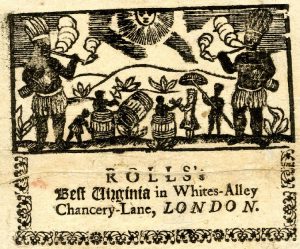
Daley notes he supplies “Hog-Tail, Pig-Tail, and Shagg in Papers.”  These wrappers were likely unadorned, marking a significant deviation from tobacco advertising on the other side of the Atlantic.  By the turn of the eighteenth century, as Catherine Molineux notes, “Tobacconists and other tradespeople began commissioning local artisans to engrave or etch trade cards, billheads, and what the British Museum characterizes as tobacco papers, or wrappers.” [1]  Although trade cards and billheads became increasingly common among other occupational groups in America as the eighteenth century progressed, either tobacconists did not provide wrappers that advertised their wares or such printed ephemera has not survived.

If you have encountered eighteenth-century tobacco wrappers distributed by American tobacconists, I would very much appreciate knowing about them!

Rolls's_Best_Virginia_tobacco_advertisement
An eighteenth-century tobacco advertisement from the collections of the British Museum, London.

[1] Catherine Molineux, “Pleasures of the Smoke:  ‘Black Virginians’ in Georgian London’s Tobacco Shops,” William and Mary Quarterly, 3rd. ser., 64, no. 2 (April 2007): 343.