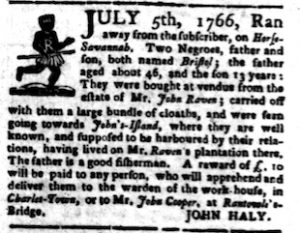
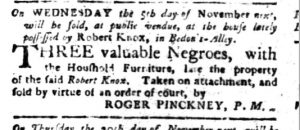
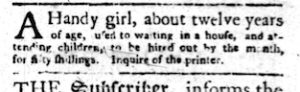
The Slavery Adverts 250 Project chronicles the role of newspaper advertising in perpetuating slavery in the era of the American Revolution. The project seeks to reveal the ubiquity of slavery in eighteenth-century life from New England to Georgia by republishing advertisements about enslaved people – for sale as individuals or in groups, wanted to purchase or for hire for short periods, runaways who liberated themselves, and those who were subsequently captured and confined in jails and workhouses – in daily digests on this site as well as in real time via the @SlaveAdverts250 Twitter feed, utilizing twenty-first-century media to stand in for the print media of the eighteenth century.
The project aims to provide modern audiences with a sense of just how often colonizers encountered these advertisements in their daily lives. Enslaved men, women, and children appeared in print somewhere in the colonies almost every single day. Those advertisements served as a constant backdrop for social, cultural, economic, and political life in colonial and revolutionary America. Colonizers who did not purport to own enslaved people were still confronted with slavery as well as invited to maintain the system by purchasing enslaved men, women, and children or assisting in the capture of so-called “runaways” who sought to free themselves from bondage. The frequency of these newspaper advertisements suggests just how embedded slavery was in colonial and revolutionary American culture in everyday interactions beyond the printed page.
These advertisements also testify to the experiences of enslaved men, women, and children, though readers must consider that those experiences have been remediated through descriptions offered by enslavers rather than enslaved people themselves. Often unnamed in the advertisements, enslaved men, women, and children were not invisible or unimportant in early America.
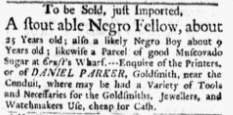
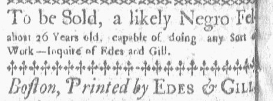
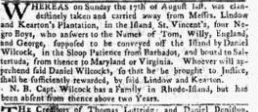
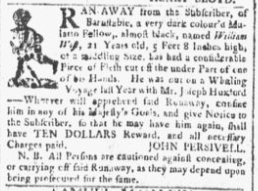
These advertisements appeared in colonial American newspapers 250 years ago today.
Boston Evening-Post (November 3, 1766).
**********
Boston Evening-Post (November 3, 1766).
**********
Boston Evening-Post (November 3, 1766).
**********
Boston-Gazette (November 3, 1766).
**********
Supplement to the Boston-Gazette (November 3, 1766).
What was advertised in a colonial newspaper 250 years ago this week?
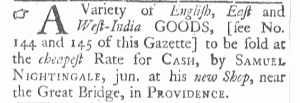
Providence Gazette (November 1, 1766).
“A Variety of English, East and West-India GOODS, … to be sold at the cheapest Rate for CASH.”
In this advertisement in the Providence Gazette, Samuel Nightingale, Jr., sold an assortment of goods from England, as well as both the East and West Indies, in his “new Shop, near the Great Bridge” in Providence.
Since this advertisement mentions earlier issues that included the actual information about what was being sold, I went in search of them. In issue 145, published on October 25, 1766, I found a much larger advertisement with a vast list of goods. The majority of the items on the list were linens and other sorts of textiles, but it also included other things, such as “Ivory and buckling combs,” “Pewter dishes, plates and basons,” and “Flat irons. English Steel.”
Providence Gazette (October 18, 1766).
Pewter was very popular in the eighteenth century. James A. Mulholland notes that “[a]ll but the poorest families owned at least one or two pewter items, and wealthier families accumulated substantial inventories of pewterware, including porrigngers, tankards, coffeepots, and candlesticks.”[1] He also noted that the majority of pewter came from England.
**********
ADDITIONAL COMMENTARY: Carl Robert Keyes
I was very excited when Ceara selected this advertisement. When guest curators are participating in this project I leave the decisions about which advertisements to feature to them, provided they follow the project’s methodology. That means that they sometimes pass over advertisements that I find either interesting or significant, but that’s just the way it goes sometimes when working on a collaborative project. After all, the guest curators can learn something interesting or significant about colonial America from any advertisement.
Why was I so excited when Ceara submitted this advertisement for approval? She mentioned the reason in her own analysis. Samuel Nightingale, Jr., instructed potential customers to “[see No. 144 and 145 of this Gazette]” for a list of the “Variety of English, East and West-India GOODS” that he sold. When she noticed this, Ceara did the sort of historical detective work that I consider an enjoyable part of this project: she consulted the earlier issues (October 11 and 18, 1766) of the Providence Gazette to find out more about those advertisements. In the process, she discovered an advertisement that resembled others by Thompson and Arnold and Benjamin Thurber and Edward Thurber, both previously featured by the Adverts 250 Project.
In the course of a few weeks, Nightingale published two advertisements with rather extraordinary features. His first advertisement borrowed innovations from competitors, but those innovations had not been so widely adopted that Nightingale’s advertisement blended in with others. With a decorative border and spanning two columns, Nightingale’s earlier advertisements dominated the pages on which they appeared.
Providence Gazette (October 18, 1766).
Today’s advertisement did not have the same visual impact, but it did incorporate one rather unusual feature. It instructed readers to consult another newspaper to see the original advertisement. Nightingale assumed a high level of interest among potential customers. At the very least, he hoped to incite interest by offering a brief description and then challenging readers to find the original advertisements in earlier issues.
This tells us something about how colonists used newspapers. Nightingale’s directions to “[see No. 144 and 145 of this Gazette]” only worked if readers still had access to those issues. It suggests that subscribers held on to newspapers for at least several weeks to consult the news, advertisements, and other items they contained. Newspapers were not immediately ephemeral in the eighteenth century. In turn, that means that the advertisement printed in colonial newspapers had longer lives than the week that passed before the publication of the next issue.
Running his lengthy advertisement for two weeks may have been a significant investment for Samuel Nightingale, Jr., but it may also have been a risk worth taking if he could depend on it to keep circulating for quite some time after that. To shore up his bet, today’s brief notice directed potential customers back to the impressive original advertisement.
**********
[1] James A. Mulholland, History of Metals in Colonial America (Tuscaloosa: University of Alabama Press, 1981), 95.
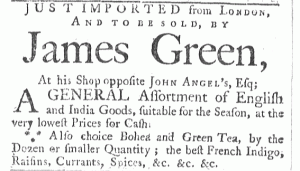
What was advertised in a colonial American newspaper 250 years ago today?
Providence Gazette (November 1, 1766).
“A GENERAL Assortment of English and India Goods.”
In this advertisement in the Providence Gazette, James Green sought to sell an “assortment of English and India Goods.” The “India Goods” had been sent to London by the British East India Company.
Originally, the British East India Company’s primarily goal was trade, but it eventually became a ruling power in India. How? What kept the British East India Company in India was something more useful than any goods that could be exported: armies. They realized that Indians with modern weaponry could be just as good as European soldiers, but for half the price. The Company also used its armies to gain favor with rulers in India. Those armies aided Indian princes, thus creating opportunities for the Company to have sway in governing India.
The Company was able to avoid certain taxes that would normally be put on them for trading. Some Indian leaders tried to oppose the Company, such as the nawāb (or governor) Sirajud-Dawla and the Mughal emperor. They failed when the Company’s army defeated their armies in 1764. After that, the British East India Company gained more control over trade, including the revenue systems of Bengal, Orissa, and Bihar.
James Green sold “A GENERAL Assortment of … Goods” and commodities that had been transported great distances. The “Bohea and Green Tea” came from China, the indigo came from France, the spices came from the East Indies, and the “India Goods” came from the Indian subcontinent.
Ceara traces some of the history of the British East India Company in the years immediately before this advertisement appeared in a newspaper on the other side of the world. In providing glimpses of the British East India Company’s interventions in India, she demonstrates that colonists in New England were connected to faraway places that, until recently, have not been associated with the colonial American experience. For a generation and more, however, scholars have been reconceiving of colonial America as only a portion of a larger Atlantic world, but even those expansive boundaries cannot contain the webs of commerce and conquest that spread around the globe. Historians continue to discover that early America was much more vast than we previously realized!
For instance, in a book published earlier this year, Selling Empire: India in the Making of Britain and America, 1600-1830, Jonathan Eacott “recasts the British empire’s chronology and geography by situating the development of consumer culture, the American Revolution, and British industrialization in the commercial intersections linking the Atlantic and Indian Oceans.” Eacott examines “evolving networks, ideas, and fashions that bound India, Britain, and America” in the seventeenth through nineteenth centuries.
In doing her research to write about today’s advertisement, Ceara discovered a portion of this story on her own. It is a story that departs from traditional definitions and expectations about what should be included in a history of colonial America, but it is a more complete story that acknowledges that shopkeepers like James Green and his potential customers who read the Providence Gazette represented only two links in a much longer chain of supply and exchange that extended far beyond London to British merchants and officials operating in a very different colonial context in India.
The Slavery Adverts 250 Project chronicles the role of newspaper advertising in perpetuating slavery in the era of the American Revolution. The project seeks to reveal the ubiquity of slavery in eighteenth-century life from New England to Georgia by republishing advertisements about enslaved people – for sale as individuals or in groups, wanted to purchase or for hire for short periods, runaways who liberated themselves, and those who were subsequently captured and confined in jails and workhouses – in daily digests on this site as well as in real time via the @SlaveAdverts250 Twitter feed, utilizing twenty-first-century media to stand in for the print media of the eighteenth century.
The project aims to provide modern audiences with a sense of just how often colonizers encountered these advertisements in their daily lives. Enslaved men, women, and children appeared in print somewhere in the colonies almost every single day. Those advertisements served as a constant backdrop for social, cultural, economic, and political life in colonial and revolutionary America. Colonizers who did not purport to own enslaved people were still confronted with slavery as well as invited to maintain the system by purchasing enslaved men, women, and children or assisting in the capture of so-called “runaways” who sought to free themselves from bondage. The frequency of these newspaper advertisements suggests just how embedded slavery was in colonial and revolutionary American culture in everyday interactions beyond the printed page.
These advertisements also testify to the experiences of enslaved men, women, and children, though readers must consider that those experiences have been remediated through descriptions offered by enslavers rather than enslaved people themselves. Often unnamed in the advertisements, enslaved men, women, and children were not invisible or unimportant in early America.
These advertisements appeared in colonial American newspapers 250 years ago today.