
What was advertised in a revolutionary American newspaper 250 years ago today?
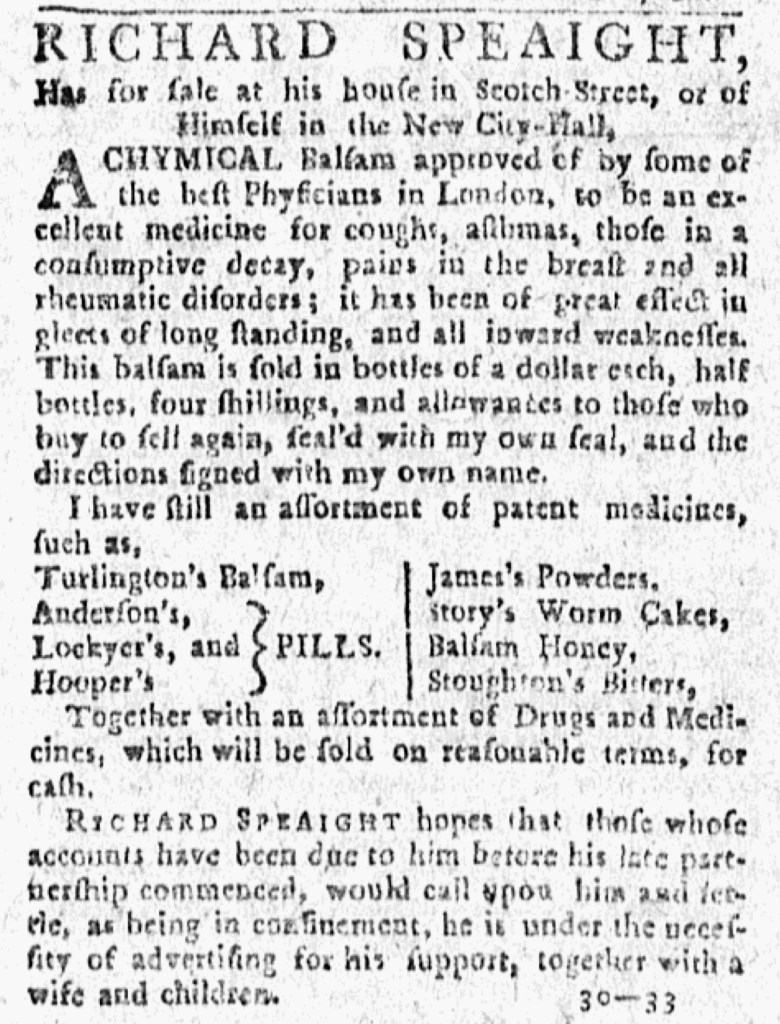
“This balsam is sold in bottles … seal’d with my own seal.”
Richard Speaight hawked a variety of patent medicines in an advertisement in the March 21, 1776, edition of the New-York Journal. He listed Turlington’s Balsam, Anderson’s Pills, Lockyer’s Pills, Hooper’s Pills, James’s Powders, Story’s Worm Cakes, and Stoughton’s Bitters. All these remedies were so familiar to consumers that Speaight did not consider it necessary to indicate which of them relieved which maladies. Prospective customers knew them as well as modern consumers know the over-the-counter medications available at local pharmacies. He sold all of them, along with “an assortment of [other] Drugs and Medicines,” for reasonable prices.
On the other hand, Speaight did devote a significant portion of his advertisement to describing a “CHYMICAL Balsam approved of by some of the best Physicians in London.” Those practitioners, he reported, considered the balsam “an excellent medicine for coughs, asthmas, those in a consumptive decay, pains in the breast and all rheumatic disorders.” It supposedly worked to “great effect,” a welcome promise to readers who had tried other treatments without success.
In addition to customers who purchased the balsam for their own use, Speaight also hoped to attract the attention of retails who would stock it in their own shops. He set the price at one dollar per bottle and four shillings for a half bottle while also making “allowances to those who buy to sell again.” In other words, he offered discounts for buying in volume. To avoid counterfeits, he informed the public that bottles of the balsam were “seal’d with my own seal.” Furthermore, he provided “directions signed with my own name.” Retailers and consumers alike could refer to those instructions when selling or using the balsam. For a medicine not nearly as familiar as Anderson’s Pills and Stoughton’s Bitters, a seal and printed directions likely enhanced confidence in the efficacy of the product.
Hello!
Richard Speaight is my great great great grand-uncle. He was the older brother of my great great great grandfather William Speaight. Richard Speaight was the first of the three sons of Shubael and Sarah Speight (the family later added the ‘a’ to create the surname Speaight probably around the 1770s – an addition which also helped them stand out from any other ‘Speights’ without the additional ‘a’). He was born in Stepney, London in 1748. He was apprenticed to a chemist in London. He then sailed to New York and was apprenticed with Dr William Stewart of New York City. While working as an apprentice he landed himself in trouble by spreading false reports about Edward Agar, another New York chemist. By 1770 he was spelling his name Speaight (like his family in London) and he married his first wife Marija Thomas at the Dutch Reformed Church in New York. They had at least three children. He opened one of the first drug stores in New York City.
In 1775 Richard travelled back to the UK, having left New York for fear of his life, during the American Revolution. The following appeared in Caledonian Mercury, 19 August 1775: ‘A few days ago, arrived in in town (London) from New York, Mr Speaight of that place, chemist and druggist, who was obliged to fly from that country, for refusing to take up arms against the government, and to join the rebellious army; and for speaking in the Government’s favour, his life and property were threatened and in danger. Mr Speaight had three days to get away. He left his wife and family behind together with all his worth.’
In the same year Richard returned to New York. He was then ‘imprisoned as a person disaffected by the American cause’ and, after seven months in prison, he was so desperate to get out of prison ‘that he is ready to accept employment as a chemist or surgeon to a regiment in the army and therefore requests a discharge’. His plea was successful and he made an announcement that his drug store had reopened with the amazing name ‘At the Sign of the Elaboratory’, which was located between Burling’s and Beekman’s slip in Manhattan.
In 1780 Richard was made a Freemason of New York City. In 1795 he married his second wife Mary and they had 10 children, up to Richard’s death in 1817. Official documentation (e.g. census returns and marriage records) relating to at least three of his daughters in America state their father – Richard Speaight – was born in England – and one actually states ‘London’, so we (the family in the UK who are related to him) know this is definitely Richard, son of Sarah and Shubael. And I am in touch with one of Richard’s American descendants, who is on Ancestry. I have a much more detailed life story for Richard, if anyone is interested.