Kurt Falter is a senior majoring in History with minors in Education, Peace and Conflict Studies, and Political Science. His favorite topics of study are American history, twentieth-century world history, and American government. He serves as a history tutor at the Academic Support Center and co-leader of Candlelight Prayer at Assumption College. He has previously interned at the Edward M. Kennedy Institute for the United States Senate in Boston, where he conducted a research project on the growing apathy of Americans towards government. His responsibilities also included leading tour groups.
The Slavery Adverts 250 Project chronicles the role of newspaper advertising in perpetuating slavery in the era of the American Revolution. The project seeks to reveal the ubiquity of slavery in eighteenth-century life from New England to Georgia by republishing advertisements for slaves – for sale, wanted to purchase, runaways, captured fugitives – in daily digests on this site as well as in real time via the @SlaveAdverts250 Twitter feed, utilizing twenty-first-century media to stand in for the print media of the eighteenth century.
The project aims to provide modern audiences with a sense of just how often colonists encountered these advertisements in their daily lives. Enslaved men, women, and children appeared in print somewhere in the colonies almost every single day. Those advertisements served as a constant backdrop for social, cultural, economic, and political life in colonial and revolutionary America. Colonists who did not own slaves were still confronted with slavery as well as invited to maintain the system by purchasing slaves or assisting in the capture of runaways. The frequency of these newspaper advertisements suggests just how embedded slavery was in colonial and revolutionary American culture in everyday interactions beyond the printed page.
These advertisements also testify to the experiences of enslaved men, women, and children, though readers must consider that those experiences have been remediated through descriptions offered by slaveholders rather than the slaves themselves. Often unnamed in the advertisements, enslaved men, women, and children were not invisible or unimportant in early America.
These advertisements appeared in colonial American newspapers 250 years ago today.
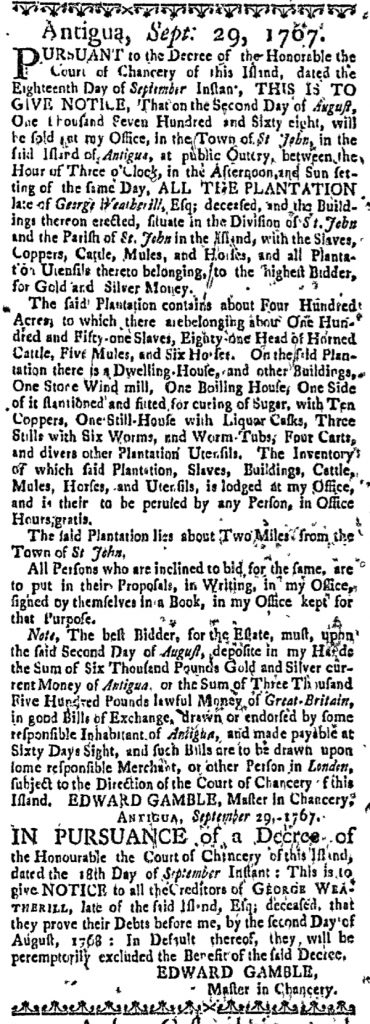
Massachusetts Gazette (April 15, 1768).
**********
Supplement to the Massachusetts Gazette (April 15, 1768).
**********
New-London Gazette (April 15, 1768).
**********
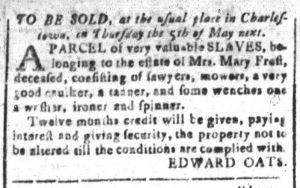
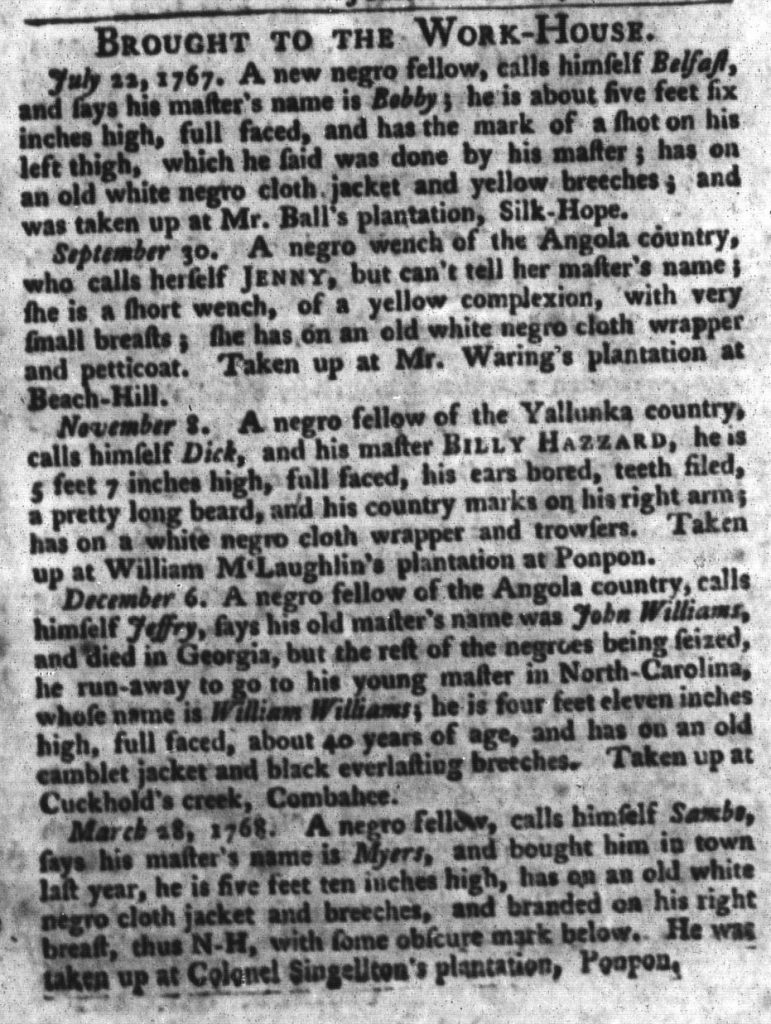
South-Carolina and American General Gazette (April 15, 1768).
**********
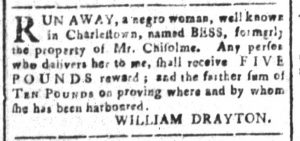
South-Carolina and American General Gazette (April 15, 1768).
**********
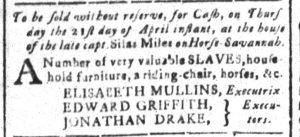
South-Carolina and American General Gazette (April 15, 1768).
**********
South-Carolina and American General Gazette (April 15, 1768).
**********
South-Carolina and American General Gazette (April 15, 1768).
**********
South-Carolina and American General Gazette (April 15, 1768).
**********
South-Carolina and American General Gazette (April 15, 1768).
What was advertised in a colonial American newspaper 250 years ago today?
Pennsylvania Gazette (April 14, 1768).
“Among all the WRITERS in favour of the COLONIES, the FARMER shines unrivaled for strength of argument, elegance of diction, knowledge in the laws of Great Britain and the true interest of the COLONIES.”
In the April 14, 1768, edition of the Pennsylvania Gazette David Hall and William Sellers published an advertisement for a pamphlet containing a popular and widely read set of letters written by John Dickinson, a lawyer and legislator from Pennsylvania. They are titled “LETTERS from a FARMER in Pennsylvania, to the INHABITANTS of the BRITISH COLONIES.”According to the introductory notes in the “Online Library of Liberty” compiled by the Liberty Fund, Dickinson penned them under the name of “A Farmer” due to the fact that they were quite controversial. In these letters, he spoke out against the British Parliament and discussed the sovereignty of the thirteen colonies. The “Letters” famously helped unite the colonists against the Townshend Acts. These acts were passed largely in response to the failure of the Stamp Act. Dickinson argues in his letters that the taxes laid upon the people with these laws were for the sole purpose of gaining revenue from the colonies. Parliament was not trying to regulate trade or the market. This meant that they were illegal and should not have been passed. This pamphlet was meant to collect all of the “Letters” to help spread Dickinson’s arguments, showing that there was already growing discontent in the colonies in the late 1760s.
**********
ADDITIONAL COMMENTARY: Carl Robert Keyes
Hall and Sellers did not merely make an announcement that they had “Just published” a pamphlet that collected together all twelve of John Dickinson’s “LETTERS from a FARMER in Pennsylvania, to the INHABITANTS of the BRITISH COLONIES.” Not unlike modern publishers, their marketing efforts included a testimonial that described the significance of the title they offered for sale. Indeed, they devoted nearly half of the space in their advertisement to an endorsement reprinted from the Boston Chronicle. In so doing, Hall and Sellers advised potential customers that “Among all the WRITERS in favour of the COLONIES, the FARMER shines unrivalled for strength of argument, elegance of diction, knowledge in thelawsof Great-Britain, and the true interest of the COLONIES.” Colonists unfamiliar with the “Letters” were encouraged to purchase the pamphlet and read them. Colonists who had already read them as they appeared in newspapers were encouraged to acquire the pamphlet and continue referring to the wisdom provided by “such an able adviser, and affectionate friend.”
The testimonial from the Boston Chronicle also indicated that the “Letters” “have been printed in every Colony, from Florida to Nova-Scotia.” For several months in late 1767 and early 1768, printers up and down the Atlantic coast reprinted this series of twelve essays. For some this meant an essay a week over the course of three months, but others published supplementary issues that sped up publication of the “Letters” as they simultaneously disseminated other news and advertising. Not all newspapers had finished the project at the time Hall and Sellers published the pamphlet that collected all of the “Letters” together. The day before their advertisement appeared in the Pennsylvania Gazette, James Johnston published “LETTER X” in the Georgia Gazette. Once the pamphlet was ready for sale, printer-booksellers in several colonies began promoting it in their own newspapers. A network of printers participated in distributing Dickinson’s “Letters” twice, first as editorial content in newspapers and then as pamphlets that conveniently collected the essays into a single volume. As Zach notes, Dickinson’s reasoned arguments aided in uniting many colonists in opposition to abuses committed by Parliament, but the dissemination of his work depended on the active involvement of colonial printers.
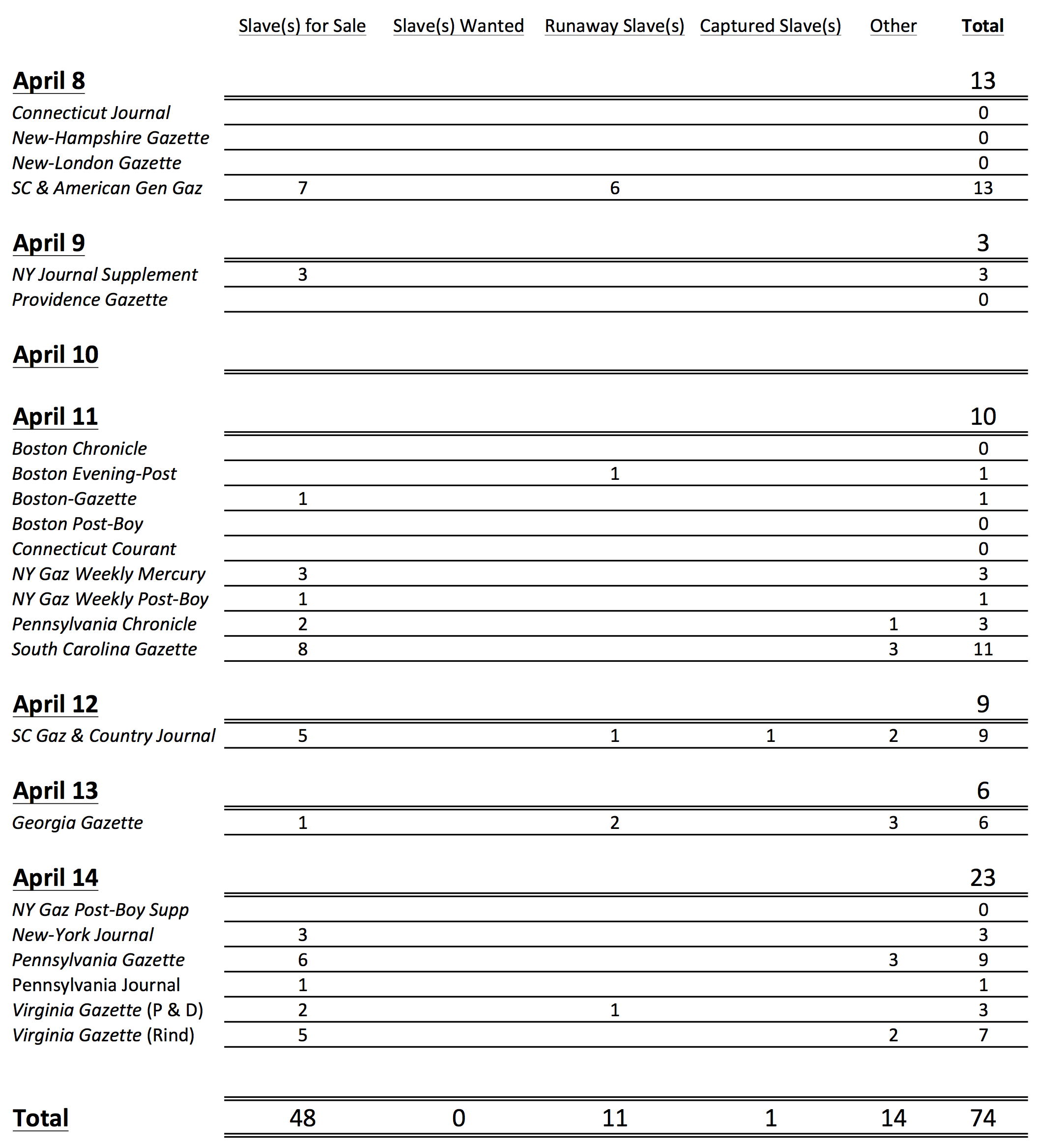
These tables indicate how many advertisements for slaves appeared in colonial American newspapers during the week of April 8-14, 1768.
Note: These tables are as comprehensive as currently digitized sources permit, but they may not be an exhaustive account. They includes all newspapers that have been digitized and made available via Accessible Archives, Colonial Williamsburg’s Digital Library, and Readex’s America’s Historical Newspapers. There are several reasons some newspapers may not have been consulted:
Issues that are no longer extant;
Issues that are extant but have not yet been digitized (including the Pennsylvania Journal); and
Newspapers published in a language other than English (including the Wochentliche Philadelphische Staatsbote).
**********
Slavery Advertisements Published April 8-14, 1768: By Date
**********
Slavery Advertisements Published April 8-14, 1768: By Region
The Slavery Adverts 250 Project chronicles the role of newspaper advertising in perpetuating slavery in the era of the American Revolution. The project seeks to reveal the ubiquity of slavery in eighteenth-century life from New England to Georgia by republishing advertisements for slaves – for sale, wanted to purchase, runaways, captured fugitives – in daily digests on this site as well as in real time via the @SlaveAdverts250 Twitter feed, utilizing twenty-first-century media to stand in for the print media of the eighteenth century.
The project aims to provide modern audiences with a sense of just how often colonists encountered these advertisements in their daily lives. Enslaved men, women, and children appeared in print somewhere in the colonies almost every single day. Those advertisements served as a constant backdrop for social, cultural, economic, and political life in colonial and revolutionary America. Colonists who did not own slaves were still confronted with slavery as well as invited to maintain the system by purchasing slaves or assisting in the capture of runaways. The frequency of these newspaper advertisements suggests just how embedded slavery was in colonial and revolutionary American culture in everyday interactions beyond the printed page.
These advertisements also testify to the experiences of enslaved men, women, and children, though readers must consider that those experiences have been remediated through descriptions offered by slaveholders rather than the slaves themselves. Often unnamed in the advertisements, enslaved men, women, and children were not invisible or unimportant in early America.
These advertisements appeared in colonial American newspapers 250 years ago today.
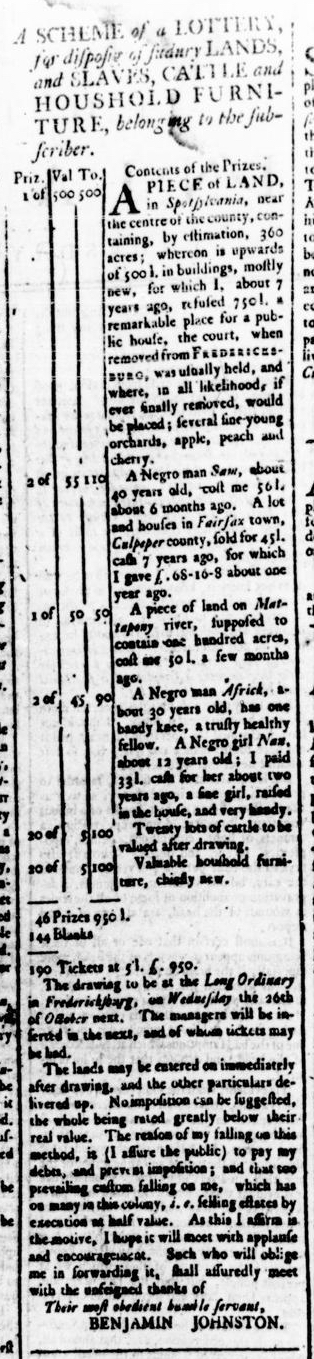
New-York Journal (April 14, 1768).
**********
New-York Journal (April 14, 1768).
**********
New-York Journal (April 14, 1768).
**********
Pennsylvania Gazette (April 14, 1768).
**********
Pennsylvania Gazette (April 14, 1768).
**********
Pennsylvania Gazette (April 14, 1768).
**********
Pennsylvania Gazette (April 14, 1768).
**********
Pennsylvania Gazette (April 14, 1768).
**********
Pennsylvania Gazette (April 14, 1768).
**********
Pennsylvania Gazette (April 14, 1768).
**********
Supplement to the Pennsylvania Gazette (April 14, 1768).
**********
Supplement to the Pennsylvania Gazette (April 14, 1768).
What was advertised in a colonial American newspaper 250 years ago today?
Georgia Gazette (April 13, 1768).
“A NEAT ASSORTMENT of IRISH LINEN CLOTH, of a bright colour and good fabric.”
During the colonial era linen was an essential resource to many of the colonists who worked in the mercantile market. These goods were responsible for a lot of commerce along trading networks that involved many farmers and merchants, according to Michelle M. Mormul. Linen was often imported from Europe due to the local production never being able to keep up with the amount demanded in the colonial market. Raw materials could be hard to come by and the colonies were not yet properly equipped to make the linen themselves.
Irish linen saw an increase in popularity due to boycotts against British goods. An entry on “Linen” in The World of the American Revolution: A Daily Life Encyclopedia indicates that this was due to linen traders taking an active stand against British policies. This advertisement by Joseph Wright may have tried to capitalize on those feelings. Wright could be one of the many people looking at the resistance efforts in the colonies as a chance for profit. The boycott from colonial merchants ended in the early 1770s, not long after this advertisement was published.
**********
ADDITIONAL COMMENTARY: Carl Robert Keyes
Zach presents an interesting interpretation of this advertisement for imported “IRISH LINEN CLOTH.” Joseph Wright did not explicitly make a political argument in his advertisement, but he may not have considered doing so necessary. He might have assumed that his prospective customers were already aware of the distinctions between Irish linens and English fabrics as well as the political ramifications of consuming textiles imported from Britain. The Georgia Gazette, which carried his advertisement, certainly made the case. In the same issue, James Johnston reprinted news from England that originally appeared in newspapers from Boston, including commentary on the effects of colonists boycotting English textiles. “There was no mention made of American affairs in the House of Commons from the 14th to the 27th of January; but the towns of Leeds, Wakefield, and others, where coarse woolens are manufactured, have petitioned the Parliament for relief, on account of the great decline of the demand for their manufactures.” Such coverage implied that colonial resistance to the Townshend Act via consumer activism was responsible for the “great decline” experienced by manufacturers in England.
Other items in the same issue of the Georgia Gazette contributed to encouraging a spirit of resistance among readers, especially the editorial that comprised half of that edition. Johnston devoted the first two pages (with the exception of the masthead) to “LETTER X” of John Dickinson’s “Letters from a Farmer in Pennsylvania to the Inhabitants of the British Colonies.” Throughout the colonies printers had been publishing this series of twelve letters warning against abuses by Parliament in their own newspapers, reprinting from one to another just as Johnston reprinted news from England that originally appeared in a newspaper printed in Boston. Readers who perused the April 13 edition of the Georgia Gazette from start to finish encountered “LETTER X” on the first two pages, a column of advertising and a column of news reprinted from other newspapers on the third page, and two columns of advertising on the final page. By the time they read Wright’s advertisement many would have been contemplating politics, especially the politics of consumption, perhaps causing them to be more inclined to purchase the “IRISH LINEN CLOTH, of a bright colour and good fabric” that the merchant peddled.
Zachary Karpowich is a junior majoring in History and minoring in Political Science at Assumption College. He has served as the treasurer of the Assumption College Moot Court Club during the 2017-2018 academic year. He is also the tuba player for the Assumption College Concert Band. Karpowich is from Trumbull, Connecticut.
The Slavery Adverts 250 Project chronicles the role of newspaper advertising in perpetuating slavery in the era of the American Revolution. The project seeks to reveal the ubiquity of slavery in eighteenth-century life from New England to Georgia by republishing advertisements for slaves – for sale, wanted to purchase, runaways, captured fugitives – in daily digests on this site as well as in real time via the @SlaveAdverts250 Twitter feed, utilizing twenty-first-century media to stand in for the print media of the eighteenth century.
The project aims to provide modern audiences with a sense of just how often colonists encountered these advertisements in their daily lives. Enslaved men, women, and children appeared in print somewhere in the colonies almost every single day. Those advertisements served as a constant backdrop for social, cultural, economic, and political life in colonial and revolutionary America. Colonists who did not own slaves were still confronted with slavery as well as invited to maintain the system by purchasing slaves or assisting in the capture of runaways. The frequency of these newspaper advertisements suggests just how embedded slavery was in colonial and revolutionary American culture in everyday interactions beyond the printed page.
These advertisements also testify to the experiences of enslaved men, women, and children, though readers must consider that those experiences have been remediated through descriptions offered by slaveholders rather than the slaves themselves. Often unnamed in the advertisements, enslaved men, women, and children were not invisible or unimportant in early America.
These advertisements appeared in colonial American newspapers 250 years ago today.
What was advertised in a colonial American newspaper 250 years ago today?
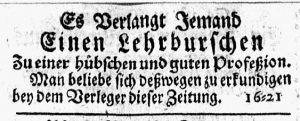
“An apprentice is needed for this well and fin occupation. Those interested should inquire of the publisher of this paper.” Wochenlichte Philadelphische Staatsbote (April 12, 1768).
“Es Verlangt Jemand Einen Lehrburschen.”
In contemporary America where all those of European descent are typically simply labeled under the moniker of ‘white,’ we can forget that the diversity of European cultures present during the colonial period was often a defining aspect of people’s lives. Settlers from different places in Europe brought their own traditions, aesthetics, Christian denominations, and, most importantly, languages to the colonies they considered a new world. In Pennsylvania, Germans left an indelible mark on colonial culture. Such was the scope of German immigration to the British colonies that newspapers such as the Wochentliche Philadelphische Staatsbote sprung up to cater to the large German-speaking population.
The advertisement shown above asked for an apprentice, likely one for the paper itself. The very act of putting out such an advertisement indicates that there was a large enough German-speaking population (of youths in particular, as apprentices would themselves be in their teenage years) that an advertisement in this newspaper would be worth the cost and would likely ensure a response. This advertisement also implies that business was good enough between the newspaper and job printing that the printer needed more assistance, a likely case given the sheer magnitude of the number of Germans in Pennsylvania in this period.
Today Sean introduces the first advertisement from a German-language newspaper featured on the Adverts 250 Project, noting that a substantial population of German migrants to Pennsylvania established their its own newspapers and participated in shaping colonial culture and commerce. The Wochentliche Philadelphische Staatsbotewas not the only German-language newspaper that served that community in 1768. The Germantowner Zeitungalso disseminated news and advertising to colonists who spoke German rather than English.
Yet those titles represent only a fraction of the more than two dozen German-language newspapers published in Pennsylvania in the eighteenth century. See the list below, compiled from Clarence Brigham’s monumental History and Bibliography of American Newspapers, 1690-1820, for a complete census of known German-language newspapers founded prior to 1800. Nine were founded prior to the American Revolution, another four during the years of the war, and the remaining thirteen after independence had been achieved. The Harrisburger Morgenröthe Zeitung continued publication well into the nineteenth century, demonstrating that German migrants and their descendants continued to maintain their own language and some aspects of their culture even as they participated in creating a distinctive American identity in the era of the early republic. This series of newspapers testifies to the presence of German migrants in colonial America. German settlers in Pennsylvania were among the many ethnic groups other than the English that made a home in England’s North American colonies.
The Slavery Adverts 250 Project chronicles the role of newspaper advertising in perpetuating slavery in the era of the American Revolution. The project seeks to reveal the ubiquity of slavery in eighteenth-century life from New England to Georgia by republishing advertisements for slaves – for sale, wanted to purchase, runaways, captured fugitives – in daily digests on this site as well as in real time via the @SlaveAdverts250 Twitter feed, utilizing twenty-first-century media to stand in for the print media of the eighteenth century.
The project aims to provide modern audiences with a sense of just how often colonists encountered these advertisements in their daily lives. Enslaved men, women, and children appeared in print somewhere in the colonies almost every single day. Those advertisements served as a constant backdrop for social, cultural, economic, and political life in colonial and revolutionary America. Colonists who did not own slaves were still confronted with slavery as well as invited to maintain the system by purchasing slaves or assisting in the capture of runaways. The frequency of these newspaper advertisements suggests just how embedded slavery was in colonial and revolutionary American culture in everyday interactions beyond the printed page.
These advertisements also testify to the experiences of enslaved men, women, and children, though readers must consider that those experiences have been remediated through descriptions offered by slaveholders rather than the slaves themselves. Often unnamed in the advertisements, enslaved men, women, and children were not invisible or unimportant in early America.
These advertisements appeared in colonial American newspapers 250 years ago today.
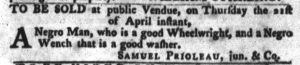
South-Carolina Gazette and Country Journal (April 12, 1768).
**********
South-Carolina Gazette and Country Journal (April 12, 1768).
**********
South-Carolina Gazette and Country Journal (April 12, 1768).
**********
South-Carolina Gazette and Country Journal (April 12, 1768).
**********
South-Carolina Gazette and Country Journal (April 12, 1768).
**********
South-Carolina Gazette and Country Journal (April 12, 1768).
**********
South-Carolina Gazette and Country Journal (April 12, 1768).
**********
South-Carolina Gazette and Country Journal (April 12, 1768).
**********
South-Carolina Gazette and Country Journal (April 12, 1768).