April 11

GUEST CURATOR:  Sean Sullivan

What was advertised in a colonial newspaper 250 years ago today?

Apr 11 - 4:11:1768 Pennsylvania Chronicle
Pennsylvania Chronicle (April 11, 1768).

“BOHEA TEA in large Chests, HYSON TEA in small Chests or Cannisters.”

Tea was an established part of life in the colonial America, consumed both in metropolitan centers along the coast as well as further inland, nearly ubiquitous across the British colonies. This advertisement from the Pennsylvania Chronicle mentioned two varieties, Bohea and Hyson. Bohea was a more expensive black tea while hyson was a cheaper and more common green variant. However, savvy merchants likely would not have hindered themselves with selling one variety and thus limiting their potential clientele. By importing both varieties of tea, Christopher and Charles Marshall appealed to the widest market available, increasing both potential profits and their presence in the sphere of public business. Such an action would be in the best interests of any aspiring entrepreneur, as the tea market in colonial America was massive not only economically but, as Rodris Roth argues, as a part of the wider culture. Colonial customs were highly reflective of trends prominent in Europe, and the consumption of tea was among the most significant of these trends. By the middle of the eighteenth century, tea had become the social lubricant of choice. Anyone in the mercantile realm who could find a steady market for tea would therefore be almost guaranteed a lucrative business.

**********

ADDITIONAL COMMENTARY:  Carl Robert Keyes

Tea was indeed a major commodity consumed throughout the British colonies in the eighteenth century.  Many assume that tea was a luxury in colonial America, but that interpretation reflects its position when it was first introduced to consumers rather than the position it eventually held in the marketplace and in the social lives of colonists.  As Rodris Roth reports, “During the first half of the eighteenth century the limited amount of tea, available at prohibitively high prices, restricted its use to a proportionately small segment of the population.  About mid-century, however, tea was beginning to be drunk by more and more people, as supplies increased and costs decreased, due in part to the propaganda and merchandising efforts of the East India Company.[1]  The expanding market for tea placed it at the center of the consumer revolution that took place throughout the British Atlantic world in the eighteenth century.

Indeed, tea might be considered emblematic of colonists participating in the consumer revolution since consuming it required acquiring a variety of other goods, some of them for its preparation and some considered necessary for the social rituals associated with consuming the beverage. Shopkeepers advertised and colonists purchased elaborate tea sets that included cups, saucers, teapots, sugar bowls, containers for cream or milk, waste bowls, tongs, strainers, canisters for storing tea, spoons, and other items.  Yet the equipage did not end there.  Depending on their means, colonists also bought tea tables and chairs as well as trays and tablecloths.  Whether made of metal or imported porcelain, the popular styles for tea sets changed over the years, just as the fashions for garments shifted. Merchants and shopkeepers noted such changes in their advertisements, spurring potential customers to make additional purchases and further fueling the consumer revolution.  Yet consuming tea contributed to importing other goods, especially sugar.  No matter how genteel the setting for socializing while sipping tea, colonists were enmeshed in networks of exchange that depended on the involuntary labor of enslaved men and women who worked on sugar plantations in the Caribbean.

Today’s advertisement for tea may appear rather simple at first glance, yet upon closer examination it tells a much larger story about the consumption and culture in eighteenth-century America.  For even more information, see Rodris Roth’s “Tea-Drinking in Eighteenth-Century America:  Its Etiquette and Equipage,” available in its entirety via Project Gutenberg.

**********

[1]Rodris Roth, “Tea Drinking in Eighteenth-Century America:  Its Etiquette and Equipage,” in Material Life in America, 1600-1860, ed. Robert Blair St. George (Boston:  Northeastern University Press, 1988), 442.

Welcome, Guest Curator Sean Sullivan

Sean Sullivan is a senior at Assumption College, double majoring in History and Theology with a minor in German Studies. Many of his studies focus on human sexuality and its intersection with religion, most especially Christianity. In addition to earning a place on the Dean’s List every semester, he is president of the college’s chapter of Phi Alpha Theta, the national History Honor Society. In 2017, he participated in Assumption College’s 23rd annual Undergraduate Symposium, presenting on the eccentric Austrian psychologist, sexologist, and energy theorist Wilhelm Reich. Beyond academics, he enjoys writing as well as role-playing games of both the tabletop and digital variety.
Welcome, Sean Sullivan!

Slavery Advertisements Published April 11, 1768

GUEST CURATOR:  Anna MacLean

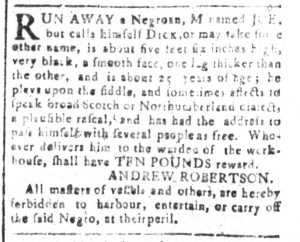
The Slavery Adverts 250 Project chronicles the role of newspaper advertising in perpetuating slavery in the era of the American Revolution. The project seeks to reveal the ubiquity of slavery in eighteenth-century life from New England to Georgia by republishing advertisements for slaves – for sale, wanted to purchase, runaways, captured fugitives – in daily digests on this site as well as in real time via the @SlaveAdverts250 Twitter feed, utilizing twenty-first-century media to stand in for the print media of the eighteenth century.

The project aims to provide modern audiences with a sense of just how often colonists encountered these advertisements in their daily lives. Enslaved men, women, and children appeared in print somewhere in the colonies almost every single day. Those advertisements served as a constant backdrop for social, cultural, economic, and political life in colonial and revolutionary America. Colonists who did not own slaves were still confronted with slavery as well as invited to maintain the system by purchasing slaves or assisting in the capture of runaways. The frequency of these newspaper advertisements suggests just how embedded slavery was in colonial and revolutionary American culture in everyday interactions beyond the printed page.

These advertisements also testify to the experiences of enslaved men, women, and children, though readers must consider that those experiences have been remediated through descriptions offered by slaveholders rather than the slaves themselves. Often unnamed in the advertisements, enslaved men, women, and children were not invisible or unimportant in early America.

These advertisements appeared in colonial American newspapers 250 years ago today.

Apr 11 - Boston Evening-Post Slavery 1
Boston Evening-Post (April 11, 1768).

**********

Apr 11 - Boston-Gazette Slavery 1
Boston-Gazette (April 11, 1768).

**********

Apr 11 - New-York Gazette Weekly Mercury Slavery 1
New-York Gazette and Weekly Mercury (April 11, 1768).

**********

Apr 11 - New-York Gazette Weekly Mercury Slavery 2
New-York Gazette and Weekly Mercury (April 11, 1768).

**********

Apr 11 - New-York Gazette Weekly Mercury Supplement Slavery 1
Supplement to the New-York Gazette and Weekly Mercury (April 11, 1768).

**********

Apr 11 - New-York Gazette Weekly Post-Boy Slavery 1
New-York Gazette: Or, the Weekly Post-Boy (April 11, 1768).

**********

Apr 11 - Pennsylvania Chronicle Slavery 1
Pennsylvania Chronicle (April 11, 1768).

**********

Apr 11 - Pennsylvania Chronicle Slavery 2
Pennsylvania Chronicle (April 11, 1768).

**********

Apr 11 - Pennsylvania Chronicle Slavery 3
Pennsylvania Chronicle (April 11, 1768).

**********

Apr 11 - South Carolina Gazette Slavery 1
South Carolina Gazette (April 11, 1768).

**********

Apr 11 - South Carolina Gazette Slavery 2
South Carolina Gazette (April 11, 1768).

**********

Apr 11 - South Carolina Gazette Slavery 3
South Carolina Gazette (April 11, 1768).

**********

Apr 11 - South Carolina Gazette Slavery 4
South Carolina Gazette (April 11, 1768).

**********

Apr 11 - South Carolina Gazette Slavery 5
South Carolina Gazette (April 11, 1768).

**********

Apr 11 - South Carolina Gazette Slavery 6
South Carolina Gazette (April 11, 1768).

**********

Apr 11 - South Carolina Gazette Slavery 7
South Carolina Gazette (April 11, 1768).

**********

Apr 11 - South Carolina Gazette Slavery 8
South Carolina Gazette (April 11, 1768).

**********

Apr 11 - South Carolina Gazette Slavery 9
South Carolina Gazette (April 11, 1768).

**********

Apr 11 - South Carolina Gazette Slavery 10
South Carolina Gazette (April 11, 1768).

**********

Apr 11 - South Carolina Gazette Slavery 11
South Carolina Gazette (April 11, 1768).

April 10

What was advertised in a colonial American newspaper 250 years ago this week?

Apr 10 - 4:9:1768 Providence Gazette
Providence Gazette (April 9, 1768).

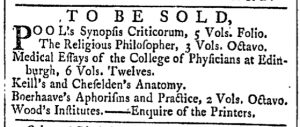
“Enquire of the Printers.”

This short advertisement from the April 9, 1768, edition of the Providence Gazetteoffered several books for sale.  Interested readers were advised to “Enquire of the Printers” to learn more about the conditions of the sale. Sarah Goddard and John Carter, publishers of the Providence Gazette, may have placed the advertisement.  After all, many colonial printers simultaneously sold books and stationery at their shops.  However, this advertisement more likely promoted books from a private library. For various reasons, colonists interested in selling used goods often placed anonymous notices in newspapers, instructing potential buyers to “Enquire of the Printers.”  As a result, printing offices became clearinghouses for disseminating information, not only in print but also via letters and conversations. Newspaper printers also served as brokers who made introductions between buyers and sellers when the latter did not wish to disclose their identity to the general public.

That Goddard and Carter placed this advertisement seems especially unlikely considering that they more explicitly marketed their wares and services elsewhere in the same issue. The colophon consistently invited readers to purchase subscriptions and advertisements as well as commission “all Manner of PRINTING WORK.”  In another short advertisement, Goddard and Carter forthrightly stated, “BLANKS of all Kinds sold by the Printers hereof.”  In contrast, “Enquire of the Printers” did not assume the same level of responsibility for an anticipated sale.  Furthermore, the majority of the books listed in the advertisement were medical texts, suggesting that they came from the library or estate of a reader who had specific interests.

That being the case, the fees that some advertisers paid to place their notices in newspapers apparently covered more than setting the type and the amount of space occupied in the publication for a series of weeks.  Advertisers who asked readers to “Enquire of the Printers” expected to receive additional services; they relied on printers to expend additional time and energy in facilitating transactions with potential buyers.  For their part, printers absorbed this as the cost of doing business.  The revenues generated from advertisements justified any additional labor required when they published “Enquire of the Printer” notices in their newspapers.

April 9

GUEST CURATOR:  Jonathan Bisceglia

What was advertised in a colonial American newspaper 250 years ago today?

Apr 9 - 4:9:1768 New-York Journal Supplement
Supplement to the New-York Journal (April 9, 1768).

“Pipe Staves will be taken in Payment for a considerable Quantity of said Wine.”

Thomas Durham placed this advertisement for “Teneriffe Wine” in the New-York Journal on April 9, 1768. Durham sold a special type of wine from the Canary Islands. However, a more interesting part of the advertisement appeared in a note dedicated to forms of payment:  “Pipe Staves will be taken in Payment.” According to the Oxford English Dictionary, pipe staves were “hooped together to make a cask.” In simple terms, they were the pieces of wood put together to construct a cask.

Apr 9 - Parts of Barrel
Parts of a Barrel (Courtesy Colonial Sense).

In the colonial period in America there was a system that was put in place of credits and alternatives to paying. According to the Federal Reserve Bank of Philadelphia, “A shortage of money was a problem for the American colonies.  …  Without enough money, the colonists had to barter for goods.” This advertisement provides evidence of the barter system. Thomas Durham offered a deal in which a customer could provide staves to count as payment for the wine. This tells of the larger cycle of consumption and production in which customers were allowed to trade or barter items related to what they were trying to obtain. Economic arrangements of this sort show the diversity of ways that colonists conducted business.

**********

ADDITIONAL COMMENTARY:  Carl Robert Keyes

Today’s advertisement appeared in a four-page supplement to John Holt’s New-York Journal, a supplement published on Saturday, April 9, 1768.  Holt, however, distributed the standard issues of the New-York Journal on Thursdays, yet he had sufficient content – news, letters to the printer, and advertisements – to justify printing and distributing what amounted to a second issue for that week.

Why this merits notice requires an overview of newspaper publication practices in the colonial period. Printers typically published one issue each week.  Each issue consisted of four pages, created by printing two pages on each side of a broadsheet and folding it in half.  The balance of news items and advertising varied, but among newspapers printed in the busiest urban ports – Boston, Charleston, Newport, New York, and Philadelphia – news comprised about half of each issue and advertising the other half. Printers sometimes found that they had sufficient content to require a supplement, usually two pages bearing the same date as the regular issue and distributed with it.  By the late 1760s the Pennsylvania Gazette so often included a two-page supplement that even though it clearly bore the title “Supplement” many subscribers likely expected to receive a six-page newspaper each Thursday. On occasion, however, printers distributed supplements later in the week, especially if particularly important news arrived that could not wait for the next issue.  When ships entered port with news that Parliament had repealed the Stamp Act, for instance, many printers published supplements to spread the word as quickly as possible.  In general, supplements usually amounted to two pages.

Yet the supplement that carried today’s advertisement consisted of four pages distributed later in the week than the newspaper’s usual publication day.  This happened quite frequently in 1768.  Throughout the year Holt distributed no fewer than eighteen supplements to the New-York Journal on days other than Thursday, in addition to fifty-two regular issues and sometimes additional supplements on Thursdays.  Between politics and the economy, Holt determined that his readers needed access to more information that traditional publication practices allowed. Historians of print culture and journalism often refer to an explosion of print that took place after the American Revolution as citizens of the new nation consumed greater amounts of information, believing that they could safeguard the young republic by becoming as informed as possible.  The number of newspapers expanded.  Many moved to semi-weekly, tri-weekly, and, by the end of the eighteenth century, daily publication.  John Holt’s publication schedule for 1768 serves as a precursor to that expansion of the press, a harbinger during the imperial crisis of the extensive publication and distribution of newspapers after the American Revolution.

Slavery Advertisements Published April 9, 1768

GUEST CURATOR:  Anna MacLean

The Slavery Adverts 250 Project chronicles the role of newspaper advertising in perpetuating slavery in the era of the American Revolution. The project seeks to reveal the ubiquity of slavery in eighteenth-century life from New England to Georgia by republishing advertisements for slaves – for sale, wanted to purchase, runaways, captured fugitives – in daily digests on this site as well as in real time via the @SlaveAdverts250 Twitter feed, utilizing twenty-first-century media to stand in for the print media of the eighteenth century.

The project aims to provide modern audiences with a sense of just how often colonists encountered these advertisements in their daily lives. Enslaved men, women, and children appeared in print somewhere in the colonies almost every single day. Those advertisements served as a constant backdrop for social, cultural, economic, and political life in colonial and revolutionary America. Colonists who did not own slaves were still confronted with slavery as well as invited to maintain the system by purchasing slaves or assisting in the capture of runaways. The frequency of these newspaper advertisements suggests just how embedded slavery was in colonial and revolutionary American culture in everyday interactions beyond the printed page.

These advertisements also testify to the experiences of enslaved men, women, and children, though readers must consider that those experiences have been remediated through descriptions offered by slaveholders rather than the slaves themselves. Often unnamed in the advertisements, enslaved men, women, and children were not invisible or unimportant in early America.

These advertisements appeared in colonial American newspapers 250 years ago today.

Apr 9 - New-York Journal Supplement Slavery 1
Supplement to the New-York Journal (April 9, 1768).

**********

Apr 9 - New-York Journal Supplement Slavery 2
Supplement to the New-York Journal (April 9, 1768).

**********

Apr 9 - New-York Journal Supplement Slavery 3
Supplement to the New-York Journal (April 9, 1768).

April 8

GUEST CURATOR:  Jonathan Biscelgia

What was advertised in a colonial American newspaper 250 years ago today?

Apr 8 - 4:8:1768 New-Hampshire Gazette
New-Hampshire Gazette (April 8, 1768).

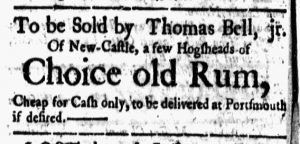
“A few Hogsheads of Choice old Rum.”

This advertisement from the New Hampshire Gazette appears straightforward about what Thomas Bell was trying to sell. However, there is more to this advertisement when examining the vernacular more closely, specifically the word “Hogsheads.” The Oxford English Dictionary defines this as “A large cask, esp. for storing liquids; spec.one of a definite capacity, varying according to the commodity held.” This keys into the fact that Thomas Bell sold large quantities of rum. Rum was prevalent in the colonies because the ingredients, particularly molasses, were easy to acquire because of the triangular trade that connected New England to sugar plantations in the Caribbean.

The sale of alcohol in these large quantities gives insight into consumption trends of the larger population. According to Ed Crews, a public historian at Colonial Williamsburg, “Rum was king of the colonies before the Revolutionary War.  …  By 1770, the colonies had more than 140 rum distilleries, making about 4.8 million gallons annually. That was on top of the 3.78 million gallons imported each year. Production was concentrated in the Northeast.” Identifying that production was concentrated in New England and the Middle Atlantic is important because it tells the larger story of slavery in America. The molasses needed for rum was produced in the Caribbean by the work of slaves. Rum could not have been distilled in mainland North America if it had not been for the struggles of enslaved men and women in the Caribbean.

**********

ADDITIONAL COMMENTARY:  Carl Robert Keyes

Today the Adverts 250 Project republishes fourteen advertisements that originally appeared in colonial newspapers 250 years ago today: Thomas Bell’s advertisement for “Choice old Rum” that Jonathan examines above and thirteen advertisements concerning enslaved men, women, and children that have been incorporated into the daily digest for the Slavery Adverts 250 Project. The South-Carolina and American General Gazette published all thirteen of the notices offering slaves for sale or warning about runaway slaves.

A cursory glance at these advertisements does not necessarily reveal the connections between Bell’s notice from the New-Hampshire Gazetteand the series from one of Charleston’s three newspapers. Further examination of all of the newspapers published 250 years ago today might initially reaffirm first impressions about enslavement in southern colonies and freedom in New England.  Two other newspapers, the Connecticut Journal and the New-London Gazette, were also published on April 8, 1768.  Like the New-Hampshire Gazette, neither of them happened to include any advertisements concerning slaves.  Considered solely in this context, the distribution of newspaper advertisements suggests a striking regional different between New England and the Lower South.

Yet the contents of newspapers published on a single day do not tell the entire story of colonial American culture and commerce.  Widening the scope a little – to just newspapers published 250 years ago this week – forces us to confront advertisements for slaves from other newspapers printed in New England as well as even more from the Middle Atlantic.  Widening the scope even more – to all newspapers from 1768 – reveals that colonists placed and read advertisements for slaves in the Connecticut Journal, the New-Hampshire Gazette, and the New-London Gazette, even if they appeared in lesser numbers or frequency than in other newspapers.

This broader view of newspapers and advertisements from 1768 illustrates that that the commerce and culture of colonial New England was not devoid of enslavement.  That being said, Jonathan demonstrates that it is not necessary to identify advertisements for slaves to use eighteenth-century advertisements to examine the region’s relationship to slavery.  Instead, advertisements for a popular commodity like rum testify to New England’s participation in networks of exchange that depended on slavery. Making this connection requires looking beyond the commodity advertised for consumption to also see the process of production and commerce that made “Choice old Rum” available to consumers in New England and throughout the colonies.

Welcome Back, Guest Curator Jonathan Bisceglia

Jonathan Bisceglia is a junior majoring in History with a minor in Education.  He previously served as guest curator when he enrolled in “Revolutionary America” in Spring 2017. He has presented twice at Assumption College’s Undergraduate Symposium: “Transcribing the Past:  Working on the Isaiah Thomas Broadside Ballads Project” (2017) and “Exploring Abby Kelley Foster and Women’s History in Worcester with Charlotte Wharton” (2016).  The second presentation emerged from an interview conducted in collaboration with the Worcester Women’s Oral History Project. His graphic design work was featured in “From Frederick Douglass to Ferguson:  Graphic Design Projects on Race in Modern America Inspired by the Collections of the American Antiquarian Society,” an exhibition at the American Antiquarian Society during Black History Month in 2016. Jonathan hopes to become a professor of colonial American history.

Welcome back, Jonathan Bisceglia!

Slavery Advertisements Published April 8, 1768

GUEST CURATOR:  Anna MacLean

The Slavery Adverts 250 Project chronicles the role of newspaper advertising in perpetuating slavery in the era of the American Revolution. The project seeks to reveal the ubiquity of slavery in eighteenth-century life from New England to Georgia by republishing advertisements for slaves – for sale, wanted to purchase, runaways, captured fugitives – in daily digests on this site as well as in real time via the @SlaveAdverts250 Twitter feed, utilizing twenty-first-century media to stand in for the print media of the eighteenth century.

The project aims to provide modern audiences with a sense of just how often colonists encountered these advertisements in their daily lives. Enslaved men, women, and children appeared in print somewhere in the colonies almost every single day. Those advertisements served as a constant backdrop for social, cultural, economic, and political life in colonial and revolutionary America. Colonists who did not own slaves were still confronted with slavery as well as invited to maintain the system by purchasing slaves or assisting in the capture of runaways. The frequency of these newspaper advertisements suggests just how embedded slavery was in colonial and revolutionary American culture in everyday interactions beyond the printed page.

These advertisements also testify to the experiences of enslaved men, women, and children, though readers must consider that those experiences have been remediated through descriptions offered by slaveholders rather than the slaves themselves. Often unnamed in the advertisements, enslaved men, women, and children were not invisible or unimportant in early America.

These advertisements appeared in colonial American newspapers 250 years ago today.

Apr 8 - South-Carolina and American General Gazette Slavery 1
South-Carolina and American General Gazette (April 8, 1768).

**********

Apr 8 - South-Carolina and American General Gazette Slavery 2
South-Carolina and American General Gazette (April 8, 1768).

**********

Apr 8 - South-Carolina and American General Gazette Slavery 3
South-Carolina and American General Gazette (April 8, 1768).

**********

Apr 8 - South-Carolina and American General Gazette Slavery 4
South-Carolina and American General Gazette (April 8, 1768).

**********

Apr 8 - South-Carolina and American General Gazette Slavery 5
South-Carolina and American General Gazette (April 8, 1768).

**********

Apr 8 - South-Carolina and American General Gazette Slavery 6
South-Carolina and American General Gazette (April 8, 1768).

**********

Apr 8 - South-Carolina and American General Gazette Slavery 7
South-Carolina and American General Gazette (April 8, 1768).

**********

Apr 8 - South-Carolina and American General Gazette Slavery 8
South-Carolina and American General Gazette (April 8, 1768).

**********

Apr 8 - South-Carolina and American General Gazette Slavery 9
South-Carolina and American General Gazette (April 8, 1768).

**********

Apr 8 - South-Carolina and American General Gazette Slavery 10
South-Carolina and American General Gazette (April 8, 1768).

**********

Apr 8 - South-Carolina and American General Gazette Slavery 11
South-Carolina and American General Gazette (April 8, 1768).

**********

Apr 8 - South-Carolina and American General Gazette Slavery 12
South-Carolina and American General Gazette (April 8, 1768).

**********

Apr 8 - South-Carolina and American General Gazette Slavery 13
South-Carolina and American General Gazette (April 8, 1768).

April 7

What was advertised in a colonial American newspaper 250 years ago today?

Apr 7 - 4:7:1768 Pennsylvania Gazette
Pennsylvania Gazette (April 7, 1768).

“MARY SYMONDS, MILLENER, Is now removed from her late Shop.”

The advertisement that Mary Symonds, a milliner, inserted in the April 7, 1768, edition of the Pennsylvania Gazettedid not look any different than others promoting consumer goods and services, but that belies her role as an extraordinary advertiser in early America.

What made Symonds extraordinary?  It was not merely that she was a female entrepreneur who advertised her wares in the public prints.  True, women were disproportionately underrepresented among newspaper advertisers in eighteenth-century America, especially in busy urban ports like Philadelphia where they comprised anywhere from a quarter to a third or more of shopkeepers.  Despite their numbers, relatively few ran newspaper advertisements.  Yet enough did that Symonds could not be considered extraordinary – then or now – for placing an advertisement that promoted the “very large and neat Assortment of MILLENERY GOODS for Sale” at her new shop on Chestnut Street.

In addition to regularly running notices in newspapers, Symonds resorted to at least one other form of advertising, one that male merchants, shopkeepers, and artisans dominated even more than newspaper advertisements.  By 1770 she distributed a large trade card to incite demand among prospective customers.  Trade cards circulated widely in England, especially in London.  The practice made its way across the Atlantic to the colonies, but relatively few women adopted this method of advertising.  Those that did tended to commission rather simple designs that did not rival the engraved images that graced the trade cards passed out by their male counterparts.

Fewer than half a dozen trade cards distributed by American women in the eighteenth century have survived, indicating that even fewer women resorted to trade cards than placed newspaper advertisements.  That made Symonds an extraordinary advertiser.  Her trade card stands out as an example not of what was probably in the eighteenth-century marketplace but instead what was possible.  The milliner devised an advertising campaign that incorporated one of the most innovative methods deployed by male entrepreneurs, supplementing her newspaper advertisements with engraved trade cards for current customers and prospective clients.  In so doing, she made a major investment in her marketing efforts, expecting it to pay off by attracting more business to her shop.

Colonists encountered a visual landscape of advertising every day.  By distributing her trade card, Mary Symonds claimed a place in that visual landscape of circulating ephemera just as she physically occupied a space in the marketplace by operating a shop on Chestnut Street in Philadelphia.

Mar 23 - Mary Symonds Trade Card
Trade card (with receipted bill on reverse) distributed  by Mary Symonds in 1770 (Historical Society of Pennsylvania:  Cadwalader Collection, Series II: General John Cadwalader Papers, Box 5: Incoming Correspondence: Pa-Sy, Item 19: Su-Sy).