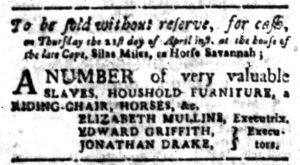
Mary Bohane is a senior majoring in History at Assumption College. She is also minoring in Philosophy. She most enjoys studying the Cold War and the subsequent fall of the Soviet Union. She previously curated the Slavery Adverts 250 Projectduring the week of March 25-31. She will be presenting on her work on the Adverts 250 Project at Assumption College’s 24th annual Undergraduate Symposium.
The Slavery Adverts 250 Project chronicles the role of newspaper advertising in perpetuating slavery in the era of the American Revolution. The project seeks to reveal the ubiquity of slavery in eighteenth-century life from New England to Georgia by republishing advertisements for slaves – for sale, wanted to purchase, runaways, captured fugitives – in daily digests on this site as well as in real time via the @SlaveAdverts250 Twitter feed, utilizing twenty-first-century media to stand in for the print media of the eighteenth century.
The project aims to provide modern audiences with a sense of just how often colonists encountered these advertisements in their daily lives. Enslaved men, women, and children appeared in print somewhere in the colonies almost every single day. Those advertisements served as a constant backdrop for social, cultural, economic, and political life in colonial and revolutionary America. Colonists who did not own slaves were still confronted with slavery as well as invited to maintain the system by purchasing slaves or assisting in the capture of runaways. The frequency of these newspaper advertisements suggests just how embedded slavery was in colonial and revolutionary American culture in everyday interactions beyond the printed page.
These advertisements also testify to the experiences of enslaved men, women, and children, though readers must consider that those experiences have been remediated through descriptions offered by slaveholders rather than the slaves themselves. Often unnamed in the advertisements, enslaved men, women, and children were not invisible or unimportant in early America.
These advertisements appeared in colonial American newspapers 250 years ago today.
Who was the subject of an advertisement in a colonial American newspaper 250 years ago today?
South-Carolina Gazette and Country Journal (April 19, 1768).
“TO BE SOLD … A PARCEL of valuable SLAVES.”
In this advertisement from the South-Carolina Gazette and Country Journal Edward Oats announced that he intended to sell “A PARCEL of valuable SLAVES.” The slaves originally belonged to the estate of Mary Frost. This advertisement shocked me with how this group of enslaved men and women were characterized as merchandise to be purchased. In addition, the details associated with the process astounded me. Edward Oats wrote that “Twelve months credit will be given, paying interest, and giving approved security, the property not to be altered till the conditions are complied with.” This set of terms and conditions sounds comparable to buying furniture or appliances in the twenty-first century.
Furthermore, I was intrigued with the advertisement because the author chose to incorporate the many skills held by individuals among this group of slaves. They included “sawyers, mowers, a very good caulker, a tanner, a compleat tight cooper, a sawyer, squarer and rough carpenter.” In the midst of my research I observed that slaves tended to be sold in parcels, or large groups, in the southern colonies more frequently than in the northern colonies. Often, the skills and talents of slaves were highlighted by newspaper advertisements as a method of attracting buyers, especially plantation owners. According to Daniel C. Littlefield in “The Varieties of Slave Labor,” eighteenth-century plantation owners “tried to maintain self-sufficiency based on the varied skills of their slaves.” Although the vast majority of African slaves were purchased specifically for agricultural work, enslaved peoples also found themselves performing a number of skilled functions to guarantee overall efficiency on plantations.
**********
ADDITIONAL COMMENTARY: Carl Robert Keyes
Although Edward Oats and the readers of the South-Carolina Gazette and Country Journal had no way of knowing it, within a decade April 19 would become one of the most important days in American history. Seven years after the publication of this advertisement armed hostilities broke out between colonists and Britain at Concord and Lexington in Massachusetts, initiating a new phase in the imperial crisis and eventually resulting in the Declaration of Independence and a war that lasted the better part of a decade.
Americans continue to commemorate April 19 today. In Massachusetts it is known as Patriots’ Day, a state holiday observed on the Monday that falls closest to April 19. The Boston Marathon takes place on Patriots’ Day. This year residents of Massachusetts received an extension on filing their taxes until Tuesday, April 17 because the traditional tax day, April 15, fell on a Sunday, followed by Patriots’ Day on Monday. Beyond Massachusetts, Americans have been celebrating the 243rd anniversary of Paul Revere’s ride and the battles at Concord and Lexington, though historians have turned to social media and other public history platforms to offer more complete and nuanced portraits of events than Henry Wadsworth Longfellow etched in popular memory in the poem he composed about the “midnight message of Paul Revere” in 1860.
In the midst of these commemorations of liberty and resistance to British oppression, Anna has chosen an advertisement that reminds us that freedom had varied meanings to different people in early America. Edward Oats had seen the Stamp Act enacted and repealed, only to be replaced by the Declaratory Act and the Townshend Act. If he read the newspaper in which he advertised “A PARCEL of valuable SLAVES,” he had been exposed to news from throughout the colonies about efforts to resist Parliament by consuming goods produced in the colonies rather than imported from England. He would have also encountered the series of “Letters from a Farmer in Pennsylvania” outlining the limits of Parliament’s authority.
Even as white Americans grappled with these political issues, they bought and sold enslaved men, women, and children, often acknowledging the skills they possessed yet obstinately refusing to acknowledge their humanity. These “SLAVES” and “wenches,” however, had their own ideas about liberty. As other advertisements in newspapers throughout the colonies indicate, many slaves seized their freedom by running away from the masters who held them in bondage. As we once again celebrate the milestones of April 19, this advertisement for “A PARCEL of valuable SLAVES” reminds us to take a broad view of the revolutionary era in order to tell a more complete story of the American past.
The Slavery Adverts 250 Project chronicles the role of newspaper advertising in perpetuating slavery in the era of the American Revolution. The project seeks to reveal the ubiquity of slavery in eighteenth-century life from New England to Georgia by republishing advertisements for slaves – for sale, wanted to purchase, runaways, captured fugitives – in daily digests on this site as well as in real time via the @SlaveAdverts250 Twitter feed, utilizing twenty-first-century media to stand in for the print media of the eighteenth century.
The project aims to provide modern audiences with a sense of just how often colonists encountered these advertisements in their daily lives. Enslaved men, women, and children appeared in print somewhere in the colonies almost every single day. Those advertisements served as a constant backdrop for social, cultural, economic, and political life in colonial and revolutionary America. Colonists who did not own slaves were still confronted with slavery as well as invited to maintain the system by purchasing slaves or assisting in the capture of runaways. The frequency of these newspaper advertisements suggests just how embedded slavery was in colonial and revolutionary American culture in everyday interactions beyond the printed page.
These advertisements also testify to the experiences of enslaved men, women, and children, though readers must consider that those experiences have been remediated through descriptions offered by slaveholders rather than the slaves themselves. Often unnamed in the advertisements, enslaved men, women, and children were not invisible or unimportant in early America.
These advertisements appeared in colonial American newspapers 250 years ago today.
South-Carolina Gazette and Country Journal (April 19, 1768).
**********
South-Carolina Gazette and Country Journal (April 19, 1768).
**********
South-Carolina Gazette and Country Journal (April 19, 1768).
**********
South-Carolina Gazette and Country Journal (April 19, 1768).
**********
South-Carolina Gazette and Country Journal (April 19, 1768).
**********
South-Carolina Gazette and Country Journal (April 19, 1768).
**********
South-Carolina Gazette and Country Journal (April 19, 1768).
**********
South-Carolina Gazette and Country Journal (April 19, 1768).
**********
South-Carolina Gazette and Country Journal (April 19, 1768).
**********
South-Carolina Gazette and Country Journal (April 19, 1768).
**********
South-Carolina Gazette and Country Journal (April 19, 1768).
**********
Supplement to the South-Carolina Gazette and Country Journal (April 19, 1768).
**********
Supplement to the South-Carolina Gazette and Country Journal (April 19, 1768).
**********
Supplement to the South-Carolina Gazette and Country Journal (April 19, 1768).
**********
Supplement to the South-Carolina Gazette and Country Journal (April 19, 1768).
**********
Supplement to the South-Carolina Gazette and Country Journal (April 19, 1768).
**********
Supplement to the South-Carolina Gazette and Country Journal (April 19, 1768).
What was advertised in a colonial American newspaper 250 years ago today?
New-York Gazette: Or, the Weekly Post-Boy (April 18, 1768).
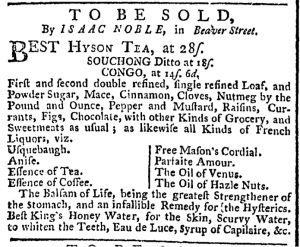
“TO BE SOLD … BEST HYSON TEA.”
An advertisement in the April 18, 1768, issue of the New-York Gazette: Or, the Weekly Post-Boy announced “BEST HYSON TEA” in addition to “Mustard, Raisins, Currants, Figs, Chocolate, with other Kinds of Grocery.” I felt compelled to select this advertisement because it sounds absurd to conceptualize a time when America didn’t “run on Dunkin’” coffee (a testament to marketing in modern America). However, by similar means, tea drinkers in colonial America looked forward to the caffeine buzz found in their kettles and teacups.
Hyson tea, characterized by Oliver Pluff & Co. as having a long twisted appearance, was a favorite among American colonists. According to the Boston Tea Party Ship and Museum, during the first half of the eighteenth-century tea was a costly luxury that only a small percentage of the colonies’ population could afford. By the middle of the century, tea was in high demand throughout the colonies and costs decreased making it an everyday beverage for the vast majority. Over time, the American colonies had evolved into a province of tea drinkers.
In addition to the “other Kinds of Grocery” that he sold at his shop on Beaver Street in New York, Isaac Noble also advertised “all Kinds of French Liquors” and listed eight varieties. Since Anna chose to examine one of Noble’s wares that remains popular today (even if it has not retained the cultural currency it enjoyed in eighteenth-century America), I decided to take a closer look at some of these other beverages that colonial Americans drank but that might be less familiar to consumers today.
The Oxford English Dictionarydescribes “Parfaite Amour” as “a sweet liqueur of Dutch origin, flavoured with lemon, cloves, cinnamon, and coriander, and coloured red or purple.” In addition to the taste, colonists may have been entertained by the color! Several other items on Noble’s list appear to have been liqueurs as well, including “Anise,” “Essence of Tea,” “Essence of Coffee,” and “Oil of Hazle Nuts.” While it may be fairly easy to imagine the flavor and composition of each of those “French Liquors,” the “Oil of Venus” presents more of a challenge. One Household Encyclopediapublished in the middle of the nineteenth century includes recipes for both Oil of Jupiter and Oil of Venus. It describes Oil of Venus as brandy infused with caraway, anise, mace, and orange rinds and mixed with sugar. Published nearly a century after Noble’s advertisement appeared in the New-York Gazette: Or, the Weekly Post-Boy, that recipe may not have been the same as the “Oil of Venus” colonists drank, but the mixture of spices does appear consistent with methods for distilling the “Parfaite Amour” listed immediately before it. The nature of the “Free Mason’s Cordial” remains more elusive, but it turns out that the “Usquebaugh” was not as exotic as the name might suggest. The Oxford English Dictionary indicates “usquebaugh” is an Irish and Scottis Gaelic word for whisky. Like tea, usquebaugh/whisky remains a popular beverage today, even if the average person does not consume either in the same quantities as colonists did in the eighteenth century.
The various “Kinds of French Liquors” advertised by Noble may not seem readily identifiable to twenty-first-century consumers, at least not by the names used to describe them in the eighteenth century, but several continue to be sold and consumed today. As a result of advances in marketing practices, some are now better known by specific brand names rather than the general descriptions deployed in the colonial era.
Anna MacLean is a senior majoring in History and minoring in Elementary Education at Assumption College. She was inducted into Phi Alpha Theta, the History Honor Society, at the conclusion of her junior year. Anna was particularly inspired by her high school history teacher who sparked her interest in the field. Her favorite historical topics include Latin American history and several different eras of American history, including the Roaring Twenties and the Cold War. Beyond her studies, Anna enjoys spending her free time training in Olympic weightlifting. She served as curator of the Slavery Adverts 250 Projectduring the week of April 8-14, 2018.
The Slavery Adverts 250 Project chronicles the role of newspaper advertising in perpetuating slavery in the era of the American Revolution. The project seeks to reveal the ubiquity of slavery in eighteenth-century life from New England to Georgia by republishing advertisements for slaves – for sale, wanted to purchase, runaways, captured fugitives – in daily digests on this site as well as in real time via the @SlaveAdverts250 Twitter feed, utilizing twenty-first-century media to stand in for the print media of the eighteenth century.
The project aims to provide modern audiences with a sense of just how often colonists encountered these advertisements in their daily lives. Enslaved men, women, and children appeared in print somewhere in the colonies almost every single day. Those advertisements served as a constant backdrop for social, cultural, economic, and political life in colonial and revolutionary America. Colonists who did not own slaves were still confronted with slavery as well as invited to maintain the system by purchasing slaves or assisting in the capture of runaways. The frequency of these newspaper advertisements suggests just how embedded slavery was in colonial and revolutionary American culture in everyday interactions beyond the printed page.
These advertisements also testify to the experiences of enslaved men, women, and children, though readers must consider that those experiences have been remediated through descriptions offered by slaveholders rather than the slaves themselves. Often unnamed in the advertisements, enslaved men, women, and children were not invisible or unimportant in early America.
These advertisements appeared in colonial American newspapers 250 years ago today.
Boston Chronicle (April 18, 1768).
**********
Boston Evening-Post (April 18, 1768).
**********
Boston Evening-Post (April 18, 1768).
**********
Boston Post-Boy (April 18, 1768).
**********
Boston-Gazette (April 18, 1768).
**********
New-York Gazette and Weekly Mercury (April 18, 1768).
**********
New-York Gazette and Weekly Mercury (April 18, 1768).
**********
Supplement to the New-York Gazette and Weekly Mercury (April 18, 1768).
**********
New-York Gazette or the Weekly Post-Boy (April 18, 1768).
What was advertised in a colonial American newspaper 250 years ago this week?
Boston Post-Boy (April 11, 1768).
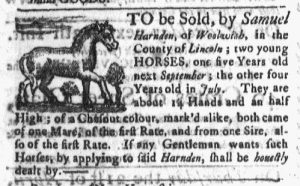
“Two young HORSES.”
Samuel Harnden placed an advertisement seeking to sell “two young HORSES” in the April 11, 1768, edition of the Boston Post-Boy. An image of a horse accompanied his advertisement, distinguishing it from most others. More than thirty advertisements appeared in that issue, but only four featured images of any sort. In addition to Harnden’s advertisement, a real estate notice included a woodcut of a house and two others concerning maritime trade and transportation incorporated woodcuts of ships. Otherwise, the issue was devoid of visual images, with the exception of the masthead. A ship at sea and a post rider flanked the newspaper title at the top of the first page of each issue of the Boston Post-Boy.
Visual images constitute an important aspect of twenty-first-century media, in general, and advertising, in particular. Printing technologies of the eighteenth century, however, made visual images in newspapers relatively rare. In addition to their type, printers also had a limited number of stock images, woodcuts that could accompany some of the most common types of advertisements. Most of these generic images were represented in the April 11, 1768, edition of the Boston Post-Boy, but advertisements also frequently included woodcuts of slaves in addition to horses, houses, and ships. Since they belonged to printers and could be used interchangeably for advertisements with the same purpose, such images were not associated with any particular advertisers. However, some advertisers did invest in woodcuts that represented their businesses, often replicating their shop signs. Compared to the stock images, significantly fewer paid notices had woodcuts commissioned by the advertiser.
Woodcuts were not the only way to introduce visual variation into eighteenth-century newspapers. Printers typically possessed a variety of printing ornaments that could be deployed to add visual interest to the page, though the extent of ornamental printing varied from newspaper to newspaper. The compositors in Green and Russell’s printing shop, for instance, did not tend to insert much ornamental printing into the pages of the Boston Post-Boy, but their counterparts in Edes and Gill’s shop used ornaments to separate news items and advertisements. In the process, they presented a more sophisticated graphic design. Given the scarcity of visual images in eighteenth-century newspapers, readers may have been even more attuned to the variations in ornamental printing than modern readers who quickly become overwhelmed by the density of the text in both news items and advertisements.
What was advertised in a colonial American newspaper 250 years ago today?
Providence Gazette (April 16, 1768).
“To be SOLD … tea kettles, skillets, spiders, &c.”
This advertisement probably seems strange to many modern readers, especially the reference to “spiders” for sale. According to Alice Ross, the term “spider” refers to a “three-legged, long-handled frying pan” commonly used during the colonial period and into the nineteenth century. The Oxford English Dictionary describes a spider as “a kind of frying-pan having legs and a long handle.” Until the kitchen stove came about, all cooking in a home was done on the only source of heat: the fireplace. The spider skillet’s legs allowed the user to place the cookware right on top of a burning fire. Before the cooking stove, cookware often had either legs or special rungs to hang pots over the fire. Given its function, most families with a hearth or fireplace most likely had a spider skillet. Ross notes that an advertisement published in the Pennsylvania Packet in 1790 mentioned spider skillets, but this advertisment demonstrates the use of spider skillets nearly a quarter century earlier. Although “spiders” are now unfamiliar to most consumers, they are still used for outdoor excursions, such as camping.
**********
ADDITIONAL COMMENTARY: Carl Robert Keyes
In addition to spider skillets, Amos Atwell sold “a variety of other articles, of American and European manufacture” at his shop “On the West Side of the Great Bridge, in Providence.” A blacksmith as well as a retailer, Atwell likely made some of the items listed in his advertisement.
Yet he did not publish his notice solely for the purpose of selling goods. He also indicated that he wished “to hire a journeyman” to assist in his shop. Like other artisans who placed employment advertisements, Atwell stressed that he would consider candidates who “can be well recommended for virtue and sobriety,” but he was interested in more than just the credentials and reputation of any journeyman blacksmith that he might welcome into his shop. Atwell sought assistance “extending this branch of American manufacture,” echoing a common theme from news reports published in the Providence Gazetteand throughout the colonies for the past several months. Due to an imbalance of trade with Britain, a situation exacerbated by new taxes levied by the Townshend Act, colonists had resolved to import fewer English goods in favor of consuming goods made in the colonies. Meeting demand, however, required significantly increasing production in the colonies. As an act of resistance, colonists pledged to promote domestic manufactures.
In hiring a journeyman “capable of extending this branch of American manufacture” Atwell signaled his stance to prospective consumers. He was not the only advertiser in the April 16, 1768, edition of the Providence Gazette who did so. In the same column as his notice, cutlers Joseph Bucklin and Nicholas Clark proclaimed that they recently established their shop with the expectation of receiving “due Countenance from the Well-wishers to American Manufactures” during “a Time when the setting up and extending Manufactures, appear to be the only Means of saving an injured and distressed Country.” Bucklin and Clark made their argument much more explicitly than Atwell did, perhaps priming readers to recognize the similar, yet more subtle, appeal made by the blacksmith. Prospective customers should patronize his shop, Atwell implied, because he was heeding the call to increase American production and, in turn, reduce dependence on imported goods.
What was advertised in a colonial American newspaper 250 years ago today?
Massachusetts Gazette (April 15, 1768).
“A few Cask choice Jamaica Sugar & Coffee.”
It is without question that coffee is far more popular drink in the United States than tea, but this was not always the case. During the colonial period, tea was the more preferred caffeine-oriented commodity due to its easy preparation, yet this is not to say that the coffee industry was absent from American culture at the time. Colonists imported some of their coffee from Jamaica, but it was never indigenous to that island; instead, in 1728 Sir Nicholas Lawes brought it over from Haiti. Jamaica’s warm climate made coffee cultivation plentiful and profitable. Approximately 12 million pounds of coffee was exported during the colonial era, making the Jamaican trade one of the largest providers of coffee to the British Empire. Unlike the roasted coffee beans or grinds sold today, usually only the recently picked and pre-roasted coffee beans were sold in colonial America, meaning that the purchaser would have to the roasting, grinding and brewing themselves.
**********
ADDITIONAL COMMENTARY: Carl Robert Keyes
Coffee, tea, and chocolate comprised a trio of exotic hot beverages popular in colonial America. Many colonists drank these beverages at home, but men also gathered in public venues to consume them together. As Kurt notes, tea became the most popular of those drinks – and arguably the most emblematic of the early American experience – but the venues that served them were known as coffeehouses. Like many other aspects of English culture, colonists transported the concept of the coffeehouse across the Atlantic.
Men gathered in coffeehouses for a variety of purposes. Some conducted business at these establishments. Merchants and other traders met to make deals and settle accounts over a hot cup of coffee. Both New York and Philadelphia had a Merchants’ Coffee House prior to the American Revolution, the name suggesting the type of clientele each sought to attract. Customers also gathered to discuss news and politics. To that end, the proprietors provided several amenities, especially newspapers and pamphlets for their clients to peruse. In addition to local newspapers, they also subscribed to publications from other cities, broadening the array of sources available to their patrons. News concerning politics spread as men in coffeehouses read newspapers from near and far, often aloud to their companions, and then discussed current events and editorial pieces, including the “Letters from a Farmer in Pennsylvania” that circulated in the wake of the Townshend Act. Merchants also visited coffeehouses to consult newspapers in hopes that the information they contained would guide them in making sound business decisions.
Yet men met at coffeehouses for reasons other than business and politics. Coffeehouses were centers of sociability. Customers gathered to converse with one another. As much as many of them liked to think of their discussions with friends and acquaintances as enlightened exchanges, they also tended to engage in gossip as well. Women were excluded from coffeehouses, from conducting business, from discussing politics, from conversations that took place there, but that did not mean that one of the vices most frequently attributed to women – gossip – was absent from those homosocial spaces. Men managed to trade stories, both fanciful and snide, without the influence of women, though they liked to pretend otherwise.
Coffee was more than a commodity sold for consumption within the household in eighteenth-century America. Colonists also gathered in public spaces to drink this hot beverage together as they conducted business, debated politics, and socialized. Like taverns, coffeehouses were important venues for exchanging information and ideas and, in turn, shaping American commerce and politics, in the era of the imperial crisis and the American Revolution.