These tables indicate how many advertisements for slaves appeared in colonial American newspapers during the week of April 1-7, 1768.
Note: These tables are as comprehensive as currently digitized sources permit, but they may not be an exhaustive account. They includes all newspapers that have been digitized and made available via Accessible Archives, Colonial Williamsburg’s Digital Library, and Readex’s America’s Historical Newspapers. There are several reasons some newspapers may not have been consulted:
Issues that are no longer extant;
Issues that are extant but have not yet been digitized (including the Pennsylvania Journal); and
Newspapers published in a language other than English (including the Wochentliche Philadelphische Staatsbote).
**********
Slavery Advertisements Published April 1-7, 1768: By Date
**********
Slavery Advertisements Published April 1-7, 1768: By Region
The Slavery Adverts 250 Project chronicles the role of newspaper advertising in perpetuating slavery in the era of the American Revolution. The project seeks to reveal the ubiquity of slavery in eighteenth-century life from New England to Georgia by republishing advertisements for slaves – for sale, wanted to purchase, runaways, captured fugitives – in daily digests on this site as well as in real time via the @SlaveAdverts250 Twitter feed, utilizing twenty-first-century media to stand in for the print media of the eighteenth century.
The project aims to provide modern audiences with a sense of just how often colonists encountered these advertisements in their daily lives. Enslaved men, women, and children appeared in print somewhere in the colonies almost every single day. Those advertisements served as a constant backdrop for social, cultural, economic, and political life in colonial and revolutionary America. Colonists who did not own slaves were still confronted with slavery as well as invited to maintain the system by purchasing slaves or assisting in the capture of runaways. The frequency of these newspaper advertisements suggests just how embedded slavery was in colonial and revolutionary American culture in everyday interactions beyond the printed page.
These advertisements also testify to the experiences of enslaved men, women, and children, though readers must consider that those experiences have been remediated through descriptions offered by slaveholders rather than the slaves themselves. Often unnamed in the advertisements, enslaved men, women, and children were not invisible or unimportant in early America.
These advertisements appeared in colonial American newspapers 250 years ago today.
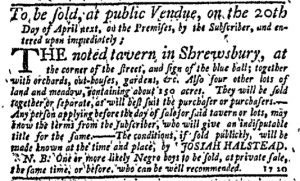
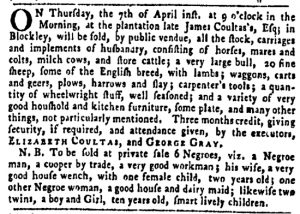
Massachusetts Gazette (April 7, 1768).
**********
Massachusetts Gazette (April 7, 1768).
**********
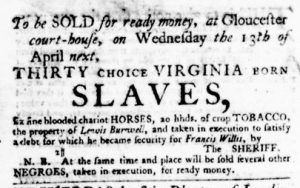
New-York Journal (April 7, 1768).
**********
New-York Journal (April 7, 1768).
**********
New-York Journal (April 7, 1768).
**********
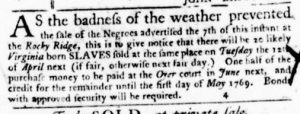
Pennsylvania Gazette (April 7, 1768).
**********
Pennsylvania Gazette (April 7, 1768).
**********
Pennsylvania Gazette (April 7, 1768).
**********
Supplement to the Pennsylvania Gazette (April 7, 1768).
**********
Supplement to the Pennsylvania Gazette (April 7, 1768).
**********
Supplement to the Pennsylvania Gazette (April 7, 1768).
**********
Supplement to the Pennsylvania Gazette (April 7, 1768).
What was advertised in a colonial American newspaper 250 years ago today?
Supplement to the Georgia Gazette (April 6, 1768).
“WHEN I saw myself attacked again by your advertisement …”
In the spring of 1768 John Joachim Zubly and Lachlan McGillivray litigated a dispute over real estate via a series of advertisements. It began when an “advertisement was stuck up” by McGillivray and George Galphin “at divers places at Augusta and New-Windsor” in Georgia in early March. Zubly responded by placing an advertisement in the March 16 edition of the Georgia Gazette. The same advertisement ran in the following issue. After that, the dispute escalated as Zubly and McGillivray published additional advertisements attacking each other.
Zubly’s advertisement ran for a third time in the March 30 edition, but by then McGillivray had composed a response of a similar length that ran on another page. They were the longest advertisements in the issue, each occupying significantly more space than any of the other paid notices. This windfall for the printer continued the following week when Zubly submitted a response to McGillivray’s response. Zubly meticulously addressed McGillivray’s counterattack, moving through his assertions charge by charge. He did so in such detail that his new advertisement extended more than a page.
James Johnston, the printer of the Georgia Gazette, did not have sufficient space to publish this war of words in a regular issue. Like most other colonial newspapers, a standard issue of the Georgia Gazette consisted of four pages printed on a broadside folded in half. Johnston filled the April 6 edition with news and other advertisements. He simultaneously distributed a two-page supplement that consisted entirely of the advertisements that so far comprised the Zubly-McGillivray dispute (with the exception of the broadsides that had been “stuck up at diverse places at Augusta and New-Windsor”). The advertisements no longer ran on separate pages; instead, the printer gathered them together chronologically in order to present a coherent story for readers.
Throughout the colonies the number of supplements to weekly editions of newspapers increased in the first months of 1768. Most of those supplements carried news about deteriorating relationships with Great Britain or selections from John Dickinson’s series of “Letters from a Farmer in Pennsylvania” or they carried advertisements that did not fit in the regular issue because the news and “Letters” had crowded them out. The supplement to the April 6 edition of the Georgia Gazettewas different. It was not the ongoing dispute between the colonies and Parliament that prompted it but instead a personal dispute between two colonists who disagreed about a real estate transaction. For Zubly and McGillivrary – and perhaps some readers of the Georgia Gazette– this drama was as compelling as the unfolding feud with Parliament. Each considered it important enough to make a handsome investment in publishing it for all to see among the advertisements in the colony’s only newspaper.
Supplement to the Georgia Gazette (April 6, 1768).
**********
Supplement to the Georgia Gazette (April 6, 1768).
The Slavery Adverts 250 Project chronicles the role of newspaper advertising in perpetuating slavery in the era of the American Revolution. The project seeks to reveal the ubiquity of slavery in eighteenth-century life from New England to Georgia by republishing advertisements for slaves – for sale, wanted to purchase, runaways, captured fugitives – in daily digests on this site as well as in real time via the @SlaveAdverts250 Twitter feed, utilizing twenty-first-century media to stand in for the print media of the eighteenth century.
The project aims to provide modern audiences with a sense of just how often colonists encountered these advertisements in their daily lives. Enslaved men, women, and children appeared in print somewhere in the colonies almost every single day. Those advertisements served as a constant backdrop for social, cultural, economic, and political life in colonial and revolutionary America. Colonists who did not own slaves were still confronted with slavery as well as invited to maintain the system by purchasing slaves or assisting in the capture of runaways. The frequency of these newspaper advertisements suggests just how embedded slavery was in colonial and revolutionary American culture in everyday interactions beyond the printed page.
These advertisements also testify to the experiences of enslaved men, women, and children, though readers must consider that those experiences have been remediated through descriptions offered by slaveholders rather than the slaves themselves. Often unnamed in the advertisements, enslaved men, women, and children were not invisible or unimportant in early America.
These advertisements appeared in colonial American newspapers 250 years ago today.
What was advertised in a colonial American newspaper 250 years ago today?
South-Carolina Gazette and Country Journal (April 5, 1768).
“BALL’s ALMANACKS for the Year 1768, to be sold by the Printer.”
Published in the lower right corner of the first page of the April 5 issue, this advertisement for “BALL’s ALMANACKS for the Year 1768” made an unseasonably late appearance in the South-Carolina Gazette and Country Journal. Readers throughout the colonies were accustomed to a certain rhythm when it came to printers advertising almanacs in newspapers. Some commenced as early as September, seeking to gain an advantage over competitors by announcing that their almanacs would soon go to press. They peddled the promise of a product that did not yet exist, but primed consumers to contemplate the version they offered before encountering any others. The number and frequency of advertisements for almanacs increased throughout the fall as the new year approached. The advertisements usually continued for the first few weeks of January but then tapered off by the time February arrived. After all, more and more of the contents became outdated every week. Yet Charles Crouch still opted to publish an advertisement for almanacs in his newspaper in early April 1768. More than a quarter of the year had passed, but Crouch tested whether he could create a market for leftover copies that he had not managed to sell.
Many eighteenth-century printers sought to generate revenues beyond job printing, newspaper subscriptions, and advertising fees by publishing and selling almanacs. Doing so was a savvy investment of their time and resources since colonists from the most humble households to the most grand acquired these popular periodicals each year … but only if printers accurately estimated the market for almanacs. Not printing a sufficient number meant turning customers away. Even worse, it could mean losing their business in future years if they purchased another almanac and developed loyalty toward its contents, author, or printer. On the other hand, printing too many almanacs could undermine any profits if a printer ended up with a significant surplus. That Crouch was still advertising “BALL’s ALMANACKS for the Year 1768” in April suggests that he did indeed have an unacceptable surplus crowding the shelves or storage space at his printing shop. Indirectly, it also testifies to the utility of almanacs in the eighteenth century. Prospective customers may not have dismissed the almanacs simply because a portion of the calendar and astronomical calculations had already passed. Instead, some may have instead focused on the other information contained within the pages of almanacs, information that remained useful throughout the year. Among their many contents, almanacs typically contained lists of colonial officials, dates for holding courts ands fairs, cures and remedies for various maladies, and amusing anecdotes. That being the case, Crouch took a chance that he might find buyers for some of his remaining almanacs even if readers did not expect to see them advertised at that time of the year.
The Slavery Adverts 250 Project chronicles the role of newspaper advertising in perpetuating slavery in the era of the American Revolution. The project seeks to reveal the ubiquity of slavery in eighteenth-century life from New England to Georgia by republishing advertisements for slaves – for sale, wanted to purchase, runaways, captured fugitives – in daily digests on this site as well as in real time via the @SlaveAdverts250 Twitter feed, utilizing twenty-first-century media to stand in for the print media of the eighteenth century.
The project aims to provide modern audiences with a sense of just how often colonists encountered these advertisements in their daily lives. Enslaved men, women, and children appeared in print somewhere in the colonies almost every single day. Those advertisements served as a constant backdrop for social, cultural, economic, and political life in colonial and revolutionary America. Colonists who did not own slaves were still confronted with slavery as well as invited to maintain the system by purchasing slaves or assisting in the capture of runaways. The frequency of these newspaper advertisements suggests just how embedded slavery was in colonial and revolutionary American culture in everyday interactions beyond the printed page.
These advertisements also testify to the experiences of enslaved men, women, and children, though readers must consider that those experiences have been remediated through descriptions offered by slaveholders rather than the slaves themselves. Often unnamed in the advertisements, enslaved men, women, and children were not invisible or unimportant in early America.
These advertisements appeared in colonial American newspapers 250 years ago today.
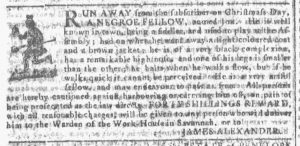
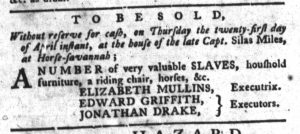
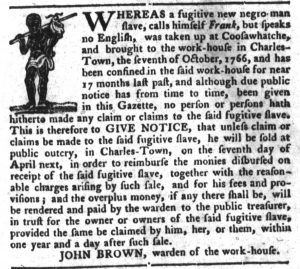
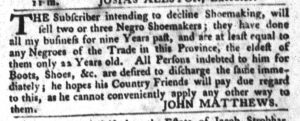
South-Carolina Gazette and Country Journal (April 5, 1768).
**********
South-Carolina Gazette and Country Journal (April 5, 1768).
**********
South-Carolina Gazette and Country Journal (April 5, 1768).
**********
South-Carolina Gazette and Country Journal (April 5, 1768).
**********
South-Carolina Gazette and Country Journal (April 5, 1768).
**********
South-Carolina Gazette and Country Journal (April 5, 1768).
**********
South-Carolina Gazette and Country Journal (April 5, 1768).
**********
South-Carolina Gazette and Country Journal (April 5, 1768).
**********
South-Carolina Gazette and Country Journal (April 5, 1768).
**********
South-Carolina Gazette and Country Journal (April 5, 1768).
**********
South-Carolina Gazette and Country Journal (April 5, 1768).
**********
South-Carolina Gazette and Country Journal (April 5, 1768).
What was advertised in a colonial American newspaper 250 years ago today?
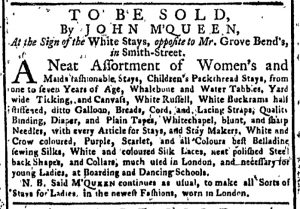
New-York Gazette: Or, the Weekly Post-Boy (April 4, 1768).
“M’QUEEN continues as usual, to make all Sorts of Stays for Ladies, in the newest Fashions, worn in London.”
How effective were the advertisements for consumer goods and services that appeared in eighteenth-century newspapers? This is a difficult question to answer, especially from the perspective of consumers. From the perspective of the advertisers, however, their persistence in running newspaper advertisements suggests that they believed those advertisements effectively generated more business than if they had instead chosen not to advertise. This speaks to attitudes about advertising in eighteenth-century America.
John McQueen sold made and sold stays (or corsets) in New York in the 1760s. He repeatedly placed advertisements in the local newspapers (including advertisements in March 1766 and February 1767), an indication that he considered them effective for stimulating demand among prospective customers. At the very least, he saw advertising as a necessity for informing readers of the various kinds of stays he stocked. Neglecting to advertise might have resulted in surrendering his share of the market to competitors. Such an interpretation implies that McQueen merely attempted to direct existing demand to his establishment. The contents of the advertisements, however, suggest that he considered advertising more powerful than that. After all, he did not merely announce that he sold stays; the staymaker also formulated appeals to fashion that he expected would resonate with potential customers.
For instance, McQueen underscored that he sold “all Sorts of Stays for Ladies, in the newest Fashions, worn in London.” This echoed appeals that he made in previous advertisements: “all sort of Stays for Ladies in the newest Fashions that is wore in London” and “all Sorts of Stays, in the newest Fashion that is wore by the Ladies of Great-Britain or France.” In addition to invoking current tastes, McQueen linked his stays to European fashions, especially those in the metropolitan center of the empire. New York was a relatively small city compared to London, but “Ladies” who purchased McQueen’s stays could trust that they were not less cosmopolitan than their counterparts on the other side of the Atlantic. McQueen reinforced this appeal when he also applied it “neat polished Steel back Shapes, and Collars, much used in London.” He continued by asserting that these items were “necessary for young Ladies, at Boarding and Dancing Schools.” He bound fashion and gentility together, seeking to convince prospective customers that they needed the stays he made and sold, especially if they intended to comport themselves appropriately at certain venues where the better sorts gathered.
McQueen considered these appeals effective enough that he consistently incorporated them into newspaper advertisements over the course of several years. He did more than announce that he made and sold stays. He offered reasons why readers should purchase his wares, attempting to stimulate demand. Had he not believed that this would yield a return on his investment then he likely would have scaled back or discontinued his advertisements rather than continue to pay for notices that had no effect on consumers.
The Slavery Adverts 250 Project chronicles the role of newspaper advertising in perpetuating slavery in the era of the American Revolution. The project seeks to reveal the ubiquity of slavery in eighteenth-century life from New England to Georgia by republishing advertisements for slaves – for sale, wanted to purchase, runaways, captured fugitives – in daily digests on this site as well as in real time via the @SlaveAdverts250 Twitter feed, utilizing twenty-first-century media to stand in for the print media of the eighteenth century.
The project aims to provide modern audiences with a sense of just how often colonists encountered these advertisements in their daily lives. Enslaved men, women, and children appeared in print somewhere in the colonies almost every single day. Those advertisements served as a constant backdrop for social, cultural, economic, and political life in colonial and revolutionary America. Colonists who did not own slaves were still confronted with slavery as well as invited to maintain the system by purchasing slaves or assisting in the capture of runaways. The frequency of these newspaper advertisements suggests just how embedded slavery was in colonial and revolutionary American culture in everyday interactions beyond the printed page.
These advertisements also testify to the experiences of enslaved men, women, and children, though readers must consider that those experiences have been remediated through descriptions offered by slaveholders rather than the slaves themselves. Often unnamed in the advertisements, enslaved men, women, and children were not invisible or unimportant in early America.
These advertisements appeared in colonial American newspapers 250 years ago today.
Boston Evening-Post (April 4, 1768).
**********
New-York Gazette and Weekly Mercury (April 4, 1768).
**********
New-York Gazette and Weekly Mercury (April 4, 1768).
**********
Supplement to the New-York Gazette and Weekly Mercury (April 4, 1768).
**********
New-York Gazette and Weekly Mercury (April 4, 1768).
**********
New-York Gazette and Weekly Mercury (April 4, 1768).
What was advertised in a colonial American newspaper 250 years ago this week?
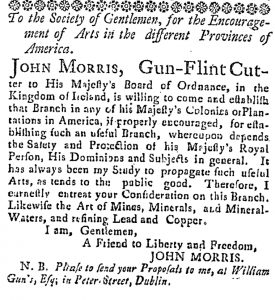
Connecticut Journal (April 1, 1768).
“Gun-Flint Cutter to His Majesty’s Board of Ordnance, in the Kingdom of Ireland.”
First in response to the Stamp Act and later in the wake of the Townshend Act, some American merchants, shopkeepers, and artisans cast their advertising appeals in terms of the politics of production and consumption. They sought to convince prospective customers that their decisions about which goods to purchase and which establishments to patronize had a political valence. In so doing, they echoed the calls to boycott imported goods and instead to encourage domestic manufactures published in the news and editorial items that appeared elsewhere in colonial newspapers.
John Morris’s advertisement in the April 1, 1768, edition of the Connecticut Journal suggests that some artisans who resided on the other side of the Atlantic became aware of this discourse and opted to mobilize it for their own benefit. Morris, a “Gun-Flint Cutter to His Majesty’s Board of Ordnance, in the Kingdom of Ireland,” announced that he was “willing to come and establish that Branch in any of his Majesty’s Colonies or Plantations in America, if properly encouraged.” In an attempt to frame his advertisement to achieve an enthusiastic response, he addressed it to “the Society of Gentlemen, for the Encouragement of Arts in the different Provinces of America.” Many colonists might have been hesitant to import a variety of goods as a means of resistance when Parliament overstepped its authority, but Morris reasoned that they would welcome an artisan whose labor would make valuable contributions in the domestic marketplace. To underscore this benefit, Morris signed himself as “A Friend to Liberty and Freedom,” indicating his sympathy for the colonists’ cause.
He did not, however, make his case in stronger terms than popular opinion permitted. Morris carefully positioned his work, stating that “the Safety and Protection of his Majesty’s Royal Person, His Dominions and Subjects in general” depended on the efforts of gunflint cutters. He provided a service to king and country. While migrating to the colonies might yield some particular advantages for certain of the monarch’s subjects who wished “for the Encouragement of the Arts in the different Provinces of America,” Morris was not advocating anything more radical than strengthening the economic position of the colonies within the empire. Colonists had called for resistance to abuses by Parliament, but they did not yet seriously entertain notions of revolution or independence. The “Honourable House of Representatives” of Massachusetts, one the colonies that led resistance efforts, underscored that point in a letter to “the Right Honourable the Earl of SHELBURNE, one of his Majesty’s Principal Secretaries of State,” a letter that circulated in colonial newspapers (including the April 2, 1768, edition of the Providence Gazette). Legislators from Massachusetts argued in favor of strengthening local government, but also that they were “not insensible of their security and happiness in their connexion with, and dependence on, the mother state.” Furthermore, “they have reason to believe [these] are the sentiments of all the colonies.”
Morris marketed his occupation and willingness to migrate to the American colonies in terms that matched the current political situation. He was an astute enough observer of the rhetoric currently in use in the colonies that even from across the Atlantic he was able to replicate both the sentiments and the appeals advanced by artisans and other advertisers who already resided “in the different Provinces of America.”
What was advertised in a colonial American newspaper 250 years ago today?
Providence Gazette (April 2, 1768).
“Extending Manufactures, appear to be the only Means of saving an injured and distressed Country.”
When Joseph Bucklin and Nicholas Clark placed an advertisement to “inform the Public, that they have set up the Cutler’s Business, in a Variety of Branches” in Providence in the spring of 1768 they imbued their products with political significance. In the wake of the Townshend Act going into effect the previous November, colonists from New England to Georgia continued to lament Parliament overstepping its authority and subjecting Americans to abuses that threatened to enslave them. Almost every newspaper published in the colonies reprinted a series of “Letters from Farmer in Pennsylvania,” twelve essays in which John Dickinson argued that Parliament could not impose taxes on the colonies for the purposes of raising revenue rather than regulating trade because the colonies were supposed to remain sovereign in their internal affairs. Starting in Boston and spreading far and wide, colonists pledged not to import goods from Britain but instead encourage domestic production to benefit the colonies both politically economically.
In that spirit, Bucklin and Clark proclaimed that “They have set up their Business in Confidence that they shall not want proper Encouragement, at a time when the setting up and extending Manufactures, appear to be the only Means of saving an injured and distressed Country.” The cutlers did not need to comment on the current political situation any more explicitly, especially since news and editorial items printed elsewhere in the same issue of the Providence Gazette provided the necessary context for prospective customers to understand their meaning. Even when considered independently of the other contents of any particular issue in which the advertisement appeared, Bucklin and Clark devised an advertisement that addressed discussions that had been taking place in print and in person for more than six months. Having done so, they expected “Proper Encouragement” for their efforts. They commenced their business for “the public Benefit” and called on “the Well-wishers to American Manufacturers” to purchase their wares. At the same time, they underscored the quality of their cutlery. Manufactured locally, their cutlery was not inferior to any imported from Britain or Ireland. Conscientious consumers, Bucklin and Clark argued, did not have to sacrifice quality when their politics guided their purchasing decisions.