September 1

What was advertised in a colonial American newspaper 250 years ago today?

Sep 1 - 9:1:1768 Virginia Gazette Purdie and Dixon
Virginia Gazette [Purdie & Dixon] (September 1, 1768).
“RUN away … Negro woman named GRACE … appears to be young with child.”

In many instances, newspaper advertisements for runaways may be the only documents that testify to the experiences of some enslaved men and women. Each runaway advertisement tells a story of someone who might otherwise have disappeared from the historical record, but these are only partial stories told by aggrieved masters rather than by the fugitive slaves themselves. Still, these truncated narratives allow us to reconstruct the past, granting insight into the thoughts and experiences of enslaved people even though they do not provide direct testimony.

Consider the story of Grace, described by James Johnson as “a likely Virginia born Negro woman … of a very black complexion.” When Grace ran away in early August 1768, Johnson placed an advertisement offering a reward for her capture in Purdie and Dixon’s Virginia Gazette. He provided a short biography, though it likely did not include the details that Grace would have chosen were she telling her own story about her life. The young woman had been born in Virginia, like most of the other enslaved men, women, and children advertised in the same the Virginia Gazette at the time she made her escape. She was not a “new negro” who had survived the Middle Passage from Africa and then transshipment within the colonies, but she had not always resided with the same master in the same town. Johnson reported that she ran away from Amelia, well inland, and would “endeavour to get on board some vessel in James river, or make for Hampton town” on the coast. Johnson was at least her third owner, having acquired Grace from James Machan who “said she had lived with Mr. Collier” near Hampton.

Johnson provided one other important detail about Grace, reporting she was “somewhat fat, middling large, and appears to be young with child.” Every fugitive had good reason for running away, but Grace may have had more motivation than others. She was probably aware that she could be separated from her child at any time. Another advertisement in the same issue listed several prizes in a lottery, including “a likely breeding woman named Agnes” valued at fifty pounds as one prize and “Agnes’s child, named Rose, 18 months old” valued at fifteen pounds as another. Mother and daughter were almost certain to be separated when the tickets were drawn and the so-called “Prizes” awarded. In addition to Agnes, the “Prizes” included another “likely breeding woman named Ruth.” Grace may not have fled merely to avoid being separated from her child. She may have been escaping sexual abuse and exploitation that led to her pregnancy, whether perpetrated by Johnson or others. In a society that treated her as a “likely breeding woman,” Grace may have been attempting to assert control over her own body and reproductive choices.

It is impossible to know for certain the precise reasons that Grace chose to run away or why she ran at the time she did, but Johnson’s advertisement suggests some likely possibilities. He did not acknowledge the abuses Grace may have suffered, but readers can fill in those silences by imagining Johnson’s narrative of the enslaved woman’s life had it been told by Grace herself.

Slavery Advertisements Published September 1, 1768

The Slavery Adverts 250 Project chronicles the role of newspaper advertising in perpetuating slavery in the era of the American Revolution. The project seeks to reveal the ubiquity of slavery in eighteenth-century life from New England to Georgia by republishing advertisements for slaves – for sale, wanted to purchase, runaways, captured fugitives – in daily digests on this site as well as in real time via the @SlaveAdverts250 Twitter feed, utilizing twenty-first-century media to stand in for the print media of the eighteenth century.

The project aims to provide modern audiences with a sense of just how often colonists encountered these advertisements in their daily lives. Enslaved men, women, and children appeared in print somewhere in the colonies almost every single day. Those advertisements served as a constant backdrop for social, cultural, economic, and political life in colonial and revolutionary America. Colonists who did not own slaves were still confronted with slavery as well as invited to maintain the system by purchasing slaves or assisting in the capture of runaways. The frequency of these newspaper advertisements suggests just how embedded slavery was in colonial and revolutionary American culture in everyday interactions beyond the printed page.

These advertisements also testify to the experiences of enslaved men, women, and children, though readers must consider that those experiences have been remediated through descriptions offered by slaveholders rather than the slaves themselves. Often unnamed in the advertisements, enslaved men, women, and children were not invisible or unimportant in early America.

These advertisements appeared in colonial American newspapers 250 years ago today.

Sep 1 - Boston Weekly News-Letter Slavery 1
Boston Weekly News-Letter (September 1, 1768).

**********

Sep 1 - Boston Weekly News-Letter Slavery 2
Boston Weekly News-Letter (September 1, 1768).

**********

Sep 1 - Massachusetts Gazette Draper Slavery 1
Massachusetts Gazette [Draper] (September 1, 1768).

**********

Sep 1 - New-York Journal Slavery 1
New-York Journal (September 1, 1768).

**********

Sep 1 - New-York Journal Slavery 2
New-York Journal (September 1, 1768).

**********

Sep 1 - New-York Journal Slavery 3
New-York Journal (September 1, 1768).

**********

Sep 1 - New-York Journal Slavery 4
Supplement to the New-York Journal (September 1, 1768).

**********

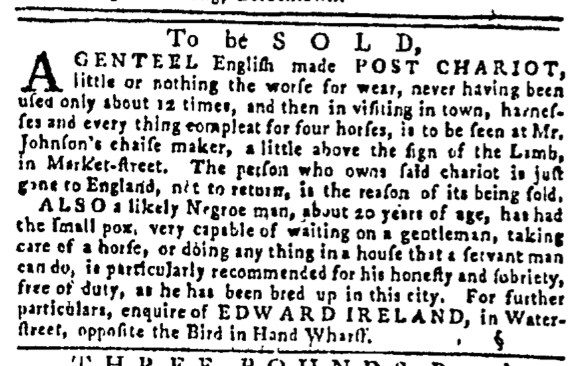
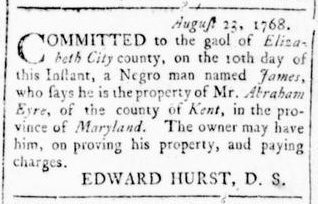
Sep 1 - Pennsylvania Gazette Slavery 1
Pennsylvania Gazette (September 1, 1768).

**********

Sep 1 - Pennsylvania Gazette Slavery 2
Pennsylvania Gazette (September 1, 1768).

**********

Sep 1 - Pennsylvania Gazette Slavery 3
Pennsylvania Gazette (September 1, 1768).

**********

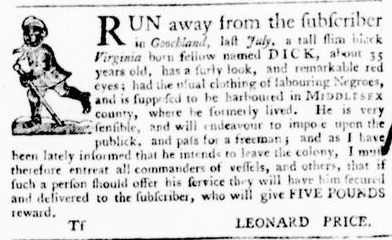
Sep 1 - Virginia Gazette Purdie and Dixon Slavery 1
Virginia Gazette [Purdie & Dixon] (September 1, 1768).

**********

Sep 1 - Virginia Gazette Purdie and Dixon Slavery 2
Virginia Gazette [Purdie & Dixon] (September 1, 1768).

**********

Sep 1 - Virginia Gazette Purdie and Dixon Slavery 3
Virginia Gazette [Purdie & Dixon] (September 1, 1768).

**********

Sep 1 - Virginia Gazette Purdie and Dixon Slavery 4
Virginia Gazette [Purdie & Dixon] (September 1, 1768).

**********

Sep 1 - Virginia Gazette Purdie and Dixon Slavery 5
Virginia Gazette [Purdie & Dixon] (September 1, 1768).

**********

Sep 1 - Virginia Gazette Purdie and Dixon Slavery 6
Virginia Gazette [Purdie & Dixon] (September 1, 1768).

**********

Sep 1 - Virginia Gazette Purdie and Dixon Slavery 7
Virginia Gazette [Purdie & Dixon] (September 1, 1768).

**********

Sep 1 - Virginia Gazette Purdie and Dixon Slavery 8
Virginia Gazette [Purdie & Dixon] (September 1, 1768).

**********

Sep 1 - Virginia Gazette Purdie and Dixon Slavery 9
Virginia Gazette [Purdie & Dixon] (September 1, 1768).

**********

Sep 1 - Virginia Gazette Purdie and Dixon Slavery 10
Virginia Gazette [Purdie & Dixon] (September 1, 1768).

**********

Sep 1 - Virginia Gazette Purdie and Dixon Slavery 11
Virginia Gazette [Purdie & Dixon] (September 1, 1768).

**********

Sep 1 - Virginia Gazette Rind Slavery 1
Virginia Gazette [Rind] (September 1, 1768).

**********

Sep 1 - Virginia Gazette Rind Slavery 2
Virginia Gazette [Rind] (September 1, 1768).

**********

Sep 1 - Virginia Gazette Rind Slavery 3
Virginia Gazette [Rind] (September 1, 1768).

**********

Sep 1 - Virginia Gazette Rind Slavery 4
Virginia Gazette [Rind] (September 1, 1768).

**********

Sep 1 - Virginia Gazette Rind Slavery 5
Virginia Gazette [Rind] (September 1, 1768).

**********

Sep 1 - Virginia Gazette Rind Slavery 6
Virginia Gazette [Rind] (September 1, 1768).

**********

Sep 1 - Virginia Gazette Rind Slavery 7
Virginia Gazette [Rind] (September 1, 1768).

**********

Sep 1 - Virginia Gazette Rind Slavery 8

Virginia Gazette [Rind] (September 1, 1768).

**********

Sep 1 - Virginia Gazette Rind Slavery 9
Virginia Gazette [Rind] (September 1, 1768).