What was advertised in a revolutionary American newspaper 250 years ago today?
Constitutional Gazette (July 31, 1776).
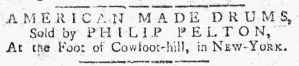
“AMERICAN MADE DRUMS.”
“Buy American” and “Made in America” are familiar marketing appeals in modern America. They are also appeals with a lineage that goes back to the eighteenth century, emerging in advertisements in American newspapers even before the Revolutionary War and the Declaration of Independence. Colonizers participated in a transatlantic consumer revolution that gained significant momentum by the middle of the century. As part of the process, they followed the lead of their counterparts in Great Britain, both by purchasing an expanding array of clothing and housewares and by thinking about the role of the colonies in an empire defined by commerce rather than by conquest. On both sides of the Atlantic, people thought of Great Britain as the producer of goods and the colonies as the consumer of goods. That led to a trade imbalance that some colonizers sought to address by producing more good for their own consumption, rather than exporting raw materials, even before the imperial crisis.
Once Parliament attempted to regulate trade and impose duties on imported goods after the Seven Years War, some colonizers became more insistent that they should increase their “domestic manufactures” or goods produced in the colonies for local consumption. A series of nonimportation agreements adopted for the purpose of gaining political leverage via commerce (or the lack of commerce) in the 1760s and 1770s made “Buy American” and “Made in America” appeals even more common as producers and consumers both imagined alternatives to goods imported from Great Britain. Once the Revolutionary War began, such appeals had even greater significance. Advertisers sometimes included short editorials in their newspaper notices to convince consumers to purchase their “domestic manufactures,” but not everyone considered that an essential part of their marketing efforts. For instance, a brief advertisement in July 31, 1776, edition of the Constitutional Gazette – just three lines – proclaimed, “AMERICAN MADE DRUMS, Sold by PHILIP PELTON, At the Foot of Cowfoot-hill, in NEW-YORK.” Pelton did not consider it necessary to elaborate on the drums he sold. He apparently considered “AMERICAN MADE” a sufficient pitch to attract customers looking to outfit companies of soldiers fighting the war for independence.
The Slavery Adverts 250 Project chronicles the role of newspaper advertising in perpetuating slavery in the era of the American Revolution. The project seeks to reveal the ubiquity of slavery in eighteenth-century life from New England to Georgia by republishing advertisements about enslaved people – for sale as individuals or in groups, wanted to purchase or for hire for short periods, runaways who liberated themselves, and those who were subsequently captured and confined in jails and workhouses – in daily digests on this site as well as in real time via the @SlaveAdverts250 Twitter feed, utilizing twenty-first-century media to stand in for the print media of the eighteenth century.
The project aims to provide modern audiences with a sense of just how often colonizers encountered these advertisements in their daily lives. Enslaved men, women, and children appeared in print somewhere in the colonies almost every single day. Those advertisements served as a constant backdrop for social, cultural, economic, and political life in colonial and revolutionary America. Colonizers who did not purport to own enslaved people were still confronted with slavery as well as invited to maintain the system by purchasing enslaved men, women, and children or assisting in the capture of so-called “runaways” who sought to free themselves from bondage. The frequency of these newspaper advertisements suggests just how embedded slavery was in colonial and revolutionary American culture in everyday interactions beyond the printed page.
These advertisements also testify to the experiences of enslaved men, women, and children, though readers must consider that those experiences have been remediated through descriptions offered by enslavers rather than enslaved people themselves. Often unnamed in the advertisements, enslaved men, women, and children were not invisible or unimportant in early America.
These advertisements appeared in revolutionary American newspapers 250 years ago today.
What was advertised in a revolutionary American newspaper 250 years ago today?
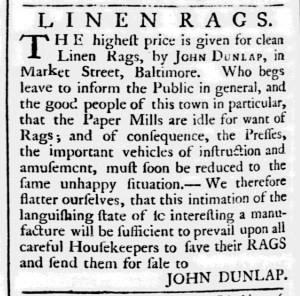
Dunlap’s Maryland Gazette (July 30, 1776).
“The Paper Mills are idle for want of Rags.”
Calls for linen rags appeared regularly in colonial American newspapers, though some readers may have had the impression that the frequency increased after the battles at Lexington and Concord. Printers and their associates needed rags for American paper mills to recycle into paper. They needed them more than ever due to disruptions in the supply of paper from England that resulted from nonimportation agreements and the Revolutionary War.
John Dunlap made a plea for “LINEN RAGS” in the July 30, 1776, edition of Dunlap’s Maryland Gazette. Some advertisements consisted of only a couple of lines, but Dunlap made a longer appeal. “THE highest price is given for clean Linen Rags, by JOHN DUNLAP, in Market Street, Baltimore,” the printer proclaimed. He “begs leave to inform the Public in general, and the good people of this town in particular,” he continued, “that the Paper Mills are idle for want of Rags; and of consequence, the Presses … must soon be reduced to the same unhappy situation.” In other words, anyone who got even some of their news from Dunlap’s newspaper had a duty to collect rags if they wanted that newspaper to continue circulating updates about the war and the actions taken by the Continental Congress as well as all sorts of other news. Dunlap described printing presses as “the important vehicles of instruction and amusement,” underscoring the responsibility that he felt toward subscribers and “the Public in general.” The printer hoped that this appeal, “this intimation of the languishing state of so interesting a manufacture” as rags into paper, “will be sufficient to prevail upon all careful Housekeepers to save their RAGS and send them for sale to JOHN DUNLAP.” Women, those “careful Housekeepers” in Baltimore and the countryside, could make an essential contribution to keep the presses operating and news about the war circulating.
American Gazette (July 30, 1776).
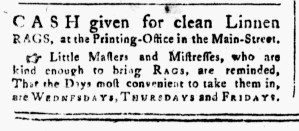
On the same day, John Rogers made a similar request to readers in Salem, Massachusetts, for “clean Linnen RAGS” in the American Gazette. “Little Masters and Mistresses, who are kind enough to bring RAGS,” he instructed, “are reminded, That the Days most convenient to take them in, are WEDNESDAYS, THURSDAYS and FRIDAYS.” In addressing “Little Masters and Mistresses,” Rogers suggested that children played an important part in gathering rags, delivering them to the printing office, and receiving payment on behalf of their families. In addition to women, boys and girls made significant contributions when it came to supplying an important resource for producing the paper necessary to keep newspapers, broadsides, pamphlets, and other items coming off of American presses during the American Revolution.
The Slavery Adverts 250 Project chronicles the role of newspaper advertising in perpetuating slavery in the era of the American Revolution. The project seeks to reveal the ubiquity of slavery in eighteenth-century life from New England to Georgia by republishing advertisements about enslaved people – for sale as individuals or in groups, wanted to purchase or for hire for short periods, runaways who liberated themselves, and those who were subsequently captured and confined in jails and workhouses – in daily digests on this site as well as in real time via the @SlaveAdverts250 Twitter feed, utilizing twenty-first-century media to stand in for the print media of the eighteenth century.
The project aims to provide modern audiences with a sense of just how often colonizers encountered these advertisements in their daily lives. Enslaved men, women, and children appeared in print somewhere in the colonies almost every single day. Those advertisements served as a constant backdrop for social, cultural, economic, and political life in colonial and revolutionary America. Colonizers who did not purport to own enslaved people were still confronted with slavery as well as invited to maintain the system by purchasing enslaved men, women, and children or assisting in the capture of so-called “runaways” who sought to free themselves from bondage. The frequency of these newspaper advertisements suggests just how embedded slavery was in colonial and revolutionary American culture in everyday interactions beyond the printed page.
These advertisements also testify to the experiences of enslaved men, women, and children, though readers must consider that those experiences have been remediated through descriptions offered by enslavers rather than enslaved people themselves. Often unnamed in the advertisements, enslaved men, women, and children were not invisible or unimportant in early America.
These advertisements appeared in revolutionary American newspapers 250 years ago today.
What was advertised in a revolutionary American newspaper 250 years ago today?
Dunlap’s Pennsylvania Packet (July 29, 1776).
“My old sign of Dr. Lucas, which hangs opposite my Liberty Pole.”
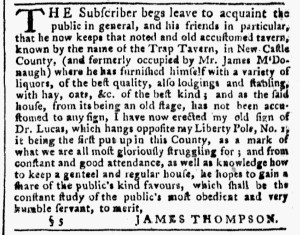
When James Thompson began operating “that noted and old accustomed tavern, known by the name of the Trap Tavern,” in New Castle County, Delaware, in the summer of 1776, he placed an advertisement in Dunlap’s Pennsylvania Packet in hopes of attracting customers among “the public in general, and his friends in particular.” Some prospective patrons may have remembered that the tavern was “formerly occupied by Mr. James McDonaugh,” yet Thompson insisted that he now provided the kind of hospitality they sought. He had, for instance, “furnished himself with a variety of liquors, of the best quality.” He also provided superior “lodgings and stabling, with hay, oats, &c. of the best kind.” He asserted that he possessed the “knowledge how to keep a genteel and regular house” and pledged “constant and good attendance in doing so.
Such appeals regularly appeared in newspaper advertisements for inns and taverns. Thompson made another pitch to prospective customers, invoking his own patriotism as a reason to visit his tavern. Readers could gather with others who supported the American cause. Thompson noted that the tavern “has not been accustomed to any sign” that marked its location. Now that he ran the place, Thompson “erected my old sign of Dr. Lucas, which hangs opposite my Liberty Pole.” The tavernkeeper deployed multiple symbols familiar to eighteenth-century readers. “Dr. Lucas” referred to Dr. Charles Lucas (1713-1771), an Irish physician and Member of Parliament for Dublin whose positions made him a favorite among American Patriots during the imperial crisis. The Sons of Liberty sometimes included Lucas alongside John Wilkes and Edmund Burke when making toasts at public events. Even though Lucas is not well known today, Thompson believed that using his image as a device to identify his tavern would resonate with prospective customers. He had apparently used his “old sign of Dr. Lucas” to mark another enterprise with results that made him believe in its effectiveness now that he displayed it again. The tavernkeeper also gave his liberty pole a name, “No. 1,” claiming that it was “the first put up in this County, as a mark of what we are all most gloriously struggling for.” Thompson intended for the spirit of revolution to inspire readers to eat, drink, and sleep at his tavern at the sign of Dr. Lucas and across from the county’s first liberty pole.
The Slavery Adverts 250 Project chronicles the role of newspaper advertising in perpetuating slavery in the era of the American Revolution. The project seeks to reveal the ubiquity of slavery in eighteenth-century life from New England to Georgia by republishing advertisements about enslaved people – for sale as individuals or in groups, wanted to purchase or for hire for short periods, runaways who liberated themselves, and those who were subsequently captured and confined in jails and workhouses – in daily digests on this site as well as in real time via the @SlaveAdverts250 Twitter feed, utilizing twenty-first-century media to stand in for the print media of the eighteenth century.
The project aims to provide modern audiences with a sense of just how often colonizers encountered these advertisements in their daily lives. Enslaved men, women, and children appeared in print somewhere in the colonies almost every single day. Those advertisements served as a constant backdrop for social, cultural, economic, and political life in colonial and revolutionary America. Colonizers who did not purport to own enslaved people were still confronted with slavery as well as invited to maintain the system by purchasing enslaved men, women, and children or assisting in the capture of so-called “runaways” who sought to free themselves from bondage. The frequency of these newspaper advertisements suggests just how embedded slavery was in colonial and revolutionary American culture in everyday interactions beyond the printed page.
These advertisements also testify to the experiences of enslaved men, women, and children, though readers must consider that those experiences have been remediated through descriptions offered by enslavers rather than enslaved people themselves. Often unnamed in the advertisements, enslaved men, women, and children were not invisible or unimportant in early America.
These advertisements appeared in revolutionary American newspapers 250 years ago today.
Connecticut Courant (July 29, 1776).
**********
Dunlap’s Pennsylvania Packet (July 29, 1776).
**********
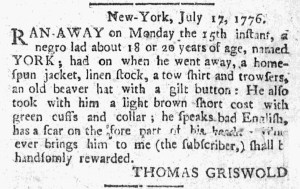
New-York Gazette and Weekly Mercury (July 29, 1776).
**********
New-York Gazette and Weekly Mercury (July 29, 1776).
**********
New-York Gazette and Weekly Mercury (July 29, 1776).
**********
New-York Gazette and Weekly Mercury (July 29, 1776).
**********
New-York Gazette and Weekly Mercury (July 29, 1776).
What was advertised in a revolutionary American newspaper 250 years ago this week?
Freeman’s Journal (July 27, 1776).
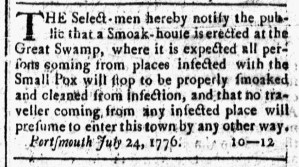
“All persons coming from places infected with the Small Pox will stop to be properly smoaked.”
It was important news, but it appeared among the advertisements in the July 27, 1776, edition of the Freeman’s Journal, or New Hampshire Gazette. The selectmen for the town of Portsmouth placed the advertisement to “notify the public that a Smoak-house is erected at the Great Swamp, where it is expected all persons coming from places infected with the Small Pox,” such as Boston, “will stop to be properly smoaked and cleaned from infection.” In addition, the selectmen demanded “that no traveller coming from any infected place will presume to enter this town by any other way.”
The notice could have appeared with the local news from Portsmouth that Benjamin Dearborn, the printer of the Freeman’s Journal, selected for that issue. Instead, it ran as an advertisement in another column, to the right of the header for news from “PORTSMOUTH,” below an advertisement that offered a “LARGE commodious BRICK HOUSE in York” for rent, and above an advertisement about a horse left at the Globe Tavern. The notation at the end of the notice, “10—12,” indicated that it was indeed an advertisement. It first appeared in issue “No. 10” on July 27 and would run in each issue through “No. 12” on August 10 before being discontinued. The notation was meant for the compositor who set the type rather than for readers. Dearborn presumably generated revenue from the advertisement. Treating it as an advertisement had the benefit of disseminating such an important announcement multiple times and increasing the chances that travelers learned about the policy for entering Portsmouth before approaching the town. Still, Dearborn could have chosen to insert the notice among the news in several consecutive issues of the Freeman’s Journal rather than consigning it to the space reserved for advertisements. Instead, he followed the same practice as other early American printers who published newspapers. Within the past week, a notice concerning voting for delegates to attend a convention “for the express purpose of forming a New Government” in Maryland appeared as an advertisement in Dunlap’s Maryland Gazette and a notice instructing Committees of Safety in Worcester County to “transmit … the Names of such Persons … who are deemed to be notoriously inimical to the rights of America” ran as an advertisement in the Massachusetts Spy. Subscribers and other readers knew that important news updates sometimes took the form of advertisements. They perused notices placed for all sorts of purposes to keep informed about local news.
What was advertised in a revolutionary American newspaper 250 years ago today?
Providence Gazette (July 27, 1776).
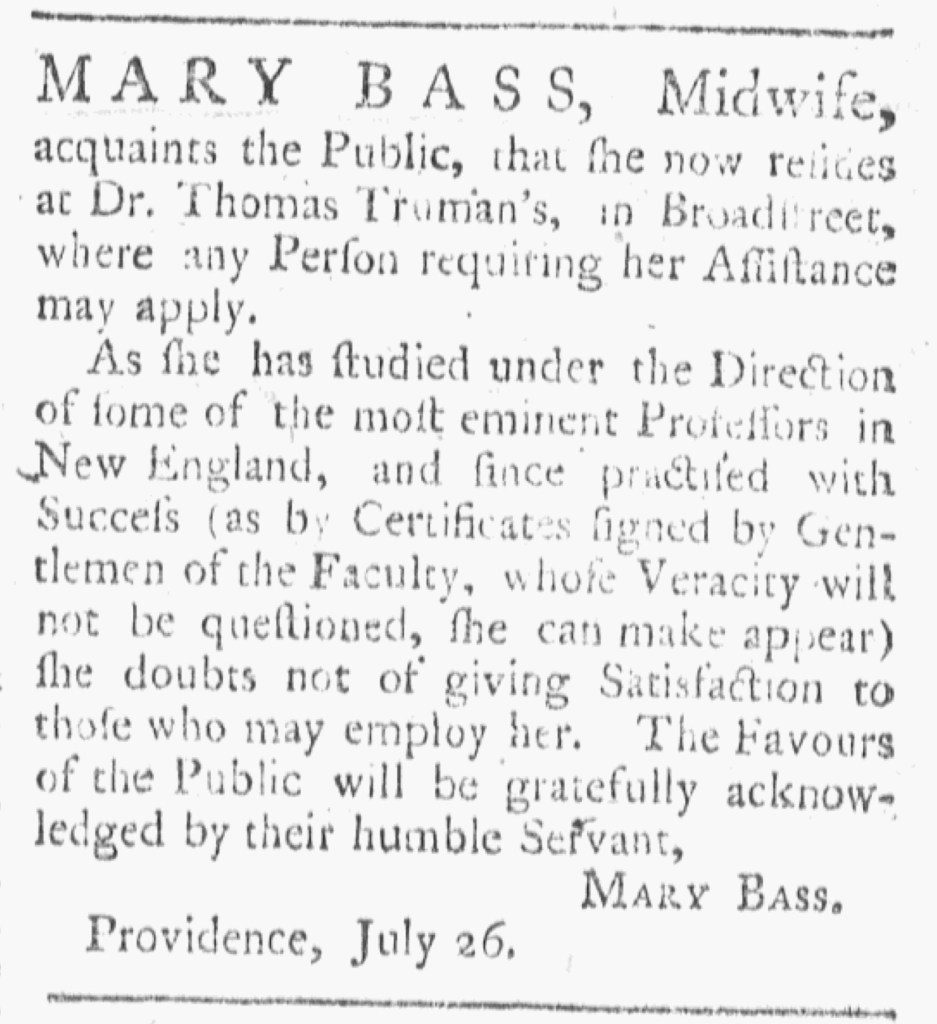
“Certificates signed by the Gentlemen of the Faculty, whose Veracity will not be questioned, she can make appear.”
Mary Bass, a midwife, provided important services to the women of Providence and their families during the era of the American Revolution. She took to the pages of the July 27, 1776, edition of the Providence Gazette to announce that she “now resides at Dr. Thomas Truman’s, in Broadstreet, where any Person requiring her Assistance may apply.” She likely hoped that an affiliation with Truman, who had been practicing medicine in Providence for several years, would double as an endorsement or a recommendation.
She did not, however, rely on Truman’s reputation alone in her efforts to convince prospective patients that she provided competent medical care. Bass asserted that she “has studied under the Direction of some of the most eminent Professors in New England.” In addition to that training, she “since practised with Success” on her own, yet neither prospective patients nor the public had to rely solely on her word about her experience as a midwife. Instead, she possessed “Certificates signed by Gentlemen of the Faculty, whose Veracity will not be question,” that she could “make appear” on request. The combination of training and experience prepared her to provide medical care to pregnant women and their infants. Bass confidently stated that she “doubts not of giving Satisfaction to those who may employ her.”
Bass was not the only woman her made note of certificates that affirmed her skill, training, and experience when advertising her services as a midwife. When Mrs. Grant arrived in Charleston in 1768, she declared that she “studied that Art regularly, and practised it afterwards with success in EDINBURGH.” To that end, she “can produce” certificates “from the Gentlemen whose Lectures she attended, and likewise from the Professors of Anatomy and Practice of Physic in that City.” Whether or not anyone ever asked to see these certificates, both Bass and Grant made clear that they could present their credentials to prospective patients who wanted to confirm their qualifications as midwives.
The Slavery Adverts 250 Project chronicles the role of newspaper advertising in perpetuating slavery in the era of the American Revolution. The project seeks to reveal the ubiquity of slavery in eighteenth-century life from New England to Georgia by republishing advertisements about enslaved people – for sale as individuals or in groups, wanted to purchase or for hire for short periods, runaways who liberated themselves, and those who were subsequently captured and confined in jails and workhouses – in daily digests on this site as well as in real time via the @SlaveAdverts250 Twitter feed, utilizing twenty-first-century media to stand in for the print media of the eighteenth century.
The project aims to provide modern audiences with a sense of just how often colonizers encountered these advertisements in their daily lives. Enslaved men, women, and children appeared in print somewhere in the colonies almost every single day. Those advertisements served as a constant backdrop for social, cultural, economic, and political life in colonial and revolutionary America. Colonizers who did not purport to own enslaved people were still confronted with slavery as well as invited to maintain the system by purchasing enslaved men, women, and children or assisting in the capture of so-called “runaways” who sought to free themselves from bondage. The frequency of these newspaper advertisements suggests just how embedded slavery was in colonial and revolutionary American culture in everyday interactions beyond the printed page.
These advertisements also testify to the experiences of enslaved men, women, and children, though readers must consider that those experiences have been remediated through descriptions offered by enslavers rather than enslaved people themselves. Often unnamed in the advertisements, enslaved men, women, and children were not invisible or unimportant in early America.
These advertisements appeared in revolutionary American newspapers 250 years ago today.
Who was the subject of an advertisement in a revolutionary American newspaper 250 years ago today?
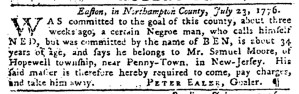
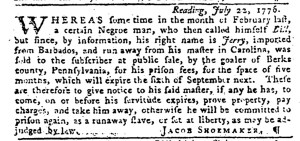
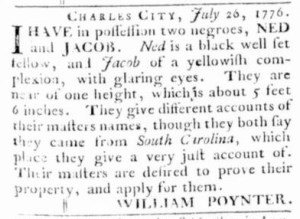
Virginia Gazette [Purdie] (July 26, 1776).“I HAVE in possession two negroes, NED, and JACOB.”
On July 26, 1776, Alexander Purdie’s Virginia Gazette became one of the last American newspapers to print the Declaration of Independence in its entirety. That issue and the supplement that accompanied it also carried several advertisements about enslaved people, yet it was not the only American newspaper that simultaneously disseminated the Declaration of Independence and published advertisements that contributed to the perpetuation of slavery in the new nation. Advertisements presenting enslaved people for sale, seeking to purchase enslaved people, offering rewards for the capture and return of enslaved people who liberated themselves by running away, and describing Black people imprisoned as suspected fugitives seeking freedom ran alongside the Declaration of Independence in newspapers from New Hampshire to Virginia. (All the newspapers in Georgia, North Carolina, and South Carolina had been suspended or ceased publication by July 1776. The South-Carolina and American General Gazette printed the Declaration of Independence when it resumed publication on August 2, 1776, but no copies of that exceptionally rare issue have been digitized for greater access. Given the content that usually appeared in that newspapers and others printed in Charleston, the August 2 edition almost certainly included advertisements about enslaved people.)
This timeline provides a census of advertisements about enslaved people that appeared in the same issues of American newspapers that printed the Declaration of Independence.
Dunlap’s Maryland Gazette; Or, the Baltimore General Advertiser printed the Declaration of Independence on the second page. On the first page, Thomas Nicholls described “Dickison, otherwise Joe,” an enslaved man “frequently used to both names” who liberated himself by running away. Nicholls offered “TWENTY DOLLARS REWARD” for the capture and return of Dickison.
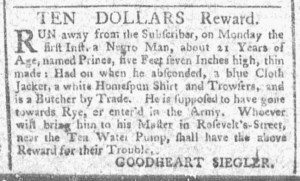
The Constitutional Gazette, published in New York, printed the Declaration of Independence on the first and second pages. A reader wrote, “A Good thing” in the margin above the masthead on the first page of the copy digitized for America’s Historical Newspapers. On the fourth page, Goodheart Siegler advertised “a negro boy named PRINCE” who may have “entered into the Continental Army.” Siegler offered “FORTY SHILLING REWARD” to whoever “will bring [Prince] to his master.”
The Maryland Journal and the Baltimore Advertiser printed the Declaration of Independence on the first and second pages. It was one of the few newspapers to devise a separate headline: “THE THIRTEEN United STATES OF AMERICA, Have declared INDEPENDENCY.” Clement Brooke advertised “a negro man named GEORGE” on the fourth page. Brooke suspected that George might be “harboured by some person in the neighbourhood.”
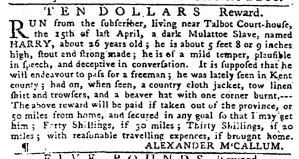
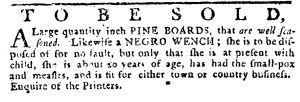
The Pennsylvania Gazette, published in Philadelphia, printed the Declaration of Independence in the first two columns on the first page. Alexander McCallum’s advertisement describing “a dark Mulattoe Slave, named HARRY” and offering “TEN DOLLARS Reward” appeared in the third column on the same page as the Declaration of Independence. Another advertisement about an enslaved man who liberated himself by running away ran on the fourth page. In it, Charles Heath described Ben and offered “EIGHT DOLLARS Reward.” The advertisement immediately above it offered a “strong healthy NEGROE Man” for sale with instructions to “Enquire of the PRINTERS” for more information.
The Pennsylvania Journal, published in Philadelphia, printed the Declaration of Independence on the first and second pages. On the third page, Thomas Wild, the jailer in Dover, Delaware, described a Black man “who calls himself SAMBO” who had been captured and imprisoned as a suspected fugitive seeking freedom. Wild called on Sambo’s enslaver to claim him immediately “or else he will be sold out for his prison charges.” On the fourth page, George Slacom, Sr., advertised “THREE country born NEGRO MEN, all brothers,” who liberated themselves. He offered rewards for Tom, Jim, and Phill.
The Maryland Gazette, published in Baltimore, printed the Declaration of Independence on the third page. Three advertisements about enslaved men appeared on the fourth page. James Smith described “a negro man called PHIL” and offered a reward for his capture and return. Similarly, Alexander Ogg sought to enslave a “negro fellow named WILL” who had liberated himself by running away. Hugh Hopewell, the sheriff of St. Mary’s County, advertised that he held “Negro Adam,” who says he belongs to Levin Woolford,” in his custody.
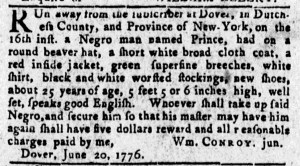
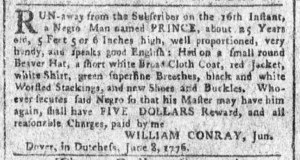
John Holt printed the Declaration of Independence as a broadside within his newspaper, the New-York Journal, devoting the entire third page to it. Three advertisements offering rewards for enslaved men who liberated themselves by running away from their enslavers appeared on the fourth page. Those advertisements appeared on the same sheet of page, but on opposite sides. Jacob Wilkins described “a negro man named JACK,” William Conary, Jr., described “a negro man, named PRINCE,” and Benjamin Pitney described “a negro man named SAMSON.” They offered rewards varying from one dollar to ten dollars.
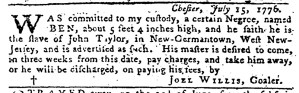
The New York Packet printed the Declaration of Independence on the second page. John Taylor described “a Negro Man, named BEN,” who liberated himself from his enslaver in New Germantown, New Jersey, in an advertisement on the fourth page. Taylor described the clothes Ben wore when he made his escape and the clothes that he took with him to aid readers in recognizing the fugitive for freedom if he changed his apparel or attempted to sell any of the items.
The Connecticut Gazette, published in New London, printed the Declaration of Independence in the second and third columns on the second page. The third column concluded with an advertisement in which Joseph Farnham, Jr., described “a negro man servant named JACK” who liberated himself by running away. Farnham warned that “all masters of vessels and others are hereby cautioned not to carry off nor conceal said negro.” That issue consisted of two pages rather than the usual four pages. The printer found room for both the Declaration of Independence and an advertisement placed for the purpose of re-enslaving Jack.
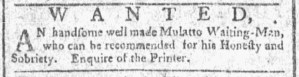
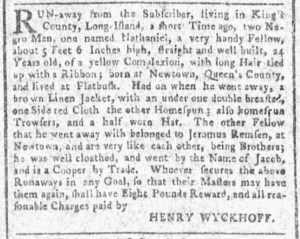
The New-York Gazette and Weekly Mercury printed the Declaration of Independence on the first page. Three advertisements about enslaved people ran on the second page. Henry Wyckhoff described “two Negro Men.” Nathaniel and Jacob were brothers who worked together to liberate themselves from Wyckhoff, Nathaniel’s enslaver, and Jeromus Remsen, Jacob’s enslaver. Goodheart Siegler placed the same advertisement offering a reward for the capture and return of Prince that previously appeared in the Constitutional Gazette. An anonymous advertiser “WANTED, AN handsome well made Mulatto Waiting-Man, who can be recommended for his Honesty and Sobriety.” Anyone willing to sell such a slave was instructed to “Enquire of the Printer.”
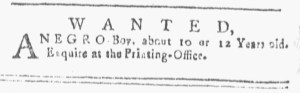
Solomon Southwick, the printer of the Newport Mercury, announced the sale of a broadside edition of the Declaration of Independence in an advertisement near the bottom of the second column on the third page. He also noted that he would print the founding document in the newspaper within a week. The anonymous advertiser who placed the notice that started the next column sought to purchase an enslaved boy: “WANTED a likely, sprightly NEGRO BOY, about ten or twelve years old: – Inquire of the printer.”
The Norwich Packet; and the Connecticut, Massachusetts, New-Hampshire and Rhode Island Weekly Advertiser printed the Declaration of Independence on the second page. On the third page, facing the Declaration of Independence, Joshua Chappell offered a reward for the capture and return of “a Negro MAN Servant, named FORTEN.” He cautioned that “All Persons are forbid harbouring said Negro.”
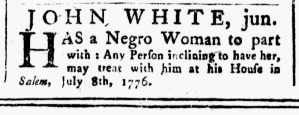
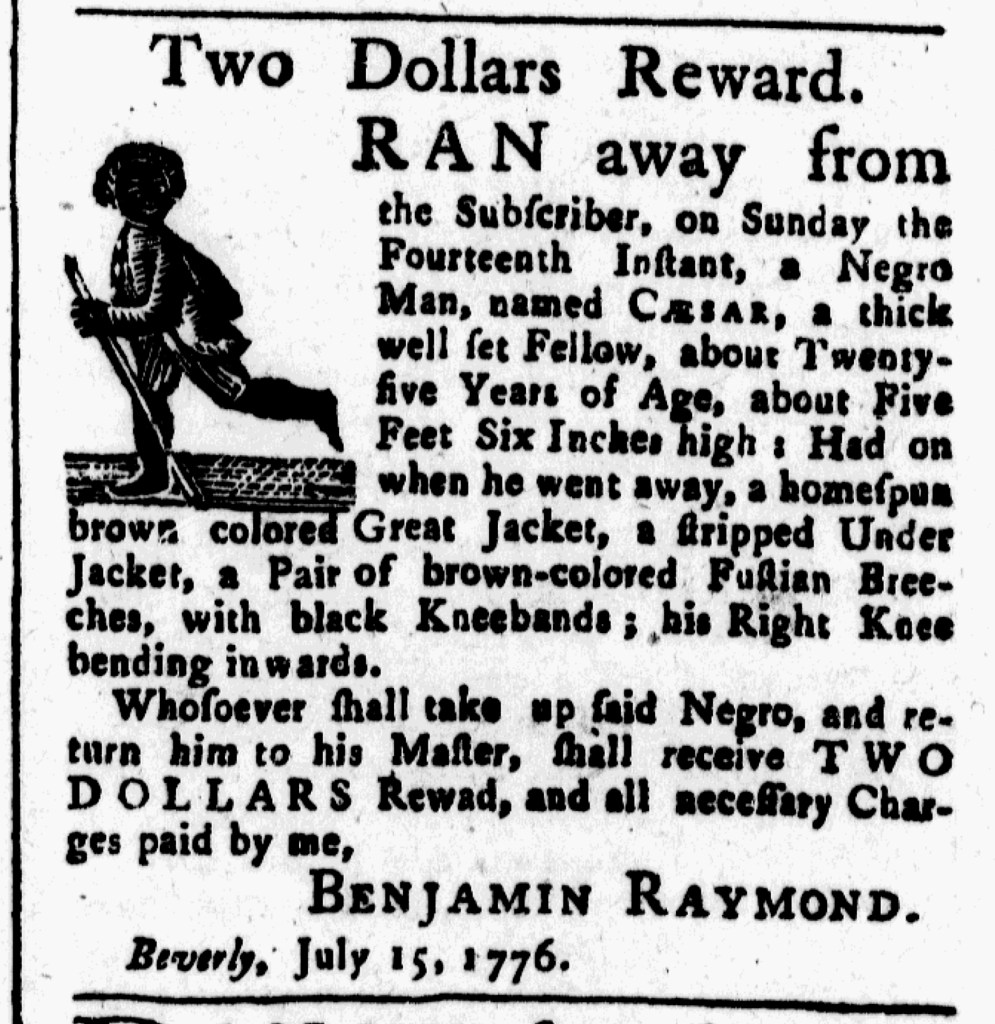
The American Gazette, published in Salem, Massachusetts, printed the Declaration of Independence on the first and fourth pages. A woodcut depicting an enslaved person on the run adorned Benjamin Raymond’s advertisement about “a Negro Man named CAESAR” on the third page. Raymond offered “TWO DOLLARS Reward” for the capture and return of Caesar. In another advertisement on the third page, John White, Jr., announced that he “HAS a Negro Woman to part with” and instructed that “Any Person inclining to have her, may treat with him at his House in Salem.”
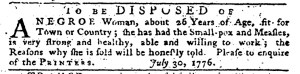
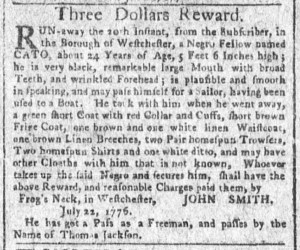
The Continental Journal, published in Boston, printed the Declaration of Independence on the first page. Three advertisements about enslaved people appeared on the fourth page. One offered “A Negro Woman” for sale, using the printer as an intermediary and broker in the transaction. The enslaved woman “understands Housework, common Cooking,” and other domestic tasks. Andrew Mitchel offered “EIGHT DOLLARS REWARD” for the capture and return of “a Negro Man named CATO.” He even designated local agents in Albany, Boston, and Pittsfield who would confine Cato if delivered to any of them. Another advertisement concerned plans to sell a brigantine “retaken” from the British and now at Portsmouth, New Hampshire. “There were four Negroes taken with said Brigantine,” a nota benebegan. It then listed two men, Adam and Scip, and two women, Bilinder and Brada, and identified the enslavers who could claim them.
In an extraordinary issue of the Newport Mercury, Solomon Southwick printed the Declaration of Independence on the second and third pages. He was the only printer to deviate from the usual publication schedule by issuing a supplement or extraordinary to disseminate the founding document to readers. The advertisement seeking “a likely, sprightly NEGRO BOY, about ten or twelve years old,” ran once again, this time immediately above the colophon on the fourth page.
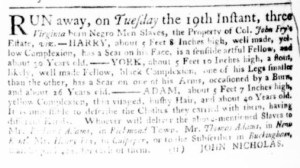
Alexander Purdie’s Virginia Gazette, published in Williamsburg, printed the last three paragraphs of the Declaration of Independence as an “Abstract from the minutes of the General Congress” on the second page. Purdie promised that the entire document “will be published at full length in next week’s Gazette.” William Browne’s advertisement describing “a mulatto servant man, named John Newton,” and offering “TEN DOLLARS REWARD” appeared on the fourth page. Among Newton’s skills, he “shaves and dresses well.” The two-page supplement that accompanied that issue featured five more advertisements about enslaved people. One offered “about forty NEGROES” for sale at the same time as a “VALUABLE tract of land” and the livestock and equipment on that plantation. Two concerned enslaved men who liberated themselves by running away. John Nicholas advertised three “Virginia born NEGRO men slaves,” named Harry, York, and Adam, while Mungo Harvey offered a reward for the capture and return of “two men slaves, both Virginia born,” named Billy and Kitt. The other two advertisements concerned Black men who had been captured and committed to jail as suspected runaways. According to James Bowdrie, Abraham was “TAKEN up at Layton’s warehouse, in Essex county.” Abraham may have been “sent here in a ship with many others from Barbados … to fight for lord Dunmore,” the last royal governor of Virginia. John Harwood, the jailer “of Charles City county,” advertised that he held Hampton and Robert. He asked their enslavers “to fetch them away, and pay charges” for the expense of confining them.
The Declaration of Independence appeared as a broadside within a newspaper on the fourth page of the Freeman’s Journal, published in Portsmouth, New Hampshire. The notice concerning the captured brigantine and the four enslaved people aboard the vessel that previously appeared in the Continental Journal ran on the third page, the reverse side of the page devoted to the Declaration of Independence.
John Dixon and William Hunter printed the Declaration of Independence on the second page of their Virginia Gazette, published in Williamsburg. Printed on a smaller sheet than most other American newspapers, that issue consisted of six pages rather than the usual four. On the fourth page, Nicholas Scouvemont inserted and advertisement that described Bagley, “a Negro man” who “has several Relations in Gloucester County, and … may have gone that way.” Scouvemont offered “TEN SHILLINGS Reward” for the capture and return of Bagley. Two more advertisements about enslaved people appeared on the sixth page. William Brown described John Newton, “an Asiatic Indian by Birth” who had been “about twelve Months in Virginia.” Brown reported that Newton was “a good Barber and Hairdresser,” so “it is probable he many endeavour to follow those Occupations as a free Man.” John Nicholas published the advertisement about Harry, York, and Adam that previously appeared in Purdie’s Virginia Gazette, making a significant investment in recovering the Black men who had liberated themselves by running away.
The Boston-Gazette and Country Journal, published in Watertown, printed the Declaration of Independence on the first page. An anonymous advertisements instructing interested parties to “Enquire of the printer” offered a “strong healthy negro man” for sale on the third page. The notice concerning the captured brigantine and the four enslaved people aboard the vessel that previously appeared in the Continental Journal and the Freeman’s Journal ran on the fourth page.
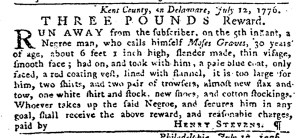
As promised in the previous issue, Alexander Purdie printed the Declaration of Independence on the first and second pages of his Virginia Gazette. Two new advertisements about enslaved men appeared on the third page. Miles Selden described “a negro man named GEORGE” who took a horse with him when he liberated himself by running away from his enslaver. Selden offered rewards for both George and the horse. William Poynter gave descriptions of Ned and Jacob, two Black men in his custody in Charles City. According to Poynter, “they both say they came from South Carolina.” They tried to put as much distance as possible between themselves and their former enslavers. A two-page supplement accompanied that issue of Purdie’s Virginia Gazette. Each of them ran in the supplement the previous week: Thomas M. Randolph’s advertisement offering “about forty NEGROES” for sale, Bowdrie’s advertisement about Abraham, supposedly sent from Barbados to fight with Dunmore, and Nicholas’s advertisement about Harry, York, and Adam who liberated themselves from their enslavers together.
Overall, advertisements about enslaved people appeared in two-thirds of the issues of American newspapers that printed the Declaration of Independence. As newspapers reported on the dissemination and reception of the Declaration of Independence, especially public readings held in cities throughout the new nation, they continued to publish advertisements about enslaved people side by side the proclamations of liberty. Early American newspapers simultaneously promoted freedom (for some people) while helping to perpetuate slavery (for other people).