January 15

What was advertised in a colonial American newspaper 250 years ago today?

Jan 15 - 1:15:1770 Pennsylvania Chronicle
Pennsylvania Chronicle (January 15, 1770).

“Dealers will meet with the usual encouragement.”

As colonists greeted a new decade, the “proprietors of the CHINA WORKS, now erecting in Southwark” took to the Pennsylvania Chronicle to advertise their new enterprise. They sought to provide consumers an alternative to the porcelain “manufactured at the famous factory in Bow near London, and imported into the colonies and plantations.” In addition to bolstering the colonial economy, the proprietors likely had an eye on the politics of the day, especially the nonimportation agreements adopted to protest the duties on imported paper, glass, lead, paint, and tea imposed by the Townshend Acts. While they eschewed goods made in England and transported across the Atlantic, American consumers were primed to acquire similar wares produced in the colonies, especially if they had a reasonable expectation of similar prices and quality. To that end, the proprietors assured prospective customers that “the clays of America are productive of as good PORCELAIN” as the merchandise that came from Bow. Furthermore, they intended to “sell upon very reasonable terms.” Indeed, they reiterated both points, concluding the notice by proclaiming that their wares were “warranted equal to any in goodness and cheapness, hitherto manufactured in or imported from England.”

The proprietors addressed multiple audiences in their advertisement. They called on skilled workmen to seek employment as well as “such parents as are inclined to bind their children” as apprentices to contact them as soon as possible. The advertisement served as a general notice to consumer, but the proprietors included notes specifically for retailers. They pledged to “take all orders in rotation, and execute the earliest first.” More significantly, they aimed to convince merchants and shopkeepers that stocking up on this porcelain would be a good investment that yielded profits because the proprietors would not undersell them when dealing directly with consumers. They asserted that “Dealers will meet with the usual encouragement,” implying discounts for merchants and shopkeepers who purchased by volume. The proprietors then explicitly stated that dealers “may be assured that no goods under thirty pounds worth will be sold to private persons, out of the factory, at a lower advance than from their shops.” Considering that pledge was the only copy throughout the entire advertisement that appeared in italics, the proprietors intended for retailers to take notice. After all, they stood to achieve significantly larger transactions with merchants and shopkeepers who then assumed the risk of dispersing the porcelain to consumers.

The imperial crisis of the late 1760s and early 1770s helped to frame the entrepreneurial activities of colonists who launched new commercial endeavors, the “domestic manufactures” so often invoked in public discourse when discussing the trade imbalance with Britain and the duties on certain imported goods. Yet those who answered the call to produce goods in the colonies realized that it was not enough merely to make them available to consumers. The “proprietors of the CHINA WORKS” and other entrepreneurs realized that they needed to convince both consumers and retailers to embrace their wares in practice as well as in the ideology that circulated in conversations and in the press. Newspaper advertisements allowed them to make a case that emphasized cost, quality, and employment opportunities. Others went into even greater detail, outlining procedures designed to persuade them to stock “domestic manufactures” in their own shops.
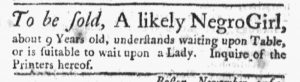
Slavery Advertisements Published January 15, 1770

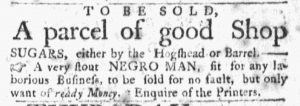
The Slavery Adverts 250 Project chronicles the role of newspaper advertising in perpetuating slavery in the era of the American Revolution. The project seeks to reveal the ubiquity of slavery in eighteenth-century life from New England to Georgia by republishing advertisements for slaves – for sale, wanted to purchase, runaways, captured fugitives – in daily digests on this site as well as in real time via the @SlaveAdverts250 Twitter feed, utilizing twenty-first-century media to stand in for the print media of the eighteenth century.

The project aims to provide modern audiences with a sense of just how often colonists encountered these advertisements in their daily lives. Enslaved men, women, and children appeared in print somewhere in the colonies almost every single day. Those advertisements served as a constant backdrop for social, cultural, economic, and political life in colonial and revolutionary America. Colonists who did not own slaves were still confronted with slavery as well as invited to maintain the system by purchasing slaves or assisting in the capture of runaways. The frequency of these newspaper advertisements suggests just how embedded slavery was in colonial and revolutionary American culture in everyday interactions beyond the printed page.

These advertisements also testify to the experiences of enslaved men, women, and children, though readers must consider that those experiences have been remediated through descriptions offered by slaveholders rather than the slaves themselves. Often unnamed in the advertisements, enslaved men, women, and children were not invisible or unimportant in early America.

These advertisements appeared in colonial American newspapers 250 years ago today.

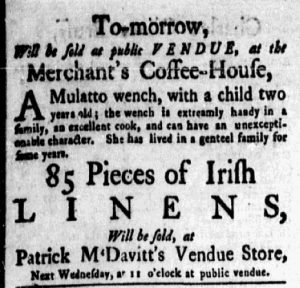
Jan 15 1770 - Massachusetts Gazette and Boston Post-Boy Slavery 1
Massachusetts Gazette and Boston Post-Boy (January 15, 1770).

**********

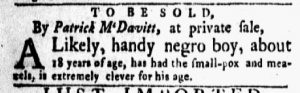
Jan 15 1770 - Massachusetts Gazette and Boston Post-Boy Slavery 2
Massachusetts Gazette and Boston Post-Boy (January 15, 1770).

**********

Jan 15 1770 - New-York Gazette and Weekly Mercury Slavery 1
New-York Gazette and Weekly Mercury (January 15, 1770).

**********

Jan 15 1770 - New-York Gazette and Weekly Mercury Slavery 2
New-York Gazette and Weekly Mercury (January 15, 1770).

**********

Jan 15 1770 - New-York Gazette and Weekly Mercury Slavery 3
New-York Gazette and Weekly Mercury (January 15, 1770).

**********

Jan 15 1770 - New-York Gazette and Weekly Mercury Slavery 4
New-York Gazette and Weekly Mercury (January 15, 1770).

**********

Jan 15 1770 - New-York Gazette and Weekly Mercury Slavery 5
New-York Gazette and Weekly Mercury (January 15, 1770).

**********

Jan 15 1770 - New-York Gazette and Weekly Mercury Slavery 6
New-York Gazette and Weekly Mercury (January 15, 1770).

**********

Jan 15 1770 - New-York Gazette or Weekly Post-Boy Slavery 1
New-York Gazette or Weekly Post-Boy (January 15, 1770).

**********

Jan 15 1770 - New-York Gazette or Weekly Post-Boy Slavery 2
New-York Gazette or Weekly Post-Boy (January 15, 1770).

**********

Jan 15 1770 - Pennsylvania Chronicle Slavery 1
Pennsylvania Chronicle (January 15, 1770).

January 14

What was advertised in a colonial American newspaper 250 years ago this week?

Jan 14 - 1:11:1770 New-York Journal
New-York Journal (January 11, 1770).

“Any Ladies uneasy in their shapes, he likewise fits without any incumberance.”

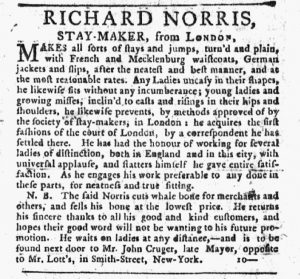
Richard Norris, “STAY-MAKER, from LONDON,” made a variety of appeals to prospective customers in an advertisement he inserted in the January 11, 1770, edition of the New-York Journal. When it came to making stays (corsets) and other garments, he promised high quality (“the neatest and best manner”) and low prices (“the most reasonable rates”). He proclaimed the superiority of his work compared to local competitors, stating that his stays were “preferable to any done in these parts, for neatness and true fitting.”

Norris developed two appeals in even greater detail. In one, he emphasized his London origins and continuing connections to the empire’s largest city. Despite political tensions between Parliament and the colonies, London remained the metropolitan center of fashion. Norris assured prospective clients that “he acquires the first fashions of the court of London, by a correspondent settled there.” Although the staymaker had migrated to the colonies, he maintained access to the latest styles in the most cosmopolitan of cities in the British Atlantic world. He also underscored that he constructed stays according to “methods approved of by the society of stay-makers, in London,” implying that his training and experience in that city ranked him above any of his rivals in New York.

While most of these appeals focused on Norris and his abilities, the other strategy that he developed in greater detail targeted female readers of the New-York Journal. He attempted to incite demand for his services by prompting women to feel “uneasy in their shapes.” He made a special point of exhorting “young ladies and growing misses” to question whether they were “inclin’d to casts and risings in their hips and shoulders,” compelling them to imagine that their bodies were misshapen. Young women could hide such imperfections from observers by wearing the stays that Norris made and sold, even though they would retain the knowledge that there was supposedly something wrong or undesirable about their bodies. In eighteenth-century America, quite like today, advertisers often relied on provoking anxieties among consumers, especially young women, and offering to reduce those anxieties as a means of promoting their products.

January 13

What was advertised in a colonial American newspaper 250 years ago today?

Jan 13 1770 - 1:13:1770 Providence Gazette
Providence Gazette (January 13, 1770).

“The COLLEGE about to be built in this Colony.”

Providence, Rhode Island, is now known as the home of Brown University, but that is not where the university has always been located. In 1770, six years after its founding, Providence became the permanent home of what was known as the Rhode Island College in its early years, later Brown University, in 1770. In March 1764, the Rhode Island General Assembly approved the charter for the “College or University in the English Colony of Rhode Island and Providence Plantations.” The Rhode Island College was only the seventh college founded in the colonies. Founded by Baptists, admission to the college was open to students of other denominations. According to “Brown’s History: A Timeline” on the university’s website, the corporation that would run the new college first met in Newport in September 1764. At that meeting, “Rhode Island Governor Stephen Hopkins (who would be a signer of the Declaration of Independence) was elected Chancellor.” James Manning served as the first president of the college, from 1765 until his death in 1791. He was also the college’s “first (and initially only) professor. He offered classes in the parsonage of the Baptist Church in Warren. The college held its first commencement in Warren in September 1769, not long before moving to Providence.

In preparation, Stephen Hopkins and John Brown, acting “in Behalf of the Committee for providing Materials and overseeing the Work” of erecting an edifice for the college in the city placed an advertisement in the January 13, 1770, edition of the Providence Gazette to request that those who had already pledged funds and others who might be inclined to do so consider donating “such Materials fit for the Building, as they would choose to furnish in Lieu of their Subscriptions.” The move to Providence was not a foregone conclusion, but such “Materials fit for the Building” and “Subscriptions” had helped to convince the Corporation. According to the “Brown’s History: A Timeline,” Warren, Newport, and other communities in Rhode Island vied to become the permanent home of the college; the members of the Corporation “heard arguments in favor of the city’s central location, availability of materials and workers, number of libraries, and money pledged to support the effort.” The newspaper notice placed by Hopkins and Brown incorporated two of those factors. A variety of primary sources tell the story of the founding and first years of the Rhode Island College. Among those, newspaper advertisements testify to some of the fundraising efforts undertaken to establish the college in the city that has now been its home for 250 years.

January 12

What was advertised in a colonial American newspaper 250 years ago today?

Jan 12 1770 - 1:12:1770 New-Hampshire Gazette
New-Hampshire Gazette (January 12, 1770).

“SIMNETT, only perfect Watchmaker ever in this Country.”

Watchmaker John Simnet returned to the pages of the New-Hampshire Gazette early in 1770, placing a short advertisement in the January 12 edition. Brief but bold, Simnet’s newest notice proclaimed, “WATCHES. SIMNETT, only perfect Watchmaker ever in this Country. —- Parade, PORTSMOUTH.” Simnet reminded readers of the services he provided, but left it to them to fill in the details.

Considered alone, this advertisement may not seem particularly interesting. Simnet did boast of his skill, declaring himself the “only perfect Watchmaker ever in this Country,” but he did not do much else to promote his business and attract clients … or so it would seem at a glance. This advertisement, however, must be considered in the larger context of an advertising campaign that Simnet had waged for the past year and his ongoing feud with rival watchmaker Nathaniel Sheaff Griffith. Regular readers of the New-Hampshire Gazette would have been very familiar with both Simnet’s previous advertisements, those placed by Griffith in response, and the professional (and seemingly even personal) animosity between the two watchmakers. That animosity likely manifested itself in interactions beyond the public prints, so colonists did not necessarily need to read all of the advertisements to know that Simnet and Griffith did not get along and regularly denigrated each other.

Simnet’s assertion that he was the “only perfect Watchmaker ever in this Country” was more than bravado about his skill. It was also an insult intentionally directed at Griffith. Simnet had migrated to New Hampshire after more than two decades working as a watchmaker in London. He received his training and served clients in the largest city in the empire. He frequently suggested that other watchmakers, especially Griffith, could not match his skill, insinuating that Griffith often did more harm than good when tasked with repairing clocks and watches. In turn, Griffith accused the newcomer of being an itinerant who was just as likely to steal watches from the residents of Portsmouth as repair them.

Simnet’s advertisement communicated far more than its eleven words might suggest to casual readers unfamiliar with his prior marketing efforts. The watchmaker did more than invite prospective clients to hire his services; he also perpetuated a feud with a rival by trumpeting his own skill and, by implication, demeaning the abilities of his primary competitor.

Slavery Advertisements Published January 12, 1770

The Slavery Adverts 250 Project chronicles the role of newspaper advertising in perpetuating slavery in the era of the American Revolution. The project seeks to reveal the ubiquity of slavery in eighteenth-century life from New England to Georgia by republishing advertisements for slaves – for sale, wanted to purchase, runaways, captured fugitives – in daily digests on this site as well as in real time via the @SlaveAdverts250 Twitter feed, utilizing twenty-first-century media to stand in for the print media of the eighteenth century.

The project aims to provide modern audiences with a sense of just how often colonists encountered these advertisements in their daily lives. Enslaved men, women, and children appeared in print somewhere in the colonies almost every single day. Those advertisements served as a constant backdrop for social, cultural, economic, and political life in colonial and revolutionary America. Colonists who did not own slaves were still confronted with slavery as well as invited to maintain the system by purchasing slaves or assisting in the capture of runaways. The frequency of these newspaper advertisements suggests just how embedded slavery was in colonial and revolutionary American culture in everyday interactions beyond the printed page.

These advertisements also testify to the experiences of enslaved men, women, and children, though readers must consider that those experiences have been remediated through descriptions offered by slaveholders rather than the slaves themselves. Often unnamed in the advertisements, enslaved men, women, and children were not invisible or unimportant in early America.

These advertisements appeared in colonial American newspapers 250 years ago today.

Jan 12 1770 - New-London Gazette Slavery 1
New-London Gazette (January 12, 1770).

**********

Jan 12 1770 - New-London Gazette Slavery 2
New-London Gazette (January 12, 1770).

January 11

What was advertised in a colonial American newspaper 250 years ago today?

Jan 11 1770 - 1:11:1770 Maryland Gazette
Maryland Gazette (January 11, 1770).

“THE MARYLAND ALMANACK, FOR THE YEAR 1770.”

The Adverts 250 Project and the Slavery Adverts 250 Project draw their contents from several databases of eighteenth-century newspapers that have been digitized to make them more accessible to the scholars and the general public. Readex has made most of the newspapers included in the projects available through its America’s Historical Newspapers collection. Although extensive, that collection is not comprehensive. For the period investigated in the projects so far, 1766-1770, America’s Historical Newspapers provides broad coverage of New England, the Middle Atlantic, and Georgia. That collection has complete or nearly complete runs of newspapers printed in those places. However, it includes only occasional issues of newspapers from the Chesapeake and the Lower South.

Fortunately, digitized copies of eighteenth-century newspapers from those regions are available via other databases. Accessible Archives has two collections relevant to the Adverts 250 Project and the Slavery Adverts 250 Project: South Carolina Newspapers and The Virginia Gazette. The projects regularly draw from issues of the South-Carolina Gazette, the South-Carolina Gazette and Country Journal, and the South-Carolina and American General Gazette, all published in Charleston during the late 1760s and early 1770s. Rather than consult the various publications all known as the Virginia Gazette, including Alexander Purdie and John Dixon’s Virginia Gazette and William Rind’s Virginia Gazette, via Accessible Archives, the projects instead rely on the digitized copies made available by Colonial Williamsburg via its Digital Library. Scholars and the general public can both access Colonial Williamsburg’s Digital Library free of charge, compared to the individual or institutional subscriptions required to examine the newspapers digitized by Readex and Accessible Archives. This means that the Adverts 250 Project and the Slavery Adverts 250 Project can provide links to the source material so readers can view advertisements in the larger context of an entire page or an entire issue.

Today’s featured advertisement comes for “THE MARYLAND ALMANACK, FOR THE YEAR 1770” comes from the Maryland Gazette, drawn from the Archives of Maryland Online series created and maintained by the Maryland State Archives. That series “currently provides access to over 471,00 historical documents that form the constitutional, legal, legislative, judicial, and administrative basis of Maryland’s government.” Those documents include the Maryland Gazette Collection, incorporating several newspapers of that name published between 1728 and 1839. Like Colonial Williamsburg’s Digital Library, scholars and the general public can access Archives of Maryland Online for free. The Maryland Gazette Collection is new to the Adverts 250 Project and the Slavery Adverts 250 Project, expanding the coverage of both of the projects and providing a more complete portrait of the role of the press, especially advertising, in promoting consumer culture and perpetuating slavery in eighteenth-century America.

I am excited to add the Maryland Gazette to the Adverts 250 Project and the Slavery Adverts 250 Project. This will benefit readers and followers, but it will also benefit the undergraduates at Assumption College who work on these projects as part of the requirements for my upper-level History courses. Each database of digitized eighteenth-century newspapers has a different interface. As students learn how to navigate each of them, they enhance their information literacy skills … and sometimes their problem solving skills as well. Sometimes errors get introduced when creating online repositories. Other times the databases replicate errors made in classifying and cataloging at a library or archive. These minor issues are usually easily resolved, but they allow undergraduates working with digitized primary sources for the first time important opportunities to play detective and, in the process, achieve a better understanding of both historical sources and research methods.

In short, adding the Maryland Gazette Collection to the Adverts 250 Project and the Slavery Adverts 250 Project will enhance both my research and my teaching by adding newspapers from another colony and resources from another database of digitized primary sources.

Slavery Advertisements Published January 11, 1770

The Slavery Adverts 250 Project chronicles the role of newspaper advertising in perpetuating slavery in the era of the American Revolution. The project seeks to reveal the ubiquity of slavery in eighteenth-century life from New England to Georgia by republishing advertisements for slaves – for sale, wanted to purchase, runaways, captured fugitives – in daily digests on this site as well as in real time via the @SlaveAdverts250 Twitter feed, utilizing twenty-first-century media to stand in for the print media of the eighteenth century.

The project aims to provide modern audiences with a sense of just how often colonists encountered these advertisements in their daily lives. Enslaved men, women, and children appeared in print somewhere in the colonies almost every single day. Those advertisements served as a constant backdrop for social, cultural, economic, and political life in colonial and revolutionary America. Colonists who did not own slaves were still confronted with slavery as well as invited to maintain the system by purchasing slaves or assisting in the capture of runaways. The frequency of these newspaper advertisements suggests just how embedded slavery was in colonial and revolutionary American culture in everyday interactions beyond the printed page.

These advertisements also testify to the experiences of enslaved men, women, and children, though readers must consider that those experiences have been remediated through descriptions offered by slaveholders rather than the slaves themselves. Often unnamed in the advertisements, enslaved men, women, and children were not invisible or unimportant in early America.

These advertisements appeared in colonial American newspapers 250 years ago today.

Jan 11 1770 - Maryland Gazette Slavery 1
Maryland Gazette (January 11, 1769).

**********

Jan 11 1770 - Maryland Gazette Slavery 2
Maryland Gazette (January 11, 1769).

**********

Jan 11 1770 - Maryland Gazette Slavery 3
Maryland Gazette (January 11, 1769).

**********

Jan 11 1770 - Maryland Gazette Slavery 4
Maryland Gazette (January 11, 1769).

**********

Jan 11 1770 - Maryland Gazette Slavery 5
Maryland Gazette (January 11, 1769).

**********

Jan 11 1770 - New-York Journal Slavery 1
New-York Journal (January 11, 1770).

**********

Jan 11 1770 - Pennsylvania Gazette Slavery 1
Pennsylvania Gazette (January 11, 1770).

**********

Jan 11 1770 - Pennsylvania Gazette Slavery 2
Pennsylvania Gazette (January 11, 1770).

**********

Jan 11 1770 - Pennsylvania Gazette Slavery 3
Pennsylvania Gazette (January 11, 1770).

**********

Jan 11 1770 - South-Carolina Gazette Slavery 1
South-Carolina Gazette (January 11, 1770).

**********

Jan 11 1770 - South-Carolina Gazette Slavery 2
South-Carolina Gazette (January 11, 1770).

**********

Jan 11 1770 - South-Carolina Gazette Slavery 3
South-Carolina Gazette (January 11, 1770).

**********

Jan 11 1770 - South-Carolina Gazette Slavery 4
South-Carolina Gazette (January 11, 1770).

**********

Jan 11 1770 - South-Carolina Gazette Slavery 5
South-Carolina Gazette (January 11, 1770).

**********

Jan 11 1770 - South-Carolina Gazette Slavery 6
South-Carolina Gazette (January 11, 1770).

**********

Jan 11 1770 - South-Carolina Gazette Supplement Slavery 1
Supplement to the South-Carolina Gazette (January 11, 1770).

**********

Jan 11 1770 - South-Carolina Gazette Supplement Slavery 2
Supplement to the South-Carolina Gazette (January 11, 1770).

**********

Jan 11 1770 - South-Carolina Gazette Supplement Slavery 3
Supplement to the South-Carolina Gazette (January 11, 1770).

January 10

What was advertised in a colonial American newspaper 250 years ago today?

Jan 10 1770 - 1:10:1770 Georgia Gazette
Georgia Gazette (January 10, 1770).

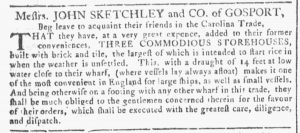
“Messrs. JOHN SKETCHLEY and CO. of GOSPORT.”

Most advertisements for goods and services in colonial newspapers came from local providers, though local did not necessarily mean close proximity to the printing office. Newspapers served not only the towns and cities where they where they were published but also entire colonies or regions. Newspapers printed in Philadelphia, for instance, served colonists in Pennsylvania, Delaware, New Jersey, and Maryland. Similarly, the Georgia Gazette served residents of Savannah and the rest of the colony. In large part this was because it was the only newspaper printed in the colony in 1770. With the exception of subscription notices for books and magazines, very few advertisements in colonial newspapers originated from beyond the region that any particular newspaper served.

Most of the advertisements in the January 10, 1770, edition of the Georgia Gazette came from Savannah, though the partnership of Williams and Mackay did insert a notice concerning “Their Trading House in Augusta.” Merchants and shopkeepers in Sunbury also placed advertisements in the Georgia Gazette on occasion, but the newspaper received few notices from neighboring South Carolina or beyond.

John Sketchley and Company of Gosport, England, placed one of those rare advertisements, addressing it to “their friends in the Carolina Trade.” They informed colonial merchants who traded rice, one of the staple commodities produced in the Lower South, that they made significant additions and improvements to their “THREE COMMODIOUS STOREHOUSES, built with brick and tile.” They further described their wharf in Gosport as “one of the most convenient in England for large ships, as well as small vessels.” Furthermore, Sketchley and Company pledged to serve their clients “with the greatest care, diligence, and dispatch.” By placing an advertisement in the Georgia Gazette, they hoped to divert vessels departing from Savannah to their wharf and storehouses in Gosport rather than sailing for other British ports. Due to the distance, placing their advertisement in the Georgia Gazette required more coordination than most that ran in that newspaper, but Sketchley and Company apparently considered it worth the investment in time and effort. In the process, the colonial press made the British Atlantic world just a little bit smaller with an advertisement that integrated commercial interests in Georgia and southern England.

Slavery Advertisements Published January 10, 1770

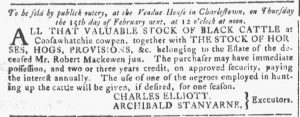
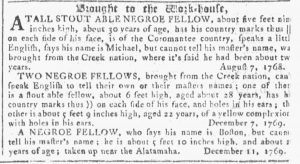
The Slavery Adverts 250 Project chronicles the role of newspaper advertising in perpetuating slavery in the era of the American Revolution. The project seeks to reveal the ubiquity of slavery in eighteenth-century life from New England to Georgia by republishing advertisements for slaves – for sale, wanted to purchase, runaways, captured fugitives – in daily digests on this site as well as in real time via the @SlaveAdverts250 Twitter feed, utilizing twenty-first-century media to stand in for the print media of the eighteenth century.

The project aims to provide modern audiences with a sense of just how often colonists encountered these advertisements in their daily lives. Enslaved men, women, and children appeared in print somewhere in the colonies almost every single day. Those advertisements served as a constant backdrop for social, cultural, economic, and political life in colonial and revolutionary America. Colonists who did not own slaves were still confronted with slavery as well as invited to maintain the system by purchasing slaves or assisting in the capture of runaways. The frequency of these newspaper advertisements suggests just how embedded slavery was in colonial and revolutionary American culture in everyday interactions beyond the printed page.

These advertisements also testify to the experiences of enslaved men, women, and children, though readers must consider that those experiences have been remediated through descriptions offered by slaveholders rather than the slaves themselves. Often unnamed in the advertisements, enslaved men, women, and children were not invisible or unimportant in early America.

These advertisements appeared in colonial American newspapers 250 years ago today.

Jan 10 1770 - Georgia Gazette Slavery 10
Georgia Gazette (January 10, 1770).

**********

Jan 10 1770 - Georgia Gazette Slavery 1
Georgia Gazette (January 10, 1770).

**********

Jan 10 1770 - Georgia Gazette Slavery 2
Georgia Gazette (January 10, 1770).

**********

Jan 10 1770 - Georgia Gazette Slavery 3
Georgia Gazette (January 10, 1770).

**********

Jan 10 1770 - Georgia Gazette Slavery 4
Georgia Gazette (January 10, 1770).

**********

Jan 10 1770 - Georgia Gazette Slavery 5
Georgia Gazette (January 10, 1770).

**********

Jan 10 1770 - Georgia Gazette Slavery 11
Georgia Gazette (January 10, 1770).

**********

Jan 10 1770 - Georgia Gazette Slavery 6
Georgia Gazette (January 10, 1770).

**********

Jan 10 1770 - Georgia Gazette Slavery 7
Georgia Gazette (January 10, 1770).

**********

Jan 10 1770 - Georgia Gazette Slavery 8
Georgia Gazette (January 10, 1770).

**********

Jan 10 1770 - Georgia Gazette Slavery 9
Georgia Gazette (January 10, 1770).