April 11

What was advertised in a revolutionary American newspaper 250 years ago today?
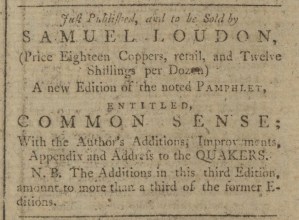
New-York Packet (April 11, 1776).

Just Published … by SAMUEL LOUDON.”

Samuel Loudon launched a new newspaper, the New York Packet, on January 4, 1776.  It lasted for about eight months before closing down just before the British occupation of New York.  The Adverts 250 Project featured subscription proposals for the newspaper that ran in the Connecticut Journal and the Pennsylvania Gazette on December 27, 1775, and an announcement that Loudon “published the first Number of his News Paper” that ran in the New-York Journal on January 11, 1776.  In that latter entry, I stated that “surviving issues have not been digitized for greater access, so advertisements and other content from the New-York Packet will not appear in the Adverts 250 Project.”  I have since learned that the New York Packet has indeed been digitized and made available via the Library of Congress’s Chronicling America: Historic American Newspapers.  When I discovered it there, I also learned that advertisements referred to the newspaper as the New-York Packet (hyphenating “New-York” like other newspapers published during the era of the American Revolution) yet the elaborate script in the masthead presented it as the New York Packet (without the hyphen).
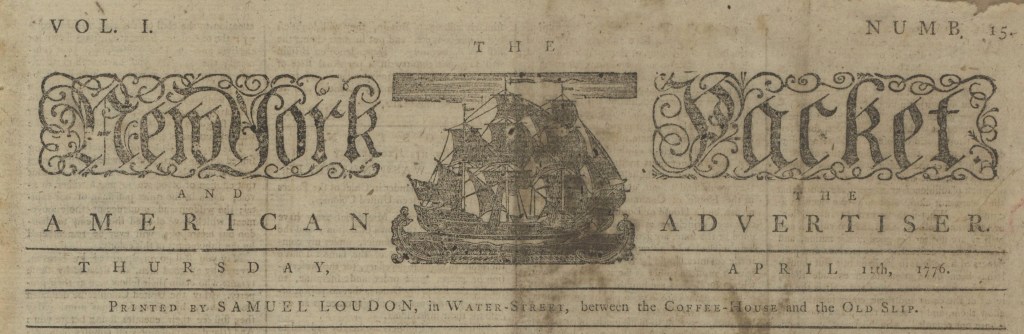
New-York Packet (April 11, 1776).

Throughout the decade I have been producing the Adverts 250 Project, I have relied on four databases of digitized eighteenth-century American newspapers.  Archives of Maryland Online, sponsored by the Maryland State Archives, provides access to issues of the Maryland Gazette published in Annapolis between 1728 and 1839.  Colonial Williamsburg provides access to three newspapers, each named the Virginia Gazette, published in Williamsburg between 1736 and 1780.  In the 1760s and 1770s, two and sometimes three operated simultaneously.  Accessible Archives, now part of History Commons, provides access to several newspapers published in Charleston, including the South-Carolina Gazette, the South-Carolina Gazette and Country Journal, and the South-Carolina and American General Gazette.  Readex/Newsbank’s America’s Historical Newspapers & Periodicals provides the most comprehensive access to early American newspapers, incorporating dozens of newspapers published throughout the colonies and new nation in the eighteenth century.  That collection, however, does not include the New York Packet.  I neglected to consult Chronicling America before declaring that the New York Packet has not been digitized.

Since then, I have acquired digital copies of all the issues of the New York Packet available via Chronicling America, examined them to identify advertisements that belong in the Slavery Adverts 250 Project and special features chronicling advertisements for Thomas Paine’s Common Sense, and made updates and revisions as necessary.  As I continue with the Adverts 250 Project, I will cross reference issues of early American newspapers available via Chronicling America with those in the other databases that have made this project possible.

Cheers to the National Endowment for the Humanities’ National Digital Newspaper Program and the Library of Congress for making early American newspapers even more accessible to scholars, students, and the public!

January 11

What was advertised in a colonial American newspaper 250 years ago today?

Jan 11 1770 - 1:11:1770 Maryland Gazette
Maryland Gazette (January 11, 1770).

“THE MARYLAND ALMANACK, FOR THE YEAR 1770.”

The Adverts 250 Project and the Slavery Adverts 250 Project draw their contents from several databases of eighteenth-century newspapers that have been digitized to make them more accessible to the scholars and the general public. Readex has made most of the newspapers included in the projects available through its America’s Historical Newspapers collection. Although extensive, that collection is not comprehensive. For the period investigated in the projects so far, 1766-1770, America’s Historical Newspapers provides broad coverage of New England, the Middle Atlantic, and Georgia. That collection has complete or nearly complete runs of newspapers printed in those places. However, it includes only occasional issues of newspapers from the Chesapeake and the Lower South.

Fortunately, digitized copies of eighteenth-century newspapers from those regions are available via other databases. Accessible Archives has two collections relevant to the Adverts 250 Project and the Slavery Adverts 250 Project: South Carolina Newspapers and The Virginia Gazette. The projects regularly draw from issues of the South-Carolina Gazette, the South-Carolina Gazette and Country Journal, and the South-Carolina and American General Gazette, all published in Charleston during the late 1760s and early 1770s. Rather than consult the various publications all known as the Virginia Gazette, including Alexander Purdie and John Dixon’s Virginia Gazette and William Rind’s Virginia Gazette, via Accessible Archives, the projects instead rely on the digitized copies made available by Colonial Williamsburg via its Digital Library. Scholars and the general public can both access Colonial Williamsburg’s Digital Library free of charge, compared to the individual or institutional subscriptions required to examine the newspapers digitized by Readex and Accessible Archives. This means that the Adverts 250 Project and the Slavery Adverts 250 Project can provide links to the source material so readers can view advertisements in the larger context of an entire page or an entire issue.

Today’s featured advertisement comes for “THE MARYLAND ALMANACK, FOR THE YEAR 1770” comes from the Maryland Gazette, drawn from the Archives of Maryland Online series created and maintained by the Maryland State Archives. That series “currently provides access to over 471,00 historical documents that form the constitutional, legal, legislative, judicial, and administrative basis of Maryland’s government.” Those documents include the Maryland Gazette Collection, incorporating several newspapers of that name published between 1728 and 1839. Like Colonial Williamsburg’s Digital Library, scholars and the general public can access Archives of Maryland Online for free. The Maryland Gazette Collection is new to the Adverts 250 Project and the Slavery Adverts 250 Project, expanding the coverage of both of the projects and providing a more complete portrait of the role of the press, especially advertising, in promoting consumer culture and perpetuating slavery in eighteenth-century America.

I am excited to add the Maryland Gazette to the Adverts 250 Project and the Slavery Adverts 250 Project. This will benefit readers and followers, but it will also benefit the undergraduates at Assumption College who work on these projects as part of the requirements for my upper-level History courses. Each database of digitized eighteenth-century newspapers has a different interface. As students learn how to navigate each of them, they enhance their information literacy skills … and sometimes their problem solving skills as well. Sometimes errors get introduced when creating online repositories. Other times the databases replicate errors made in classifying and cataloging at a library or archive. These minor issues are usually easily resolved, but they allow undergraduates working with digitized primary sources for the first time important opportunities to play detective and, in the process, achieve a better understanding of both historical sources and research methods.

In short, adding the Maryland Gazette Collection to the Adverts 250 Project and the Slavery Adverts 250 Project will enhance both my research and my teaching by adding newspapers from another colony and resources from another database of digitized primary sources.