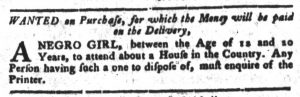
Slavery Advertisements Published May 3, 1770

The Slavery Adverts 250 Project chronicles the role of newspaper advertising in perpetuating slavery in the era of the American Revolution. The project seeks to reveal the ubiquity of slavery in eighteenth-century life from New England to Georgia by republishing advertisements for slaves – for sale, wanted to purchase, runaways, captured fugitives – in daily digests on this site as well as in real time via the @SlaveAdverts250 Twitter feed, utilizing twenty-first-century media to stand in for the print media of the eighteenth century.

The project aims to provide modern audiences with a sense of just how often colonists encountered these advertisements in their daily lives. Enslaved men, women, and children appeared in print somewhere in the colonies almost every single day. Those advertisements served as a constant backdrop for social, cultural, economic, and political life in colonial and revolutionary America. Colonists who did not own slaves were still confronted with slavery as well as invited to maintain the system by purchasing slaves or assisting in the capture of runaways. The frequency of these newspaper advertisements suggests just how embedded slavery was in colonial and revolutionary American culture in everyday interactions beyond the printed page.

These advertisements also testify to the experiences of enslaved men, women, and children, though readers must consider that those experiences have been remediated through descriptions offered by slaveholders rather than the slaves themselves. Often unnamed in the advertisements, enslaved men, women, and children were not invisible or unimportant in early America.

These advertisements appeared in colonial American newspapers 250 years ago today.

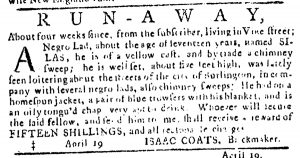
May 3 1770 - Maryland Gazette Slavery 1
Maryland Gazette (May 3, 1770).

**********

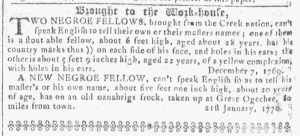
May 3 1770 - Maryland Gazette Slavery 2
Maryland Gazette (May 3, 1770).

**********

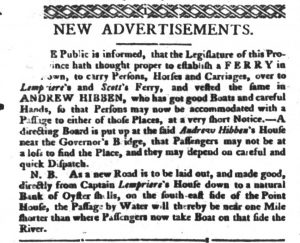
May 3 1770 - Maryland Gazette Slavery 3
Maryland Gazette (May 3, 1770).

**********

May 3 1770 - New-York Journal Slavery 1
New-York Journal (May 3, 1770).

**********

May 3 1770 - Pennsylvania Journal Slavery 1
Pennsylvania Journal (May 3, 1770).

**********

May 3 1770 - Pennsylvania Journal Supplement Slavery 1
Supplement to the Pennsylvania Journal (May 3, 1770).

**********

May 3 1770 - Pennsylvania Journal Supplement Slavery 2
Supplement to the Pennsylvania Journal (May 3, 1770).

**********

May 3 1770 - Virginia Gazette Rind Slavery 1
Virginia Gazette [Rind] (May 3, 1770).

**********

May 3 1770 - Virginia Gazette Rind Slavery 2
Virginia Gazette [Rind] (May 3, 1770).

**********

May 3 1770 - Virginia Gazette Rind Slavery 3
Virginia Gazette [Rind] (May 3, 1770).

May 2

What was advertised in a colonial American newspaper 250 years ago today?

May 2 - 5:2:1770 Georgia Gazette
Georgia Gazette (May 2, 1770).

“Will engage to cut any Quantity of Live Oak and Cedar Ship Timbers.”

Printers did not organize or classify advertisements in eighteenth-century newspapers.  Instead, advertisements placed for various purposes appeared indiscriminately next to each other and above and below each other.  Readers could not consult a particular portion of the advertisements in the newspaper to find notices of interest, such as consumer goods for sale or real estate or legal notices.  Instead, they had to peruse all of the advertisements throughout the entire issue to determine if any contained the kind of information they sought.

That may have been just as well when it came to the advertisement John Morel placed in the May 2, 1770, edition of the Georgia Gazette.  His lengthy advertisement defied classification.  In it, he aimed to achieve five different goals.  On Ossabaw Island, one of Georgia largest barrier islands, he offered several commodities for sale, including “Exceeding good barreled Beef,” “Myrtle-wax and Tallow Candles plain and fluted,” and “Hard Soap of the best kind.”  He had a different and more extensive array of goods to sell in Savannah, such as “an Assortment of Hinges and Locks,” “some neat Mens, Womens, and Youths Shoes and Hose,” and “some Sets of Dutch Tile.”  In the third portion of his advertisement, Morel encouraged prospective customers to place their orders for “any Quantity of Live Oak and Cedar Ship Timbers.”  He would cut them to “any shape and size required” and deliver them on Ossabaw Island.  In addition to these various consumer goods and commodities Morel also had “Part of a Tract of Land known by the name of Bewlie” for sale.  He described various aspects of the property, noting that it was “well stored with live oak and other valuable timber.”  Finally, Morel called on “all of those indebted to him” to settle accounts.  He did not threaten legal action as some colonists tended to do when they placed such notice.

Not only did readers of the Georgia Gazette have to examine all of the advertisements to determine which interested them, they also had to scrutinize the various segments of Morel’s advertisement to ascertain what it actually contained.  If the printer had required advertisers to place classified notices that fit within specific categories, Morel would have needed to divide his lengthy advertisement into several shorter notices.

Slavery Advertisements Published May 2, 1770

The Slavery Adverts 250 Project chronicles the role of newspaper advertising in perpetuating slavery in the era of the American Revolution. The project seeks to reveal the ubiquity of slavery in eighteenth-century life from New England to Georgia by republishing advertisements for slaves – for sale, wanted to purchase, runaways, captured fugitives – in daily digests on this site as well as in real time via the @SlaveAdverts250 Twitter feed, utilizing twenty-first-century media to stand in for the print media of the eighteenth century.

The project aims to provide modern audiences with a sense of just how often colonists encountered these advertisements in their daily lives. Enslaved men, women, and children appeared in print somewhere in the colonies almost every single day. Those advertisements served as a constant backdrop for social, cultural, economic, and political life in colonial and revolutionary America. Colonists who did not own slaves were still confronted with slavery as well as invited to maintain the system by purchasing slaves or assisting in the capture of runaways. The frequency of these newspaper advertisements suggests just how embedded slavery was in colonial and revolutionary American culture in everyday interactions beyond the printed page.

These advertisements also testify to the experiences of enslaved men, women, and children, though readers must consider that those experiences have been remediated through descriptions offered by slaveholders rather than the slaves themselves. Often unnamed in the advertisements, enslaved men, women, and children were not invisible or unimportant in early America.

These advertisements appeared in colonial American newspapers 250 years ago today.

May 2 1770 - Georgia Gazette Slavery 1
Georgia Gazette (May 2, 1770).

**********

May 2 1770 - Georgia Gazette Slavery 2
Georgia Gazette (May 2, 1770).

**********

May 2 1770 - Georgia Gazette Slavery 3
Georgia Gazette (May 2, 1770).

**********

May 2 1770 - Georgia Gazette Slavery 4
Georgia Gazette (May 2, 1770).

**********

May 2 1770 - Georgia Gazette Slavery 5
Georgia Gazette (May 2, 1770).

**********

May 2 1770 - Georgia Gazette Slavery 8
Georgia Gazette (May 2, 1770).

**********

May 2 1770 - Georgia Gazette Slavery 6
Georgia Gazette (May 2, 1770).

**********

May 2 1770 - Georgia Gazette Slavery 7
Georgia Gazette (May 2, 1770).

May 1

What was advertised in a colonial American newspaper 250 years ago today?

May 1 - 5:1:1770 South-Carolina Gazette and Country Journal
South-Carolina Gazette and Country Journal (May 1, 1770).

“NEW ADVERTISEMENTS.”

As usual, the masthead for the May 1, 1770, edition of the South-Carolina Gazette and Country Journal proclaimed that it contained “the freshest Advices, both Foreign and Domestic.”  The front page featured news from Boston, including reports that a committee had been formed to gather testimonies from colonists who witnessed the Boston Massacre.  That issue also included news reprinted from newspapers published in Providence, Newport, Hartford, New York, and Philadelphia, though those items were often themselves republished from English newspapers or letters received from correspondents in faraway places like Gibraltar and Jamaica.  A couple of items of local news as well as the shipping news from the customs house rounded out the “freshest Advices.”

Yet news of the Boston Massacre was not the first item that readers encountered, even though it was on the first page.  Instead, a legal notice filled the upper half of the first two columns.  Assorted advertisements appeared below the legal notice.  News from Boston ran in the third column.  Elsewhere in that issue, news items comprised the entire second page and most of the first column on the fourth, but advertisements filled the third page and two of the three columns on the final page.  The standard issue consisted of five columns of news and seven columns of paid notices … and that was not even the end of the advertising disseminated in the South-Carolina Gazette and Country Journal on May 1.  Charles Crouch, the printer, issued a two-page supplement, another six columns, that consisted entirely of paid notices. Advertising accounted for more than two-thirds of the content delivered to subscribers in the May 1 edition and its supplement.  Like many other printers, Crouch touted the “freshest Advices” that appeared in his newspaper, but the publication was also (and on many occasions primarily) a vehicle for distributing advertising.

Slavery Advertisements Published May 1, 1770

The Slavery Adverts 250 Project chronicles the role of newspaper advertising in perpetuating slavery in the era of the American Revolution. The project seeks to reveal the ubiquity of slavery in eighteenth-century life from New England to Georgia by republishing advertisements for slaves – for sale, wanted to purchase, runaways, captured fugitives – in daily digests on this site as well as in real time via the @SlaveAdverts250 Twitter feed, utilizing twenty-first-century media to stand in for the print media of the eighteenth century.

The project aims to provide modern audiences with a sense of just how often colonists encountered these advertisements in their daily lives. Enslaved men, women, and children appeared in print somewhere in the colonies almost every single day. Those advertisements served as a constant backdrop for social, cultural, economic, and political life in colonial and revolutionary America. Colonists who did not own slaves were still confronted with slavery as well as invited to maintain the system by purchasing slaves or assisting in the capture of runaways. The frequency of these newspaper advertisements suggests just how embedded slavery was in colonial and revolutionary American culture in everyday interactions beyond the printed page.

These advertisements also testify to the experiences of enslaved men, women, and children, though readers must consider that those experiences have been remediated through descriptions offered by slaveholders rather than the slaves themselves. Often unnamed in the advertisements, enslaved men, women, and children were not invisible or unimportant in early America.

These advertisements appeared in colonial American newspapers 250 years ago today.

May 1 1770 - Essex Gazette Slavery 1
Essex Gazette (May 1, 1770).

**********

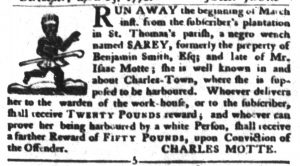
May 1 1770 - South-Carolina Gazette and Country Journal Slavery 1
South-Carolina Gazette and Country Journal (May 1, 1770).

**********

May 1 1770 - South-Carolina Gazette and Country Journal Slavery 2
South-Carolina Gazette and Country Journal (May 1, 1770).

**********

May 1 1770 - South-Carolina Gazette and Country Journal Slavery 3
South-Carolina Gazette and Country Journal (May 1, 1770).

**********

May 1 1770 - South-Carolina Gazette and Country Journal Slavery 4
South-Carolina Gazette and Country Journal (May 1, 1770).

**********

May 1 1770 - South-Carolina Gazette and Country Journal Slavery 5
South-Carolina Gazette and Country Journal (May 1, 1770).

**********

May 1 1770 - South-Carolina Gazette and Country Journal Slavery 6
South-Carolina Gazette and Country Journal (May 1, 1770).

**********

May 1 1770 - South-Carolina Gazette and Country Journal Slavery 7
South-Carolina Gazette and Country Journal (May 1, 1770).

**********

May 1 1770 - South-Carolina Gazette and Country Journal Supplement Slavery 1
Supplement to the South-Carolina Gazette and Country Journal (May 1, 1770).

**********

May 1 1770 - South-Carolina Gazette and Country Journal Supplement Slavery 2
Supplement to the South-Carolina Gazette and Country Journal (May 1, 1770).

**********

May 1 1770 - South-Carolina Gazette and Country Journal Supplement Slavery 3
Supplement to the South-Carolina Gazette and Country Journal (May 1, 1770).

**********

May 1 1770 - South-Carolina Gazette and Country Journal Supplement Slavery 4
Supplement to the South-Carolina Gazette and Country Journal (May 1, 1770).

**********

May 1 1770 - South-Carolina Gazette and Country Journal Supplement Slavery 5
Supplement to the South-Carolina Gazette and Country Journal (May 1, 1770).

**********

May 1 1770 - South-Carolina Gazette and Country Journal Supplement Slavery 6
Supplement to the South-Carolina Gazette and Country Journal (May 1, 1770).

**********

May 1 1770 - South-Carolina Gazette and Country Journal Supplement Slavery 7
Supplement to the South-Carolina Gazette and Country Journal (May 1, 1770).