Slavery Advertisements Published May 9, 1770

The Slavery Adverts 250 Project chronicles the role of newspaper advertising in perpetuating slavery in the era of the American Revolution. The project seeks to reveal the ubiquity of slavery in eighteenth-century life from New England to Georgia by republishing advertisements for slaves – for sale, wanted to purchase, runaways, captured fugitives – in daily digests on this site as well as in real time via the @SlaveAdverts250 Twitter feed, utilizing twenty-first-century media to stand in for the print media of the eighteenth century.

The project aims to provide modern audiences with a sense of just how often colonists encountered these advertisements in their daily lives. Enslaved men, women, and children appeared in print somewhere in the colonies almost every single day. Those advertisements served as a constant backdrop for social, cultural, economic, and political life in colonial and revolutionary America. Colonists who did not own slaves were still confronted with slavery as well as invited to maintain the system by purchasing slaves or assisting in the capture of runaways. The frequency of these newspaper advertisements suggests just how embedded slavery was in colonial and revolutionary American culture in everyday interactions beyond the printed page.

These advertisements also testify to the experiences of enslaved men, women, and children, though readers must consider that those experiences have been remediated through descriptions offered by slaveholders rather than the slaves themselves. Often unnamed in the advertisements, enslaved men, women, and children were not invisible or unimportant in early America.

These advertisements appeared in colonial American newspapers 250 years ago today.

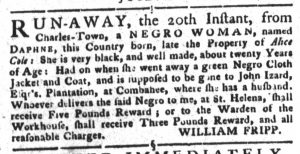
May 9 1770 - Georgia Gazette Slavery 1
Georgia Gazette (May 9, 1770).

**********

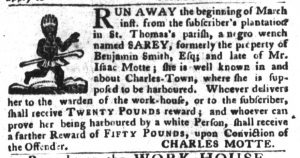
May 9 1770 - Georgia Gazette Slavery 2
Georgia Gazette (May 9, 1770).

**********

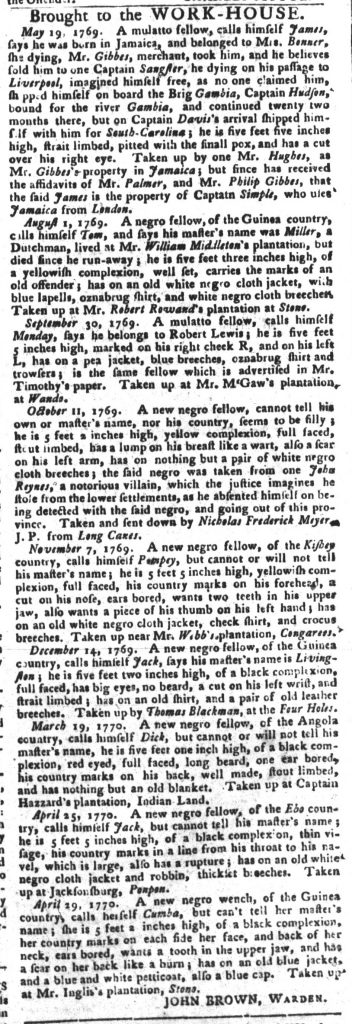
May 9 1770 - Georgia Gazette Slavery 3
Georgia Gazette (May 9, 1770).

**********
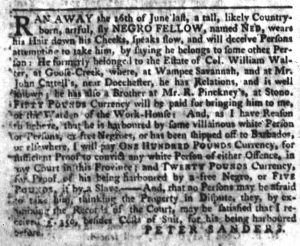
May 9 1770 - Georgia Gazette Slavery 4
Georgia Gazette (May 9, 1770).

**********

May 9 1770 - Georgia Gazette Slavery 5
Georgia Gazette (May 9, 1770).

May 8

What was advertised in a colonial American newspaper 250 years ago today?

May 8 - 5:8:1770 Essex Gazette
Essex Gazette (May 8, 1770).

“Negro Boy … can work in the Iron Works, both at Blooming and at Refining.”

Advertisements concerning several enslaved men and women ran in the Essex Gazette and the South-Carolina Gazette and Country Journal on May 8, 1770.  A notice in the latter offered for sale a “NEGRO FELLOW who is a good Sawyer and Caulker.”  On the same page, another advertisement sought to sell an enslaved woman who “is a very good Sempstress.”  In the Essex Gazette, published in Salem, Massachusetts, an advertisement for a “Negro Boy, 20 Years old,” indicated that the young man “can work in the Iron Works, both at Blooming and at Refining.”  These enslaved people each possessed specialized skills beyond agricultural labor and domestic service.  Advertisements that described enslaved men and women published in newspapers from New England to Georgia testified to the range of skills they acquired and the many contributions they made to commercial life and economic development in the colonies.

Although historians of early America have long known this, misconceptions of enslaved men and women working solely in the fields and in plantation houses have deep roots in the popular imagination … and in the education many students receive before enrolling in college-level history courses.  Such misconceptions have proven stubbornly difficult to dislodge.  When I invite students to work as guest curators for the Slavery Adverts 250 Project in my various courses, they most frequently express surprise at two aspects of slavery in early America:  that it was a common practice throughout the colonies rather than confined to southern colonies and that enslaved people had far more occupations than agricultural labor.  Yet the misconceptions are so ingrained that even after being introduced to evidence to the contrary, some students continue to resort to those misconceptions as their default understanding of the experiences of enslaved people.  Correcting this is an iterative process.  Students have to be exposed to this information multiple times.  Sometimes I have to ask them if they would like to reformulate statements they make in class or in written work in order to take into account the evidence they have examined in advertisements and other primary sources, gently nudging them to embrace what they have learned and disregard their prior misconceptions.  Working as guest curators on the Slavery Adverts 250 Project facilitates the process of reimagining early America and learning about the many and varied experiences of enslaved people rather than relying on misconceptions that circulate in popular culture.  As guest curators, students encounter advertisement after advertisement describing enslaved people as artisans or otherwise highlighting their specialized skills.  That evidence is much harder to overlook than if I presented them with a couple of representative advertisements.  Similarly, scrolling through the Slavery Adverts 250 Project feed and seeing advertisement after advertisement is intended to have the same effect for both students and the general public.  Advertisement after advertisement in that feed mentions the skills possessed by enslaved men and women, making it difficult to maintain assumptions to the contrary.

Slavery Advertisements Published May 8, 1770

The Slavery Adverts 250 Project chronicles the role of newspaper advertising in perpetuating slavery in the era of the American Revolution. The project seeks to reveal the ubiquity of slavery in eighteenth-century life from New England to Georgia by republishing advertisements for slaves – for sale, wanted to purchase, runaways, captured fugitives – in daily digests on this site as well as in real time via the @SlaveAdverts250 Twitter feed, utilizing twenty-first-century media to stand in for the print media of the eighteenth century.

The project aims to provide modern audiences with a sense of just how often colonists encountered these advertisements in their daily lives. Enslaved men, women, and children appeared in print somewhere in the colonies almost every single day. Those advertisements served as a constant backdrop for social, cultural, economic, and political life in colonial and revolutionary America. Colonists who did not own slaves were still confronted with slavery as well as invited to maintain the system by purchasing slaves or assisting in the capture of runaways. The frequency of these newspaper advertisements suggests just how embedded slavery was in colonial and revolutionary American culture in everyday interactions beyond the printed page.

These advertisements also testify to the experiences of enslaved men, women, and children, though readers must consider that those experiences have been remediated through descriptions offered by slaveholders rather than the slaves themselves. Often unnamed in the advertisements, enslaved men, women, and children were not invisible or unimportant in early America.

These advertisements appeared in colonial American newspapers 250 years ago today.

May 8 1770 - Essex Gazette Slavery 1
Essex Gazette (May 8, 1770).

**********

May 8 1770 - South-Carolina Gazette and Country Journal Slavery 1
South-Carolina Gazette and Country Journal (May 8, 1770).

**********
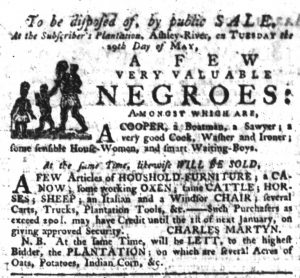
May 8 1770 - South-Carolina Gazette and Country Journal Supplement Slavery 1
Supplement to the South-Carolina Gazette and Country Journal (May 8, 1770).

**********

May 8 1770 - South-Carolina Gazette and Country Journal Supplement Slavery 2
Supplement to the South-Carolina Gazette and Country Journal (May 8, 1770).

**********

May 8 1770 - South-Carolina Gazette and Country Journal Supplement Slavery 3
Supplement to the South-Carolina Gazette and Country Journal (May 8, 1770).

**********

May 8 1770 - South-Carolina Gazette and Country Journal Supplement Slavery 4
Supplement to the South-Carolina Gazette and Country Journal (May 8, 1770).

**********

May 8 1770 - South-Carolina Gazette and Country Journal Supplement Slavery 5
Supplement to the South-Carolina Gazette and Country Journal (May 8, 1770).

**********

May 8 1770 - South-Carolina Gazette and Country Journal Supplement Slavery 6
Supplement to the South-Carolina Gazette and Country Journal (May 8, 1770).

**********
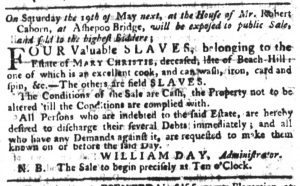
May 8 1770 - South-Carolina Gazette and Country Journal Supplement Slavery 7
Supplement to the South-Carolina Gazette and Country Journal (May 8, 1770).

**********

May 8 1770 - South-Carolina Gazette and Country Journal Supplement Slavery 8
Supplement to the South-Carolina Gazette and Country Journal (May 8, 1770).

May 7

What was advertised in a colonial American newspaper 250 years ago today?

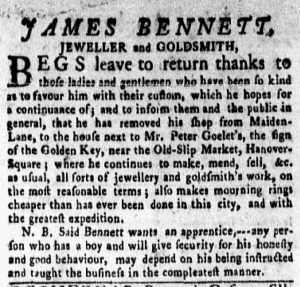
May 7 - 5:7:1770 New-York Gazette and Weekly Mercury
New-York Gazette and Weekly Mercury (May 7, 1770).

“Mourning rings cheaper than has ever been done in this city.”

Upon the occasion of moving to a new location, jeweler and goldsmith James Bennet placed an advertisement in the New-York Gazette and Weekly Mercury.  He informed former and prospective customers that he no longer ran a shop on Maiden Lane.  Instead, the “public in general” could find him at his new shop at “the house next to Mr. Peter Goelet’s, the sign of the Golden Key, near the Old-Slip Market, Hanover-Square.”  In an era before standardized street numbers, Bennett provided plenty of landmarks to help customers find his new location.

He opened his advertisement by expressing appreciation for “those ladies and gentlemen who have been so kind as to favour him with their custom.”  He hoped that they would continue as customers.  Acknowledging their prior support for his business also alerted prospective new customers that even though he set up shop at a new location this was not a new endeavor.  Bennett already had experience pursuing his trade in New York.  In thanking former customers, he also sought to demonstrate demand for his services among readers who had not yet visited his shop at any location.

To further capture their interest, he briefly described his services, stating that he continued “to make, mend, [and] sell … all sorts of jewellery and goldsmith’s work.”  He embellished that rather plain overview with a much more enticing offer, claiming that he “makes mourning rings cheaper than has ever been done in this city, and with the greatest expedition.” An advertisement for a jeweler and goldsmith moving from one location to another was pretty standard fare among the notices that ran in colonial newspapers.  A declaration about the lowest prices possible for a popular piece of jewelry, on the other hand, challenged consumers to visit his shop to see for themselves.  If that managed to get customers through the door, it gave Bennett opportunities to secure other sales.  Even if readers were skeptical of his claim, they could not know for certain unless they investigated on their own.  Rather than merely announce that he moved to a new location, Bennett enticed prospective customers with a bold claim intended to grab their attention.

Slavery Advertisements Published May 7, 1770

The Slavery Adverts 250 Project chronicles the role of newspaper advertising in perpetuating slavery in the era of the American Revolution. The project seeks to reveal the ubiquity of slavery in eighteenth-century life from New England to Georgia by republishing advertisements for slaves – for sale, wanted to purchase, runaways, captured fugitives – in daily digests on this site as well as in real time via the @SlaveAdverts250 Twitter feed, utilizing twenty-first-century media to stand in for the print media of the eighteenth century.

The project aims to provide modern audiences with a sense of just how often colonists encountered these advertisements in their daily lives. Enslaved men, women, and children appeared in print somewhere in the colonies almost every single day. Those advertisements served as a constant backdrop for social, cultural, economic, and political life in colonial and revolutionary America. Colonists who did not own slaves were still confronted with slavery as well as invited to maintain the system by purchasing slaves or assisting in the capture of runaways. The frequency of these newspaper advertisements suggests just how embedded slavery was in colonial and revolutionary American culture in everyday interactions beyond the printed page.

These advertisements also testify to the experiences of enslaved men, women, and children, though readers must consider that those experiences have been remediated through descriptions offered by slaveholders rather than the slaves themselves. Often unnamed in the advertisements, enslaved men, women, and children were not invisible or unimportant in early America.

These advertisements appeared in colonial American newspapers 250 years ago today.

May 7 1770 - Boston-Gazette Slavery 1
Boston-Gazette (May 7, 1770).

**********

May 7 1770 - Boston-Gazette Supplement Slavery 1
Supplement to the Boston-Gazette (May 7, 1770).

**********

May 7 1770 - New-York Gazette and Weekly Mercury Slavery 1
New-York Gazette and Weekly Mercury (May 7, 1770).

**********

May 7 1770 - New-York Gazette and Weekly Mercury Slavery 2
New-York Gazette and Weekly Mercury (May 7, 1770).

**********

May 7 1770 - New-York Gazette and Weekly Mercury Slavery 3
New-York Gazette and Weekly Mercury (May 7, 1770).

**********

May 7 1770 - New-York Gazette and Weekly Mercury Slavery 4
New-York Gazette and Weekly Mercury (May 7, 1770).

**********

May 7 1770 - New-York Gazette and Weekly Mercury Slavery 5
New-York Gazette and Weekly Mercury (May 7, 1770).

**********

May 7 1770 - New-York Gazette or Weekly Post-Boy Slavery 1
New-York Gazette or Weekly Post-Boy (May 7, 1770).

**********

May 7 1770 - New-York Gazette or Weekly Post-Boy Slavery 2
New-York Gazette or Weekly Post-Boy (May 7, 1770).

May 6

What was advertised in a colonial American newspaper 250 years ago this week?

May 6 - 5:3:1770 Pennsylvania Journal Supplement
Supplement to the Pennsylvania Journal (May 3, 1770).

“Carry on the business with the same head workman as manufactured for Jackson and Gibbons.”

At the beginning of 1770, William Norton and Company placed an advertisement for “MUSTARD and CHOCOLATE” in the Pennsylvania Journal and then continued to insert it on occasion over the next several months.  They advised prospective customers that they “fitted up a shop” on Front Street.  Buyers could visit them there or, if they lived “at a distance,” send orders to the company.  Norton and Company made both wholesale and retail sales of their mustard and chocolate.  To encourage others to purchase in bulk for resale, they offered a discount.  They also pledged good customer service.

Yet these were not the only appeals deployed by Norton and Company.  Their business may have been new, but the enterprise was not.  They built on a foundation that had already been established by Jackson and Gibbons, familiar names in Pennsylvania when it came to the production of mustard and chocolate.  Jackson and Gibbons previously ran their own advertisements, complete with a woodcut depicting their seal flanked by a bottle of mustard and a brick of chocolate, in the Pennsylvania Gazette.  Norton and Company opened their own notice by proclaiming that they had “purchased the mills, late Benjamin Jackson’s, and carry on the business with the same head workman as manufactured for Jackson and Gibbons.”  They assumed that for many consumers it mattered less whose names appeared at the top of the advertisement and oversaw the business and more who actually produced the mustard and chocolate for Norton and Company.

They sought to benefit from the reputation Jackson and Gibbons already earned.  In prior advertisements, their predecessors proclaimed, “The said JACKSON is the Original, and indeed only, proper Manufacturer on this Continent … and has brought his Machines to greater Perfection than any other even in England.”  Having acquired Jackson and Gibbons’s mill and head workman, Norton and Company were prepared to provide the same quality products to consumers without interruption.

May 5

What was advertised in a colonial American newspaper 250 years ago today?

May 5 - 5:5:1770 Providence Gazette
Providence Gazette (May 5, 1770).

“One blue Broadcloth Coat, trimmed with blue, and has a blue Velvet Cape.”

George West listed an impressive array of garments in his advertisement in the May 5, 1770, edition of the Providence Gazette.  He began with a “blue Broadcloth Coat, trimmed with blue, and has a blue Velvet Cape” before describing “a black Velvet Waistcoast, trimmed with black” and “one Pair of Black Velvet Breeches, trimmed with black, and lined with Leather.”  In addition, he mentioned a “Pair of Mouse-coloured Velvet Breeches, trimmed with the same, having Silk Knee-straps, lined with Leather” as well as a “new Beaver Hat,” a “new homespun Check S[h]irt,” and “two striped Cotton and Linen Shirts.”  Yet West was not a merchant nor a shopkeeper nor a tailor attempting to sell these garments to consumers.  Instead, he was the captain of the Sarah, “lying at Cushing’s Wharff, in Providence,” and the victim of a theft.  Someone had stolen the garments that he listed in his advertisement.

West’s notice testifies to one of the many ways that colonists participated in the consumer revolution of the eighteenth century.  Many purchased new goods from retailers and artisans or acquired secondhand goods at auctions and estate sales.  Others, however, participated in what Serena Zabin has termed an “informal economy,” either stealing goods for their own use or purchasing (sometimes, but now always, unwittingly) goods that had been stolen and fenced.  Theft gave some colonists greater access to goods that otherwise would have been beyond their reach.  West’s “blue Broadcloth Coat, trimmed with blue” and its “blue Velvet Cape,” for instance, represented quite an investment, yet someone benefited from West’s sartorial sensibilities without spending a shilling … provided that he managed to remain undetected.

Advertisements placed by shopkeepers and tailors were not the only newspaper notices that commented on fashion and taste in eighteenth-century America.  Advertisements concerning stolen goods often went into as much detail or more when it came to describing garments and other goods that colonists sought to acquire, sometimes through nefarious means.

May 4

What was advertised in a colonial American newspaper 250 years ago today?

May 4 - 5:4:1770 South-Carolina Gazette
South-Carolina Gazette (May 4, 1770).

“All American Manufactures.”

Thomas Shute’s advertisement occupied a privileged place in the May 4, 1770, edition of the South-Carolina Gazette.  It appeared in the first column of the first page, immediately below the “PRESENTMENTS OF THE GRAND-JURORS.”  A separate headline, “New Advertisements,” introduced Shute’s notice.  Considering that Shute sold “All American Manufactures,” the placement of this advertisement may have been quite deliberate on the part of Peter Timothy, the printer of the South-Carolina Gazette.

Shute’s commercial activities addressed political concerns that had been widely reported in newspapers and discussed among colonists for several years.  When Parliament imposed duties on imported paper, glass, paint, lead, and tea, colonists responded by adopting nonimportation agreements for a vast array of goods as a means of exerting economic pressure to achieve political ends.  At the same time, they embraced “domestic manufactures” as alternatives to imported goods, also arguing that producing and purchasing such items provided a variety of benefits.  Producing domestic manufactures provided employment for colonists; purchasing those wares addressed a trade imbalance with Britain and kept specie in the colonies rather than sending it across the Atlantic.

Shute offered an assortment of “American Manufactures” to consumers in South Carolina, all of them imported from Philadelphia rather than from London and other ports in England.  Pennsylvania had long been a source for many of the agricultural items, such as flour, bread, and ham, but Shute also emphasized goods more often associated with manufacturers on the other side of the Atlantic, including “Sundry Kinds of CAST IRON,” “EARTHEN WARE,” and “HORSE COLLARS.”  Shute made a brief appeal to quality, stating that his inventory “may be depended upon as good,” to reassure prospective customers that investing in domestic manufactures did not require them to accept inferior merchandise.

By the time Shute’s advertisement appeared in the South-Carolina Gazette, a partial repeal of the Revenue Act had already been approved by Parliament on March 5 and received royal assent on April 12.  Duties on tea remained in place, but not the duties on other imported goods.  It took some time for word to arrive in the colonies.  Once it did, colonists withdrew from their nonimportation agreements.  For the moment, however, Shute deployed a marketing strategy that gained popularity throughout the colonies over the course of several years.

Slavery Advertisements Published May 4, 1770

The Slavery Adverts 250 Project chronicles the role of newspaper advertising in perpetuating slavery in the era of the American Revolution. The project seeks to reveal the ubiquity of slavery in eighteenth-century life from New England to Georgia by republishing advertisements for slaves – for sale, wanted to purchase, runaways, captured fugitives – in daily digests on this site as well as in real time via the @SlaveAdverts250 Twitter feed, utilizing twenty-first-century media to stand in for the print media of the eighteenth century.

The project aims to provide modern audiences with a sense of just how often colonists encountered these advertisements in their daily lives. Enslaved men, women, and children appeared in print somewhere in the colonies almost every single day. Those advertisements served as a constant backdrop for social, cultural, economic, and political life in colonial and revolutionary America. Colonists who did not own slaves were still confronted with slavery as well as invited to maintain the system by purchasing slaves or assisting in the capture of runaways. The frequency of these newspaper advertisements suggests just how embedded slavery was in colonial and revolutionary American culture in everyday interactions beyond the printed page.

These advertisements also testify to the experiences of enslaved men, women, and children, though readers must consider that those experiences have been remediated through descriptions offered by slaveholders rather than the slaves themselves. Often unnamed in the advertisements, enslaved men, women, and children were not invisible or unimportant in early America.

These advertisements appeared in colonial American newspapers 250 years ago today.

May 4 1770 - New-Hampshire Gazette Slavery 1
New-Hampshire Gazette (May 4, 1770).

**********

May 4 1770 - New-London Gazette Slavery 1
New-London Gazette (May 4, 1770).

**********

May 4 1770 - South-Carolina Gazette Slavery 1
South-Carolina Gazette (May 4, 1770).

**********

May 4 1770 - South-Carolina Gazette Slavery 2
South-Carolina Gazette (May 4, 1770).

**********

May 4 1770 - South-Carolina Gazette Slavery 3
South-Carolina Gazette (May 4, 1770).

**********

May 4 1770 - South-Carolina Gazette Slavery 4
South-Carolina Gazette (May 4, 1770).

**********

May 4 1770 - South-Carolina Gazette Slavery 5
South-Carolina Gazette (May 4, 1770).

**********

May 4 1770 - South-Carolina Gazette Slavery 6
South-Carolina Gazette (May 4, 1770).

**********

May 4 1770 - South-Carolina Gazette Slavery 7
South-Carolina Gazette (May 4, 1770).

**********

May 4 1770 - South-Carolina Gazette Slavery 8
South-Carolina Gazette (May 4, 1770).

**********

May 4 1770 - South-Carolina Gazette Slavery 9
South-Carolina Gazette (May 4, 1770).

**********

May 4 1770 - South-Carolina Gazette Slavery 10
South-Carolina Gazette (May 4, 1770).

**********

May 4 1770 - South-Carolina Gazette Slavery 11
South-Carolina Gazette (May 4, 1770).

**********

May 4 1770 - South-Carolina Gazette Slavery 12
South-Carolina Gazette (May 4, 1770).

**********

May 4 1770 - South-Carolina Gazette Slavery 13
South-Carolina Gazette (May 4, 1770).

**********

May 4 1770 - South-Carolina Gazette Slavery 14
South-Carolina Gazette (May 4, 1770).

**********

May 4 1770 - South-Carolina Gazette Slavery 15
South-Carolina Gazette (May 4, 1770).

May 3

What advertised in a colonial American newspaper 250 years ago today?

May 3 - 5:3:1770 Pennsylvania Gazette
Postscript Extraordinary to the Pennsylvania Gazette (May 3, 1770).

“The Sign of the Hunting-Side-Saddle.”

A striking image of a saddle embellished Elias Botner’s advertisement in the Postscript Extraordinary to the Pennsylvania Gazette published on May 3, 1770.  The woodcut announced Botner’s occupation before readers had a chance to peruse the advertising copy that described “GENTLEMENS English, hunting, full welted and plain, Hogskin, Buckskin, and Neats Leather, seated SADDLES,” “Ladies hunting Side-Saddles,” and all kinds of accessories.  Inserting this image represented a significant investment for Botner.  He had to commission the woodcut that corresponded to his business and would not be used in any other advertisements, plus he had to pay for the space that it occupied on the printed page.  Eighteenth-century advertisers paid by the amount of space required for their notices, not the number of words.  The image of the saddle nearly doubled the amount of space for Botner’s advertisement.

The saddler quite likely considered it worth the investment.  His saddle was the only visual image on either page of the Postscript Extraordinary, drawing the eye away from the dense text that constituted both news and every other advertisement.  Including an image was itself extraordinary in the various parts of the May 3 edition of the Pennsylvania Gazette.  The standard four-page issue featured only two images, the shield that adorned the masthead on the front page and a generic image of a ship that accompanied a notice about a ship preparing to depart for Bristol.  In the two-page Supplement, another woodcut of a ship appeared in another notice about a ship sailing for Bristol.  Both images of ships belonged to the printer and could be deployed interchangeably in advertisements concerning maritime trade.  Over the course of the eight pages that constituted the standard issue, the Supplement, and the Postscript Extraordinary, readers encountered only four images.  Botner’s saddle was the only one that would have been unique or unexpected.  As a result, it may have been just as effective as (or even more effective than) his description of hjs goods or his promises of customer service in attracting the attention of prospective customers.