November 7

GUEST CURATOR:  Nicholas Macchione

What was advertised in a colonial American newspaper 250 years ago today?

Supplement to the Massachusetts Gazette and Boston Weekly News-Letter (November 7, 1771).

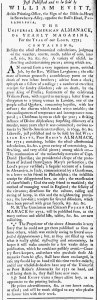
“A New MEDICINAL DISCOVERY, of the UTMOST CONSEQUENCE to MANKIND; known abroad by the Name of, VELNOS’ Vegetable SYRUP: An acknowledged Specific in all Venereal and Scorbutic Cases

This plant-based medication is proposed as a safer alternative to the conventional treatment of the day, which involved exposing patients to mercury in the hopes that it would induce them to expel the disease through bodily secretions. Despite the known dangers of mercury, and its unsavory side effects, it was still widely accepted in the medical community in the late eighteenth century. The advertisement claims that in addition to acting as a substitute for mercury, it also “repairs the havock it has made.” To emphasize the legitimacy of this alternative treatment to any skeptics, the advertisement describes the rigorous testing and clinical trials that the syrup underwent in Paris. Another selling point is the substance’s use in the relief of a number of ailments “arising from a foulness of the blood” not limited to venereal cases.

J. Burrows, the physician who claimed to be the “sole Proprietor of this remedy,” appears to have been one of several enterprising men who began selling their own version of vegetable syrup under the same name throughout the colonies. A certain Isaac Swainson took issue with this and denounced these imposters in his 1792 work, An Account of Cures by Velnos’ Vegetable Syrup, mentioning Burrows and others by name and assuring the public that “the Genuine Syrup of De Velnos can be prepared only by me.” This reveals that a certain level of competition between purveyors of this cure must have existed which prompted Swainson to put such a warning in writing, either out of concern for prospective patients or, more likely, to discredit his competition.

A 1789 etching published in London depicts angry physicians armed with scalpels and mercury who are unable to contend with Velnos’ Syrup being sold by Swainson, who stands smiling, surrounded by bottles of his cure. The cartoon also includes a reference to the number of people allegedly cured in 1788 and 1789 demonstrating that the syrup remained popular in the subsequent decades.

Thomas Rowlandson, Mercury and His Advocates Defeated, or Vegetable Intrenchment (London: S.W. Fores, 1789). Courtesy British Museum.

**********

ADDITIONAL COMMENTARY:  Carl Robert Keyes

This advertisement lists “J. BURROWS, M.D.” as the “Sole Proprietor of this Remedy,” yet he did not market it in Boston.  Instead, a local agent, John Fleeming, hawked Velnos’ Vegetable Syrup to prospective patients in Boston and its hinterlands in the fall of 1771.  The lengthy advertisement focused primarily on the patent medicine, but a brief note at the end informed readers that Fleeming also sold “Cheap Books and Stationary” at his shop “opposite the South Door of the Town-House.”  In another advertisement in the same issue of the Massachusetts Gazette and Boston Weekly News-Letter, Fleeming announced his plans to publish the “NEW-ENGLAND REGISTER, With an Almanack for 1772” in December.

Fleeming was well known in Boston as a printer, publisher, and bookseller, especially because he partnered with John Mein in publishing the Boston Chronicle, a newspaper that unapologetically expressed a Tory perspective and mocked Patriot leaders, from 1767 to 1770.  Mein took the lead in that enterprise and caused so much controversy that he fled Boston for his own safety in 1769.  Fleeming continued publishing the newspaper for only a few months.  He turned his attention to other projects, including publishing an account of the trials that followed the Boston Massacre.

Like most colonial printers, Fleeming supplemented his revenues by selling “Cheap Books and Stationary.” A good number of printers also listed patent medicines in their advertisements, making those remedies the most common goods not directly associated with the books trades to appear in their newspaper notices.  Eighteenth-century consumers would not have considered it out of the ordinary that Fleeming sold patent medicines, though the length and detail of the advertisement for Velnos’ Vegetable Syrup far exceeded the attention printers usually devoted to such nostrums.  They tended to carry popular potions that needed no further explanation, but Fleeming and his associates apparently believed that prospective customers would be more likely to purchase this “New MEDICINAL DISCOVERY” when they learned more about it.  The prospects for increased sales justified the greater expense for such a lengthy advertisement.

Welcome, Guest Curator Nicholas Macchione

Nicholas Macchione is a senior studying History, Music, and Italian at Assumption University. His historical interests include Classical Antiquity, Viking Age Europe, and Colonial America. An avid musician, Nick enjoys playing the drums and piano in his spare time and is involved in many on-campus musical groups including the AU Jazz Ensemble and Music Ministry. He also serves as an Admissions Ambassador for the University and was awarded the 2020 Moggio Prize for Best Short Historical Essay for his work, “A Special Path? Examining Germany’s Sonderweg.” Nicholas contributed to this project as part of HIS 400 Research Methods: Vast Early America in the Spring of 2021.

Welcome, guest curator Nicholas Macchione!

Slavery Advertisements Published November 7, 1771

GUEST CURATOR: Chloe Amour
with contributions from Nicholas Macchione

The Slavery Adverts 250 Project chronicles the role of newspaper advertising in perpetuating slavery in the era of the American Revolution. The project seeks to reveal the ubiquity of slavery in eighteenth-century life from New England to Georgia by republishing advertisements about enslaved people – for sale as individuals or in groups, wanted to purchase or for hire for short periods, runaways who liberated themselves, and those who were subsequently captured and confined in jails and workhouses – in daily digests on this site as well as in real time via the @SlaveAdverts250 Twitter feed, utilizing twenty-first-century media to stand in for the print media of the eighteenth century.

The project aims to provide modern audiences with a sense of just how often colonists encountered these advertisements in their daily lives. Enslaved men, women, and children appeared in print somewhere in the colonies almost every single day. Those advertisements served as a constant backdrop for social, cultural, economic, and political life in colonial and revolutionary America. Colonists who did not purport to own enslaved people were still confronted with slavery as well as invited to maintain the system by purchasing enslaved men, women, and children or assisting in the capture of so-called “runaways” who sought to free themselves from bondage. The frequency of these newspaper advertisements suggests just how embedded slavery was in colonial and revolutionary American culture in everyday interactions beyond the printed page.

These advertisements also testify to the experiences of enslaved men, women, and children, though readers must consider that those experiences have been remediated through descriptions offered by enslavers rather than enslaved people themselves. Often unnamed in the advertisements, enslaved men, women, and children were not invisible or unimportant in early America.

From compiling an archive of digitized eighteenth-century newspapers to identifying advertisements about enslaved men, women, and children in those newspapers to preparing images of each advertisement to posting this daily digest, Chloe Amour served as guest curator for this entry.  She completed this work while enrolled in an independent study for HIS 390 – Digital Humanities Practicum at Assumption University in Worcester, Massachusetts, in Spring 2021.

These advertisements appeared in colonial American newspapers 250 years ago today.

Maryland Gazette (November 7, 1771).

**********

Maryland Gazette (November 7, 1771).

**********

Maryland Gazette (November 7, 1771).

**********

Maryland Gazette (November 7, 1771).

**********

Maryland Gazette (November 7, 1771).

**********

Maryland Gazette (November 7, 1771).

**********

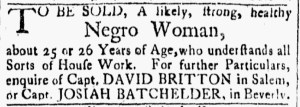
Masachusetts Gazette & Boston Weekly News-Letter (November 7, 1771).

**********

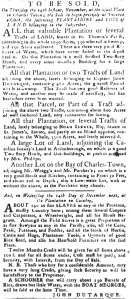
Massachusetts Gazette & Boston Weekly News-Letter (November 7, 1771).

**********

Massachusetts Spy (November 7, 1771).

**********

New-York Journal (November 7, 1771).

**********

New-York Journal (November 7, 1771).

**********

New-York Journal (November 7, 1771).

**********

New-York Journal (November 7, 1771).

**********

Pennsylvania Journal (November 7, 1771).

**********

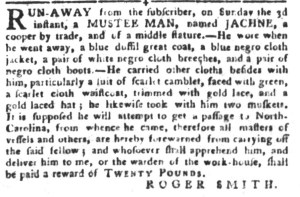
South-Carolina Gazette (November 7, 1771).

**********

South-Carolina Gazette (November 7, 1771).

**********

South-Carolina Gazette (November 7, 1771).

**********

South-Carolina Gazette (November 7, 1771).

**********

South-Carolina Gazette (November 7, 1771).

**********

South-Carolina Gazette (November 7, 1771).

**********

South-Carolina Gazette (November 7, 1771).

**********

South-Carolina Gazette (November 7, 1771).

**********

South-Carolina Gazette (November 7, 1771).

**********

South-Carolina Gazette (November 7, 1771).

**********

South-Carolina Gazette (November 7, 1771).

**********

Virginia Gazette [Purdie & Dixon](November 7, 1771).

**********

Virginia Gazette [Purdie & Dixon](November 7, 1771).

**********

Virginia Gazette [Purdie & Dixon](November 7, 1771).

**********

Virginia Gazette [Purdie & Dixon](November 7, 1771).

**********

Virginia Gazette [Purdie & Dixon](November 7, 1771).

**********

Virginia Gazette [Purdie & Dixon](November 7, 1771).

**********

Virginia Gazette [Purdie & Dixon](November 7, 1771).

**********

Virginia Gazette [Purdie & Dixon](November 7, 1771).

**********

Virginia Gazette [Purdie & Dixon](November 7, 1771).

**********

Virginia Gazette [Purdie & Dixon](November 7, 1771).

**********

Virginia Gazette [Purdie & Dixon](November 7, 1771).

**********

Virginia Gazette [Purdie & Dixon](November 7, 1771).

**********

Virginia Gazette [Purdie & Dixon](November 7, 1771).

**********

Virginia Gazette [Purdie & Dixon](November 7, 1771).

**********

Virginia Gazette [Purdie & Dixon](November 7, 1771).

**********

Virginia Gazette [Purdie & Dixon](November 7, 1771).

**********

Virginia Gazette [Purdie & Dixon](November 7, 1771).

**********

Virginia Gazette [Purdie & Dixon](November 7, 1771).

November 6

What was advertised in a colonial American newspaper 250 years ago this week?

Pennsylvania Packet (November 4, 1771).

“If any wholesale dealers have any of the Universal or Poor Robin’s Almanacks for 1771 on hand … they shall have new ones.”

When it came to publishing and advertising almanacs for 1772, William Evitt was late to the game.  He inserted an advertisement in the November 4, 1771, edition of the Pennsylvania Packet to inform readers that he had “Just Published … THE UNIVERSAL AMERICAN ALMANACK, OR YEARLY MAGAZINE, For the YEAR of our LORD, 1772” as well as “POOR ROBIN’S ALMANACK for 1772.”  To entice prospective customers, he listed the various contents of each.  In addition, he declared that the “Gentleman and Citizen’s POCKET ALMANACK for 1772, will be published soon.”  He was still in the process of gathering “the many curious and useful lists, tables, &c. &c.”

Evitt offered an apology for his tardiness in taking these almanacs to press and advertising them for sale.  He regretted that “he could not get them published as soon as some others, which was owing to several unexpected disappointments.”  He hoped, however, that since they contained “what is really useful, instructing and entertaining” that it would “make amends for a few weeks delay in publication, which he could not possibly avoid.”

In addition to those apologies, Evitt offered a deal to retailers who took a chance on acquiring these almanacs for resale at such a late date.  After all, many consumers, even those who favored the titles published by Evitt, likely already purchased other almanacs that had been on the market for weeks.  Realizing that retailers did not want to get stuck with surplus inventory that would never sell, the printer instructed “Country store-keepers, and others who purchase these Almanacks from his office” that they could “have them exchanged, in case any should lay on hand till this time twelve-month.”  In other words, Evitt offered a guarantee of sorts to retailers who took a chance on stocking his almanacs even though so much of the season for purchasing them already passed.  If the almanacs did not sell by early November 1772, retailers could exchange them for new almanacs for 1773.

Evitt also informed “wholesale dealers” who had “any of the Universal or Poor Robin’s Almanacks for 1771 on hand” that they could exchange them for “new ones” for 1772.  He retroactively applied the promise he made about almanacs for 1772 to those for 1771 that had not yet sold (and were extremely unlikely to sell with less than two months remaining in the year).  Other printers may have made similar arrangements with “Country store-keepers” and other retailers, but they did not promote such exchanges in their advertisements.  Alternately, Evitt may have improvised that deal out of necessity when “unexpected disappointments” prevented him from making his almanacs available in a busy marketplace at the same time as his competitors.  In general, printers marketed their almanacs to both consumers and retailers.  They depended on the latter purchasing in volume and distributing their product.

November 5

What was advertised in a colonial American newspaper 250 years ago today?

Connecticut Courant (November 5, 1771).

“Stolen … a small pair of mens worsted black stockings.”

Several advertisers placed notices in the November 5, 1771, edition of the Connecticut Courant to inform readers that they carried a variety of items.  Thomas Hopkins, for instance, hawked a “fresh & general assortment of English & India GOODS” at his shop in Hartford.  Similarly, P. Verstille promoted a “neat and universal assortment of English and East India GOODS … at his Store in Weathersfield.”  Daniel Cotton and Nathaniel Goodwin, both in Hartford, inserted similar advertisements.

Even in small towns in Connecticut, colonists had many opportunities to participate in the consumer revolution by shopping at local stores.  Yet visiting those shops and paying in “Cash or Produce in hand,” as each of the advertisers specified, was not the only means for acquiring new goods.  In the same issue, Walter Hyde of Lebanon placed an advertisement that a “thief or thieves” stole “a small pair of mens worsted black stockings, & two pieces of claret colour’d homespun serge.”  The shopkeeper suspected that “some other articles are taken away that are not missed yet.”  Hyde offered a reward in hopes of apprehending the culprits and recovering his merchandise.

The thieves may have stolen the stockings and textiles for their own use, but they might also have sold them to others who were unaware or did not care that they were stolen.  An informal economy, a black market of sorts, emerged in eighteenth-century America, running parallel to the legitimate transactions that took place in the shops and stores that appeared in so many newspaper advertisements.  For the poor and marginalized who could not afford or could not gain access to those spaces, purchasing secondhand or stolen goods became a viable alternative that allowed them to participate in the consumer revolution.  Such was the situation not only in the largest urban ports but also in small towns like Lebanon, Connecticut.  The consumer revolution and the informal economy both had long reaches.

Slavery Advertisements Published November 5, 1771

GUEST CURATOR: Chloe Amour
with contributions from Jake Luongo

The Slavery Adverts 250 Project chronicles the role of newspaper advertising in perpetuating slavery in the era of the American Revolution. The project seeks to reveal the ubiquity of slavery in eighteenth-century life from New England to Georgia by republishing advertisements about enslaved people – for sale as individuals or in groups, wanted to purchase or for hire for short periods, runaways who liberated themselves, and those who were subsequently captured and confined in jails and workhouses – in daily digests on this site as well as in real time via the @SlaveAdverts250 Twitter feed, utilizing twenty-first-century media to stand in for the print media of the eighteenth century.

The project aims to provide modern audiences with a sense of just how often colonists encountered these advertisements in their daily lives. Enslaved men, women, and children appeared in print somewhere in the colonies almost every single day. Those advertisements served as a constant backdrop for social, cultural, economic, and political life in colonial and revolutionary America. Colonists who did not purport to own enslaved people were still confronted with slavery as well as invited to maintain the system by purchasing enslaved men, women, and children or assisting in the capture of so-called “runaways” who sought to free themselves from bondage. The frequency of these newspaper advertisements suggests just how embedded slavery was in colonial and revolutionary American culture in everyday interactions beyond the printed page.

These advertisements also testify to the experiences of enslaved men, women, and children, though readers must consider that those experiences have been remediated through descriptions offered by enslavers rather than enslaved people themselves. Often unnamed in the advertisements, enslaved men, women, and children were not invisible or unimportant in early America.

From compiling an archive of digitized eighteenth-century newspapers to identifying advertisements about enslaved men, women, and children in those newspapers to preparing images of each advertisement to posting this daily digest, Chloe Amour served as guest curator for this entry.  She completed this work while enrolled in an independent study for HIS 390 – Digital Humanities Practicum at Assumption University in Worcester, Massachusetts, in Spring 2021.

These advertisements appeared in colonial American newspapers 250 years ago today.

Essex Gazette (November 5, 1771).

**********

South-Carolina Gazette and Country Journal (November 5, 1771).

**********

South-Carolina Gazette and Country Journal (November 5, 1771).

**********

South-Carolina Gazette and Country Journal (November 5, 1771).

**********

South-Carolina Gazette and Country Journal (November 5, 1771).

**********

South-Carolina Gazette and Country Journal (November 5, 1771).

**********

South-Carolina Gazette and Country Journal (November 5, 1771).

**********

South-Carolina Gazette and Country Journal (November 5, 1771).

**********

South-Carolina Gazette and Country Journal (November 5, 1771).

**********

South-Carolina Gazette and Country Journal (November 5, 1771).

November 4

Who was the subject of an advertisement in a colonial American newspaper 250 years ago today?

Pennsylvania Packet (November 4, 1771).

“WANTED, A NEGRO BOY … apply to the Printer.”

Two issues.  It took only two issues for John Dunlap, the printer of the Pennsylvania Packet, to become a slave broker.  Dunlap published the inaugural issue of his newspaper on October 28, 1771.  It overflowed with advertising.  So many advertisers submitted notices to the printing office that Dunlap published a two-page supplement and inserted a note that other advertisements arrived too late for publication that week but would appear in the next edition.  Most advertisements in that first issue promoted consumer goods and services.

The following week, however, Dunlap ran another sort of advertisement that regularly appeared in newspapers from New England to Georgia:  a notice in which an unnamed advertiser sought to purchase an enslaved person.  “WANTED,” the advertisement proclaimed, “A NEGRO BOY, from fourteen to twenty years of age, that can be well recommended.”  In running that advertisement, John Dunlap and the Pennsylvania Packet helped to perpetuate slavery and the slave trade.  Yet Dunlap did more than provide space in his newspaper in exchange for advertising fees that made his new publication a viable venture.  The advertisement instructed that “Any person who has such to dispose of, may hear of a Purchaser by applying to the Printer.”  Dunlap brokered the sale by supplying additional information to readers who responded to the advertisement.

That was a common practice throughout the eighteenth century.  In “Enquire of the Printer: Newspaper Advertising and the Moral Economy of the North American Slave Trade, 1704-1807,” Jordan E. Taylor analyzes a “dataset of more than 2,100 unique eighteenth-century North American ‘enquire of the printer’ newspaper slave advertisements appearing from 1704 through 1807.”[1]  Most of those advertisements ran for multiple weeks, making them even more ubiquitous before the eyes of readers and profitable for printers.  Dunlap, then, was not an outlier among printers during the era of the American Revolution.  Instead, he very quickly adopted a widespread practice.  Not exclusively a broker of information, the printer also served as a broker of enslaved men, women, and children.

**********

[1] Jordan E. Taylor, “Enquire of the Printer: Newspaper Advertising and the Moral Economy of the North American Slave Trade, 1704-1807,” Early American Studies: An Interdisciplinary Journal 18, no. 3 (Summer 2020): 290.

Slavery Advertisements Published November 4, 1771

GUEST CURATOR: Chloe Amour
with contributions from Jake Luongo

The Slavery Adverts 250 Project chronicles the role of newspaper advertising in perpetuating slavery in the era of the American Revolution. The project seeks to reveal the ubiquity of slavery in eighteenth-century life from New England to Georgia by republishing advertisements about enslaved people – for sale as individuals or in groups, wanted to purchase or for hire for short periods, runaways who liberated themselves, and those who were subsequently captured and confined in jails and workhouses – in daily digests on this site as well as in real time via the @SlaveAdverts250 Twitter feed, utilizing twenty-first-century media to stand in for the print media of the eighteenth century.

The project aims to provide modern audiences with a sense of just how often colonists encountered these advertisements in their daily lives. Enslaved men, women, and children appeared in print somewhere in the colonies almost every single day. Those advertisements served as a constant backdrop for social, cultural, economic, and political life in colonial and revolutionary America. Colonists who did not purport to own enslaved people were still confronted with slavery as well as invited to maintain the system by purchasing enslaved men, women, and children or assisting in the capture of so-called “runaways” who sought to free themselves from bondage. The frequency of these newspaper advertisements suggests just how embedded slavery was in colonial and revolutionary American culture in everyday interactions beyond the printed page.

These advertisements also testify to the experiences of enslaved men, women, and children, though readers must consider that those experiences have been remediated through descriptions offered by enslavers rather than enslaved people themselves. Often unnamed in the advertisements, enslaved men, women, and children were not invisible or unimportant in early America.

From compiling an archive of digitized eighteenth-century newspapers to identifying advertisements about enslaved men, women, and children in those newspapers to preparing images of each advertisement to posting this daily digest, Chloe Amour served as guest curator for this entry.  She completed this work while enrolled in an independent study for HIS 390 – Digital Humanities Practicum at Assumption University in Worcester, Massachusetts, in Spring 2021.

These advertisements appeared in colonial American newspapers 250 years ago today.

Boston Gazette (November 4, 1771).

**********

New-York Gazette and Weekly Mercury (November 4, 1771).

**********

New-York Gazette and Weekly Mercury (November 4, 1771).

**********

New-York Gazette and Weekly Mercury (November 4, 1771).

**********

New-York Gazette and Weekly Mercury (November 4, 1771).

**********

New-York Gazette and Weekly Mercury (November 4, 1771).

**********

New-York Gazette and Weekly Mercury (November 4, 1771).

**********

New-York Gazette and Weekly Mercury (November 4, 1771).

**********

Pennsylvania Packet (November 4, 1771).

**********

South-Carolina and American General Gazette (November 4, 1771).

**********

South-Carolina and American General Gazette (November 4, 1771).

**********

South-Carolina and American General Gazette (November 4, 1771).

**********

South-Carolina and American General Gazette (November 4, 1771).

**********

South-Carolina and American General Gazette (November 4, 1771).

**********

South-Carolina and American General Gazette (November 4, 1771).

**********

South-Carolina and American General Gazette (November 4, 1771).

**********

South-Carolina and American General Gazette (November 4, 1771).

**********

South-Carolina and American General Gazette (November 4, 1771).

**********

South-Carolina and American General Gazette (November 4, 1771).

**********

South-Carolina and American General Gazette (November 4, 1771).

November 3

What was advertised in a colonial American newspaper 250 years ago this week?

Pennsylvania Gazette (October 31, 1771).

“THOMAS SHIELDS … at the Golden Cup and Crown.”

When Thomas Shields, a goldsmith, advertised his services in the October 31, 1771, edition of the Pennsylvania Gazette, he adorned his notice with a depiction of a crown suspended above a cup.  That image corresponded to the sign that marked his location on Front Street in Philadelphia.  It also helped to distinguish his advertisement from others in the same issue.  Ten other notices incorporated images, but all of them featured woodcuts of vessels at sea.  Each of those advertisements sought passengers and freight for ships preparing to leave the busy port.

The images of the ships belonged to David Hall and William Sellers, the printers of the Pennsylvania Gazette.  Along with stock images of houses, horses, enslaved people, and indentured servants, colonial printers provided images of ships to advertisers.  Those who desired more specialized images, on the other hand, commissioned them and retained ownership.  That being the case, some advertisers used their woodcuts in one newspaper for a while before transferring them to another newspaper.  At about the same time that Shields ran his advertisement in the Pennsylvania Gazette, James Cunning, a shopkeeper “At the sign of the SPINNING WHEEL,” supplied his woodcut of a spinning wheel to two other newspapers, first the Pennsylvania Journal and then the Pennsylvania Packet.  The notation at the end of Shields’s advertisement, “5 W,” indicated that he arranged for it to run for five weeks.  After that, he could collect his woodcut from Hall and Sellers and transfer it to another printing office.

I regularly choose these unique images that adorned newspaper advertisements when I select notices to feature on the Adverts 250 Project.  Relative to their numbers and frequency in the early American press, such images are overrepresented on this project, meriting a disclaimer that Shields’s advertisement and others with such images were not typical.  They do, however, testify to what was possible in eighteenth-century advertising and the choices that advertisers made when it came to format, incurring additional expenses, and placing notices in multiple newspapers.  In addition, the Adverts 250 Project has compiled an informal census of woodcuts that advertisers commissioned in the late 1760s and early 1770s.  After nearly six years producing the Adverts 250 Project, I get the impression (though this needs to be tested against a more systematic accounting) that the frequency of such images accelerated in the early 1770s, a sign that greater numbers of advertisers embraced the additional expense if those woodcuts garnered greater attention for their newspaper notices.

November 2

What was advertised in a colonial American newspaper 250 years ago today?

Providence Gazette (November 2, 1771).

West’s SHEET-ALMANACK, For the Year of our LORD 1772.”

In the fall of 1771, Benjamin West, an astronomer and mathematician, and John Carter, printer of the Providence Gazette, collaborated in producing, marketing, and selling the “NEW-ENGLAND ALMANACK, OR, Lady’s and Gentleman’s DIARY, For the Year of our LORD 1772.”  It was West’s tenth almanac.  Over a decade he worked with a succession of printers of the Providence Gazette, including William Goddard (almanacs for 1763, 1764, and 1765), William Goddard and Sarah Goddard (1766), Sarah Goddard and Company (1767), Sarah Goddard and John Carter (1768), and John Carter (1769, 1770, 1771, and 1772).  West not only provided the “usual Astronomical Calculations” but also assisted in selling copies to both readers and retailers.  Advertisements for the New-England Almanack consistently informed buyers that it was “Sold by the Printer hereof, and by the Author.”

West and Carter also collaborated in developing more than one format to suit the needs of their customers.  In late September, they announced the imminent publication of the standard edition, a pamphlet containing twenty-four pages.  In early November, they marketed an additional product, “West’s SHEET-ALMANACK, For the Year of our LORD 1772.”  Colonists who purchased that broadside as an alternative to the standard edition could post it for easy reference throughout the year.  The broadside cost a little less than the standard edition, four coppers compared to six.  In addition, West and Carter offered discounts for purchasing a quantity.  For the standard edition, buyers paid a lower rate “per single Dozen” and an even lower rate “per Dozen by the Quantity.”  The pricing structure for the broadside edition, however, was less complicated; buyers received a discount “per Dozen” regardless of how many dozens they purchased.

Rather than combine the marketing into a single advertisement, West and Carter promoted the two editions separately.  Doing so may have allowed them to gain greater notice through repetition since the advertisements ran on different pages of the Providence Gazette.  As printer of the newspaper, Carter exercised control over where notices appeared, an advantage not available to other advertisers.  In their efforts to sell the New-England Almanack, West and Carter brought together several strategies, including multiple formats, discounts for retailers and others who bought a quantity, and privileged placement on the page within the newspaper.