Slavery Advertisements Published November 14, 1771

GUEST CURATOR: Chloe Amour
with contributions from Kaden McSheffrey

The Slavery Adverts 250 Project chronicles the role of newspaper advertising in perpetuating slavery in the era of the American Revolution. The project seeks to reveal the ubiquity of slavery in eighteenth-century life from New England to Georgia by republishing advertisements about enslaved people – for sale as individuals or in groups, wanted to purchase or for hire for short periods, runaways who liberated themselves, and those who were subsequently captured and confined in jails and workhouses – in daily digests on this site as well as in real time via the @SlaveAdverts250 Twitter feed, utilizing twenty-first-century media to stand in for the print media of the eighteenth century.

The project aims to provide modern audiences with a sense of just how often colonists encountered these advertisements in their daily lives. Enslaved men, women, and children appeared in print somewhere in the colonies almost every single day. Those advertisements served as a constant backdrop for social, cultural, economic, and political life in colonial and revolutionary America. Colonists who did not purport to own enslaved people were still confronted with slavery as well as invited to maintain the system by purchasing enslaved men, women, and children or assisting in the capture of so-called “runaways” who sought to free themselves from bondage. The frequency of these newspaper advertisements suggests just how embedded slavery was in colonial and revolutionary American culture in everyday interactions beyond the printed page.

These advertisements also testify to the experiences of enslaved men, women, and children, though readers must consider that those experiences have been remediated through descriptions offered by enslavers rather than enslaved people themselves. Often unnamed in the advertisements, enslaved men, women, and children were not invisible or unimportant in early America.

From compiling an archive of digitized eighteenth-century newspapers to identifying advertisements about enslaved men, women, and children in those newspapers to preparing images of each advertisement to posting this daily digest, Chloe Amour served as guest curator for this entry.  She completed this work while enrolled in an independent study for HIS 390 – Digital Humanities Practicum at Assumption University in Worcester, Massachusetts, in Spring 2021.

These advertisements appeared in colonial American newspapers 250 years ago today.

Maryland Gazette (November 14, 1771).

**********

Maryland Gazette (November 14, 1771).

**********

Maryland Gazette (November 14, 1771).

**********

Maryland Gazette (November 14, 1771).

**********

Maryland Gazette (November 14, 1771).

**********

Maryland Gazette (November 14, 1771).

**********

Maryland Gazette (November 14, 1771).

**********

Massachusetts Gazette and Boston Weekly News-Letter (November 14, 1771).

**********

Massachusetts Spy (November 14, 1771).

**********

New-York Journal (November 14, 1771).

**********

New-York Journal (November 14, 1771).

**********

New-York Journal (November 14, 1771).

**********

New-York Journal (November 14, 1771).

**********

South-Carolina Gazette (November 14, 1771).

**********

South-Carolina Gazette (November 14, 1771).

**********

South-Carolina Gazette (November 14, 1771).

**********

South-Carolina Gazette (November 14, 1771).

**********

South-Carolina Gazette (November 14, 1771).

**********

South-Carolina Gazette (November 14, 1771).

**********

South-Carolina Gazette (November 14, 1771).

**********

South-Carolina Gazette (November 14, 1771).

**********

South-Carolina Gazette (November 14, 1771).

**********

South-Carolina Gazette (November 14, 1771).

**********

South-Carolina Gazette (November 14, 1771).

**********

South-Carolina Gazette (November 14, 1771).

**********

South-Carolina Gazette (November 14, 1771).

**********

Virginia Gazette [Purdie and Dixon] (November 14, 1771).

**********

Virginia Gazette [Purdie and Dixon] (November 14, 1771).

**********

Virginia Gazette [Purdie and Dixon] (November 14, 1771).

**********

Virginia Gazette [Purdie and Dixon] (November 14, 1771).

**********

Virginia Gazette [Purdie and Dixon] (November 14, 1771).

**********

Virginia Gazette [Purdie and Dixon] (November 14, 1771).

**********

Virginia Gazette [Purdie and Dixon] (November 14, 1771).

**********

Virginia Gazette [Purdie and Dixon] (November 14, 1771).

**********

Virginia Gazette [Purdie and Dixon] (November 14, 1771).

**********

Virginia Gazette [Purdie and Dixon] (November 14, 1771).

**********

Virginia Gazette [Purdie and Dixon] (November 14, 1771).

**********

Virginia Gazette [Purdie and Dixon] (November 14, 1771).

**********

Virginia Gazette [Purdie and Dixon] (November 14, 1771).

**********

Virginia Gazette [Purdie and Dixon] (November 14, 1771).

**********

Virginia Gazette [Purdie and Dixon] (November 14, 1771).

**********

Virginia Gazette [Purdie and Dixon] (November 14, 1771).

**********

Virginia Gazette [Purdie and Dixon] (November 14, 1771).

**********

Virginia Gazette [Purdie and Dixon] (November 14, 1771).

**********

Virginia Gazette [Purdie and Dixon] (November 14, 1771).

**********

Virginia Gazette [Purdie and Dixon] (November 14, 1771).

**********

Virginia Gazette [Purdie and Dixon] (November 14, 1771).

November 13

What was advertised in a colonial American newspaper 250 years ago this week?

South-Carolina and American General Gazette (November 11, 1771).

“Freight or Passage.”

Charleston, one of the largest cities in the colonies during the era of the American Revolution, was a busy port and bustling center of commerce.  Residents glimpsed this activity as they went about their daily lives, but they also encountered depictions of it in the public prints.  Newspapers regularly included both shipping news from the customs house and advertisements about ships seeking passengers and freight as they prepared to depart.

For instance, more than two dozen vessels appeared among those that arrived, recently sailed, or were “NOW LOADING” in the shipping news in the November 11, 1771, edition of the South-Carolina and American General Gazette.  The arrivals came from Bermuda, Georgia, and New Providence, while the departures headed for East Florida, North Carolina, and Philadelphia.  Ships preparing to sail had an even wider array of destinations, including Bristol, Falmouth, Lancaster, Liverpool, London, Georgia, New York, Barbados, Bermuda, Granada, Jamaica, and New Providence.  The shipping news documented extensive networks of trade that connected Charleston to England and other colonies in North America and the Caribbean.

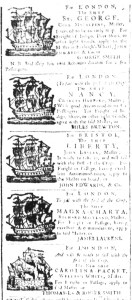
Advertisements also testified to the level of activity in the port, especially those featuring woodcuts that showed ships at sea.  In the November 11 issue, the compositor chose to cluster five such advertisements together, replicating a view that readers might have seen at the wharves.  Each of the advertisements sought passengers and freight, some of them specifying “Indigo, Deer Skins, or other light Goods” as their preferred cargo.

These visual representations of maritime commerce were not unique to newspapers published in Charleston.  That same week, the Massachusetts Gazette and Boston Weekly News-Letter included a cluster of three advertisements with woodcuts of ships at sea and the Pennsylvania Gazette had a cluster of seven such advertisements.  The Pennsylvania Journal ran thirteen of those advertisements one after another, so many that the armada of commercial vessels filled an entire column and overflowed into another.  Compositors did not usually arrange newspaper notices according to genre or purpose in the eighteenth century, but on those occasions that they did place advertisements with images of ships together they created stunning visual representations of an empire of trade.

November 12

Who was the subject of an advertisement in a colonial American newspaper 250 years ago today?

South-Carolina Gazette and Country Journal (November 12, 1771).

“RUN-AWAY … six Angola negro men.”

“LIBERTY … excellent Accommodations.”

In the fall of 1771, John Edwards and Company sought freight and passengers for the Liberty, soon departing Charleston for Bristol.  In an advertisement in the November 12, 1771, edition of the South-Carolina Gazette and Country Journal, Edwards and Company promised “excellent Accommodations” for passengers.  Two aspects of the advertisement helped draw attention to it:  the name of the ship, “LIBERTY,” in capital letters and a large font as well as a woodcut of a ship at sea.  Wind seemed to fill the sails and unfurl the flags, suggesting a quick and comfortable journey.  The advertisement for freight and passage aboard the Liberty appeared two notices below another advertisement that also incorporated a woodcut.  That image, however, depicted an enslaved man on the run.  He seemed to move in the opposite direction across the page in relation to the ship adorning the advertisement for the Liberty, testifying to the very different conceptions of liberty among enslavers and enslaved people in South Carolina in the era of the American Revolution.

Francis Yonge placed that advertisement to offer a reward for the capture and return of not just one enslaved man but instead “six Angola negro men” who had “RUN-AWAY” from his plantation at the end of October.  Yonge purchased the men a few months earlier, suggesting that they had only recently arrived in South Carolina and “cannot as yet speak English.”  Readers could also identify them by the clothing they wore, blue jackets and breeches made of “negro cloth” with their enslaver’s initials sewn “in scarlet cloth … upon the forepart of their jackets.”  Yonge selected the rough cloth for its low costs, not for its comfort.  Such callousness would have been familiar to the six men from Angola by the time Yonge outfitted them at his plantation.  After all, they had survived the Middle Passage on a ship that did not offer “excellent Accommodations” for its human cargo, unlike the Liberty that carried passengers from South Carolina to England.  As was so often the case in early American newspapers, advertisements that perpetuated the enslavement of Africans and African Americans appeared in stark contrast to other advertisements, editorials, and articles that promoted, in one way or another, the liberty that white colonists demanded for themselves.

Slavery Advertisements Published November 12, 1771

GUEST CURATOR: Chloe Amour
with contributions from Nicholas Macchione

The Slavery Adverts 250 Project chronicles the role of newspaper advertising in perpetuating slavery in the era of the American Revolution. The project seeks to reveal the ubiquity of slavery in eighteenth-century life from New England to Georgia by republishing advertisements about enslaved people – for sale as individuals or in groups, wanted to purchase or for hire for short periods, runaways who liberated themselves, and those who were subsequently captured and confined in jails and workhouses – in daily digests on this site as well as in real time via the @SlaveAdverts250 Twitter feed, utilizing twenty-first-century media to stand in for the print media of the eighteenth century.

The project aims to provide modern audiences with a sense of just how often colonists encountered these advertisements in their daily lives. Enslaved men, women, and children appeared in print somewhere in the colonies almost every single day. Those advertisements served as a constant backdrop for social, cultural, economic, and political life in colonial and revolutionary America. Colonists who did not purport to own enslaved people were still confronted with slavery as well as invited to maintain the system by purchasing enslaved men, women, and children or assisting in the capture of so-called “runaways” who sought to free themselves from bondage. The frequency of these newspaper advertisements suggests just how embedded slavery was in colonial and revolutionary American culture in everyday interactions beyond the printed page.

These advertisements also testify to the experiences of enslaved men, women, and children, though readers must consider that those experiences have been remediated through descriptions offered by enslavers rather than enslaved people themselves. Often unnamed in the advertisements, enslaved men, women, and children were not invisible or unimportant in early America.

From compiling an archive of digitized eighteenth-century newspapers to identifying advertisements about enslaved men, women, and children in those newspapers to preparing images of each advertisement to posting this daily digest, Chloe Amour served as guest curator for this entry.  She completed this work while enrolled in an independent study for HIS 390 – Digital Humanities Practicum at Assumption University in Worcester, Massachusetts, in Spring 2021.

These advertisements appeared in colonial American newspapers 250 years ago today.

Essex Gazette (November 12, 1771).

**********

Essex Gazette (November 12, 1771).

**********

South-Carolina Gazette & Country Journal (November 12, 1771).

**********

South-Carolina Gazette & Country Journal (November 12, 1771).

**********

South-Carolina Gazette & Country Journal (November 12, 1771).

**********

South-Carolina Gazette & Country Journal (November 12, 1771).

**********

South-Carolina Gazette & Country Journal (November 12, 1771).

**********

South-Carolina Gazette & Country Journal (November 12, 1771).

**********

South-Carolina Gazette & Country Journal (November 12, 1771).

**********

South-Carolina Gazette & Country Journal (November 12, 1771).

**********

South-Carolina Gazette & Country Journal (November 12, 1771).

**********

South-Carolina Gazette & Country Journal (November 12, 1771).

**********

South-Carolina Gazette & Country Journal (November 12, 1771).

**********

South-Carolina Gazette & Country Journal (November 12, 1771).

November 11

What was advertised in a colonial American newspaper 250 years ago today?

New-York Gazette and Weekly Mercury (November 11, 1771).

“Mr. SAUNDERS … is lately returned to this town.”

Hyman Saunders needed no introduction … or, more appropriately, when the illusionist returned to New York after an absence of a couple of months in 1771 he needed very little introduction.  In a brief advertisement in the November 11 edition of the New-York Gazette and Weekly Mercury, Saunders “acquaint[ed] the nobility and gentry, that he is lately returned to this town, and intends to perform in private, (only) his dexterity and grand deception, to any select company.”  He advised those who wished to hire him to perform to send a note via the printer a day in advance.

Saunders needed little introduction in part because he had advertised in the public prints upon first arriving in New York a year earlier.  In the fall of 1770, he placed advertisements in the New-York Journal to announce that he had “Just arrived from EUROPE” and intended to stage “several new and astonishing performances in the dexterity of hand, different from what has been hitherto attempted, and such as was never seen in this province.”  Saunders offered a spectacle to entertain audiences, both those who attended his public performances and those who hired him for private shows.  To incite demand, he proclaimed that he would stay in the city “but a few weeks,” a common strategy among itinerant performers, but he extended his stay into February 1771.  At that time, he informed prospective audiences that he “intends to CONTINUE his PERFORMANCES a few Nights.”  He did indeed move on to Philadelphia eventually, advertising in the May 6, 1771, edition of the Pennsylvania Chronicle that he had “Just arrived from EUROPE” but had also performed “before his Excellency the Earl of DUNMORE, governor of New-York” upon arriving in the colonies.  In introducing himself to audiences in Philadelphia, Saunders distributed an advertisement that closely paralleled his initial notice in the New-York Journal.

He did not need to be so verbose when he returned to New York six months later.  His earlier advertisements introduced him to the public and his performances established his reputation in the city.  Those who saw performances of his “dexterity and grand deception” likely bolstered his publicity in the press via conversations with family, friends, and acquaintances.  In the fall of 1771, the itinerant performer no longer required the same sort of elaborate advertisements that he customarily inserted in local newspapers upon arriving in a new town.  Familiar to New Yorkers, Saunders determined that a brief notice would suffice.

Slavery Advertisements Published November 11, 1771

GUEST CURATOR: Chloe Amour
with contributions from Nicholas Macchione

The Slavery Adverts 250 Project chronicles the role of newspaper advertising in perpetuating slavery in the era of the American Revolution. The project seeks to reveal the ubiquity of slavery in eighteenth-century life from New England to Georgia by republishing advertisements about enslaved people – for sale as individuals or in groups, wanted to purchase or for hire for short periods, runaways who liberated themselves, and those who were subsequently captured and confined in jails and workhouses – in daily digests on this site as well as in real time via the @SlaveAdverts250 Twitter feed, utilizing twenty-first-century media to stand in for the print media of the eighteenth century.

The project aims to provide modern audiences with a sense of just how often colonists encountered these advertisements in their daily lives. Enslaved men, women, and children appeared in print somewhere in the colonies almost every single day. Those advertisements served as a constant backdrop for social, cultural, economic, and political life in colonial and revolutionary America. Colonists who did not purport to own enslaved people were still confronted with slavery as well as invited to maintain the system by purchasing enslaved men, women, and children or assisting in the capture of so-called “runaways” who sought to free themselves from bondage. The frequency of these newspaper advertisements suggests just how embedded slavery was in colonial and revolutionary American culture in everyday interactions beyond the printed page.

These advertisements also testify to the experiences of enslaved men, women, and children, though readers must consider that those experiences have been remediated through descriptions offered by enslavers rather than enslaved people themselves. Often unnamed in the advertisements, enslaved men, women, and children were not invisible or unimportant in early America.

From compiling an archive of digitized eighteenth-century newspapers to identifying advertisements about enslaved men, women, and children in those newspapers to preparing images of each advertisement to posting this daily digest, Chloe Amour served as guest curator for this entry.  She completed this work while enrolled in an independent study for HIS 390 – Digital Humanities Practicum at Assumption University in Worcester, Massachusetts, in Spring 2021.

These advertisements appeared in colonial American newspapers 250 years ago today.

Boston Gazette (November 11, 1771).

**********

New-York Gazette & Weekly Mercury (November 11, 1771).

**********

New-York Gazette & Weekly Mercury (November 11, 1771).

**********

Newport Mercury (November 11, 1771).

**********

Newport Mercury (November 11, 1771).

**********

Pennsylvania Packet (November 11, 1771).

**********

South-Carolina & American General Gazette (November 11, 1771).

**********

South-Carolina & American General Gazette (November 11, 1771).

**********

South-Carolina & American General Gazette (November 11, 1771).

**********

South-Carolina & American General Gazette (November 11, 1771).

**********

South-Carolina & American General Gazette (November 11, 1771).

**********

South-Carolina & American General Gazette (November 11, 1771).

**********

South-Carolina & American General Gazette (November 11, 1771).

**********

South-Carolina & American General Gazette (November 11, 1771).

**********

South-Carolina & American General Gazette (November 11, 1771).

November 10

What was advertised in a colonial American newspaper 250 years ago this week?

Pennsylvania Journal (November 8, 1771).

American FLINT GLASS.”

When Parliament repealed most of the duties on imported goods imposed by the Townshend Acts, leaving only the duty on tea in place, most American merchants counted it as a victory that merited bringing their own nonimportation agreements to end in favor of resuming regular trade with Britain.  Some colonists objected, insisting that they should hold out until Parliament met all of their demands by repealing the duty on tea as well, but they were in the minority.  Merchants and consumers alike welcomed the return to transatlantic business as usual.

That did not, however, prevent American producers from promoting their “domestic manufactures” as alternatives to imported goods.  Henry William Stiegel, for instance, advertised “American FLINT GLASS … made at the factory in Manheim in Lancaster county” in Pennsylvania during the summer of 1771 and into the fall.  Stiegel proclaimed that his product was “equal in quality with any imported from Europe,” reassuring prospective customers that they did not have to sacrifice quality when choosing to support American industry.  He also promised that “merchants, store-keepers and others” could acquire his glass “on very reasonable terms.”  In addition to competitive prices, “Wholesale dealers” received discounts for “buying large quantities.”

Pocket Bottle, attributed to American Flint Glass Manufactory, 1769-1774. Courtesy Metropolitan Museum of Art.

Stiegel also framed purchasing his “American FLINT GLASS” as a patriotic duty for both retailers and consumers, even though the situation between the colonies and Britain was relative calm at the moment.  He declared that “as the proprietor” of the factory in Manheim he “well knows the patriotic spirit of the Americans” and “flatters himself they will encourage the manufactories of their own country” whenever possible instead of purchasing or retailing imported goods.  To help consumers and retailers throughout the region submit orders, Stiegel designated local agents in Philadelphia, Lancaster, and York in Pennsylvania as well as Baltimore in Maryland.

Work attributed to Stiegel and the American Flint Glass Manufactory, including this pocket bottle produced at about the same time he advertised in the Pennsylvania Journal, survives in museums and private collections.  Whether attracted by the quality, price, or invitation to “Buy American,” colonial consumers purchased “domestic manufactures” even as they resumed buying imported goods.  Stiegel managed to garner a share of the market amid the array of choices available. The frequency that he placed notices in newspapers suggests that he apparently believed that advertising aided in that endeavor.

November 9

What was advertised in a colonial American newspaper 250 years ago today?

Providence Gazette (November 9, 1771).

“Atwell hath hired an English Workman, of exquisite Sill.”

In the fall of 1771, Amos Atwell took to the page of the Providence Gazette to let “the Town and Country” know that he “hath set up the CUTLERY BUSINESS, in all its Branches, at his Smith’s Shop.”  Residents of Providence and nearby towns knew Atwell as a blacksmith, so the “CUTLERY BUSINESS” was a new endeavor for him.  That being the case, he provided an overview of his goods and services to instill confidence that he was indeed prepared to expand his business.  Atwell carried “Case Knives and Forks, Carving Knives and Forks, Pocket and Pen Knives of various Kinds, Razors, Surgeons Instruments, &c. &c.”  Repeating “&c.” (the abbreviation for et cetera most commonly used in the eighteenth century) underscored the range of cutlery available at his shop.  In addition, customers could have “all Kinds of Cutlery Ware cleaned, ground, and put in the best Order.”

The blacksmith did not undertake these tasks himself.  Instead, this enterprise depended on acquiring qualified help, “for which Purpose said Atwell hath hired an English Workman.”  Atwell proclaimed that he “carries on the Blacksmith’s Business as usual,” so his new employee attended to the “CUTLERY BUSINESS, in all its Branches.”  Atwell declared that the cutler possessed “exquisite Skill” and promised that he “gives constant Attendance on the Business, and is always ready to receive and execute the Commands” of customers.  New to the town, the unnamed cutler had not yet established his own reputation among prospective clients.  That made his arrangement with Atwell mutually beneficial.  The blacksmith aimed to attract more customers now that he offered more services at his shop, while the cutler received an endorsement from an artisan well known in the community.  In their newspaper advertisements, blacksmiths and other artisans rarely mentioned the workers, free or enslaved, who labored in their shops.  These circumstances, however, demanded that Atwell acknowledge that even though he “hath set up the CUTLERY BUSINESS” that another artisan actually oversaw those services at his shop.

Slavery Advertisements Published November 9, 1771

GUEST CURATOR: Chloe Amour
with contributions from Nicholas Macchione

The Slavery Adverts 250 Project chronicles the role of newspaper advertising in perpetuating slavery in the era of the American Revolution. The project seeks to reveal the ubiquity of slavery in eighteenth-century life from New England to Georgia by republishing advertisements about enslaved people – for sale as individuals or in groups, wanted to purchase or for hire for short periods, runaways who liberated themselves, and those who were subsequently captured and confined in jails and workhouses – in daily digests on this site as well as in real time via the @SlaveAdverts250 Twitter feed, utilizing twenty-first-century media to stand in for the print media of the eighteenth century.

The project aims to provide modern audiences with a sense of just how often colonists encountered these advertisements in their daily lives. Enslaved men, women, and children appeared in print somewhere in the colonies almost every single day. Those advertisements served as a constant backdrop for social, cultural, economic, and political life in colonial and revolutionary America. Colonists who did not purport to own enslaved people were still confronted with slavery as well as invited to maintain the system by purchasing enslaved men, women, and children or assisting in the capture of so-called “runaways” who sought to free themselves from bondage. The frequency of these newspaper advertisements suggests just how embedded slavery was in colonial and revolutionary American culture in everyday interactions beyond the printed page.

These advertisements also testify to the experiences of enslaved men, women, and children, though readers must consider that those experiences have been remediated through descriptions offered by enslavers rather than enslaved people themselves. Often unnamed in the advertisements, enslaved men, women, and children were not invisible or unimportant in early America.

From compiling an archive of digitized eighteenth-century newspapers to identifying advertisements about enslaved men, women, and children in those newspapers to preparing images of each advertisement to posting this daily digest, Chloe Amour served as guest curator for this entry.  She completed this work while enrolled in an independent study for HIS 390 – Digital Humanities Practicum at Assumption University in Worcester, Massachusetts, in Spring 2021.

These advertisements appeared in colonial American newspapers 250 years ago today.

Providence Gazette (November 9, 1771).

November 8

What was advertised in a colonial American newspaper 250 years ago today?

New-London Gazette (November 8, 1771).

“As compleat an Assortment as is to be met with at any Store in NORWICH.”

As October became November in 1771, John-McClarren Breed continued to advertise an assortment of goods available at his store in Norwich, Connecticut.  His lengthy advertisement extended more than half a column in the New-London Gazette, cataloging an array of textiles, housewares, hardware, books, and other items in his inventory.  Prospective customers could see at a glance that Breed offered many choices to suit their tastes.

Breed was not the only merchant in Norwich who advertised in the New-London Gazette in the fall of 1771.  John B. Brimmer inserted his own notice in the November 8 edition, fortunate enough to have it appear as the first item on the first page.  A few months earlier, Brimmer ran advertisements that rivaled Breed’s in length and the number of goods enumerated, but that was no longer the case in his newest advertisement.  Instead, he “Informs his Customers, That he has just received from LONDON, A further Supply of Fall Goods” and asked readers to take into account his previous notices.  “[W]ith the other GOODS he has lately advertised,” Brimmer asserted, the new items from the latest shipment “make up perhaps, as compleat an Assortment as is to be met with at any Store in NORWICH.”

Even if readers did not recall the advertisements that Brimmer placed during the summer months, he attempted to distract prospective customers from assuming that Breed had a larger inventory just because his advertisement occupied so much space on the page.  Indeed, in the November 8 edition Breed’s advertisement began in one column and overflowed into another, giving the impression that it contained even more than it did.  Even though Brimmer was no stranger when it came to placing such elaborate advertisements, he opted for a less-is-more approach in drawing attention to his “further Supply of Fall Goods,” perhaps depending on his reputation for providing “as compleat an Assortment” to do the rest.