
What was advertised in a revolutionary American newspaper 250 years ago this week?
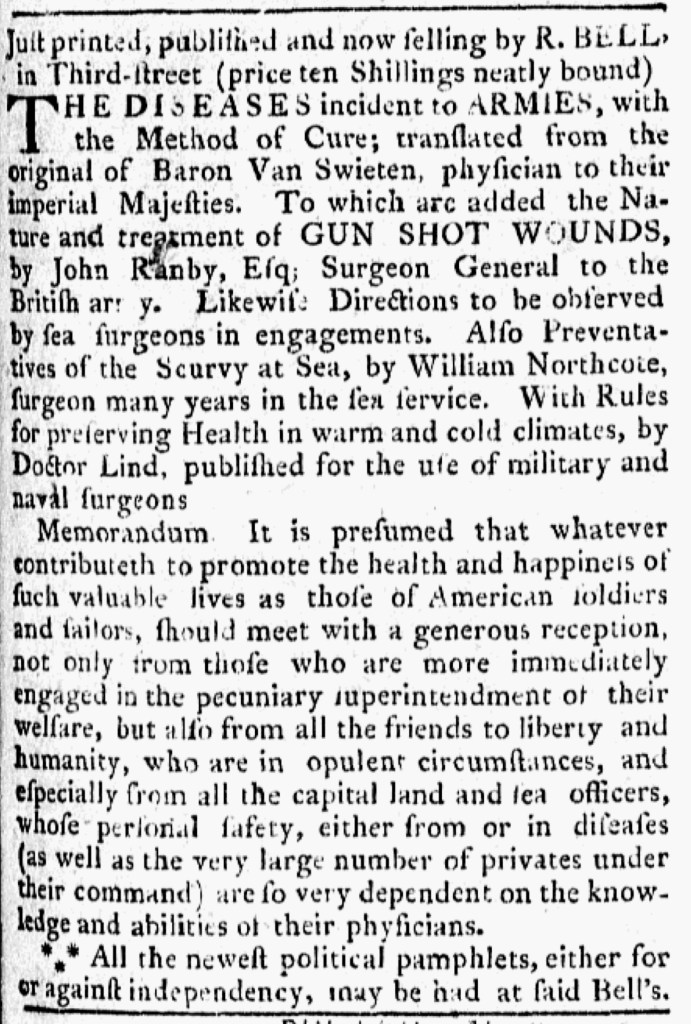
“All the newest political pamphlets, either for or against independency, may be had at said Bell’s.”
Robert Bell, one of the most prominent American printers and booksellers of the second half of the eighteenth century, advertised his publications widely. In the spring of 1776, he ran an advertisement that announced, “Just printed, published and now selling … THE DISEASES incident to ARMIES” and other medical treatises compiled in a single volume “for the use of military and naval surgeons. He deployed identical copy in the Pennsylvania Evening Post and the Pennsylvania Ledger, stating that the volume would “contributeth to promote the health and happiness of such valuable lives as those of American soldiers and sailors.” The savvy publisher sought to convince “land and sea officers,” in particular, and “all the friends of liberty and humanity,” in general, that they should endorse the publication and perhaps even purchase copies to supply to “military and naval surgeons” who treated American soldiers and sailors.
Despite such marketing appeals, Bell did not take a position on whether the colonies should declare independence, at least not in the works he selected to print, advertise, and sell. He concluded his advertisement with at noted that “All the newest political pamphlets, either for or against independency, may be had at said Bell’s.” Other printers and booksellers had pursued a similar course, though not as recently. James Humphreys, Jr., the printer of the Pennsylvania Ledger, advertised “POLITICAL PAMPHLETS, ON Both Sides of the Question” a month after the battles at Lexington and Concord. James Rivington listed political pamphlets that took opposing positions, some of them written in direct response to others, in advertisements with headlines like “THE AMERICAN CONTEST” and “The American Controversy” before the Sons of Liberty attacked his office, destroyed his press, and forced him to discontinue publishing Rivington’s New-York Gazetteer. More than a year into the war, Bell was the only printer who promoted pamphlets “for or against independency” in his advertisements. Other printers and booksellers likely stocked and sold some of those pamphlets, but they did not call attention to it as boldly as Bell did.
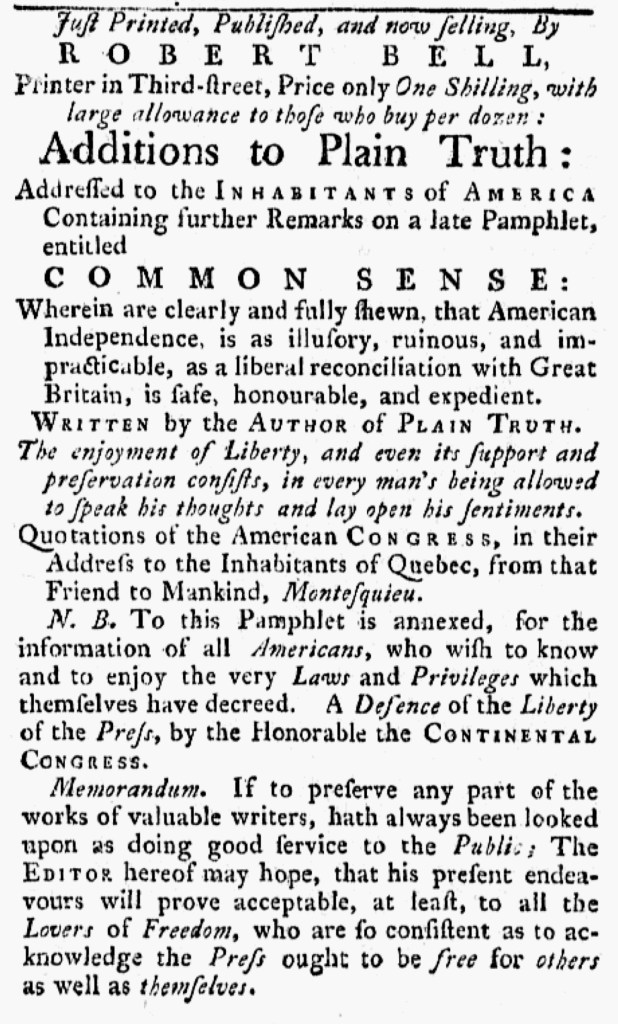
Indeed, an advertisement for the second edition of Plain Truth appeared immediately below Bell’s advertisement for the medical manual in the May 11 edition of the Pennsylvania Ledger. That pamphlet “contain[ed] remarks on … COMMON SENSE; Wherein are shewn that the Scheme of Independence is ruinous, delusive and impracticable.” In another advertisement in the same issue, Bell advertised “Additions to Plain Truth.” In both advertisements, he made an appeal for freedom of the press to justify publishing and selling “political pamphlets, either for or against independency.” A nota bene at the end of the first advertisement declared, “To this pamphlet is subjoined a Defence of the Liberty of the Press, by the sagacious and patriotic Junius.” The other pamphlet, according to the second advertisement, included a similar supplementary work. “To this Pamphlet is annexed, for the information of all Americans, who wish to know and to enjoy the very Laws and Privileges which themselves have decreed,” a nota bene announced, “A Defence of the Liberty of the Press, by the Honorable the CONTINENTAL CONGRESS.” If that did not provide sufficient cover, Bell also opined, “The enjoyment of Liberty, and even its support and preservation consists, in every man’s being allowed to speak his thoughts and lay open his sentiments.” Bell had also published the first edition of Thomas Paine’s Common Sense, demonstrating that his press did disseminate diverse political views.
The advertisement concluded with a “Memorandum,” perhaps penned by Bell or possibly inserted by Humphreys, a loyalist printer known for charting a more moderate course than fellow printers in Philadelphia. “If to preserve any part of the works of valuable writers, hath been looked upon as doing good service to the Public,” the memorandum explained, “The EDITOR hereof may hope, this his present endeavours will prove acceptable, at least to all the Loversof Freedom.” Leveraging the principles that those “Lovers of Freedom” embraced and enunciated, the memorandum insisted that they must be “so consistent as to acknowledge the Press ought to be free for others as well as themselves.” They could not have it both ways and still claim to be “Lovers of Freedom.” Rivington had made similar arguments. Bell and Humphreys hoped for more success in doing so, encouraging greater consistency in their views about “Libertyof the Press” from those who did not like everything that they printed or sold.