January 19

What was advertised in a colonial American newspaper 250 years ago today?

South-Carolina Gazette and Country Journal (January 19, 1773).

“WILLIAM BOWER … continues to carry on the CLOCK and WATCH-MAKING BUSINESS.”

“KATHARINE BOWER … carries on the MILLINARY BUSINESS.”

When clock- and watch-maker William Bower moved to a new location, he placed an advertisement in the January 19, 1773, edition of the South-Carolina Gazette and Country Journal to inform current and prospective customers.  Now located “next door to The Great Stationary and Book Store,” he continued to offer the same services “as cheap and expeditiously done, as by any [other clock- and watchmaker] in the province.”  Katharine Bower, a milliner, also advised the public that she moved to a new location “where she carries on the MILLINARY BUSINESS in all its branches, and will be much obliged to her friends for a continuance of their favours.”  William and Katharine, presumably husband and wife, but possibly otherwise related, now ran businesses from the same location at “the store the fourth corner of Tradd-street and the Bay, lately possessed by Messrs. Mackenzie & Tunno.”  Previously, William had a workshop on Broad Street, while Katharine kept shop on Church Street.

In addition to sharing a store at the corner of Tradd Street and the Bay, William and Katharine also advertised together, purchasing a “square” of space in one of the local newspapers.  Husbands and wives (and other male and female relatives) who pursued separate occupations sometimes did so, especially in newspapers published in Charleston.  Those advertisements tended to adhere to certain patterns.  The husband or other male relative usually appeared first, followed by his wife or other female relative.  In some instances, the female entrepreneur appeared only in a brief note at the end of the advertisement.  In this case, however, both William and Katharine had headlines in larger fonts that made their names visible to readers.  William had a secondary headline that gave his occupation, “CLOCK and WATCH MAKER,” while Katharine did not.  Even when female entrepreneurs were not relegated to a short note, the amount of space devoted to promoting the husband’s business usually exceeded that amount of space for the wife’s business.  At a glance, that looked like the case in the Bowers’ advertisement.  However, much of the additional space in William’s portion of the notice gave extensive directions to the new shop, directions that Katharine did not need to repeat.  Katharine did not make as elaborate appeals about price and customer service as William, but she did encourage existing customers to visit her at her new location.

The Bowers pooled their resources to insert an advertisement in the South-Carolina Gazette and Country Journal.  Their notice gave preference to William by listing his business first and including a secondary headline that listed his occupation, but this did not overshadow Katharine’s enterprise as much as some other advertisements placed jointly by men and women.  Katharine’s name appeared as a headline in the same size font as William’s name and, aside from the directions to the new location, the details about her business occupied a similar amount of space.  In general, the notice communicated that both William and Katharine were competent entrepreneurs responsible for their own participation in the marketplace.

Happy Birthday, Isaiah Thomas!

Isaiah Thomas, patriot printer and founder of the American Antiquarian Society, was born on January 19 (New Style) in 1749 (or January 8, 1748/49, Old Style).  It’s quite an historical coincidence that the three most significant printers in eighteenth-century America — Benjamin Franklin, Isaiah Thomas, and Mathew Carey — were all born in January.

isaiah_thomas1818
Isaiah Thomas (January 30, 1739 – April 4, 1831). American Antiquarian Society.

The Adverts 250 Project is possible in large part due to Thomas’s efforts to collect as much early American printed material as he could, originally to write his monumental History of Printing in America.  The newspapers, broadsides, books, almanacs, pamphlets, and other items he gathered in the process eventually became the initial collections of the American Antiquarian Society.  That institution’s ongoing mission to acquire at least one copy of every American imprint through 1876 has yielded an impressive collection of eighteenth-century advertising materials, including newspapers, magazine wrappers, trade cards, billheads, watch papers, book catalogs, subscription notices, broadsides, and a variety of other items.  Exploring the history of advertising in early America — indeed, exploring any topic related to the history, culture, and literature of early America at all — has been facilitated for more than two centuries by the vision of Isaiah Thomas and the dedication of the curators and other specialists at the American Antiquarian Society over the years.

Thomas’s connections to early American advertising were not limited to collecting and preserving the items created on American presses during the colonial, Revolutionary, and early national periods.  Like Mathew Carey, he was at the hub of a network he cultivated for distributing newspapers, books, and other printed goods — including advertising to stimulate demand for those items.  Sometimes this advertising was intended for dissemination to the general public (such as book catalogs and subscription notices), but other times it amounted to trade advertising (such as circular letters and exchange catalogs intended only for fellow printers, publishers, and booksellers).

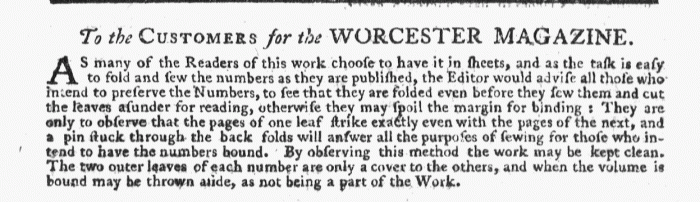
Thomas also experimented with advertising on wrappers that accompanied his Worcester Magazine, though he acknowledged to subscribers that these wrappers were ancillary to the publication:  “The two outer leaves of each number are only a cover to the others, and when the volume is bound may be thrown aside, as not being a part of the Work.”[1]

jan-30-worcerster-magazine-april-1786
Detail of Advertising Wrapper, Worcester Magazine (Second Week of April, 1786).

Thomas’s patriotic commitment to freedom of the press played a significant role in his decision to develop advertising wrappers.  As Thomas relays in his History of Printing in America, he discontinued printing his newspaper, the Massachusetts Spy, after the state legislature passed a law that “laid a duty of two-thirds of a penny on newspapers, and a penny on almanacs, which were to be stamped.”  Such a move met with strong protest since it was too reminiscent of the Stamp Act imposed by the British two decades earlier, prompting the legislature to repeal it before it went into effect.  On its heels, however, “another act was passed, which imposed a duty on all advertisements inserted in the newspapers” printed in Massachusetts.  Thomas vehemently rejected this law as “an improper restraint on the press. He, therefore, discontinued the Spy during the period that this act was in force, which was two years. But he published as a substitute a periodical work, entitled ‘The Worcester Weekly Magazine,’ in octavo.”[2] This weekly magazine lasted for two years; Thomas discontinued it and once again began printing the Spy after the legislature repealed the objectionable act.

jan-30-advertising-wrapper-worcester-magazine-4th-week-may-1786
Third Page of Advertising Wrapper, Worcester Magazine (Fourth Week of May, 1786).

Isaiah Thomas was not interested in advertising for its own sake to the same extent as Mathew Carey, but his political concerns did help to shape the landscape of early American advertising.  Furthermore, his vision for collecting American printed material preserved a variety of advertising media for later generations to admire, analyze, ponder, and enjoy.  Happy 274th birthday, Isaiah Thomas!

**********

[1] Isaiah Thomas, “To the CUSTOMERS for the WORCESTER MAGAZINE,” Worcester Magazine, wrapper, second week of April, 1786.

[2] Isaiah Thomas, The History of Printing in America: With a Biography of Printers, and an Account of Newspapers, vol. 2 (Worcester, MA: Isaac Sturtevant, 1810), 267-268.

Slavery Advertisements Published January 19, 1773

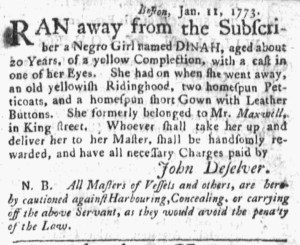
The Slavery Adverts 250 Project chronicles the role of newspaper advertising in perpetuating slavery in the era of the American Revolution. The project seeks to reveal the ubiquity of slavery in eighteenth-century life from New England to Georgia by republishing advertisements about enslaved people – for sale as individuals or in groups, wanted to purchase or for hire for short periods, runaways who liberated themselves, and those who were subsequently captured and confined in jails and workhouses – in daily digests on this site as well as in real time via the @SlaveAdverts250 Twitter feed, utilizing twenty-first-century media to stand in for the print media of the eighteenth century.

The project aims to provide modern audiences with a sense of just how often colonizers encountered these advertisements in their daily lives. Enslaved men, women, and children appeared in print somewhere in the colonies almost every single day. Those advertisements served as a constant backdrop for social, cultural, economic, and political life in colonial and revolutionary America. Colonizers who did not purport to own enslaved people were still confronted with slavery as well as invited to maintain the system by purchasing enslaved men, women, and children or assisting in the capture of so-called “runaways” who sought to free themselves from bondage. The frequency of these newspaper advertisements suggests just how embedded slavery was in colonial and revolutionary American culture in everyday interactions beyond the printed page.

These advertisements also testify to the experiences of enslaved men, women, and children, though readers must consider that those experiences have been remediated through descriptions offered by enslavers rather than enslaved people themselves. Often unnamed in the advertisements, enslaved men, women, and children were not invisible or unimportant in early America.

These advertisements appeared in colonial American newspapers 250 years ago today.

Essex Gazette (January 19, 1773).

**********

South-Carolina Gazette and Country Journal (January 19, 1773).

**********

South-Carolina Gazette and Country Journal (January 19, 1773).

**********

South-Carolina Gazette and Country Journal (January 19, 1773).

**********

South-Carolina Gazette and Country Journal (January 19, 1773).

**********

South-Carolina Gazette and Country Journal (January 19, 1773).

**********

South-Carolina Gazette and Country Journal (January 19, 1773).

January 18

What was advertised in a colonial American newspaper 250 years ago today?

Pennsylvania Packet (January 18, 1773).

“AN ADDRESS TO THE INHABITANTS OF THE BRITISH SETTLEMENTS IN AMERICA, UPON SLAVE-KEEPING.”

In January 1773, John Dunlap, printer of the Pennsylvania Packet, announced that An Address to the Inhabitants of the British Settlements in America, upon Slave-Keeping, a work attributed to Benjamin Rush, was “Just published” and available for sale.  Dunlap leveraged his access to the press to give the announcement special prominence in his newspaper, treating it as an editorial rather than an advertisement.

Consider how Dunlap organized the contents of the January 18, 1773, edition of the Pennsylvania Packet and the supplement that accompanied it.  In the standard issue, news items and editorials appeared on the first two pages, followed by advertising on the last two pages.  Similarly, the two-page supplement began with two columns of news and the remainder of the content consisted of advertising.  Dunlap’s announcement masqueraded as an editorial that ran in the first column of the second page and overflowed into the next column, followed by news from London, Newport, New York, and Philadelphia.  The printer inserted an excerpt from the pamphlet, hoping to entice readers to want more and purchase their own copies.  In giving prospective customers an overview of the essay, Dunlap noted that the “Author of the above Address after having showed the inconsistency of Slave-keeping with the principles of humanity – justice – good policy and religion; concludes as follows.”  After reading that conclusion, prospective customers could acquire the pamphlet and examine the various arguments about humanity, justice, good policy, and religion for themselves.  In treating this announcement as an editorial or news item, Dunlap adopted a strategy sometimes deployed by other printers to promote books and pamphlets they published.

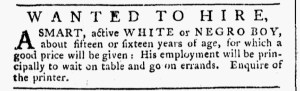
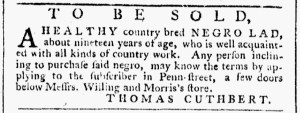
Whatever the conclusions reached in the Address … upon Slave-Keeping, Dunlap apparently did not find them sufficiently convincing to alter his policies concerning the kinds of advertising that he printed in the Pennsylvania Packet.  Two advertisements about enslaved people appeared on the facing page, one offering a “HEALTHY country bred NEGRO LAD” for sale and the other seeking to hire a “SMART, active WHITE or NEGRO BOY … to wait on table and go on errands.”  Candidates for that position included enslaved youths who did the work while their enslavers received the wages.  An advertisement in the supplement described a “Negro Fellow named LONDON” who liberated himself by running away from his enslaver in Baltimore and offered a reward for his capture and return.  Even as Dunlap treated the conclusion of the Address … upon Slave-Keeping as an editorial intended to arouse interest in a pamphlet he sold, he generated revenue by printing and disseminating advertisements that perpetuated slavery.

Slavery Advertisements Published January 18, 1773

The Slavery Adverts 250 Project chronicles the role of newspaper advertising in perpetuating slavery in the era of the American Revolution. The project seeks to reveal the ubiquity of slavery in eighteenth-century life from New England to Georgia by republishing advertisements about enslaved people – for sale as individuals or in groups, wanted to purchase or for hire for short periods, runaways who liberated themselves, and those who were subsequently captured and confined in jails and workhouses – in daily digests on this site as well as in real time via the @SlaveAdverts250 Twitter feed, utilizing twenty-first-century media to stand in for the print media of the eighteenth century.

The project aims to provide modern audiences with a sense of just how often colonizers encountered these advertisements in their daily lives. Enslaved men, women, and children appeared in print somewhere in the colonies almost every single day. Those advertisements served as a constant backdrop for social, cultural, economic, and political life in colonial and revolutionary America. Colonizers who did not purport to own enslaved people were still confronted with slavery as well as invited to maintain the system by purchasing enslaved men, women, and children or assisting in the capture of so-called “runaways” who sought to free themselves from bondage. The frequency of these newspaper advertisements suggests just how embedded slavery was in colonial and revolutionary American culture in everyday interactions beyond the printed page.

These advertisements also testify to the experiences of enslaved men, women, and children, though readers must consider that those experiences have been remediated through descriptions offered by enslavers rather than enslaved people themselves. Often unnamed in the advertisements, enslaved men, women, and children were not invisible or unimportant in early America.

These advertisements appeared in colonial American newspapers 250 years ago today.

Boston Evening-Post (January 18, 1773).

**********

Boston Evening-Post (January 18, 1773).

**********

Boston Evening-Post (January 18, 1773).

**********

Boston-Gazette (January 18, 1773).

**********

Boston-Gazette (January 18, 1773).

**********

Boston-Gazette (January 18, 1773).

**********

Boston-Gazette (January 18, 1773).

**********

Massachusetts Gazette and Boston Post-Boy (January 18, 1773).

**********

Newport Mercury (January 18, 1773).

**********

New-York Gazette and Weekly Mercury (January 18, 1773).

**********

New-York Gazette and Weekly Mercury (January 18, 1773).

**********

New-York Gazette and Weekly Mercury (January 18, 1773).

**********

New-York Gazette and Weekly Mercury (January 18, 1773).

**********

New-York Gazette and Weekly Mercury (January 18, 1773).

**********

New-York Gazette and Weekly Mercury (January 18, 1773).

**********

Pennsylvania Packet (January 18, 1773).

**********

Pennsylvania Packet (January 18, 1773).

**********

Supplement to the Pennsylvania Packet (January 18, 1773).

January 17

What was advertised in a colonial American newspaper 250 years ago this week?

Virginia Gazette [Purdie and Dixon] (January 14, 1773).
“ADVERTISEMENTS coming to this Office from any other those with whom we have Accounts, unless the NEEDFUL accompanies them, will be paid no Regard to.”

In the second edition of the Virginia Gazette published in 1773, Alexander Purdie and John Dixon, the printers, inserted a notice addressed to “CUSTOMERS who have never paid a Farthing since the Commencement of our Partnership (very near Seven Years).”  They made the usual sorts of threats that printers throughout the colonies made when they found themselves in similar situations.  They vowed not to deliver any more newspapers to those recalcitrant subscribers.  In addition, those who did not settle accounts “before the ensuing April General Court” could expect that they “will be put in the Hands of an Attorney to bring Suit.”  Other customers had also neglected to pay their bills, including some who “have owed us a great Deal too long for BOOKS and STATIONARY.”  They would receive “the same Treatment, if they do not pay in a very short Time.”

The printers did not mention whether they previously extended credit to advertisers who also neglected to make payments.  Many printers required advertisers to pay in advance, but not all did so.  A note that Purdie and Dixon added at the end of their notice indicated that, no matter their policy in the past, certain advertisers had to submit payment along with any advertising copy directed to the printers.  “ADVERTISEMENTS coming to this Office from any other those with whom we have Accounts,” the printers advised, “unless the NEEDFUL accompanies them, will be paid no Regard to.”  In other words, prospective advertisers had to send payment or else Purdie and Dixon would not print their notices.  The colophon specified that advertisements “of a moderate Length” cost three shilling for the first week, covering the cost of setting type as well as the amount of space they occupied, and another two shillings for each additional insertion.  Given that subscriptions cost twelve shillings and six pence per year, Purdie and Dixon may have been able to wait seven years for some subscribers to pay their bills because they collected payment for most advertisements before publishing them.  In such an instance, advertising accounted for a more significant revenue stream than subscriptions.

Happy Birthday, Benjamin Franklin!

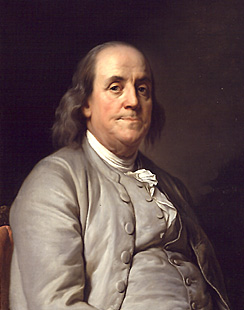
Today is an important day for specialists in early American print culture, for Benjamin Franklin was born on January 17, 1706 (January 6, 1705, Old Style), in Boston. Among his many other accomplishments, Franklin is known as the “Father of American Advertising.” Although I have argued elsewhere that this title should more accurately be bestowed upon Mathew Carey (in my view more prolific and innovative in the realm of advertising as a printer, publisher, and advocate of marketing), I recognize that Franklin deserves credit as well. Franklin is often known as “The First American,” so it not surprising that others should rank him first among the founders of advertising in America.

benjamin-franklin
Benjamin Franklin (Joseph Siffred Duplessis, ca. 1785).  National Portrait Gallery.

Franklin purchased the Pennsylvania Gazette in 1729. In the wake of becoming printer, he experimented with the visual layout of advertisements that appeared in the weekly newspaper, incorporating significantly more white space and varying font sizes in order to better attract readers’ and potential customers’ attention. Advertising flourished in the Pennsylvania Gazette, which expanded from two to four pages in part to accommodate the greater number of commercial notices.

jan-17-pennsylvania-gazette-19-161736
Advertisements with white space, varying sizes of font, capitals and italics, and a woodcut from Benjamin Franklin’s Pennsylvania Gazette (December 9-16, 1736).

Many historians of the press and print culture in early America have noted that Franklin became wealthy and retired as a printer in favor of a multitude of other pursuits in part because of the revenue he collected from advertising. Others, especially David Waldstreicher, have underscored that this wealth was amassed through participation in the colonial slave trade. The advertisements for goods and services featured in the Pennsylvania Gazette included announcements about buying and selling enslaved men, women, and children as well as notices offering rewards for those who escaped from bondage.

jan-17-pennsylvania-gazette-slave-19-161736
Advertisement for an enslaved woman and an enslaved child from Benjamin Franklin’s Pennsylvania Gazette (December 9-16, 1736).

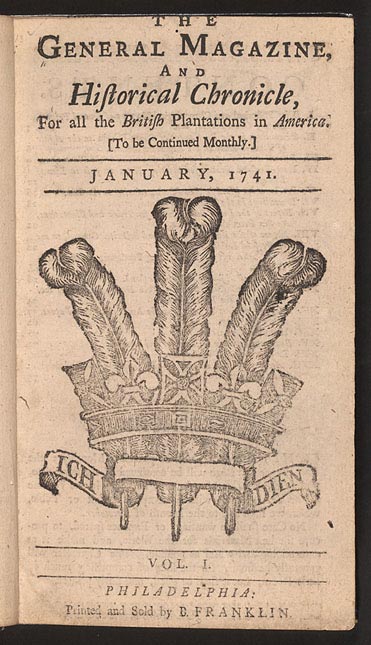
In 1741 Franklin published one of colonial America’s first magazines, The General Magazine and Historical Chronicle, for all the British Plantations in America (which barely missed out on being the first American magazine, a distinction earned by Franklin’s competitor, Andrew Bradford, with The American Magazine or Monthly View of the Political State of the British Colonies). The magazine lasted only a handful of issues, but that was sufficient for Franklin to become the first American printer to include an advertisement in a magazine (though advertising did not become a standard part of magazine publication until special advertising wrappers were developed later in the century — and Mathew Carey was unarguably the master of that medium).

general-magazine
General Magazine and Historical Chronicle, For all the British Plantations in America (January 1741).  Library of Congress.

In 1744 Franklin published an octavo-sized Catalogue of Choice and Valuable Books, including 445 entries. This is the first known American book catalogue aimed at consumers (though the Library Company of Philadelphia previously published catalogs listing their holdings in 1733, 1735, and 1741). Later that same year, Franklin printed a Catalogue of Books to Be Sold at Auction.

Franklin pursued advertising through many media in eighteenth-century America, earning recognition as one of the founders of American advertising. Happy 317th birthday, Benjamin Franklin!

January 16

What was advertised in a colonial American newspaper 250 years ago today?

Pennsylvania Chronicle (January 16, 1773).

“By limiting the number of his pupils … he has a singular advantage.”

Samuel Blair ran a boarding school for boys in Philadelphia in the early 1770s.  In an advertisement in the January 16, 1773, edition of the Pennsylvania Chronicle, the schoolmaster announced that he had openings for two pupils and promoted the benefits of learning in such an exclusive setting.  He explained that for the “special benefit” of his students, he limited enrollment to only twelve boys.  He advertised “whenever a vacancy occurs,” alerting parents who “choose … to have [their sons] instructed in a private family rather than a public school.”

Blair briefly outlined his curriculum, but devoted most of his advertisement to the virtues of a residential setting for a small number of students.  The course of study included “the Latin and Greek Languages, Geography, Arithmetic, and all the most useful practical branches of the Mathematics” as well as “the arts of reading, writing, spelling, and speaking English with elegance and propriety.”  His school, he suggested, produced genteel young men.

Their comportment, not just the skills they acquired and the subjects they mastered, made them genteel.  Blair asserted that “limiting the number of his pupils” allowed him to “devot[e] himself wholly to the care of their education,” including “constant intercourse and conversations with them as members of his family.”  That represented a “singular advantage” for his students compared to the attention they received from other schoolmasters.  In addition to “bringing [his pupils] on in these studies and exercises with expedition and accuracy … in such a way as shall render them most easy and agreeable to their young and impatient minds,” Blair declared that he instituted a gentle system of discipline that formed young men of character.  In the course of spending time with his students in and beyond the classroom, he took responsibility “for correcting and forming their tempers, for inspecting and regulating their general deportment, and for governing them by the milder and more successful means of argument and persuasion.”  The schoolmaster did not deploy harsh methods of correction.  Instead, he treated his students as members of an extended family.

Blair did not rely on exclusivity alone to generate interest in his boarding school.  To attract interest from the parents of prospective pupils, he described the benefits of that exclusivity.  His students not only received an education but also an upbringing that transformed them into genteel young men.  When they entrusted their sons to his care, parents could depend on them learning a variety of subjects, both practical and refined, under the watchful eye of a schoolmaster who kept order and instilled good manners without resorting to draconian means.  Blair believed that his program presented a “singular advantage” for his students … and aimed to convince parents of prospective pupils that was indeed the case.

January 15

What was advertised in a colonial American newspaper 250 years ago today?

New-Hampshire Gazette (January 15, 1773).

“He has set up a STAGE between this Town and Boston.”

As the new year arrived, Theodore Davis launched a new enterprise, informing the public that he established stage service between Portsmouth and Boston.  He first advertised in the New-Hampshire Gazette on December 25, 1772, and then continued placing notices in January 1773.  He had at least one competitor.  John Stavers had been operating a stage along that route for more than a decade, sometimes in partnership with others.

Realizing that he was a newcomer on the scene, Davis advised prospective passengers that he “served his Apprenticeship in the Business,” though he did not give more details.  Perhaps he had previously worked on a route that connected other towns or perhaps he had been involved with one of the competitors that periodically challenged Stavers or perhaps he had even worked with Stavers and now challenged him for business.  Whatever his background, Davis claimed that he was “well acquainted with the best Houses of Entertainment” and other amenities on the route between Portsmouth and Boston.  His advertisement suggested that some prospective clients did know him from one of the stages that plied that route; he requested “the Continuance of their Favours, as he now sets out on his own Account.”

New-Hampshire Gazette (January 15, 1773).

One aspect of Davis’s service certainly distinguished it from the stage operated by Stavers.  Davis departed on Mondays, a day before Stavers made the journey.  When Stavers answered Davis’s advertisement with a notice of his own in the January 15, 1773, edition of the New-Hampshire Gazette, he expressed some exasperation with that ploy.  As he had done on other occasions, he underscored that he established the first route between Portsmouth and Boston, declaring himself “the first Promoter of a Stage Coach in this Province.”  Accordingly, he felt a sense of entitlement, this time adding that “the Public will think he ought to have the Preference, and not countenance others in taking Passengers the beginning of the Week.”  Besides, he lamented, he had a history of accommodating his passengers and “has always been ready to serve them on Monday, as well as Tuesdays, if their Business required it.”  To make that possible, Stavers “expended a large sum of Money.”  The veteran stage operator did more than emphasize his long experience.  He attempted to leverage a sense of obligation on the part of prospective passengers.

That may have been an effective strategy for Stavers, at least in the past.  After all, other competitors had not managed to put him out of business.  Still, he believed that Davis’s new service infringed on a clientele that rightfully should have belonged to him and could have an impact on his livelihood.  He called on his “old Customers and others” to engage his services rather than choosing an upstart who was relatively new to route connecting Portsmouth and Boston.

Slavery Advertisements Published January 15, 1773

The Slavery Adverts 250 Project chronicles the role of newspaper advertising in perpetuating slavery in the era of the American Revolution. The project seeks to reveal the ubiquity of slavery in eighteenth-century life from New England to Georgia by republishing advertisements about enslaved people – for sale as individuals or in groups, wanted to purchase or for hire for short periods, runaways who liberated themselves, and those who were subsequently captured and confined in jails and workhouses – in daily digests on this site as well as in real time via the @SlaveAdverts250 Twitter feed, utilizing twenty-first-century media to stand in for the print media of the eighteenth century.

The project aims to provide modern audiences with a sense of just how often colonizers encountered these advertisements in their daily lives. Enslaved men, women, and children appeared in print somewhere in the colonies almost every single day. Those advertisements served as a constant backdrop for social, cultural, economic, and political life in colonial and revolutionary America. Colonizers who did not purport to own enslaved people were still confronted with slavery as well as invited to maintain the system by purchasing enslaved men, women, and children or assisting in the capture of so-called “runaways” who sought to free themselves from bondage. The frequency of these newspaper advertisements suggests just how embedded slavery was in colonial and revolutionary American culture in everyday interactions beyond the printed page.

These advertisements also testify to the experiences of enslaved men, women, and children, though readers must consider that those experiences have been remediated through descriptions offered by enslavers rather than enslaved people themselves. Often unnamed in the advertisements, enslaved men, women, and children were not invisible or unimportant in early America.

These advertisements appeared in colonial American newspapers 250 years ago today.

New-London Gazette (January 15, 1772).