January 14

What was advertised in a colonial American newspaper 250 years ago today?

Massachusetts Spy (January 14, 1773).

“AN ORATION on the Beauties of Liberty.”

An advertisement in the January 14, 1773, editions of the Massachusetts Gazette and Boston Weekly News-Letter and the Massachusetts Spy announced the imminent publication and sale of a political pamphlet about “the Beauties of Liberty or the essential rights of the Americans.”  David Kneeland and Nathaniel Davis advised that the work was “Now in the press” and would be available in a few days.  The printers also noted that the pamphlet was “AN ORATION … Delivered at the second Baptist-Church in Boston, upon the last annual thanksgiving.”

Kneeland and Davis did not name the orator-author, perhaps expecting that many prospective customers already knew his identity as a result of having heard the sermon on liberty or heard about it from friends and acquaintances.  The title page attributed the Oration on the Beauties of Liberty to “A British Bostonian.”  The same author composed The American Alarm, published and advertised a few weeks earlier.  John M. Bumsted and Charles E. Clark identify both pamphlets as the work of John Allen, “a Baptist minister and recent émigré from England, politically disenchanted and personally discredited” for an incident involving a forged promissory note.[1]

According to Bumsted and Clark, the second of those pamphlets, the Oration, “proved to be one of the best-selling pamphlets of the pre-Revolutionary crisis, passing through seven editions in four cities between 1773 and 1775” and the “immense popularity of this fiery attack on British policy – specifically the appointment of the Commissioners of Inquiry into the burning of the Gaspee – marked the author as an agitator of considerable importance.”[2]  Advertising may have contributed to the popularity of the pamphlet, especially if Kneeland and Davis carefully chose which newspapers carried their notice.  Isaiah Thomas, the printer of the Massachusetts Spy, had a reputation as an agitator.  Benjamin Edes and John Gill, printers of the Boston-Gazette did as well.  Following the initial announcement about the pamphlet on January 14, Kneeland and Davis placed an advertisement in the Boston-Gazette on January 18, but opted not to insert notices in the other two newspapers published in the city that day, the Boston Evening-Post and the Massachusetts Gazette and Boston Post-Boy.  Their conceptions of the political sympathies of both the printers and readers of those newspapers may have played a role in selecting where to invest their limited funds for advertising.

**********

[1] John M. Bumsted and Charles E. Clark, “New England’s Tom Paine: John Allen and the Spirit of Liberty,” William and Mary Quarterly, 3rd ser., 21, no. 4 (October 1964): 562.

[2] Bumsted and Clark, “New England’s Tom Paine,” 561.
Slavery Advertisements Published January 14, 1773

The Slavery Adverts 250 Project chronicles the role of newspaper advertising in perpetuating slavery in the era of the American Revolution. The project seeks to reveal the ubiquity of slavery in eighteenth-century life from New England to Georgia by republishing advertisements about enslaved people – for sale as individuals or in groups, wanted to purchase or for hire for short periods, runaways who liberated themselves, and those who were subsequently captured and confined in jails and workhouses – in daily digests on this site as well as in real time via the @SlaveAdverts250 Twitter feed, utilizing twenty-first-century media to stand in for the print media of the eighteenth century.

The project aims to provide modern audiences with a sense of just how often colonizers encountered these advertisements in their daily lives. Enslaved men, women, and children appeared in print somewhere in the colonies almost every single day. Those advertisements served as a constant backdrop for social, cultural, economic, and political life in colonial and revolutionary America. Colonizers who did not purport to own enslaved people were still confronted with slavery as well as invited to maintain the system by purchasing enslaved men, women, and children or assisting in the capture of so-called “runaways” who sought to free themselves from bondage. The frequency of these newspaper advertisements suggests just how embedded slavery was in colonial and revolutionary American culture in everyday interactions beyond the printed page.

These advertisements also testify to the experiences of enslaved men, women, and children, though readers must consider that those experiences have been remediated through descriptions offered by enslavers rather than enslaved people themselves. Often unnamed in the advertisements, enslaved men, women, and children were not invisible or unimportant in early America.

These advertisements appeared in colonial American newspapers 250 years ago today.

Maryland Gazette (January 14, 1773).

**********

Massachusetts Gazette and Boston Weekly News-Letter (January 14, 1773).

**********

Massachusetts Gazette and Boston Weekly News-Letter (January 14, 1773).

**********

Massachusetts Gazette and Boston Weekly News-Letter (January 14, 1773).

**********

Massachusetts Gazette and Boston Weekly News-Letter (January 14, 1773).

**********

New-York Journal (January 14, 1773).

**********

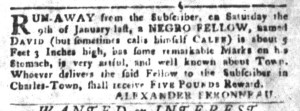
South-Carolina Gazette (January 14, 1773).

**********

South-Carolina Gazette (January 14, 1773).

**********

South-Carolina Gazette (January 14, 1773).

**********

South-Carolina Gazette (January 14, 1773).

**********

South-Carolina Gazette (January 14, 1773).

**********

South-Carolina Gazette (January 14, 1773).

**********

South-Carolina Gazette (January 14, 1773).

**********

South-Carolina Gazette (January 14, 1773).

**********

South-Carolina Gazette (January 14, 1773).

**********

South-Carolina Gazette (January 14, 1773).

**********

South-Carolina Gazette (January 14, 1773).

**********

Supplement to the South-Carolina Gazette (January 14, 1773).

**********

Virginia Gazette [Purdie and Dixon] (January 14, 1773).

**********

Virginia Gazette [Purdie and Dixon] (January 14, 1773).

**********

Virginia Gazette [Purdie and Dixon] (January 14, 1773).

**********

Virginia Gazette [Purdie and Dixon] (January 14, 1773).

**********

Virginia Gazette [Purdie and Dixon] (January 14, 1773).

**********

Virginia Gazette [Purdie and Dixon] (January 14, 1773).

**********

Virginia Gazette [Purdie and Dixon] (January 14, 1773).

**********

Virginia Gazette [Purdie and Dixon] (January 14, 1773).

**********

Virginia Gazette [Purdie and Dixon] (January 14, 1773).

**********

Virginia Gazette [Purdie and Dixon] (January 14, 1773).

**********

Virginia Gazette [Rind] (January 14, 1773).

**********

Virginia Gazette [Rind] (January 14, 1773).

**********

Virginia Gazette [Rind] (January 14, 1773).

**********

Virginia Gazette [Rind] (January 14, 1773).

**********

Virginia Gazette [Rind] (January 14, 1773).

**********

Virginia Gazette [Rind] (January 14, 1773).

January 13

What was advertised in a colonial American newspaper 250 years ago today?

Pennsylvania Gazette (January 13, 1773).

“MASON AND PATTON … have purchased all the remaining stock of MASON and HARTLEY.”

Mason and Hartley sold dry goods in Philadelphia in the early 1770s.  When the partners went their separate ways, a new firm, Mason and Patton, positioned itself as the successor to Mason and Hartley in a newspaper advertisement that asked former customers to give them their business.  Though the new partners certainly wished to retain the patronage of the clientele that Mason and Hartley cultivated, they also had other purposes when they published their advertisement in the January 13, 1773, edition of the Pennsylvania Gazette.

Indeed, Mason and Patton commenced their notice by announcing that the “partnership of MASON and HARTLEY is now dissolved” and called on “all those indebted to the company, to make immediate payment, as their respective debts become due.”  The new partners asserted that they “are invested with the sole power to collect and settle their company books.”  In addition to customers with outstanding bills, Mason and Patton also requested that those “that have any demands against the said company … send in their accounts … for payment.”  Before promoting their new endeavor, Mason and Patton first attended to the responsible conclusion of the previous partnership.

In so doing, they used the same advertisement “to acquaint the public, that they have purchased all the remaining stock of MASON and HARTLEY, … which they will sell on the most reasonable terms.”  That inventory included a “compleat assortment of EUROPEAN and EAST-INDIA GOODS.”  The new partners retained the location formerly occupied by Mason and Hartley.  They hoped that the continuity in the merchandise and the location would prompt “the continuance of the customers of Mason and Hartley.”  To entice both former and prospective new customers, Mason and Patton proclaimed that they “intend to pursue the Dry Goods Business in a very extensive manner,” touting their “constant fresh supplies from Europe.”  Although they acquired the remaining stock of the former company, that did not mean that customers would select only among goods that lingered on the shelves.  Mason and Patton promised choices to consumers, both returning customers and “the public in general.”

Slavery Advertisements Published January 13, 1773

The Slavery Adverts 250 Project chronicles the role of newspaper advertising in perpetuating slavery in the era of the American Revolution. The project seeks to reveal the ubiquity of slavery in eighteenth-century life from New England to Georgia by republishing advertisements about enslaved people – for sale as individuals or in groups, wanted to purchase or for hire for short periods, runaways who liberated themselves, and those who were subsequently captured and confined in jails and workhouses – in daily digests on this site as well as in real time via the @SlaveAdverts250 Twitter feed, utilizing twenty-first-century media to stand in for the print media of the eighteenth century.

The project aims to provide modern audiences with a sense of just how often colonizers encountered these advertisements in their daily lives. Enslaved men, women, and children appeared in print somewhere in the colonies almost every single day. Those advertisements served as a constant backdrop for social, cultural, economic, and political life in colonial and revolutionary America. Colonizers who did not purport to own enslaved people were still confronted with slavery as well as invited to maintain the system by purchasing enslaved men, women, and children or assisting in the capture of so-called “runaways” who sought to free themselves from bondage. The frequency of these newspaper advertisements suggests just how embedded slavery was in colonial and revolutionary American culture in everyday interactions beyond the printed page.

These advertisements also testify to the experiences of enslaved men, women, and children, though readers must consider that those experiences have been remediated through descriptions offered by enslavers rather than enslaved people themselves. Often unnamed in the advertisements, enslaved men, women, and children were not invisible or unimportant in early America.

These advertisements appeared in colonial American newspapers 250 years ago today.

Pennsylvania Gazette (January 13, 1773).

**********

Pennsylvania Gazette (January 13, 1773).

January 12

What was advertised in a colonial American newspaper 250 years ago today?

South-Carolina Gazette and Country Journal (January 12, 1773).

“Their Customers may depend on being as well supplied by them as they could be by any House in this Province.”

Atkins and Weston informed readers of the South-Carolina Gazette and Country Journal that they carried a “great Variety of GOODS” imported from Glasgow as well as “GOODS from BRISTOL” and “two large Cargoes of Goods” from London.  Their inventory included a “large Supply of SILKS,” a “great Assortment of LINENS of all Sorts,” a “great Variety of flowered, striped, and plain MUSLINS,” a “large Supply of the most fashionable RIBBONS and VELVET COLLARS,” and a “good Assortment of well-chosen BED FURNITURE.”  Throughout their advertisement, Atkins and Weston underscored the array of choices that they made available to consumers.

To make sure that prospective customers did not overlook that fact, the merchants added a note that explained no other shop, store, or warehouse in the colony had a larger selection of merchandise than they did.  “Their late Importations have been very large, and their Assortments general,” Atkins and Weston asserted, adding that “they buy their Goods on the best Terms, and design constantly to keep up a large Stock.”  As a result, “their Customers may depend on being as well supplied by them as they could be by any House in this Province.”  Colonizers might browse elsewhere, but they would not encounter more choices anywhere else.

Other advertisers made similar pronouncements.  Hawkins, Petrie, and Company, for instance, declared that they “keep one of the largest assortments [of goods] in the province.”  Even entrepreneurs located in towns beyond Charleston highlighted the choices they offered and made provisions for keeping local customers supplied with the wares they wanted and needed.  John Tunno and Company in Jacksonburgh promoted a “complete assortment of GOODS” and listed a variety of items in their advertisement.  They pledged that “Should they be out of any article, they will always send to town for it by the first boat, without any extra charge to their friend here.”  Tunno and Company did not explicitly acknowledge that their inventory might not be as extensive as the shops in Charleston, though they presented a workaround in an effort to convince prospective customers that shopping with them would be just as fulfilling as if they were in the bustling urban port.

Advertisers regularly emphasized consumer choice in their newspaper advertisements during the era of the American Revolution.  Many did so by publishing long lists of merchandise.  Some, like Atkins and Westin, Hawkins, Petrie and Company, and Tunno and Company, added other appeals in their efforts to attract customers.  They declared that their inventory rivaled others in the colony or promised that they could quickly acquire whatever merchandise their patrons requested.

Slavery Advertisements Published January 12, 1773

The Slavery Adverts 250 Project chronicles the role of newspaper advertising in perpetuating slavery in the era of the American Revolution. The project seeks to reveal the ubiquity of slavery in eighteenth-century life from New England to Georgia by republishing advertisements about enslaved people – for sale as individuals or in groups, wanted to purchase or for hire for short periods, runaways who liberated themselves, and those who were subsequently captured and confined in jails and workhouses – in daily digests on this site as well as in real time via the @SlaveAdverts250 Twitter feed, utilizing twenty-first-century media to stand in for the print media of the eighteenth century.

The project aims to provide modern audiences with a sense of just how often colonizers encountered these advertisements in their daily lives. Enslaved men, women, and children appeared in print somewhere in the colonies almost every single day. Those advertisements served as a constant backdrop for social, cultural, economic, and political life in colonial and revolutionary America. Colonizers who did not purport to own enslaved people were still confronted with slavery as well as invited to maintain the system by purchasing enslaved men, women, and children or assisting in the capture of so-called “runaways” who sought to free themselves from bondage. The frequency of these newspaper advertisements suggests just how embedded slavery was in colonial and revolutionary American culture in everyday interactions beyond the printed page.

These advertisements also testify to the experiences of enslaved men, women, and children, though readers must consider that those experiences have been remediated through descriptions offered by enslavers rather than enslaved people themselves. Often unnamed in the advertisements, enslaved men, women, and children were not invisible or unimportant in early America.

These advertisements appeared in colonial American newspapers 250 years ago today.

Essex Gazette (January 12, 1773).

**********

South-Carolina Gazette and Country Journal (January 12, 1773).

**********

South-Carolina Gazette and Country Journal (January 12, 1773).

**********

South-Carolina Gazette and Country Journal (January 12, 1773).

**********

South-Carolina Gazette and Country Journal (January 12, 1773).

**********

Supplement to the South-Carolina Gazette and Country Journal (January 12, 1773).

**********

Supplement to the South-Carolina Gazette and Country Journal (January 12, 1773).

**********

Supplement to the South-Carolina Gazette and Country Journal (January 12, 1773).

**********

Supplement to the South-Carolina Gazette and Country Journal (January 12, 1773).

**********

Supplement to the South-Carolina Gazette and Country Journal (January 12, 1773).

**********

Supplement to the South-Carolina Gazette and Country Journal (January 12, 1773).

January 11

What was advertised in a colonial American newspaper 250 years ago today?

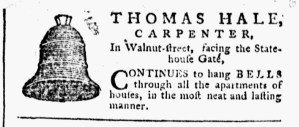
Pennsylvania Packet (January 11, 1773).

“THOMAS HALE … CONTINUES to hang BELLS.”

When Thomas Hale, a carpenter, arrived in Philadelphia from London in the late 1760s, he placed an advertisement in the Pennsylvania Chronicle to advise prospective customers that he “undertakers the Business of hanging Bells through all the Apartments of Houses.”  A woodcut depicting a bell adorned his advertisement.  Hale acknowledged that he was “a Stranger” in the city, but asserted that “any Person can be credibly assured of his Integrity.”

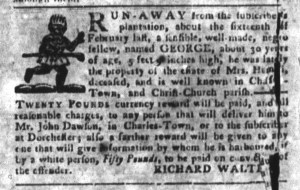
Hale was no longer “a Stranger” when he inserted a similar advertisement in the Pennsylvania Packet in January 1773.  He reminded readers that he “CONTINUES to hang BELLS through all the apartments of houses, in the most neat and lasting manner.”  He once again adorned his advertisement with an image of a bell, likely the same woodcut from his advertisement in 1767.  Hale sought a return on his initial investment in commissioning the woodcut, using it to draw attention to his notice.  Elsewhere in the January 11 edition of the Pennsylvania Packet, an image of a ship in the masthead was the only other image.  The bell certainly distinguished Hale’s advertisement from others.  The two-page supplement that accompanied that issue featured two woodcuts, both of them stock images of runaway indentured servants provided by the printer.  Among the merchants, shopkeepers, and artisans who placed notices, Hale was the only advertiser who incorporated an image, humble through it was, directly linked to the business he operated.

If it was the same woodcut that Hale used in his advertisement more than half a decade earlier, that suggests that he collected it from the printing office and retained possession of it after he discontinued his previous advertisement.  The same week that he advertised in the Pennsylvania Packet he also ran an advertisement with identical copy but no image in the Pennsylvania Chronicle, the newspaper that previously carried his advertisement with the woodcut of the bell.  Including an image enhanced an advertisement, but when Hale opted to advertise in more than one newspaper, he had to make a choice about which one should feature the image … or invest in a second woodcut.  He apparently did not consider the image so essential to his business that he needed to make the additional investment.  It was one of several choices that he made when budgeting for marketing, including the length of his advertisement and where to publish it.  For instance, he did not insert it in the Pennsylvania Gazette, the Pennsylvania Journal, or the Wochentliche Pennsylvanische Staatsbote, the other newspapers published in Philadelphia at the time.  With limited resources to devote to marketing, Hale decided to get more use out of the woodcut in one newspaper and supplement that advertisement with a notice in a second newspaper.

Slavery Advertisements Published January 11, 1773

The Slavery Adverts 250 Project chronicles the role of newspaper advertising in perpetuating slavery in the era of the American Revolution. The project seeks to reveal the ubiquity of slavery in eighteenth-century life from New England to Georgia by republishing advertisements about enslaved people – for sale as individuals or in groups, wanted to purchase or for hire for short periods, runaways who liberated themselves, and those who were subsequently captured and confined in jails and workhouses – in daily digests on this site as well as in real time via the @SlaveAdverts250 Twitter feed, utilizing twenty-first-century media to stand in for the print media of the eighteenth century.

The project aims to provide modern audiences with a sense of just how often colonizers encountered these advertisements in their daily lives. Enslaved men, women, and children appeared in print somewhere in the colonies almost every single day. Those advertisements served as a constant backdrop for social, cultural, economic, and political life in colonial and revolutionary America. Colonizers who did not purport to own enslaved people were still confronted with slavery as well as invited to maintain the system by purchasing enslaved men, women, and children or assisting in the capture of so-called “runaways” who sought to free themselves from bondage. The frequency of these newspaper advertisements suggests just how embedded slavery was in colonial and revolutionary American culture in everyday interactions beyond the printed page.

These advertisements also testify to the experiences of enslaved men, women, and children, though readers must consider that those experiences have been remediated through descriptions offered by enslavers rather than enslaved people themselves. Often unnamed in the advertisements, enslaved men, women, and children were not invisible or unimportant in early America.

These advertisements appeared in colonial American newspapers 250 years ago today.

Boston Evening-Post (January 11, 1773).

**********

Supplement to the Boston Evening-Post (January 11, 1773).

**********

Massachusetts Gazette and Boston Post-Boy (January 11, 1773).

**********

Newport Mercury (January 11, 1773).

**********

New-York Gazette and Weekly Mercury (January 11, 1773).

**********

New-York Gazette and Weekly Mercury (January 11, 1773).

**********

New-York Gazette and Weekly Mercury (January 11, 1773).

**********

New-York Gazette and Weekly Mercury (January 11, 1773).

**********

New-York Gazette and Weekly Mercury (January 11, 1773).

**********

Postscript to the South-Carolina Gazette (January 11, 1773).

January 10

What was advertised in a colonial American newspaper 250 years ago this week?

South-Carolina Gazette (January 7, 1773).

A great Number of NEW ADVERTISEMENTS … shall be inserted in a Paper that will be published early on MONDAY next.”

The South-Carolina Gazette might better have been named the South-Carolina Gazette and Advertiser.  That was especially true for the January 7, 1773, edition of the newspaper since advertising constituted the vast majority of the content.  The printers, Thomas Powell and Company, distributed a standard four-page edition and a two-page supplement.  Advertising comprised fifteen of the eighteen columns.

Except for the masthead, the front page consisted entirely of advertising.  A banner that announced “New Advertisements” appeared at the top of the first column.  Similarly, the second page consisted entirely of advertising with a banner for “New Advertisements” once again running at the top of the first column.  Readers encountered the first news items on the third page.  The first column carried local news from Charleston.  Near the bottom, “Timothy’s Marine List,” a feature that retained the name of the former printer, provided news from the customs house about the arrival and departure of ships in the busy port.  It overflowed into the second column, filling most of it.  Another banner for “New Advertisements” described the rest of the page.  The final page did not feature any news items, only advertisements.

In the supplement, the first page column of the first page contained “NEWS from the Continent of Germany” and a short essay denigrating the “CHARACTERS of some of the crowned Heads od EUROPE.”  The second and third columns as well as all three columns on the second page featured advertisements exclusively.  That does not mean, however, that those portions of the newspaper did not deliver important information to readers.  Some of those advertisements included a proclamation from the governor concerning the “Boundary Line” with North Carolina and legal notices about court proceedings.

In addition to all that advertising, a note that ran at the end of news from Charleston and just above “Timothy’s Marine List” indicated that Powell and Company did not have sufficient space to publish all of the advertisements received in the printing office.  “A great Number of NEW ADVERTISEMENTS,” the note stated, “now left out for Want of Room, shall be inserted in a Paper that will be published early on MONDAY next.”  In addition, “Advertisements sent before that Time, shall (if desired) make their Appearance in it.”  Four days later, Powell and Company published a two-page Postscript to the South-Carolina Gazette on January 11.  It devoted more space to news than the previous issue and its supplement combined!  Advertising filled only two and a half of the six columns, though “New Advertisements” accounted for the first column on the first page.  The banner for “New Advertisements” once again appeared halfway down the second column on the second page.

The South-Carolina Gazette was certainly a delivery mechanism for advertising, sometimes more than a delivery mechanism for news.  That meant that readers gleaned information via a variety of formats, not just articles that reported on recent events.  It also meant significant revenues for the printers, underwriting the dissemination of news articles when Powell and Company made space for them.

January 9

What was advertised in a colonial American newspaper 250 years ago today?

Pennsylvania Chronicle (January 9, 1773).

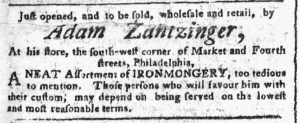
“A NEAT Assortment of Ironmongery, too tedious to mention.”

In January 1773, Hugh Roberts and George Roberts continued taking to the pages of the Pennsylvania Chronicle to hawk their wares.  They proclaimed that they carried “IRONMONGERY AND BRASS WARES, In their most extensive BRANCHES.”  In other words, they stocked some of everything!  They also declared that they had a “large Assortment of COPPER WARE, INDIA-METAL WARE, JAPAN’D WARE, and CUTLERY.”  The Robertses suggested that the selection would satisfy any of their customers.

They asked readers to take their word for it and, better yet, visit their “WARE-HOUSE” at the corner of Market Street and Grindstone Alley in Philadelphia to see for themselves.  They could have published an extensive catalog of their merchandise to demonstrate the range of choices available to consumers.  Many merchants and shopkeepers adopted that marketing strategy in the second half of the eighteenth century.  Instead, the Robertses inserted a note intended to tantalize prospective customers.  “The Ironmongery, Brass and the other Wares, at the said Ware-house,” they asserted, “consist of so great a variety of sizes, patterns and workmanship, that, to particularize the articles in an advertisement, would be too extensive for publication in a news-paper.”  In addition to being “too extensive,” such an advertisement may have been more expensive than the Robertses wished to pay.

Adam Zantzinger, who also sold a “NEAT Assortment of IRONMONGERY,” offered a sharper critique of what he considered excessive detail in newspaper advertisements.  In his own advertisement, Zantzinger insisted his selection was “too tedious to mention.”  Presumably prospective customers would not find browsing his store at the corner of Market and Fourth Streets “too tedious,” especially since they could acquire goods there “on the lowest and most reasonable terms.”  In contrast, Jonathan Zane and Sons ran an advertisement that filled an entire column and overflowed into another as they listed hundreds of items from among their “large assortment of IRONMONGERY, CUTLERY, BRASS WARE, SADLERY, DYE STUFFS, PAINTERS COLOURS,” and other items.  Perhaps Zantzinger directed his comments at those competitors in addition to making a general statement about advertising practices then in style.

In an era when many merchants and shopkeepers sought to demonstrate the array of choices that they provided for consumers by imbedding lengthy lists of merchandise in their newspaper advertisements, some advertisers rejected such methods in favor of making simple promises that they carried items prospective customers wanted or needed.  Their strategy may have been motivated in part by the cost of advertising, but that did not prevent them from making appeals that they believed would resonate with consumers, including highlighting their large selection and low prices.