Slavery Advertisements Published January 4, 1773

The Slavery Adverts 250 Project chronicles the role of newspaper advertising in perpetuating slavery in the era of the American Revolution. The project seeks to reveal the ubiquity of slavery in eighteenth-century life from New England to Georgia by republishing advertisements about enslaved people – for sale as individuals or in groups, wanted to purchase or for hire for short periods, runaways who liberated themselves, and those who were subsequently captured and confined in jails and workhouses – in daily digests on this site as well as in real time via the @SlaveAdverts250 Twitter feed, utilizing twenty-first-century media to stand in for the print media of the eighteenth century.

The project aims to provide modern audiences with a sense of just how often colonizers encountered these advertisements in their daily lives. Enslaved men, women, and children appeared in print somewhere in the colonies almost every single day. Those advertisements served as a constant backdrop for social, cultural, economic, and political life in colonial and revolutionary America. Colonizers who did not purport to own enslaved people were still confronted with slavery as well as invited to maintain the system by purchasing enslaved men, women, and children or assisting in the capture of so-called “runaways” who sought to free themselves from bondage. The frequency of these newspaper advertisements suggests just how embedded slavery was in colonial and revolutionary American culture in everyday interactions beyond the printed page.

These advertisements also testify to the experiences of enslaved men, women, and children, though readers must consider that those experiences have been remediated through descriptions offered by enslavers rather than enslaved people themselves. Often unnamed in the advertisements, enslaved men, women, and children were not invisible or unimportant in early America.

These advertisements appeared in colonial American newspapers 250 years ago today.

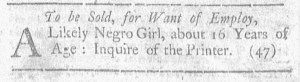
Boston Evening-Post (January 4, 1773).

**********

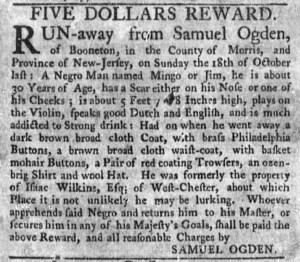
Boston Evening-Post (January 4, 1773).

**********

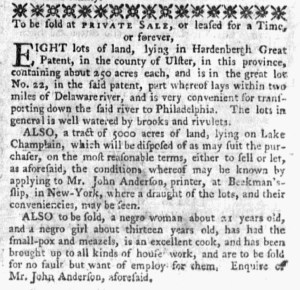
Newport Mercury (January 4, 1773).

**********

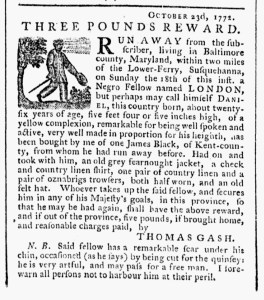
New-York Gazette and Weekly Mercury (January 4, 1773).

**********

Supplement to the New-York Gazette and Weekly Mercury (January 4, 1773).

**********

Supplement to the New-York Gazette and Weekly Mercury (January 4, 1773).

**********

Supplement to the New-York Gazette and Weekly Mercury (January 4, 1773).

**********

Supplement to the New-York Gazette and Weekly Mercury (January 4, 1773).

**********

Supplement to the Pennsylvania Packet (January 4, 1773).

January 3

What was advertised in a colonial American newspaper 250 years ago this week?

Pennsylvania Chronicle (January 3, 1772).

“Blanks and Hand-Bills, in particular, are done on the shortest Notice, in a neat and correct Manner.”

Some colonial printers used the colophon at the bottom of the final page of their newspapers merely to give publication information.  Such was the case in several newspapers during the first week of 1773.  The colophon for the New-Hampshire Gazette succinctly stated, “PORTSMOUTH, Printed by Daniel and Robert Fowle.”  Similarly, the colophon for the Boston-Gazette simply read, “Boston: Printed by EDES & GILL, in Queen-Street, 1773.”  Beyond New England, the colophon for the Pennsylvania Gazette gave similar information: “PHILADELPHIA: Printed by HALL and SELLERS, at the NEW PRINTING-OFFICE, near the Market.”

In contrast, many printers treated their colophons as perpetual advertisements for the goods and services they provided at their printing offices.  In many instances, those colophons included the most readily accessible information about subscription prices, advertising fees, or both.  Consider the colophon for the Pennsylvania Chronicle.  It opened with the same information that appeared in concise versions in other newspapers: “PHILADELPHIA: Printed by WILLIAM GODDARD, at the NEW PRINTING-OFFICE in Front-Street, near Market-Street, on the Bank Side, and almost opposite to the London Coffee-House.”  In a bustling city where printers published four other newspapers, Goddard wanted to make sure that subscribers, advertisers, and other customers could find his printing office.

From there, the printer noted that “Subscriptions, (at TEN SHILLINGS per Annum) Advertisements, Articles and Letters of Intelligence are gratefully received for this paper.”  In addition to generating revenue through subscriptions and advertising, Goddard encouraged an eighteenth-century version of crowdsourcing for content that he might choose to include in his publication.  In addition to publishing the Pennsylvania Chronicle, Goddard also accepted orders for job printing.  In the final lines of the colophon, he asserted that “all Manner of Printing Work is performed with Care, Fidelity and Expedition,” adding that “Blanks [or printed forms] and Hand-Bills, in particular, are done on the shortest Notice, in a neat and correct Manner.”  That Goddard and other printers so often mentioned handbills in their colophons suggests that many more of those ephemeral advertisements came off of colonial presses than the relatively few that survived might suggest.

Eighteenth-century printers introduced a variety of variations into their colophons.  Some included only brief publication information, while others consistently used their colophons as advertisements to promote their businesses.  Those who took that approach were the most consistent advertisers of the period, disseminating at least one advertisement in each issue they printed.  Even the most prolific advertisers among the merchants, shopkeepers, and artisans who placed paid notices did not advertise at that rate.

January 2

What was advertised in a colonial American newspaper 250 years ago today?

Pennsylvania Chronicle (January 2, 1772).

“AMERICAN MANUFACTURE.”

Pelatiah Webster advertised a variety of goods available at his store on Water Street in Philadelphia at the end of 1772 and the beginning of 1773.  Although he mentioned some imported items, he emphasized that he carried several items made in the colonies.  He deployed a version of “Made in America” or “Buy American” even before the American Revolution.  Purveyors of goods and services did so at various times during the imperial crisis that eventually resulted in thirteen colonies declaring independence from Britain, most frequently during periods when colonizers adopted nonimportation agreements as political leverage.  That did not mean, however, that advertisers did not encourage consumers to purchase “domestic manufactures” at times of relative calm.

Webster apparently believed that highlighting the American origins of many of his wares would aid in attracting customers.  He may have also hoped that this strategy would remind consumers that they could make choices in the marketplace that had political ramifications.  He opened his advertisement with a “NEAT assortment of BOSTON SHOES,” trumpeting their “excellent quality” and the “variety of colours.”  Merchants and shopkeepers throughout the colonies often listed dozens of different kinds of imported textiles, hoping to match the tastes and budgets of prospective customers.  Webster, on the other hand, stocked “a variety of coarse woollens, cottons, check flannels, &c. AMERICAN MANUFACTURE, very serviceable, at 2s. and 2s6 per yard.”  Those textiles were not as fancy as imported alternatives, but Webster considered them both practical and, at two shillings or two shillings and six pence per yard, quire reasonable.  For many colonizers, using such homespun fabrics became a badge of honor, a visible testimonial of their politics or commitment to supporting the local economy or both.

In the January 2, 1773, edition of the Pennsylvania Chronicle, Webster’s advertisement ran in the first column on the final page, below George Weed’s advertisement for medicines he compounded at shop on Market Street, alternatives to patent medicines imported from London.  The middle column consisted entirely of an advertisement in which Jonathan Zane and Sons cataloged a “large assortment of IRONMONGERY, CUTLERY, BRASS WARE, SADLERY, DYE STUFFS, PAINTERS COLOURS” and more that they acquired “at the manufactories of Great-Britain and imported in the last vessels from London and Bristol.”  In the final column, John Marie’s advertisement ran once again, offering the services of a “TAYLOR, from PARIS” who had previously clothed “some of the most respectable Gentlemen in London.”  That constellation of advertisements and marketing strategies on a single page testified to some of the tension inherent in consumer culture during the era of the American Revolution.  Consumers navigated competing messages about the meanings of goods and services and how they should participate in the marketplace.

Slavery Advertisements Published January 2, 1773

The Slavery Adverts 250 Project chronicles the role of newspaper advertising in perpetuating slavery in the era of the American Revolution. The project seeks to reveal the ubiquity of slavery in eighteenth-century life from New England to Georgia by republishing advertisements about enslaved people – for sale as individuals or in groups, wanted to purchase or for hire for short periods, runaways who liberated themselves, and those who were subsequently captured and confined in jails and workhouses – in daily digests on this site as well as in real time via the @SlaveAdverts250 Twitter feed, utilizing twenty-first-century media to stand in for the print media of the eighteenth century.

The project aims to provide modern audiences with a sense of just how often colonizers encountered these advertisements in their daily lives. Enslaved men, women, and children appeared in print somewhere in the colonies almost every single day. Those advertisements served as a constant backdrop for social, cultural, economic, and political life in colonial and revolutionary America. Colonizers who did not purport to own enslaved people were still confronted with slavery as well as invited to maintain the system by purchasing enslaved men, women, and children or assisting in the capture of so-called “runaways” who sought to free themselves from bondage. The frequency of these newspaper advertisements suggests just how embedded slavery was in colonial and revolutionary American culture in everyday interactions beyond the printed page.

These advertisements also testify to the experiences of enslaved men, women, and children, though readers must consider that those experiences have been remediated through descriptions offered by enslavers rather than enslaved people themselves. Often unnamed in the advertisements, enslaved men, women, and children were not invisible or unimportant in early America.

These advertisements appeared in colonial American newspapers 250 years ago today.

Providence Gazette (January 2, 1773).

January 1

What was advertised in a colonial American newspaper 250 years ago today?

New-Hampshire Gazette (January 1, 1773).

“GOODS … as cheap for Cash as at any Shop in Boston.”

Samuel Flagg, a shopkeeper in Salem, complained about “so many flashy Advertisements” that ran in the Essex Gazette in his own notice in that newspaper and others published in New England as 1772 came to an end.  In contrast, the advertisement that Caruth and Nash, who kept shop “at Mr. Abbot’s Tavern, on Kingston Plains,” was not flashy at all.  In the first issue of the New-Hampshire Gazette for 1773, the partners published an advertisement to inform prospective customers that the “JUST IMPORTED, AND … SOLD … A Large and general Assortment of Scotch and English GOODS.”  The way that their name appeared as a headline in all capital letters was the most flashy aspect of Caruth and Nash’s notice.

Yet Flagg had not commented on typography and graphic design alone.  He was even more dismissive of the “Story” that merchants and shopkeepers told consumers in their attempts to incite demand and generate revenue.  Caruth and Nash did not tell a story anywhere near as elaborate as those that Flagg found so absurd and cloying, but that did not mean that their notice lacked any of the marketing strategies in use at the time.  The partners were more reserved in how they presented those appeals to the public.

For instance, they did not go into great detail about their low prices or, especially, what kinds of relationships they cultivated with manufacturers and merchants in England that allowed them to offer great bargains to their customers.  They did, however, pledge that they sold their wares “Wholesale and Retail, as cheap for Cash as at any Shop in Boston.”  Their prices, they assured prospective customers in rural New Hampshire, were competitive with those in the largest urban center in New England.  Caruth and Nash also adopted another strategy that annoyed Flaff, commenting on their customer service.  “Those who are pleased to favour them with their Custom,” the partners advised, “may depend on the best Usage, and the smallest Favour gratefully acknowledged.”  Flagg was not impressed with merchants and shopkeepers who insincerely professed that they “held [themselves] obliged to the good People” for merely looking at their merchandise “without buying.”  Caruth and Nash, on the other hand, incorporated a brief version of that appeal into their newspaper advertisement.

Caruth and Nash’s advertisement was not flashy by the standards of the period, but that did not mean that it lacked marketing appeals intended to sway prospective customers.  They hardly published a mere announcement in the New-Hampshire Gazette.  Instead, their notice included appeals to price and customer service that they believed would help convince readers to purchase from them rather than their competitors.

Slavery Advertisements Published January 1, 1773

The Slavery Adverts 250 Project chronicles the role of newspaper advertising in perpetuating slavery in the era of the American Revolution. The project seeks to reveal the ubiquity of slavery in eighteenth-century life from New England to Georgia by republishing advertisements about enslaved people – for sale as individuals or in groups, wanted to purchase or for hire for short periods, runaways who liberated themselves, and those who were subsequently captured and confined in jails and workhouses – in daily digests on this site as well as in real time via the @SlaveAdverts250 Twitter feed, utilizing twenty-first-century media to stand in for the print media of the eighteenth century.

The project aims to provide modern audiences with a sense of just how often colonizers encountered these advertisements in their daily lives. Enslaved men, women, and children appeared in print somewhere in the colonies almost every single day. Those advertisements served as a constant backdrop for social, cultural, economic, and political life in colonial and revolutionary America. Colonizers who did not purport to own enslaved people were still confronted with slavery as well as invited to maintain the system by purchasing enslaved men, women, and children or assisting in the capture of so-called “runaways” who sought to free themselves from bondage. The frequency of these newspaper advertisements suggests just how embedded slavery was in colonial and revolutionary American culture in everyday interactions beyond the printed page.

These advertisements also testify to the experiences of enslaved men, women, and children, though readers must consider that those experiences have been remediated through descriptions offered by enslavers rather than enslaved people themselves. Often unnamed in the advertisements, enslaved men, women, and children were not invisible or unimportant in early America.

These advertisements appeared in colonial American newspapers 250 years ago today.

New-London Gazette (January 1, 1773).

**********

New-London Gazette (January 1, 1773).