Slavery Advertisements Published January 9, 1773

The Slavery Adverts 250 Project chronicles the role of newspaper advertising in perpetuating slavery in the era of the American Revolution. The project seeks to reveal the ubiquity of slavery in eighteenth-century life from New England to Georgia by republishing advertisements about enslaved people – for sale as individuals or in groups, wanted to purchase or for hire for short periods, runaways who liberated themselves, and those who were subsequently captured and confined in jails and workhouses – in daily digests on this site as well as in real time via the @SlaveAdverts250 Twitter feed, utilizing twenty-first-century media to stand in for the print media of the eighteenth century.

The project aims to provide modern audiences with a sense of just how often colonizers encountered these advertisements in their daily lives. Enslaved men, women, and children appeared in print somewhere in the colonies almost every single day. Those advertisements served as a constant backdrop for social, cultural, economic, and political life in colonial and revolutionary America. Colonizers who did not purport to own enslaved people were still confronted with slavery as well as invited to maintain the system by purchasing enslaved men, women, and children or assisting in the capture of so-called “runaways” who sought to free themselves from bondage. The frequency of these newspaper advertisements suggests just how embedded slavery was in colonial and revolutionary American culture in everyday interactions beyond the printed page.

These advertisements also testify to the experiences of enslaved men, women, and children, though readers must consider that those experiences have been remediated through descriptions offered by enslavers rather than enslaved people themselves. Often unnamed in the advertisements, enslaved men, women, and children were not invisible or unimportant in early America.

These advertisements appeared in colonial American newspapers 250 years ago today.

Providence Gazette (January 9, 1773).

January 8

What was advertised in a colonial American newspaper 250 years ago today?

Connecticut Journal (January 8, 1773).

“Whose motive is to settle here if health permit[s], and the business answers.”

When Thomas Hilldrup arrived in Hartford in the fall of 1772, he commenced an advertising campaign to advise prospective customers that he repaired watches “in a perfect and durable manner, at an easy expence.”  Throughout late September and into October, November, and December, he consistently ran his advertisement in the Connecticut Courant, alerting readers that he planned “to settle here if health permit[s], and the business answers.”  That being the case, he invited the public “to make a trial of his abilities.”  In addition to repairing watches, Hilldrup also sold watches and accessories and provided ancillary services, including consultations with “those who are about to buy, sell or exchange.”

Hilldrup continued placing his advertisement in the Connecticut Courant in the new year.  He also decided to expand his advertising campaign to another newspaper, the Connecticut Journal and New-Haven Post-Boy.  Doing so extended the reach of his advertising and gave him access to a new market.  Why did the watchmaker decide to advertise in another publication?  Did he believe that the notice in the Connecticut Courant had been sufficiently successful to merit advertising in a newspaper in another town?  Among colonizers who perused multiple newspapers as they circulated far and wide in Connecticut and beyond, that certainly likely enhanced Hilldrup’s visibility and name recognition.  That he continued to invest in advertisements in the Connecticut Courant also suggests that he considered the outcomes so far worth the expense.

On the other hand, those advertisements may not have been as successful as Hilldrup hoped.  Perhaps placing the same notice in the Connecticut Journal and attempting to capture a portion of an adjacent market was an attempt to generate enough business to make remaining in Hartford a viable option.  Whatever his reasons for choosing to run his advertisement in an additional newspaper in January 1773, Hilldrup eventually determined that he cultivated a large enough clientele to remain in Hartford.  He continued advertising watches and repairs in newspapers published in that town for nearly two decades.  In the coming months, the Adverts 250 Project will examine some of his subsequent newspaper notices.

Slavery Advertisements Published January 8, 1773

The Slavery Adverts 250 Project chronicles the role of newspaper advertising in perpetuating slavery in the era of the American Revolution. The project seeks to reveal the ubiquity of slavery in eighteenth-century life from New England to Georgia by republishing advertisements about enslaved people – for sale as individuals or in groups, wanted to purchase or for hire for short periods, runaways who liberated themselves, and those who were subsequently captured and confined in jails and workhouses – in daily digests on this site as well as in real time via the @SlaveAdverts250 Twitter feed, utilizing twenty-first-century media to stand in for the print media of the eighteenth century.

The project aims to provide modern audiences with a sense of just how often colonizers encountered these advertisements in their daily lives. Enslaved men, women, and children appeared in print somewhere in the colonies almost every single day. Those advertisements served as a constant backdrop for social, cultural, economic, and political life in colonial and revolutionary America. Colonizers who did not purport to own enslaved people were still confronted with slavery as well as invited to maintain the system by purchasing enslaved men, women, and children or assisting in the capture of so-called “runaways” who sought to free themselves from bondage. The frequency of these newspaper advertisements suggests just how embedded slavery was in colonial and revolutionary American culture in everyday interactions beyond the printed page.

These advertisements also testify to the experiences of enslaved men, women, and children, though readers must consider that those experiences have been remediated through descriptions offered by enslavers rather than enslaved people themselves. Often unnamed in the advertisements, enslaved men, women, and children were not invisible or unimportant in early America.

These advertisements appeared in colonial American newspapers 250 years ago today.

New-London Gazette (January 8, 1773).

**********

New-London Gazette (January 8, 1773).

January 7

Who was the subject of an advertisement in a colonial American newspaper 250 years ago today?

Massachusetts Gazette and Boston Weekly News-Letter (January 7, 1773).

“A Negro Man whose extraordinary Genius has been assisted by one of the best Masters in London.”

An advertisement in the January 7, 1773, edition of the Massachusetts Gazette and Boston Weekly News-Letter informed readers of a novelty that they could see for themselves.  “At Mr. M’Lean’s, Watch-Maker near the Town-House,” it read, “is a Negro Man whose extraordinary Genius has been assisted by one of the best Masters in London; he takes Faces at the lowest Rates.”  For anyone intrigued by this notice, “Specimens of his Performances may be seen at said Place.”  According to J.L. Bell, this “portrait artist was probably Prince Demah, enslaved to Henry Barnes of Marlborough. Barnes had recently taken the young man to London and arranged for lessons from the artist Robert Edge Pine. In February, Demah painted a portrait William Duguid,” now at the Metropolitan Museum of Art.

Although the advertiser depicted the Black man as possessing “extraordinary Genius,” recognized and cultivated by a white artisan, free and enslaved Black men and women possessed a variety of skills and contributed to colonial commerce in many ways.  They did far more than perform agricultural labor.  From New England to Georgia, they worked alongside white artisans who often received credit for the items they produced or otherwise profited from their industry.  In Boston, for instance, an enslaved family of printers, Peter Fleet and his sons Pompey and Caesar, worked in the printing office where Thomas Fleet published the Boston Evening-Post in the middle of the eighteenth century.

On the same day that the notice in the Massachusetts Gazette and Boston Weekly News-Letter described the “extraordinary Genius” of a Black man at a local watchmaker’s workshop, an advertisement in the South-Carolina Gazette reported that Abraham, an enslaved man who liberated himself by running away from his enslaver on Christmas Day, was a “Cabinet-Maker by Trade.”  In the same issue, William Wayne sought to hire out “Four Negro Painters … Who are capable of finishing a Piece of Work in any Manner their Employers may think proper to have it.”  Other advertisements that offered enslaved men and women for sale or promised rewards for the capture and return of enslaved men and women who liberated themselves regularly indicated that they pursued skilled trades, including carpenters, coopers, blacksmiths, and seamstresses.

A watchmaker in Boston treated the “extraordinary Genius” of a Black man as a marketing ploy to draw prospective customers to his shop, yet readers may not have been easily convinced that this announcement merited their attention.  Through everyday experience, they knew that Black men and women worked at any number of skilled trades.

Slavery Advertisements Published January 7, 1773

The Slavery Adverts 250 Project chronicles the role of newspaper advertising in perpetuating slavery in the era of the American Revolution. The project seeks to reveal the ubiquity of slavery in eighteenth-century life from New England to Georgia by republishing advertisements about enslaved people – for sale as individuals or in groups, wanted to purchase or for hire for short periods, runaways who liberated themselves, and those who were subsequently captured and confined in jails and workhouses – in daily digests on this site as well as in real time via the @SlaveAdverts250 Twitter feed, utilizing twenty-first-century media to stand in for the print media of the eighteenth century.

The project aims to provide modern audiences with a sense of just how often colonizers encountered these advertisements in their daily lives. Enslaved men, women, and children appeared in print somewhere in the colonies almost every single day. Those advertisements served as a constant backdrop for social, cultural, economic, and political life in colonial and revolutionary America. Colonizers who did not purport to own enslaved people were still confronted with slavery as well as invited to maintain the system by purchasing enslaved men, women, and children or assisting in the capture of so-called “runaways” who sought to free themselves from bondage. The frequency of these newspaper advertisements suggests just how embedded slavery was in colonial and revolutionary American culture in everyday interactions beyond the printed page.

These advertisements also testify to the experiences of enslaved men, women, and children, though readers must consider that those experiences have been remediated through descriptions offered by enslavers rather than enslaved people themselves. Often unnamed in the advertisements, enslaved men, women, and children were not invisible or unimportant in early America.

These advertisements appeared in colonial American newspapers 250 years ago today.

Maryland Gazette (January 7, 1773).

**********

Maryland Gazette (January 7, 1773).

**********

Maryland Gazette (January 7, 1773).

**********

Massachusetts Gazette and Boston Weekly News-Letter (January 7, 1773).

**********

Massachusetts Gazette and Boston Weekly News-Letter (January 7, 1773).

**********

Supplement to the Massachusetts Gazette and Boston Weekly News-Letter (January 7, 1773).

**********

New-York Journal (January 7, 1773).

**********

South-Carolina Gazette (January 7, 1773).

**********

South-Carolina Gazette (January 7, 1773).

**********

South-Carolina Gazette (January 7, 1773).

**********

South-Carolina Gazette (January 7, 1773).

**********

South-Carolina Gazette (January 7, 1773).

**********

South-Carolina Gazette (January 7, 1773).

**********

South-Carolina Gazette (January 7, 1773).

**********

South-Carolina Gazette (January 7, 1773).

**********

South-Carolina Gazette (January 7, 1773).

**********

South-Carolina Gazette (January 7, 1773).

**********

South-Carolina Gazette (January 7, 1773).

**********

South-Carolina Gazette (January 7, 1773).

**********

South-Carolina Gazette (January 7, 1773).

**********

Supplement to the South-Carolina Gazette (January 7, 1773).

**********

Supplement to the South-Carolina Gazette (January 7, 1773).

**********

Supplement to the South-Carolina Gazette (January 7, 1773).

**********

Supplement to the South-Carolina Gazette (January 7, 1773).

**********

Supplement to the South-Carolina Gazette (January 7, 1773).

**********

Supplement to the South-Carolina Gazette (January 7, 1773).

**********

Supplement to the South-Carolina Gazette (January 7, 1773).

**********

Virginia Gazette [Purdie and Dixon] (January 7, 1773).

**********

Virginia Gazette [Purdie and Dixon] (January 7, 1773).

**********

Virginia Gazette [Purdie and Dixon] (January 7, 1773).

**********

Virginia Gazette [Purdie and Dixon] (January 7, 1773).

**********

Virginia Gazette [Purdie and Dixon] (January 7, 1773).

**********

Virginia Gazette [Purdie and Dixon] (January 7, 1773).

**********

Virginia Gazette [Purdie and Dixon] (January 7, 1773).

**********

Virginia Gazette [Purdie and Dixon] (January 7, 1773).

**********

Virginia Gazette [Purdie and Dixon] (January 7, 1773).

**********

Virginia Gazette [Purdie and Dixon] (January 7, 1773).

**********

Virginia Gazette [Rind] (January 7, 1773).

**********

Virginia Gazette [Rind] (January 7, 1773).

**********

Virginia Gazette [Rind] (January 7, 1773).

**********

Virginia Gazette [Rind] (January 7, 1773).

**********

Virginia Gazette [Rind] (January 7, 1773).

**********

Virginia Gazette [Rind] (January 7, 1773).

**********

Virginia Gazette [Rind] (January 7, 1773).

**********

Virginia Gazette [Rind] (January 7, 1773).

**********

Virginia Gazette [Rind] (January 7, 1773).

**********

Virginia Gazette [Rind] (January 7, 1773).

**********

Virginia Gazette [Rind] (January 7, 1773).

January 6

Who was the subject of an advertisement in a colonial American newspaper 250 years ago today?

Pennsylvania Journal (January 6, 1773).

“RUN AWAY … an Irish servant man, named Michael Nugent.”

James Riddle’s advertisements concerning an indentured servant who had “RUN AWAY” shortly before the new year received a privileged place in January 6, 1773, edition of the Pennsylvania Journal.  It was the only advertisement on the first page of the newspaper.  As readers perused an “Extract of a letter from a Gentleman in London,” “Extracts from the Minutes of the House of Burgesses in Virginia,” and news from Warsaw, they encountered a notice that described Michael Nugent, “an Irish servant man, … by trade a taylor,” and offered a reward for capturing and imprisoning him or delivering him to Riddle on Shippen Street in Philadelphia.  The advertisement appeared at the bottom of the middle column of the first page.

That an advertisement appeared on the front page of a colonial newspaper was not uncommon.  Printers frequently ran paid notices on the first page, often as a practical matter.  Newspapers consisted of four pages created by printing two pages on each side of a broadsheet and then folding it in half.  Some printers placed advertisement, which ran for multiple weeks, on the first and last pages, printed those first, and reserved the second and third pages for the most recent news that arrived in the printing office.  Even when they did not devote the entire first page to advertising, printers tended to cluster notices together in complete columns.  The front page of a newspaper, for instance, could feature two columns of news and one column of advertising or one column of news and two columns of advertising.

A single advertisement, especially one that did not promote some aspect of the printer’s own business, was unusual.  In this instance, the printers placed all other advertisements in the final column of the third page and filled the final page with notices, segregating news from advertising except for the lone notice about a runaway indentured servant on the front page.  Its placement may have also been a practical matter since it was just the right length to complete the column that included news from Virginia before starting a new column of news from Warsaw.  Riddle’s advertisement generated revenue for the printers of the Pennsylvania Journal, but it served another purpose as well.  It functioned as filler when laying out the first page of the newspaper.

Slavery Advertisements Published January 6, 1773

The Slavery Adverts 250 Project chronicles the role of newspaper advertising in perpetuating slavery in the era of the American Revolution. The project seeks to reveal the ubiquity of slavery in eighteenth-century life from New England to Georgia by republishing advertisements about enslaved people – for sale as individuals or in groups, wanted to purchase or for hire for short periods, runaways who liberated themselves, and those who were subsequently captured and confined in jails and workhouses – in daily digests on this site as well as in real time via the @SlaveAdverts250 Twitter feed, utilizing twenty-first-century media to stand in for the print media of the eighteenth century.

The project aims to provide modern audiences with a sense of just how often colonizers encountered these advertisements in their daily lives. Enslaved men, women, and children appeared in print somewhere in the colonies almost every single day. Those advertisements served as a constant backdrop for social, cultural, economic, and political life in colonial and revolutionary America. Colonizers who did not purport to own enslaved people were still confronted with slavery as well as invited to maintain the system by purchasing enslaved men, women, and children or assisting in the capture of so-called “runaways” who sought to free themselves from bondage. The frequency of these newspaper advertisements suggests just how embedded slavery was in colonial and revolutionary American culture in everyday interactions beyond the printed page.

These advertisements also testify to the experiences of enslaved men, women, and children, though readers must consider that those experiences have been remediated through descriptions offered by enslavers rather than enslaved people themselves. Often unnamed in the advertisements, enslaved men, women, and children were not invisible or unimportant in early America.

These advertisements appeared in colonial American newspapers 250 years ago today.

Pennsylvania Gazette (January 6, 1773).

**********

Pennsylvania Gazette (January 6, 1773).

**********

Pennsylvania Journal (January 6, 1773).

January 5

What was advertised in a colonial American newspaper 250 years ago today?

Essex Gazette (January 5, 1773).

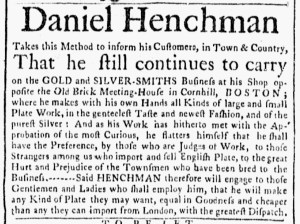
“Strangers among us who import and sell English Plate, to the great Hurt and Prejudice of the Townsmen who have been bred to the Business.”

During the first week of 1773, Daniel Henchman, a silversmith, launched an advertising campaign intended to encourage consumers to support what colonizers called domestic manufactures.  In other words, he wanted them to purchase goods made in the colonies rather than items imported from England.  To disseminate his message to prospective customers “in Town & Country,” he placed a notice in the January 4 edition of the Boston Evening-Post and the January 5 edition of the Essex Gazette, published in Salem.

Henchman explained that he “makes with his own Hands all Kinds of large and small Plate Work, in the genteelest Taste and newest Fashion.”  By invoking both taste and fashion, the silversmith primed readers to think of his work as equivalent to imported goods before he even mentioned “English Plate.”  He also underscored the quality of his work, stating that it “has hitherto met with the Approbation of the most Curious.”  Furthermore, Henchman challenged others to compare his work to imported items, proclaiming his confidence that “he shall have the preference, by those who are Judges of Work, to those Strangers among us who import and sell English Plate.”  Only then did he cast aspersions on the importers, asserting that their actions caused “great Hurt and Prejudice [to] the Townsmen who have been bred to the Business.”  Consumers had a duty, Henchman suggested, to support their neighbors and to bolster the local economy through the choices they made in the marketplace.

To that end, the silversmith pledged to do his part if given the opportunity.  He declared that “he will make any Kind of Plate [his customers] may want, equal in Goodness and cheaper than any they can import from London.”  If his other appeals did not sway them, Henchman hoped that low prices would seal the deal with prospective customers.  He deployed some of the most common marketing strategies in use during the era of the American Revolution, making appeals to price, quality, and fashion, while also enhancing them within the context of supporting domestic manufactures.

Slavery Advertisements Published January 5, 1773

The Slavery Adverts 250 Project chronicles the role of newspaper advertising in perpetuating slavery in the era of the American Revolution. The project seeks to reveal the ubiquity of slavery in eighteenth-century life from New England to Georgia by republishing advertisements about enslaved people – for sale as individuals or in groups, wanted to purchase or for hire for short periods, runaways who liberated themselves, and those who were subsequently captured and confined in jails and workhouses – in daily digests on this site as well as in real time via the @SlaveAdverts250 Twitter feed, utilizing twenty-first-century media to stand in for the print media of the eighteenth century.

The project aims to provide modern audiences with a sense of just how often colonizers encountered these advertisements in their daily lives. Enslaved men, women, and children appeared in print somewhere in the colonies almost every single day. Those advertisements served as a constant backdrop for social, cultural, economic, and political life in colonial and revolutionary America. Colonizers who did not purport to own enslaved people were still confronted with slavery as well as invited to maintain the system by purchasing enslaved men, women, and children or assisting in the capture of so-called “runaways” who sought to free themselves from bondage. The frequency of these newspaper advertisements suggests just how embedded slavery was in colonial and revolutionary American culture in everyday interactions beyond the printed page.

These advertisements also testify to the experiences of enslaved men, women, and children, though readers must consider that those experiences have been remediated through descriptions offered by enslavers rather than enslaved people themselves. Often unnamed in the advertisements, enslaved men, women, and children were not invisible or unimportant in early America.

These advertisements appeared in colonial American newspapers 250 years ago today.

Essex Gazette (January 5, 1773).

**********

South-Carolina Gazette and Country Journal (January 5, 1773).

**********

South-Carolina Gazette and Country Journal (January 5, 1773).

**********

South-Carolina Gazette and Country Journal (January 5, 1773).

**********

South-Carolina Gazette and Country Journal (January 5, 1773).

**********

South-Carolina Gazette and Country Journal (January 5, 1773).

**********

Supplement to the South-Carolina Gazette and Country Journal (January 5, 1773).

**********

Supplement to the South-Carolina Gazette and Country Journal (January 5, 1773).

**********

Supplement to the South-Carolina Gazette and Country Journal (January 5, 1773).

**********

Supplement to the South-Carolina Gazette and Country Journal (January 5, 1773).

**********

Supplement to the South-Carolina Gazette and Country Journal (January 5, 1773).

January 4

What was advertised in a colonial American newspaper 250 years ago today?

Massachusetts Gazette and Boston Post-Boy (January 4, 1773).

“More certificates may be seen, and any other particulars concerning them fully explained.”

Michael B. Goldthwait placed an advertisement for “Dr. KEYSER’S celebrated PILLS” in the January 4, 1773, edition of the Massachusetts Gazette and Boston Post-Boy, yet he had little to do with generating the copy.  Instead, he republished an advertisement that previously ran in the New-York Gazette and Weekly Mercury.  James Rivington, a printer and bookseller in New York, hawked the patent medicine to generate additional revenue.  He placed an advertisement that made a patient’s “certificate” or testimonial about the efficacy of Keyser’s pills its main focus.  Goldthwait may have worked with Rivington when he decided to reprint the advertisement in one of Boston’s newspapers.  Given the wide circulation of colonial newspapers, however, he Goldthwait may have seen Rivington’s advertisement in a copy of the New-York Gazette and Weekly Mercury that made its way to Boston and decided to appropriate it for his own use.

Goldthwait made only a few revisions to the notice before submitting it to a local printing office.  He altered the headline from “KEYSER’s PILLS” to “Dr. KEYSER’S celebrated PILLS” and streamlined the introductory paragraph that gave context for William Shipman’s testimonial, softening some of the language about the “purchase money” necessary to acquire the medicine.  The entire testimonial appeared, including Shipman’s assertion that it “is a faithful relation of my Case, and I can with an honest confidence recommend the Medicine to those who are afflicted with any Rheumatic complaints.”  Goldthwait did devise one significant embellishment.  Rivington concluded the original advertisement with an offer to provide “very satisfactory information” to anyone “desirous of enquiring further to the efficacy of this medicine,” but Goldthwait claimed that he had “more certificates” or testimonials at his shop near the Mill Bridge.  Those certificates likely included testimonials he published in an advertisement in August 1772.  Furthermore, Goldthwait could supply “other particulars” that “fully explained” those certificates.

When it came to advertisements appearing in multiple newspapers published in a town or city, merchants, shopkeepers, artisans, and other purveyors of goods and services often placed the same notice in more than one publication.  In terms of advertisements for consumer goods appearing in multiple newspapers published in different cities, that most often occurred with subscription notices for books, pamphlets, newspapers, and other printed materials as printers attempted to generate sufficient demand to make those ventures viable.  Apothecaries, shopkeepers, printers, and others throughout the colonies advertised Keyser’s pills, but they did not coordinate their marketing messages.  Shipman’s testimonial running in newspapers in Boston and New York was a rare instance of entrepreneurs in two towns exposing consumers to the same marketing campaign.