October 9

What was advertised in a colonial American newspaper 250 years ago today?

Providence Gazette (October 9, 1773).

“FENNING’s much-approved SPELLING-BOOK.”

John Carter, the printer of the Providence Gazette, inserted an advertisement for “FENNING’s much-approved SPELLING-BOOK” in his own newspaper on October 9, 1773.  With news items, editorials, and other advertisements, Carter had so much content that he did not provide much detail in the advertisement except to note that he sold copies “Wholesale and Retail” and set prices “Cheaper by the Dozen than any imported” for those who purchased a quantity.  The printer also advised that Jacob Richardson sold the spelling books in Newport in case some readers of the Providence Gazette might find it more convenient to make their purchases in that town.  Carter kept his advertisement for “WEST’s ALMANACK, For the Year of Our Lord 1774” similarly brief, noting that it “is now in the Press, and will be published seasonably.”

Had Carter inserted a more extensive advertisement, he likely would have generated much of it from the title of the spelling book.  Advertisements for books often quoted the lengthy subtitles common for books published in the eighteenth century.  In this case, Carter could have promoted the spelling book as a “new and easy guide to the English language” and invoked the author’s credentials as a former schoolmaster in Suffolk and author of The Use of Globes, Practical Arithmetic, Royal English Dictionary, and Young Man’s Book of Knowledge.  Both of these books, Fanning’s spelling book and West’s almanac, were so popular and widely known that Carter likely considered it worth announcing that he sold them even if he did not have additional space to promote them in that issue of the Providence Gazette.  After all, he and his predecessors who worked with West to publish an almanac each year undertook extensive advertising.  Carter’s reprint of Fanning’s spelling book was the “fifteenth edition, with additions,” according to the title page.  Prospective customers presumably already knew a lot about both books.

Even though Carter sold Fanning’s spelling book “by the Dozen,” today only one known copy survives in a research library, historical society, or private collection.  That copy, held at the American Antiquarian Society in Worcester, Massachusetts, has been damaged, a portion of its title page missing.  Carter, Richardson, booksellers, schoolmasters, shopkeepers, and peddlers may have distributed that edition of the spelling book widely in Rhode Island and nearby colonies in the early 1770s, but over time and perhaps through use those copies became as ephemeral as many of the broadsides, pamphlets, handbills, and other items produced on printing presses prior to the American Revolution.

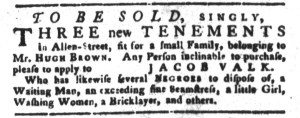
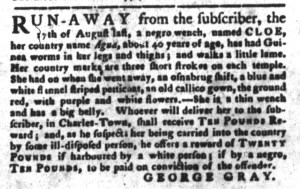
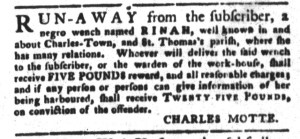
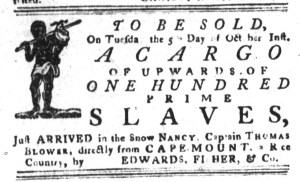
Slavery Advertisements Published October 9, 1773

The Slavery Adverts 250 Project chronicles the role of newspaper advertising in perpetuating slavery in the era of the American Revolution. The project seeks to reveal the ubiquity of slavery in eighteenth-century life from New England to Georgia by republishing advertisements about enslaved people – for sale as individuals or in groups, wanted to purchase or for hire for short periods, runaways who liberated themselves, and those who were subsequently captured and confined in jails and workhouses – in daily digests on this site as well as in real time via the @SlaveAdverts250 Twitter feed, utilizing twenty-first-century media to stand in for the print media of the eighteenth century.

The project aims to provide modern audiences with a sense of just how often colonizers encountered these advertisements in their daily lives. Enslaved men, women, and children appeared in print somewhere in the colonies almost every single day. Those advertisements served as a constant backdrop for social, cultural, economic, and political life in colonial and revolutionary America. Colonizers who did not purport to own enslaved people were still confronted with slavery as well as invited to maintain the system by purchasing enslaved men, women, and children or assisting in the capture of so-called “runaways” who sought to free themselves from bondage. The frequency of these newspaper advertisements suggests just how embedded slavery was in colonial and revolutionary American culture in everyday interactions beyond the printed page.

These advertisements also testify to the experiences of enslaved men, women, and children, though readers must consider that those experiences have been remediated through descriptions offered by enslavers rather than enslaved people themselves. Often unnamed in the advertisements, enslaved men, women, and children were not invisible or unimportant in early America.

These advertisements appeared in colonial American newspapers 250 years ago today.

Providence Gazette (October 9, 1773).

**********

Providence Gazette (October 9, 1773).

October 8

Who was the subject of an advertisement in a colonial American newspaper 250 years ago today?

Connecticut Journal (September 10, 1773).

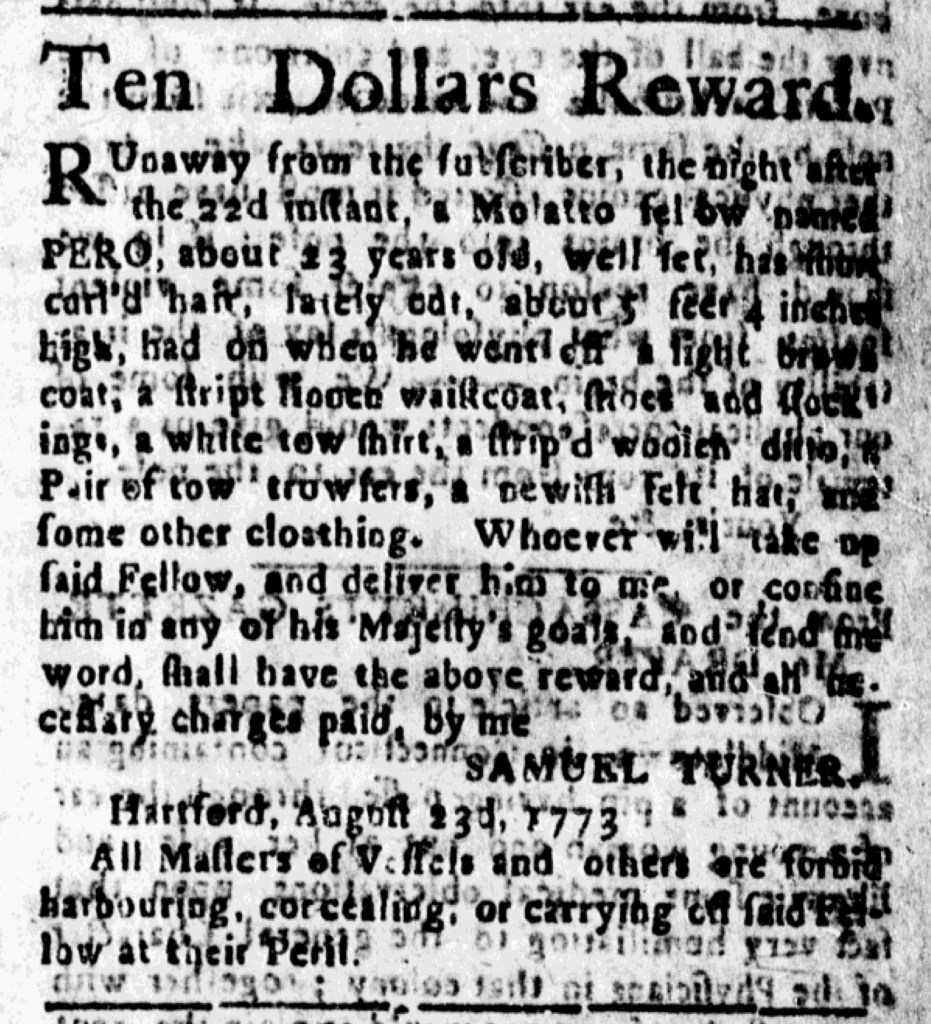
“RUNAWAY … a Molatto Fellow named PERO.”

“Said Pero, was born FREE of an Indian Woman, called Hannah Moree.”

Late in the summer of 1773, Samuel Turner of Hartford inserted an advertisement about “a Molatto Fellow named PERO” in the Connecticut Journal and New-Haven Post-Boy.  Turner alerted the public that Pero an enslaved man who ran away and offered a reward for his capture and return.  In enlisting the aid of readers in the surveillance of young men with darker skin, the enslaver provided a description of Pero that included his approximate age, height, and clothing.  He also threatened that “All Masters of Vessels and Others are forbid harbouring, concealing, or carrying off said Fellow at their Peril,” suggesting that he would initiate legal action against anyone who assisted his human property in liberating himself.

Connecticut Journal (October 8, 1773).

Several weeks later, Oliver Collins and Benjamin Douglass challenged Turner’s version of events with advertisements of their own.  Collins cited the issue in which he saw “an Advertisement sign’d Samuel Turner, offering Five Dollars Reward for taking up a Molatto Fellow, named Pero, whom the said Turner claims to be a Slave for Life.”  Turner misled the public, according to Collins.  He asserted that the young man, also known as Aaron, “was born FREE of an Indian Woman, called Hannah Moree.”  As a young child, Pero had been “bound to me by Advice of Authority … per Indenture, bearing the Date the 16th of Nov. 1750.”  Furthermore, the indenture ended five years earlier in 1768 when Aaron turned twenty-one.  Collins pleaded with “all who have the common Feelings of Humanity, to yield their Influence and Assistance to protect the said Indian against all Attempts upon his just Liberty.”  Turner attempted to leverage the power of the press to enslave Aaron, just as so many other colonizers did in their newspaper advertisements about enslaved people who liberated themselves, while Collins demonstrated that the press could be an instrument for extending and protecting freedom when colonizers chose to use it for those ends.

Advertisements alone, however, would not secure Aaron’s liberty.  Benjamin Douglas turned to the courts in his efforts to aid the young man.  Citing the same advertisement that Turner inserted “in this Paper, No. 308,” on September 10, Douglas declared his “full Conviction that Aaron Moree, a Molatto Fellow,” also known as Pero, “was free born.”  Sympathetic to the young man pursued by Douglas and perhaps hounded by colonizers who recognized him from the advertisement, Douglas “commenced a Suit for the Trial of his Liberty, and taken him into my Service and Protection, until it shall be issued.”  Ignoring Turner’s threats against anyone “harbouring, concealing, or carrying off” Aaron, Douglas issued his own warning to “any, who under the Influence of that Advertisement, may molest the said Aaron, that it shall be at their own Peril.”

Whatever Collins and Douglas’s views about enslaving Africans, African Americans, and Indigenous Americans more generally, they recognized the injustices in the case of Aaron Moree.  Most advertisements concerning enslaved people published in the early 1770s sought to perpetuate their enslavement.  In contrast, colonizers occasionally published newspaper notices that challenged slavery.  In this instance, that challenge focused on an individual, yet it demonstrated that the press did not have to be the tool of enslavers exclusively.

Slavery Advertisements Published October 8, 1773

The Slavery Adverts 250 Project chronicles the role of newspaper advertising in perpetuating slavery in the era of the American Revolution. The project seeks to reveal the ubiquity of slavery in eighteenth-century life from New England to Georgia by republishing advertisements about enslaved people – for sale as individuals or in groups, wanted to purchase or for hire for short periods, runaways who liberated themselves, and those who were subsequently captured and confined in jails and workhouses – in daily digests on this site as well as in real time via the @SlaveAdverts250 Twitter feed, utilizing twenty-first-century media to stand in for the print media of the eighteenth century.

The project aims to provide modern audiences with a sense of just how often colonizers encountered these advertisements in their daily lives. Enslaved men, women, and children appeared in print somewhere in the colonies almost every single day. Those advertisements served as a constant backdrop for social, cultural, economic, and political life in colonial and revolutionary America. Colonizers who did not purport to own enslaved people were still confronted with slavery as well as invited to maintain the system by purchasing enslaved men, women, and children or assisting in the capture of so-called “runaways” who sought to free themselves from bondage. The frequency of these newspaper advertisements suggests just how embedded slavery was in colonial and revolutionary American culture in everyday interactions beyond the printed page.

These advertisements also testify to the experiences of enslaved men, women, and children, though readers must consider that those experiences have been remediated through descriptions offered by enslavers rather than enslaved people themselves. Often unnamed in the advertisements, enslaved men, women, and children were not invisible or unimportant in early America.

These advertisements appeared in colonial American newspapers 250 years ago today.

New-Hampshire Gazette (October 8, 1773).

**********

New-Hampshire Gazette (October 8, 1773).

**********

New-London Gazette (October 8, 1773).

October 7

What was advertised in a colonial American newspaper 250 years ago today?

Massachusetts Gazette and Boston Weekly News-Letter (October 7, 1773).

“Positively the last Time here.”

Mr. Bates’s brief time in Boston would soon come to an end.  In advance of his last exhibition of his feats of horsemanship, the itinerant performer placed an advertisement in the October 7, 1773, edition of the Massachusetts Gazette and Boston Weekly News-Letter.  Three days later, on the eve of what Bates billed as “Positively the last Time here,” he placed the same advertisement in the Boston-Gazette and the Massachusetts Gazette and Boston Post-Boy.  By this time, he did not need to describe his act.  He assumed that prospective audiences in Boston had already seen, heard about, or read about his daring exhibitions.

The performer certainly made his presence known while he was in the city.  He arrived in Boston after spending a couple of months in New York.  He ran his first newspaper notices in the Boston Evening-Post and the Massachusetts Gazette and Post-Boy on September 6, deploying much of the same copy he used in his advertisements in New York.  Some sort of disruption apparently occurred at his first performance in Boston on September 8, prompting him to apologize “that the Ladies and Gentlemen were so much disturbed by a Number of unruly People” in an advertisement in Massachusetts Gazette and Boston Weekly News-Letter the next day.  That did not prevent him from simultaneously marketing his next show and announcing that he reduced the prices for tickets.    Bates also distributed at least one handbill for his show on September 28, though he may have commissioned broadsides and other handbills that have not survived.  He continued placing advertisements in various local newspapers, including in the Boston Evening-Post, the Boston-Gazette, and the Massachusetts Gazette and Boston Post-Boy on September 20.  He advertised in all three of those newspapers again a week later, though this time two of those publications carried an advertisement that denigrated the performer.  Bates did not encounter universal accolades.  Instead, a forthcoming pamphlet would demonstrate “that his Exhibitions in Boston are impoverishing, disgraceful to human Nature, and down-right Breaches of the Sixth Commandment.”

Did such critiques prompt Bates to finish up his performances in Boston?  Or did he already have plans to move along to another town?  Either way, he did not shy away from promoting his performances in the public prints, proclaiming “Positively the last Time here.”  That may have been welcome news to his detractors, yet that was not Bates’s intention.  Instead, he aimed to incite demand among prospective audiences by making clear that they had one last opportunity to witness the spectacle responsible for so much chatter around town.  He previously used a similar “limited time only” strategy in New York in his efforts to turn out audiences for his final performances there.  Whatever his shortcomings, the itinerant performer was a savvy marketer.  Bates repeatedly proclaimed himself an unexcelled master of horsemanship, harnessing the power of the press with both newspaper notices and handbills to reach the public.

Slavery Advertisements Published October 7, 1773

The Slavery Adverts 250 Project chronicles the role of newspaper advertising in perpetuating slavery in the era of the American Revolution. The project seeks to reveal the ubiquity of slavery in eighteenth-century life from New England to Georgia by republishing advertisements about enslaved people – for sale as individuals or in groups, wanted to purchase or for hire for short periods, runaways who liberated themselves, and those who were subsequently captured and confined in jails and workhouses – in daily digests on this site as well as in real time via the @SlaveAdverts250 Twitter feed, utilizing twenty-first-century media to stand in for the print media of the eighteenth century.

The project aims to provide modern audiences with a sense of just how often colonizers encountered these advertisements in their daily lives. Enslaved men, women, and children appeared in print somewhere in the colonies almost every single day. Those advertisements served as a constant backdrop for social, cultural, economic, and political life in colonial and revolutionary America. Colonizers who did not purport to own enslaved people were still confronted with slavery as well as invited to maintain the system by purchasing enslaved men, women, and children or assisting in the capture of so-called “runaways” who sought to free themselves from bondage. The frequency of these newspaper advertisements suggests just how embedded slavery was in colonial and revolutionary American culture in everyday interactions beyond the printed page.

These advertisements also testify to the experiences of enslaved men, women, and children, though readers must consider that those experiences have been remediated through descriptions offered by enslavers rather than enslaved people themselves. Often unnamed in the advertisements, enslaved men, women, and children were not invisible or unimportant in early America.

These advertisements appeared in colonial American newspapers 250 years ago today.

Maryland Gazette (October 7, 1773).

**********

Maryland Gazette (October 7, 1773).

**********

Maryland Gazette (October 7, 1773).

**********

Massachusetts Gazette and Boston Weekly News-Letter (October 7, 1773).

**********

New-York Journal (October 7, 1773).

**********

Rivington’s New-York Gazetteer (October 7, 1773).

**********

Virginia Gazette [Purdie and Dixon] (October 7, 1773).

**********

Virginia Gazette [Purdie and Dixon] (October 7, 1773).

**********

Virginia Gazette [Purdie and Dixon] (October 7, 1773).

**********

Virginia Gazette [Purdie and Dixon] (October 7, 1773).

**********

Virginia Gazette [Purdie and Dixon] (October 7, 1773).

**********

Virginia Gazette [Purdie and Dixon] (October 7, 1773).

**********

Virginia Gazette [Purdie and Dixon] (October 7, 1773).

**********

Virginia Gazette [Purdie and Dixon] (October 7, 1773).

**********

Virginia Gazette [Purdie and Dixon] (October 7, 1773).

**********

Virginia Gazette [Purdie and Dixon] (October 7, 1773).

**********

Virginia Gazette [Purdie and Dixon] (October 7, 1773).

**********

Virginia Gazette [Purdie and Dixon] (October 7, 1773).

**********

Virginia Gazette [Purdie and Dixon] (October 7, 1773).

**********

Virginia Gazette [Purdie and Dixon] (October 7, 1773).

**********

Virginia Gazette [Purdie and Dixon] (October 7, 1773).

**********

Virginia Gazette [Purdie and Dixon] (October 7, 1773).

**********

Virginia Gazette [Rind] (October 7, 1773).

**********

Virginia Gazette [Rind] (October 7, 1773).

October 6

What was advertised in a colonial American newspaper 250 years ago today?

Pennsylvania Gazette (October 6, 1773).

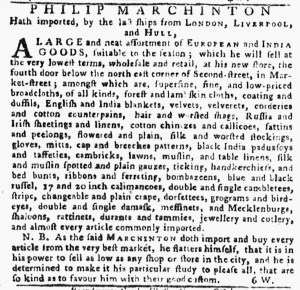
“He flatters himself, it is in his power to sell as low as any shop or store in the city.”

Philip Marchinton commenced a new advertising campaign at the beginning of October 1773.  His advertisements in the October 6 issues of the Pennsylvania Gazette and the Pennsylvania Journal both included a notation, “6 W,” that advised the compositors to run them for six weeks and then remove them from those newspapers.  Marchinton did not anticipate that anyone outside the printing offices would pay much attention to those notations.  Instead, he wanted prospective customers to focus on the “LARGE and neat assortment of EUROPEAN and INDIA GOODS” that he recently imported “by the last ships from LONDON, LIVERPOOL, and HULL.”

Marchinton’s advertisements followed a familiar format.  They commenced with a brief description of where and when he acquired his merchandise, suggesting to consumers that he did not merely peddle leftovers that he had not been able to sell.  The merchant declared that his new inventory was “suitable to the season” and made an appeal to price, offering “the very lowest terms.”  He devoted most of the advertisement to demonstrating the choices available his “assortment” of goods, listing a variety of textiles as well as “silk and worsted stockings” and “jewellery and cutlery.”  In addition, he claimed to stock “almost every article commonly imported,” putting him in competition with Andrew Bunner, William Price, and other merchants and shopkeepers who ran advertisements in the several newspapers published in Philadelphia.

Marchinton deviated from that familiar format in the final lines of his advertisement.  He appended a nota bene in which he provided a short explanation about how he could “sell at the very lowest terms,” circling back to the appeal that he made before listing his wares.  The merchant explained that he “doth import and buy every article from the very best market.”  In the process, he avoided unnecessary markups.  As a result, “it is in his power to sell as low as any shop or store in the city.”  He did not go into greater detail, content with reminding prospective customers of his low prices before making a final pledge “to make it particular study to please all, that are so kind as to favour him with their good custom.”  Low prices and good customer service went hand in hand at Marchington’s store.  Like many other merchants and shopkeepers, Marchinton mostly adhered to a familiar format while choosing a small variation to distinguish his advertisement from others.

Slavery Advertisements Published October 6, 1773

The Slavery Adverts 250 Project chronicles the role of newspaper advertising in perpetuating slavery in the era of the American Revolution. The project seeks to reveal the ubiquity of slavery in eighteenth-century life from New England to Georgia by republishing advertisements about enslaved people – for sale as individuals or in groups, wanted to purchase or for hire for short periods, runaways who liberated themselves, and those who were subsequently captured and confined in jails and workhouses – in daily digests on this site as well as in real time via the @SlaveAdverts250 Twitter feed, utilizing twenty-first-century media to stand in for the print media of the eighteenth century.

The project aims to provide modern audiences with a sense of just how often colonizers encountered these advertisements in their daily lives. Enslaved men, women, and children appeared in print somewhere in the colonies almost every single day. Those advertisements served as a constant backdrop for social, cultural, economic, and political life in colonial and revolutionary America. Colonizers who did not purport to own enslaved people were still confronted with slavery as well as invited to maintain the system by purchasing enslaved men, women, and children or assisting in the capture of so-called “runaways” who sought to free themselves from bondage. The frequency of these newspaper advertisements suggests just how embedded slavery was in colonial and revolutionary American culture in everyday interactions beyond the printed page.

These advertisements also testify to the experiences of enslaved men, women, and children, though readers must consider that those experiences have been remediated through descriptions offered by enslavers rather than enslaved people themselves. Often unnamed in the advertisements, enslaved men, women, and children were not invisible or unimportant in early America.

These advertisements appeared in colonial American newspapers 250 years ago today.

Pennsylvania Gazette (October 6, 1773).

**********

Pennsylvania Gazette (October 6, 1773).

**********

Pennsylvania Gazette (October 6, 1773).

October 5

What was advertised in a colonial American newspaper 250 years ago today?

Connecticut Courant (October 5, 1773).

“At the Sign of the Unicorn & Mortar.”

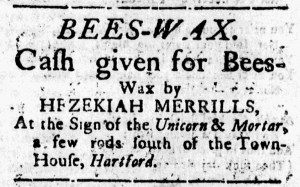
Hezekiah Merrill ran an apothecary shop in Hartford in the early 1770s.  In October 1773, he placed advertisements in the Connecticut Courant to promote the variety of patent medicines that he sold, including Bateman’s Drops and Cordials, Turlington’s Balsam of Life, and Hooper’s Female Pills.  Each of those remedies would have been as familiar to eighteenth-century readers as popular over-the-counter medications are to modern consumers.  Merrill, like others who sold the same patent medicines, did not believe that they required descriptions when advertising them.  The apothecary also stocked books at his shop.

Merrill marked the location of his shop with “the Sign of the Unicorn & Mortar,” an appropriate image for an apothecary, and further advised prospective customers that they could find it “a few rods south of the Town-House.” Residents of Hartford regularly passed the shop and its sign, making it a familiar sight in their daily routines.  For visitors from the countryside, the sign made Merrill’s location unmistakable as they navigated town.  The apothecary encouraged consumers to associate the image of the Unicorn and Mortar with his business, treating it as a logo of sorts.  He inserted two advertisements in the October 5, 1773, edition of the Connecticut Courant, both of them invoking his shop sign.  A longer one on the first page listed the patent medicines and other merchandise, while a shorter one on the third page solicited beeswax in exchange for cash.  Just as residents of Hartford frequently glimpsed the sign, readers of the Connecticut Courant encountered “the Sign of the Unicorn & Mortar” more than once when they perused that issue.

Today, those advertisements testify to some of the sights that colonizers saw as they traversed the streets of colonial Hartford.  According to Thomas Hilldrup’s advertisement in the same issue of the Connecticut Courant, “the sign of the Dial” adorned the shop where he cleaned and repaired watches near the court house.  Other purveyors of goods and services in Hartford almost certainly displayed signs, contributing to the visual landscape of commercial activity in the town.  Few of those signs survive today, except for the descriptions of them in newspaper advertisements.

Slavery Advertisements Published October 5, 1773

The Slavery Adverts 250 Project chronicles the role of newspaper advertising in perpetuating slavery in the era of the American Revolution. The project seeks to reveal the ubiquity of slavery in eighteenth-century life from New England to Georgia by republishing advertisements about enslaved people – for sale as individuals or in groups, wanted to purchase or for hire for short periods, runaways who liberated themselves, and those who were subsequently captured and confined in jails and workhouses – in daily digests on this site as well as in real time via the @SlaveAdverts250 Twitter feed, utilizing twenty-first-century media to stand in for the print media of the eighteenth century.
The project aims to provide modern audiences with a sense of just how often colonizers encountered these advertisements in their daily lives. Enslaved men, women, and children appeared in print somewhere in the colonies almost every single day. Those advertisements served as a constant backdrop for social, cultural, economic, and political life in colonial and revolutionary America. Colonizers who did not purport to own enslaved people were still confronted with slavery as well as invited to maintain the system by purchasing enslaved men, women, and children or assisting in the capture of so-called “runaways” who sought to free themselves from bondage. The frequency of these newspaper advertisements suggests just how embedded slavery was in colonial and revolutionary American culture in everyday interactions beyond the printed page.

These advertisements also testify to the experiences of enslaved men, women, and children, though readers must consider that those experiences have been remediated through descriptions offered by enslavers rather than enslaved people themselves. Often unnamed in the advertisements, enslaved men, women, and children were not invisible or unimportant in early America.

These advertisements appeared in colonial American newspapers 250 years ago today.

Connecticut Courant (October 5, 1773).

**********

South-Carolina Gazette and Country Journal (October 5, 1773).

**********

South-Carolina Gazette and Country Journal (October 5, 1773).

**********

South-Carolina Gazette and Country Journal (October 5, 1773).

**********

South-Carolina Gazette and Country Journal (October 5, 1773).

**********

South-Carolina Gazette and Country Journal (October 5, 1773).

**********

South-Carolina Gazette and Country Journal (October 5, 1773).

**********

South-Carolina Gazette and Country Journal (October 5, 1773).

**********

South-Carolina Gazette and Country Journal (October 5, 1773).

**********

South-Carolina Gazette and Country Journal (October 5, 1773).

**********

South-Carolina Gazette and Country Journal (October 5, 1773).

**********

South-Carolina Gazette and Country Journal (October 5, 1773).

**********

South-Carolina Gazette and Country Journal (October 5, 1773).

**********

South-Carolina Gazette and Country Journal (October 5, 1773).

**********

South-Carolina Gazette and Country Journal (October 5, 1773).