Slavery Advertisements Published December 2, 1773

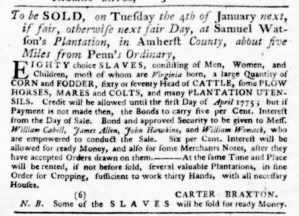
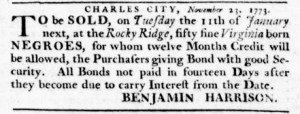
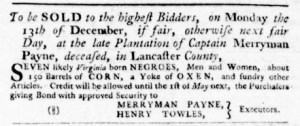
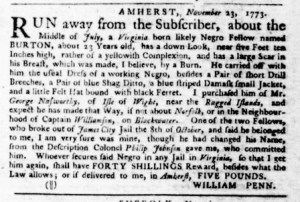
The Slavery Adverts 250 Project chronicles the role of newspaper advertising in perpetuating slavery in the era of the American Revolution. The project seeks to reveal the ubiquity of slavery in eighteenth-century life from New England to Georgia by republishing advertisements about enslaved people – for sale as individuals or in groups, wanted to purchase or for hire for short periods, runaways who liberated themselves, and those who were subsequently captured and confined in jails and workhouses – in daily digests on this site as well as in real time via the @SlaveAdverts250 Twitter feed, utilizing twenty-first-century media to stand in for the print media of the eighteenth century.

The project aims to provide modern audiences with a sense of just how often colonizers encountered these advertisements in their daily lives. Enslaved men, women, and children appeared in print somewhere in the colonies almost every single day. Those advertisements served as a constant backdrop for social, cultural, economic, and political life in colonial and revolutionary America. Colonizers who did not purport to own enslaved people were still confronted with slavery as well as invited to maintain the system by purchasing enslaved men, women, and children or assisting in the capture of so-called “runaways” who sought to free themselves from bondage. The frequency of these newspaper advertisements suggests just how embedded slavery was in colonial and revolutionary American culture in everyday interactions beyond the printed page.

These advertisements also testify to the experiences of enslaved men, women, and children, though readers must consider that those experiences have been remediated through descriptions offered by enslavers rather than enslaved people themselves. Often unnamed in the advertisements, enslaved men, women, and children were not invisible or unimportant in early America.

These advertisements appeared in colonial American newspapers 250 years ago today.
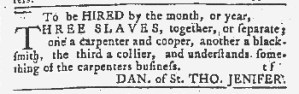
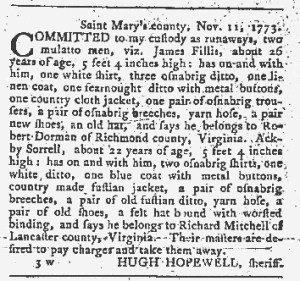
Maryland Gazette (December 2, 1773).

**********

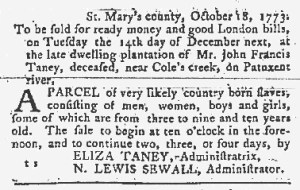
Maryland Gazette (December 2, 1773).

**********

Maryland Gazette (December 2, 1773).

**********

Maryland Gazette (December 2, 1773).

**********

Maryland Gazette (December 2, 1773).

**********

Maryland Gazette (December 2, 1773).

**********

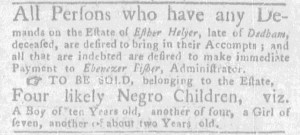
Massachusetts Gazette ad Boston Weekly News-Letter (December 2, 1773).

**********

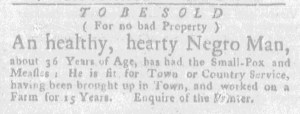
Massachusetts Gazette ad Boston Weekly News-Letter (December 2, 1773).

**********

Massachusetts Gazette ad Boston Weekly News-Letter (December 2, 1773).

**********

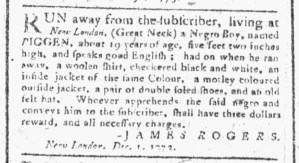
Norwich Packet (December 2, 1773).

**********

Rivington’s New-York Gazetteer (December 2, 1773).

**********

Rivington’s New-York Gazetteer (December 2, 1773).

**********

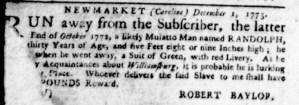
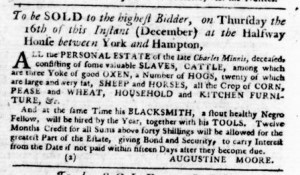
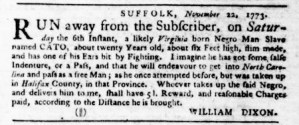
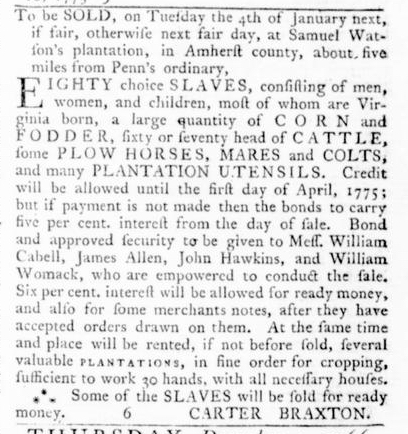
Virginia Gazette [Purdie & Dixon] (December 2, 1773).

**********

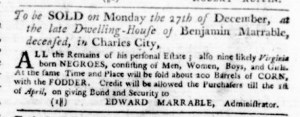
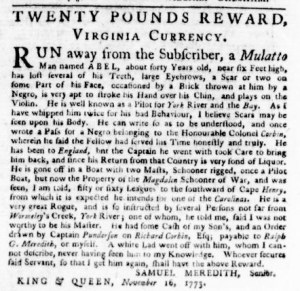
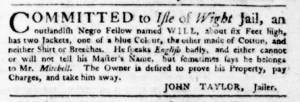
Virginia Gazette [Purdie & Dixon] (December 2, 1773).

**********

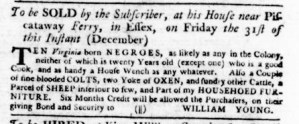
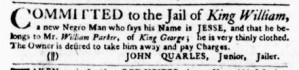
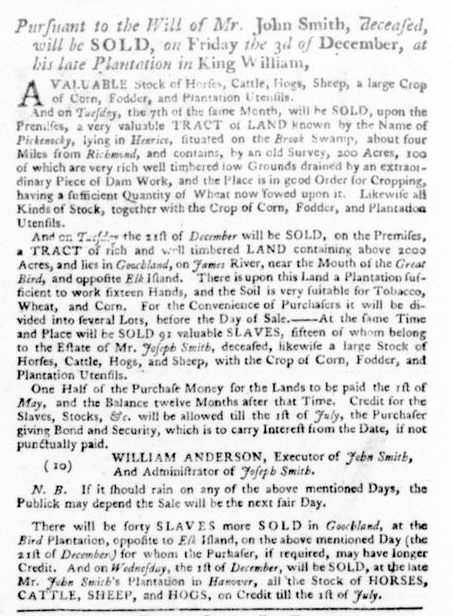
Virginia Gazette [Purdie & Dixon] (December 2, 1773).

**********

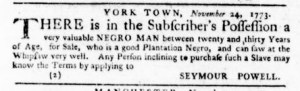
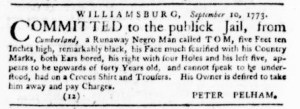
Virginia Gazette [Purdie & Dixon] (December 2, 1773).

**********

Virginia Gazette [Purdie & Dixon] (December 2, 1773).

**********

Virginia Gazette [Purdie & Dixon] (December 2, 1773).

**********

Virginia Gazette [Purdie & Dixon] (December 2, 1773).

**********

Virginia Gazette [Purdie & Dixon] (December 2, 1773).

**********

Virginia Gazette [Purdie & Dixon] (December 2, 1773).

**********

Virginia Gazette [Purdie & Dixon] (December 2, 1773).

**********

Virginia Gazette [Purdie & Dixon] (December 2, 1773).

**********

Virginia Gazette [Purdie & Dixon] (December 2, 1773).

**********

Virginia Gazette [Purdie & Dixon] (December 2, 1773).

**********

Virginia Gazette [Purdie & Dixon] (December 2, 1773).

**********

Virginia Gazette [Purdie & Dixon] (December 2, 1773).

**********

Virginia Gazette [Purdie & Dixon] (December 2, 1773).

**********

Virginia Gazette [Purdie & Dixon] (December 2, 1773).

**********

Virginia Gazette [Purdie & Dixon] (December 2, 1773).

**********

Virginia Gazette [Purdie & Dixon] (December 2, 1773).

**********

Virginia Gazette [Purdie & Dixon] (December 2, 1773).

**********

Virginia Gazette [Rind] (December 2, 1773).

**********

Virginia Gazette [Rind] (December 2, 1773).

December 1

What was advertised in a colonial American newspaper 250 years ago today?

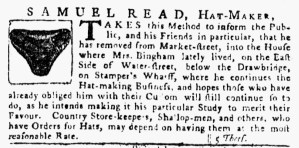
Pennsylvania Gazette (December 1, 1773).

“He continues the Hat-making Business, and hopes those who have already obliged him with their Custom will continue so to do.”

When he moved from Market Street to Water Street in Philadelphia, Samuel Read, “HAT-MAKER,” ran an advertisement in the Pennsylvania Gazette to “inform the Public, and his Friends in particular” of his new location.  He encouraged “those who have already obliged him with their Custom” to visit his new shop, especially since he “intends making it his particular Study to merit their Favour.”  Read also assured “Country Store-keepers, Shallop-men, and others, who have Orders for Hats” that they “may depend on having them at the most reasonable Rate.”

In an effort to draw attention to his advertisement, Read adorned it with a woodcut depicting a tricorne hat, a style so popular at the time that it has become widely associated with late eighteenth-century fashions.  Few advertisements in the December 1, 1773, edition of the Pennsylvania Gazette featured visual images.  The printers supplied woodcuts of vessels at sea for seven advertisements seeking freight and passengers for ships departing for other ports.  Frederick Hubley, a coppersmith in Lancaster, ran the only other advertisement with a woodcut designed for the exclusive use of his business.  Readers of the Pennsylvania Gazette became familiar with his woodcut of a still thanks to repeated insertions over several months.  Even with those advertisements appearing elsewhere in the newspaper, Read’s advertisement was the only one with a woodcut on the first page.

Rivington’s New-York Gazetteer (December 2, 1773).

Read’s woodcut reflected his occupation and distinguished his advertisement from others in the Pennsylvania Gazette, even though it was not as elaborate as a similar image that Nesbitt Deane, a hatmaker in New York, frequently used in his advertisements.  Deane’s woodcut depicted a tricorne hat above a ribbon that stated his name.  Deane also developed marketing appeals beyond those deployed by Read.  For instance, he declared that he devised “a method peculiar to himself, to turn rain, and prevent sweating of the head damaging the crown.”

Read’s advertisement was not as sophisticated as the one that Deane simultaneously ran in Rivington’s New-York Gazetteer, not in terms of the copy nor in terms of the visual image, yet the hatmaker in Philadelphia demonstrated more than a little marketing savvy.  His notice did not merely announce that he moved to a new location.  Read attempted to maintain existing relationships with his customers by promising that their satisfaction remained his primary concern.  He also promised low prices to retailers who would purchase in volume and other customers.  The woodcut, plain as it may seem to modern eyes, also drew attention to his advertisement, distinguishing it from most others in that issue of the Pennsylvania Gazette.

Slavery Advertisements Published December 1, 1773

The Slavery Adverts 250 Project chronicles the role of newspaper advertising in perpetuating slavery in the era of the American Revolution. The project seeks to reveal the ubiquity of slavery in eighteenth-century life from New England to Georgia by republishing advertisements about enslaved people – for sale as individuals or in groups, wanted to purchase or for hire for short periods, runaways who liberated themselves, and those who were subsequently captured and confined in jails and workhouses – in daily digests on this site as well as in real time via the @SlaveAdverts250 Twitter feed, utilizing twenty-first-century media to stand in for the print media of the eighteenth century.

The project aims to provide modern audiences with a sense of just how often colonizers encountered these advertisements in their daily lives. Enslaved men, women, and children appeared in print somewhere in the colonies almost every single day. Those advertisements served as a constant backdrop for social, cultural, economic, and political life in colonial and revolutionary America. Colonizers who did not purport to own enslaved people were still confronted with slavery as well as invited to maintain the system by purchasing enslaved men, women, and children or assisting in the capture of so-called “runaways” who sought to free themselves from bondage. The frequency of these newspaper advertisements suggests just how embedded slavery was in colonial and revolutionary American culture in everyday interactions beyond the printed page.

These advertisements also testify to the experiences of enslaved men, women, and children, though readers must consider that those experiences have been remediated through descriptions offered by enslavers rather than enslaved people themselves. Often unnamed in the advertisements, enslaved men, women, and children were not invisible or unimportant in early America.

These advertisements appeared in colonial American newspapers 250 years ago today.

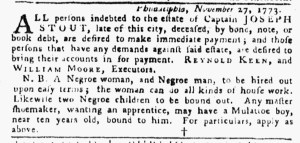
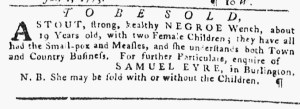
Pennsylvania Gazette (December 1, 1773).

**********

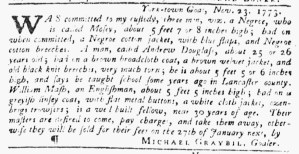
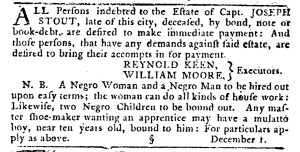
Pennsylvania Gazette (December 1, 1773).

**********

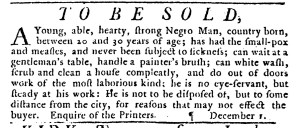
Pennsylvania Gazette (December 1, 1773).

**********

Pennsylvania Journal (December 1, 1773).

**********

Pennsylvania Journal (December 1, 1773).

**********

Pennsylvania Journal (December 1, 1773).