What was advertised in a colonial American newspaper 250 years ago today?
South-Carolina Gazette and Country Journal (December 7, 1773).
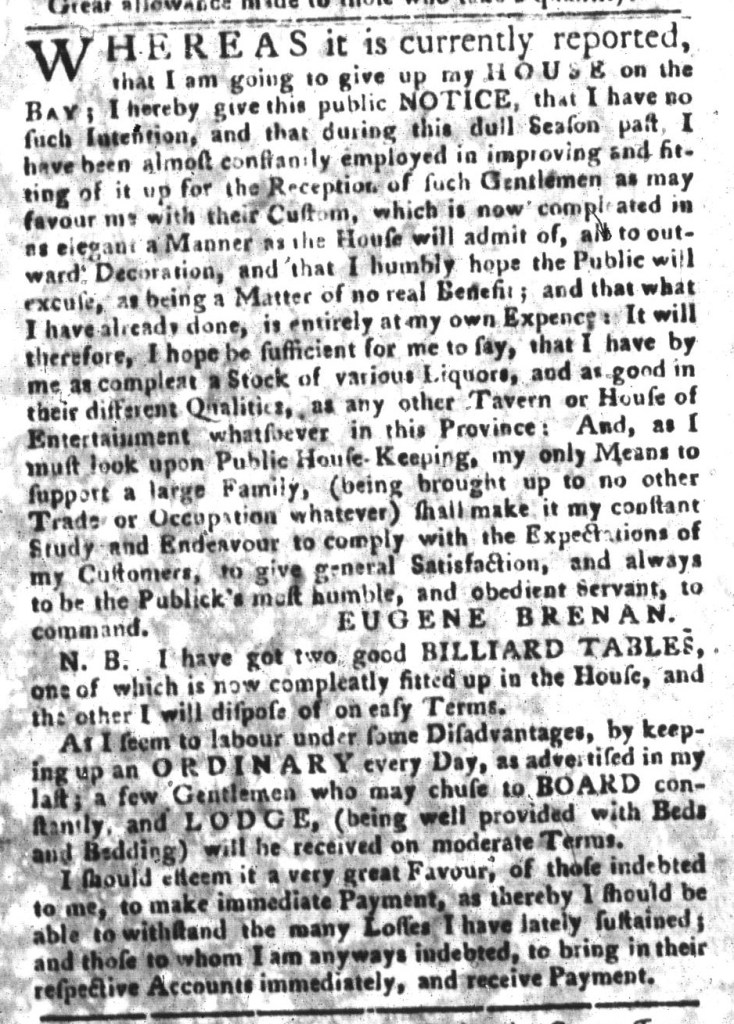
“As compleat a Stock of various Liquors … as any other Tavern or House of Entertainment whatsoever in this Province.”
Eugene Brenan worried that rumors purporting that he planned to “give up my HOUSE on the BAY” would damage business at his public house in Charleston. To dispel whatever gossip circulated about the fate of his establishment, he ran an advertisement in the December 7, 1773, edition of the South-Carolina Gazette and Country Journal. Though he acknowledged “many Losses …lately sustained,” he underscored his determination to run a public house that rivaled all others. Quite the opposite of what some reported about Brenan closing his doors, he had been “constantly employed in improving” and furnishing his public house “for the Reception of such Gentlemen as may favour [him] with their Custom.” His guests would convene in a gathering space “as elegant … as the House will admit of.” The “outward Decoration,” however, did not matter as much as other amenities that Brenan provided.
He attempted to entice customers with promises of “as compleat a Stock of various Liquors, and as good in their different Qualities, as any other Tavern or House of Entertainment whatsoever in this Province.” Whatever their tastes, gentlemen could order their favorite spirits at Brenan’s public house. He also equipped the establishment with a billiard table for the enjoyment of his patrons, allowing for some friendly competition as they socialized and sampled the “various Liquors.” Brenan encouraged readers to think of spending time at his public house as an experience, one that he “shall make it [his] constant Study and Endeavour to comply with the Expectations of [his] Customers.” He was especially motivated “to give general Satisfaction” because he had been “brought up to no other Trade or Occupation whatever.” Brenan put all of his energy into “Public House-Keeping” and tending to his patrons. Whatever the gentlemen of Charleston thought they knew about Brenan’s alleged plans to close his public house, he hoped that an advertisement setting the record straight would convince them to visit and see for themselves the improvements he made, sample the liquors he stocked, play billiards, and socialize with friends and acquaintances. Through his endeavors to serve them, Brenan suggested, his customers would discover a public house as comfortable and inviting as any in the bustling port of Charleston.
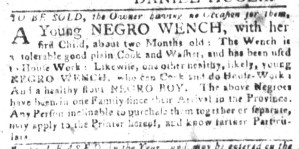
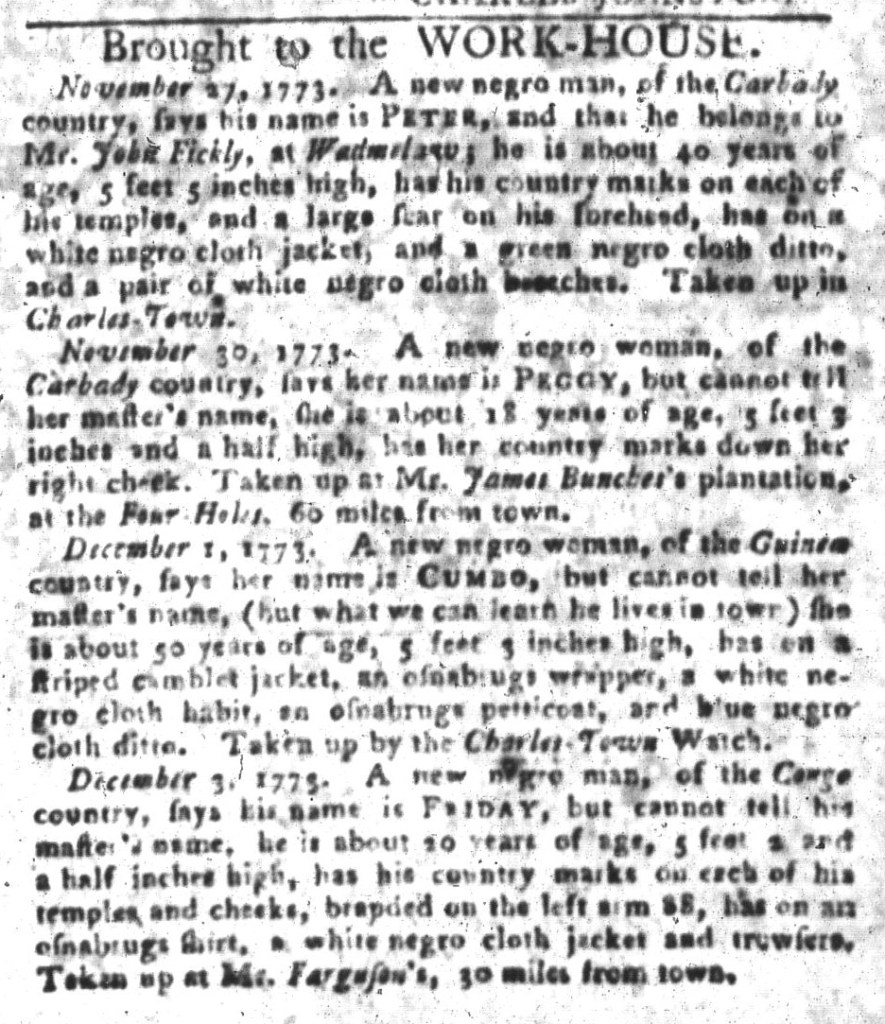
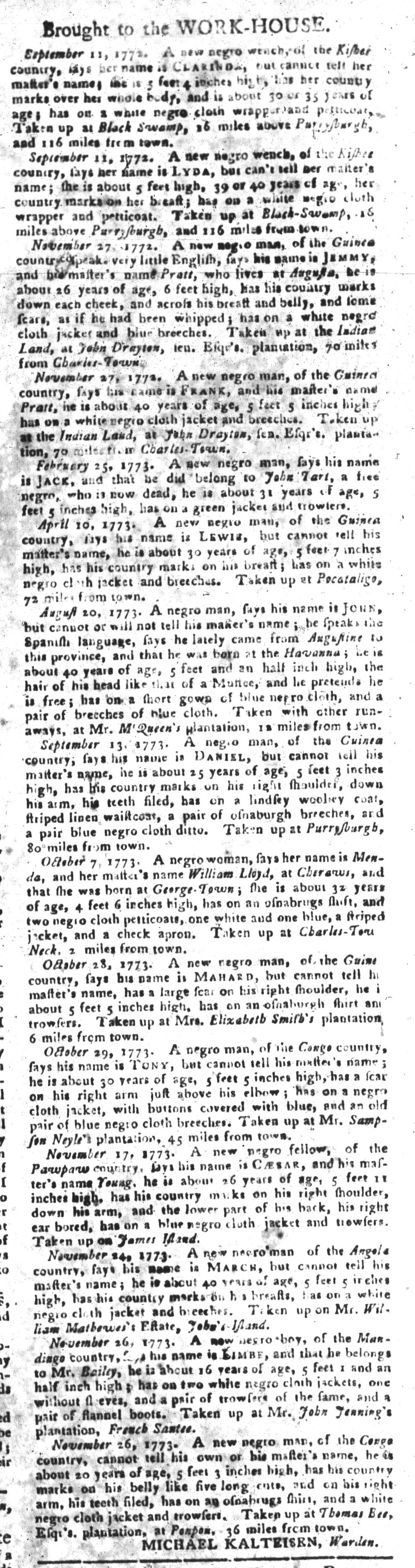
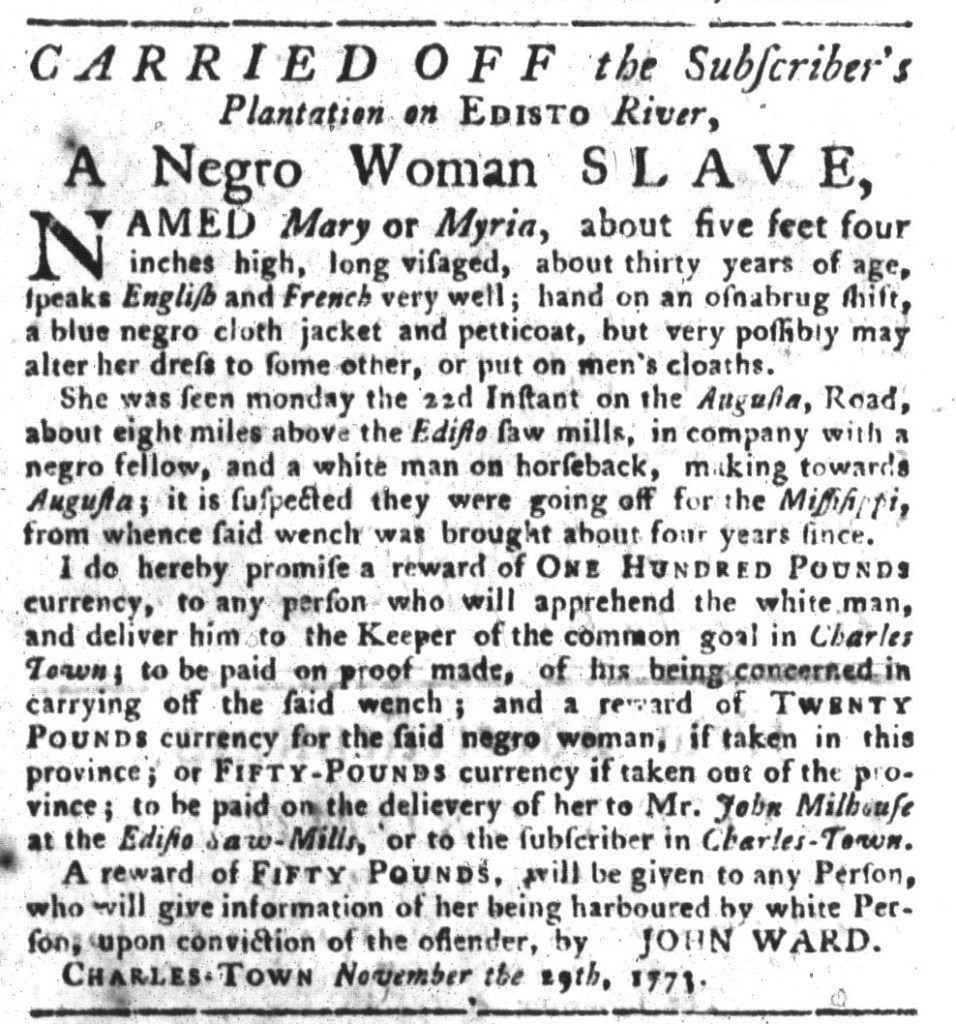
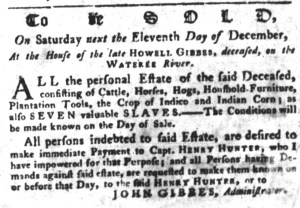
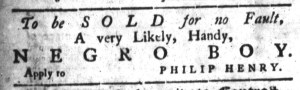
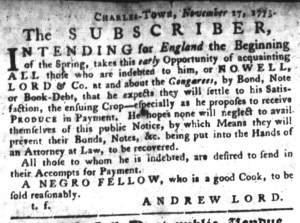
The Slavery Adverts 250 Project chronicles the role of newspaper advertising in perpetuating slavery in the era of the American Revolution. The project seeks to reveal the ubiquity of slavery in eighteenth-century life from New England to Georgia by republishing advertisements about enslaved people – for sale as individuals or in groups, wanted to purchase or for hire for short periods, runaways who liberated themselves, and those who were subsequently captured and confined in jails and workhouses – in daily digests on this site as well as in real time via the @SlaveAdverts250 Twitter feed, utilizing twenty-first-century media to stand in for the print media of the eighteenth century.
The project aims to provide modern audiences with a sense of just how often colonizers encountered these advertisements in their daily lives. Enslaved men, women, and children appeared in print somewhere in the colonies almost every single day. Those advertisements served as a constant backdrop for social, cultural, economic, and political life in colonial and revolutionary America. Colonizers who did not purport to own enslaved people were still confronted with slavery as well as invited to maintain the system by purchasing enslaved men, women, and children or assisting in the capture of so-called “runaways” who sought to free themselves from bondage. The frequency of these newspaper advertisements suggests just how embedded slavery was in colonial and revolutionary American culture in everyday interactions beyond the printed page.
These advertisements also testify to the experiences of enslaved men, women, and children, though readers must consider that those experiences have been remediated through descriptions offered by enslavers rather than enslaved people themselves. Often unnamed in the advertisements, enslaved men, women, and children were not invisible or unimportant in early America.
These advertisements appeared in colonial American newspapers 250 years ago today.
Essex Gazette (December 7, 1773).
**********
South-Carolina Gazette and Country Journal (December 7, 1773).
**********
South-Carolina Gazette and Country Journal (December 7, 1773).
**********
South-Carolina Gazette and Country Journal (December 7, 1773).
**********
South-Carolina Gazette and Country Journal (December 7, 1773).
**********
South-Carolina Gazette and Country Journal (December 7, 1773).
**********
South-Carolina Gazette and Country Journal (December 7, 1773).
**********
South-Carolina Gazette and Country Journal (December 7, 1773).
**********
South-Carolina Gazette and Country Journal (December 7, 1773).
**********
South-Carolina Gazette and Country Journal (December 7, 1773).
**********
South-Carolina Gazette and Country Journal (December 7, 1773).
What was advertised in a colonial American newspaper 250 years ago today?
Supplement to the South-Carolina Gazette (December 6, 1773).
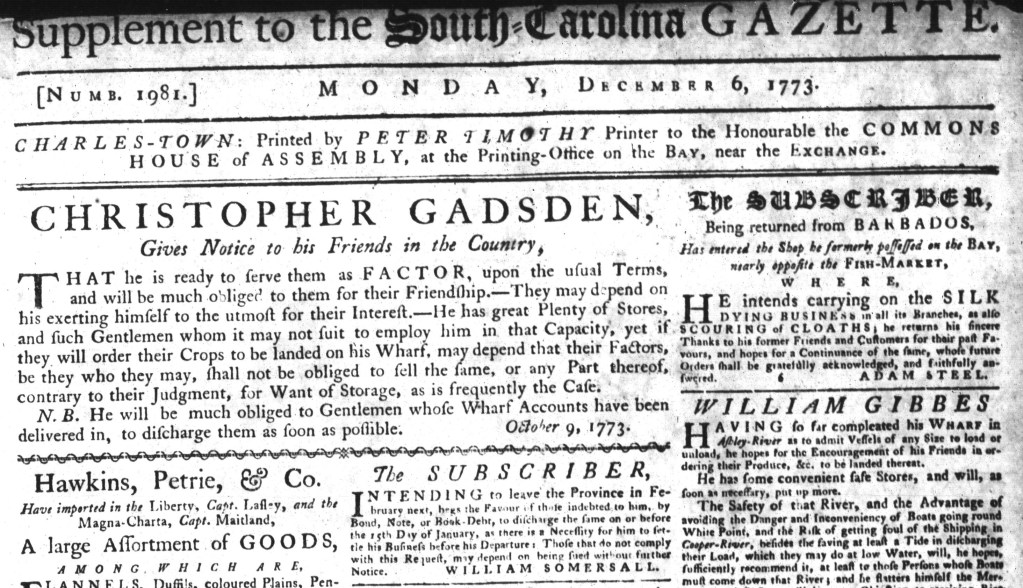
“CHRISTOPHER GADSDEN, Gives Notice to his Friends … THAT he is ready to serve them as FACTOR.”
In the fall of 1773, Christopher Gadsden took to the pages of newspapers published in Charleston to offer his services “as FACTOR, upon the usual Terms,” to plantation owners who raised rice, indigo, and other crops “in the Country.” For those who did not wish to employ him as an agent buying and selling commodities on their behalf, he also rented space in a “great Plenty of Stores” or warehouses “on his Wharf.”
The copy in Gadsden’s advertisement read much the same as the notices placed by his competitors. The format, however, distinguished his advertisement from the dozens of others placed for many different purposes. At least that was the case in the South-Carolina Gazette. In that newspaper, Gadsden’s advertisement extended across two columns. His name served as a headline, the size of the font rivaling the title of the newspaper in the masthead. The rest of the copy appeared in larger font than other notices, also demanding the attention of readers.
South-Carolina Gazette and Country Journal (December 7, 1773).
That differed from Gadsden’s advertisement in the South-Carolina Gazette and Country Journal. Featuring identical copy, it had a much different format. His name once again served as a headline, but in a font the same size used for headlines of other advertisements. Most significantly, the compositor confined that advertisement to a single column, one more notice among the many that ran in that newspaper.
Compositors usually made decisions about the format of advertisements after advertisers submitted copy to printing offices. In this instance, however, the extraordinary format for Gadsden’s advertisement in the South-Carolina Gazettesuggests that he successfully negotiated for some sort of design to set his notice apart from others. Did he envision an advertisement spanning two columns? Or did the compositor make that decision after learning that Gadsden wanted something different? Did Gadsden make a similar request for his advertisement in the South-Carolina Gazette and Country Journal, only to have it rejected? Some printers and compositors seemed more amenable to instructions from advertisers than others. In Boston, for instance, decorative borders enclosed Jolley Allen’s notices in every newspaper except the Massachusetts Spy. Isaiah Thomas, the printer, presumably rejected Allen’s trademark format. Similarly, Gadsden may have had more luck working with Peter Timothy and the South-Carolina Gazette than with Charles Crouch and the South-Carolina Gazette and Country Journal.
The Slavery Adverts 250 Project chronicles the role of newspaper advertising in perpetuating slavery in the era of the American Revolution. The project seeks to reveal the ubiquity of slavery in eighteenth-century life from New England to Georgia by republishing advertisements about enslaved people – for sale as individuals or in groups, wanted to purchase or for hire for short periods, runaways who liberated themselves, and those who were subsequently captured and confined in jails and workhouses – in daily digests on this site as well as in real time via the @SlaveAdverts250 Twitter feed, utilizing twenty-first-century media to stand in for the print media of the eighteenth century.
The project aims to provide modern audiences with a sense of just how often colonizers encountered these advertisements in their daily lives. Enslaved men, women, and children appeared in print somewhere in the colonies almost every single day. Those advertisements served as a constant backdrop for social, cultural, economic, and political life in colonial and revolutionary America. Colonizers who did not purport to own enslaved people were still confronted with slavery as well as invited to maintain the system by purchasing enslaved men, women, and children or assisting in the capture of so-called “runaways” who sought to free themselves from bondage. The frequency of these newspaper advertisements suggests just how embedded slavery was in colonial and revolutionary American culture in everyday interactions beyond the printed page.
These advertisements also testify to the experiences of enslaved men, women, and children, though readers must consider that those experiences have been remediated through descriptions offered by enslavers rather than enslaved people themselves. Often unnamed in the advertisements, enslaved men, women, and children were not invisible or unimportant in early America.
These advertisements appeared in colonial American newspapers 250 years ago today.
Boston-Gazette (December 6, 1773).
**********
Newport Mercury (December 6, 1773).
**********
Newport Mercury (December 6, 1773).
**********
New-York Gazette and Weekly Mercury (December 6, 1773).
**********
New-York Gazette and Weekly Mercury (December 6, 1773).
**********
Supplement to the New-York Gazette and Weekly Mercury (December 6, 1773).
**********
Supplement to the New-York Gazette and Weekly Mercury (December 6, 1773).
**********
Pennsylvania Packet (December 6, 1773).
**********
Pennsylvania Packet (December 6, 1773).
**********
South-Carolina Gazette (December 6, 1773).
**********
South-Carolina Gazette (December 6, 1773).
**********
South-Carolina Gazette (December 6, 1773).
**********
South-Carolina Gazette (December 6, 1773).
**********
South-Carolina Gazette (December 6, 1773).
**********
South-Carolina Gazette (December 6, 1773).
**********
Supplement to the South-Carolina Gazette (December 6, 1773).
**********
Supplement to the South-Carolina Gazette (December 6, 1773).
**********
Supplement to the South-Carolina Gazette (December 6, 1773).
**********
Supplement to the South-Carolina Gazette (December 6, 1773).
**********
Supplement to the South-Carolina Gazette (December 6, 1773).
**********
Supplement to the South-Carolina Gazette (December 6, 1773).
**********
Supplement to the South-Carolina Gazette (December 6, 1773).
**********
Supplement to the South-Carolina Gazette (December 6, 1773).
What was advertised in a colonial American newspaper 250 years ago this week?
New-York Journal (December 2, 1773).
“Those who really wish to promote the interest of America … will contribute their aid to the success of the paper manufactory.”
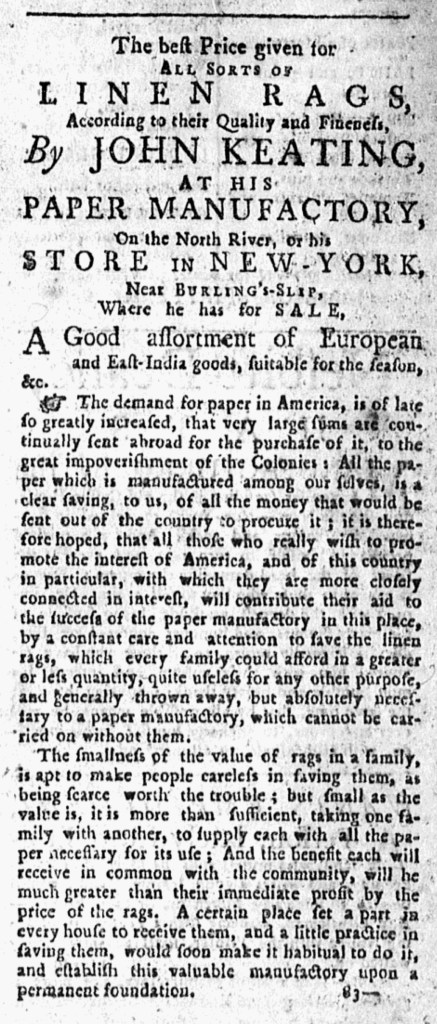
John Keating, the proprietor of a “PAPER MANUFACTORY” near New York, had a task for every household in the colonies: collect rags to make into paper. That might seem like an insignificant act, he argued in an advertisement that appeared week after week in the New-York Journal, but it had value beyond measure. “The smallness of the value of rags in a family, is apt to make people careless in saving them, as being scarce worth the trouble,” Keating acknowledged. However, “small as the value is, it is more than sufficient, taking one family with another, to supply each with all the paper necessary for its use.” This endeavor, like so many acts of protest against the abuse of Parliament, depended on colonizers working in unison. Cooperation yielded strength. Keating elaborated on his vision: “And the benefit each will receive in common with the community, will be much greater than the immediate profit by the of the rags.” To achieve that goal, he encouraged every household to designate a spot for collecting rags, noting that “a little practice in saving them, would soon make it habitual to do it, and establish this valuable manufactory upon a permanent foundation.”
True patriots would heed this call to help meet the demand for paper in America, “of late so greatly increased, that very large sums are continually sent abroad for the purchase of it.” Importing paper instead of producing it locally resulted in “the great impoverishment of the colonies,” an assertion that Keating made in advertisement after advertisement for several years in the late 1760s and early 1770s. “All the paper which is manufactured among ourselves,” he proclaimed, “is a clear saving, to us, of all the money that would be sent out of the country to procure it.” Rather than exacerbate a trade imbalance with England, “those who really wish to promote the interest of America … will contribute their aid to the success of the paper manufactory in this place.” That meant purchasing paper from Keating, yet his advertisements usually emphasized participating in the production of paper rather than the consumption of his product. Given the demand, he likely assumed that he could sell paper as quickly as he produced it. He needed the most assistance with procuring the necessary materials, “linen rags, quite useless for any other purpose, and generally thrown away.” The strength of the local economy depended on the efforts of the members of every household. According to Keating, wives and mothers, indentured servants and enslaved people, and youths and children all had a role to play in supporting this important industry in New York during the era of the American Revolution.
What was advertised in a colonial American newspaper 250 years ago today?
Essex Journal (December 4, 1773).
“THOSE LADIES and GENTLEMEN who are desirous of seeing the curious ART of PRINTING, are hereby informed that on MONDAY next the Printing Office, will be opened for their reception.”
When Isaiah Thomas and Henry-Walter Tinges formed a partnership to publish the Essex Journal and Merrimack Packet: Or, the Massachusetts and New-Hampshire General Advertiser in the fall of 1773, they devised a savvy marketing campaign. Thomas already published the Massachusetts Spy in Boston. He continued overseeing that newspaper, while Tinges ran the printing office in Newburyport. To generate interest in the new publication, the partners inserted a notice in the November 26 edition of the Massachusetts Spy, informing both prospective subscribers and prospective advertisers that they would distribute the inaugural issue of the Essex Journal “GRATIS” on December 4. They envisioned “a very large Number will be printed off, and distributed throughout the Provinces of Massachusetts Bay and New-Hampshire.”
Thomas and Tinges used that first issue as a vehicle for further promoting the newspaper as well as several ventures Thomas already had underway. An extensive address “To the PUBLIC” from the printers and “PROPOSALS For CONTINUING the ESSEX JOURNAL” filled most of the first page, appearing below a masthead that included woodcuts of the arms of the colony, an indigenous man holding an arrow in one hand and a bow in the other, on the left and a packet ship under sail, presumably carrying newspapers and letters, on the right. The title of the newspaper ran between the images. At short advertisement for a magazine that Thomas already marketed extensively completed the final column: “SUBSCRIPTIONS for the ROYAL AMERICAN MAGAZINE, which will speedily be published by I. THOMAS, in Boston, are taken in at the Printing-Office.” A longer advertisement addressed to “the generous Patrons and Promoters of useful KNOWLEDGE, throughout AMERICA,” a notice that previously appeared in several newspapers published in Boston, appeared on the final page of the inaugural issue. In it, Thomas solicited articles for the Royal American Magazine and warned prospective subscribers to submit their names soon or risk missing the first issue. A shorter advertisement on the final page promoted “Thomas’s Boston Sheet ALMANACK for the year ensuing, proper for all Merchants, Shopkeepers, &c. to paste or hang up in their Stores or Shops.”
Essex Journal (December 4, 1773).
On the third page, the first advertisement immediately following the news invited “LADIES and GENTLEMEN who are desirous of seeing the curious ART of PRINTING” to visit the printing office on the following Monday. The printers planned to open their shop to the public, prepared to “wait on all who will do them the honour of their company.” Thomas and Tinges highlighted demonstrations scheduled for “eleven o’clock in the forenoon, and at three in the afternoon.” They hoped that such exhibitions would help convince prospective subscribers and prospective advertisers to do business with them. Opening the printing office to the public “for their reception” anticipated open houses that many businesses now host to draw attention to new endeavors. Another advertisement, this one on the final page, asked “GENTLEMEN and LADIES in this and the neighbouring towns who will encourage the Publication of this Paper” to “send in their names with all convenient speed.” Thomas and Tinges suggested that publishing subsequent issues of the Essex Journal was not a foregone conclusion. Instead, they needed prospective subscribers to confirm their commitment before the next issue would go to press. A second issue depended on “a sufficient number of Subscribers.” As a final bonus, a supplement accompanied the inaugural issue. It featured news about “the detestable TEA sent out by the East-India Company, part of which being just arrived in [Boston] harbour,” that made its way to Newburyport the previous day via “Friday’s Post.” With the supplement, Thomas and Tinges made the point that subscribers to the Essex Journal could expect to receive the latest news as soon as it arrived in Newburyport rather than waiting for the Essex Gazette, published in Salem, the New-Hampshire Gazette, published in Portsmouth, or any of the newspapers published in Boston.
Despite these efforts, it took a few weeks for Thomas and Tinges to collect enough subscriptions to convince them of the viability of publishing the Essex Journal. The various marketing strategies incorporated into the inaugural issue, from distributing free copies to the extensive subscription proposals to the open house at the printing office to the news supplement, likely helped generate interest, but the process took time. Thomas and Tinges did not publish the second issue of the Essex Journal for more than three weeks. It appeared on December 29, once again carrying the proposals and conditions to entice readers who had not yet subscribed.
The Slavery Adverts 250 Project chronicles the role of newspaper advertising in perpetuating slavery in the era of the American Revolution. The project seeks to reveal the ubiquity of slavery in eighteenth-century life from New England to Georgia by republishing advertisements about enslaved people – for sale as individuals or in groups, wanted to purchase or for hire for short periods, runaways who liberated themselves, and those who were subsequently captured and confined in jails and workhouses – in daily digests on this site as well as in real time via the @SlaveAdverts250 Twitter feed, utilizing twenty-first-century media to stand in for the print media of the eighteenth century.
The project aims to provide modern audiences with a sense of just how often colonizers encountered these advertisements in their daily lives. Enslaved men, women, and children appeared in print somewhere in the colonies almost every single day. Those advertisements served as a constant backdrop for social, cultural, economic, and political life in colonial and revolutionary America. Colonizers who did not purport to own enslaved people were still confronted with slavery as well as invited to maintain the system by purchasing enslaved men, women, and children or assisting in the capture of so-called “runaways” who sought to free themselves from bondage. The frequency of these newspaper advertisements suggests just how embedded slavery was in colonial and revolutionary American culture in everyday interactions beyond the printed page.
These advertisements also testify to the experiences of enslaved men, women, and children, though readers must consider that those experiences have been remediated through descriptions offered by enslavers rather than enslaved people themselves. Often unnamed in the advertisements, enslaved men, women, and children were not invisible or unimportant in early America.
These advertisements appeared in colonial American newspapers 250 years ago today.
What was advertised in a colonial American newspaper 250 years ago today?
New-London Gazette (December 3, 1773).
“Hill’s Balsam of Honey, Ditto Elixir Bardana.”
Simon Wolcott advertised a “fresh and general Assortment of DRUGS and MEDICINES” in the December 3, 1773, edition of the New-London Gazette. The merchandise that he “Just IMPORTED from LONDON” and sold “as cheap as in New-York or Boston” included a dozen popular “PATENTED MEDICINES,” such Bateman’s Drops, Godfrey’s Cordial, and Turlington’s Balsam of Life. The copy of the New-London Gazette digitized for inclusion in America’s Historical Newspapers, the most extensive database of eighteenth-century newspapers, includes manuscript additions. At some point, someone crossed out four of the patent medicines: Hill’s Balsam of Honey, Hill’s Elixir Bardana, Jesuit’s Drops, and Mountpelier Drops. Why?
This could have been done in the printing office, especially if Wolcott wished to update his advertisement to exclude those medicines. However, Wolcott’s notice ran in the next five issues of the New-London Gazette (which became the Connecticut Gazette with the December 17 edition) without any changes before he discontinued it in the middle of January 1774. Such marks could have also been made in the printing office if Wolcott ordered handbills but for some reason wished to feature only some of the patent medicines. Any handbills, trade cards, or other advertisements that Wolcott commissioned to supplement his newspaper notices have not survived.
Alternately, a reader may have crossed off those patent medicines for their own purposes. For instance, an apothecary or shopkeeper looking to restock their own supplies could have crossed out those that they did not wish to acquire before writing a letter and sending an order to Wolcott or taking the newspaper to his shop to guide their purchases. Similarly, someone managing a household or putting together a box of commonly used medicines for traveling could have made similar notations to indicate which medicines they needed and which they did not. Someone else may have crossed out those patent medicines for some other reason, perhaps indicating which they had tried and found ineffective.
Whatever the reason for the manuscript additions to Wolcott’s advertisement in this copy of the New-London Gazette, the marks indicate that someone engaged with the newspaper beyond merely perusing its contents. The notations indicate something of some significance to the person who made them, though their purpose remains a mystery to readers who encounter the newspaper notice centuries later.
The Slavery Adverts 250 Project chronicles the role of newspaper advertising in perpetuating slavery in the era of the American Revolution. The project seeks to reveal the ubiquity of slavery in eighteenth-century life from New England to Georgia by republishing advertisements about enslaved people – for sale as individuals or in groups, wanted to purchase or for hire for short periods, runaways who liberated themselves, and those who were subsequently captured and confined in jails and workhouses – in daily digests on this site as well as in real time via the @SlaveAdverts250 Twitter feed, utilizing twenty-first-century media to stand in for the print media of the eighteenth century.
The project aims to provide modern audiences with a sense of just how often colonizers encountered these advertisements in their daily lives. Enslaved men, women, and children appeared in print somewhere in the colonies almost every single day. Those advertisements served as a constant backdrop for social, cultural, economic, and political life in colonial and revolutionary America. Colonizers who did not purport to own enslaved people were still confronted with slavery as well as invited to maintain the system by purchasing enslaved men, women, and children or assisting in the capture of so-called “runaways” who sought to free themselves from bondage. The frequency of these newspaper advertisements suggests just how embedded slavery was in colonial and revolutionary American culture in everyday interactions beyond the printed page.
These advertisements also testify to the experiences of enslaved men, women, and children, though readers must consider that those experiences have been remediated through descriptions offered by enslavers rather than enslaved people themselves. Often unnamed in the advertisements, enslaved men, women, and children were not invisible or unimportant in early America.
These advertisements appeared in colonial American newspapers 250 years ago today.
Who was the subject of an advertisement in a colonial American newspaper 250 years ago today?
Norwich Packet (December 2, 1773).
“RUN away … a Negro Boy, named PIGGEN.”
It was the ninth issue of the Norwich Packet, a newspaper established by Alexander Robertson, James Robertson, and John Trumbull in October 1773. The ninth issue included an advertisement that described “a Negro Boy, named PIGGEN,” who liberated himself by running away from his enslaver, James Rogers. The advertisement documented the clothing worn by the young man, “about 19 years of age,” when he departed from New London, Connecticut. Rogers also reported that Piggen “speaks good English,” encouraging readers to listen to Black men they did not recognize as well as take note of their apparel. Anyone who identified Piggen, captured him, and returned him to Rogers “shall have three dollars reward.” This advertisement resembled so many others that appeared in newspapers from New England to Georgia.
It may not have been the first paid notice about an enslaved person that appeared in the Norwich Packet. The first several issues have not survived. Coverage in America’s Historical Newspapers, the most extensive database of digitized images of eighteenth-century newspapers, begins with the sixth issue. Previous issues might have included advertisements offering enslaved men, women, and children for sale or advertisements about other enslaved people who liberated themselves. Every newspaper published in New England at the time ran such advertisements. Whether or not Rogers’s advertisement about Piggen was the first to appear in the Norwich Packet, it took the Robertsons and Trumbull no more than two months to incorporate this particular kind of content into their new publication. In both northern colonies and southern colonies, printers quickly became complicit in perpetuating slavery by publishing such advertisements. In Baltimore, for instance, the first issue of the Maryland Journal, published August 20, 1773, included an advertisement by a broker seeking to purchase and enslaved girl and a notice promising a reward for Prince, an enslaved man who emancipated himself. In the third issue of Rivington’s New-York Gazetteer, published May 6, 1773, James Rivington published an advertisement offering a “Very fine Negro Boy” for sale. Nathaniel Mills and John Hicks became the new proprietors of the Massachusetts Gazette and Boston Post-Boy in the spring of 1773. They continued publishing advertisements about enslaved people, a policy already in place at that newspaper. When printers ran such advertisements, they generated revenues that underwrote the dissemination of other news during the era of the American Revolution.