
What was advertised in a colonial American newspaper 250 years ago today?
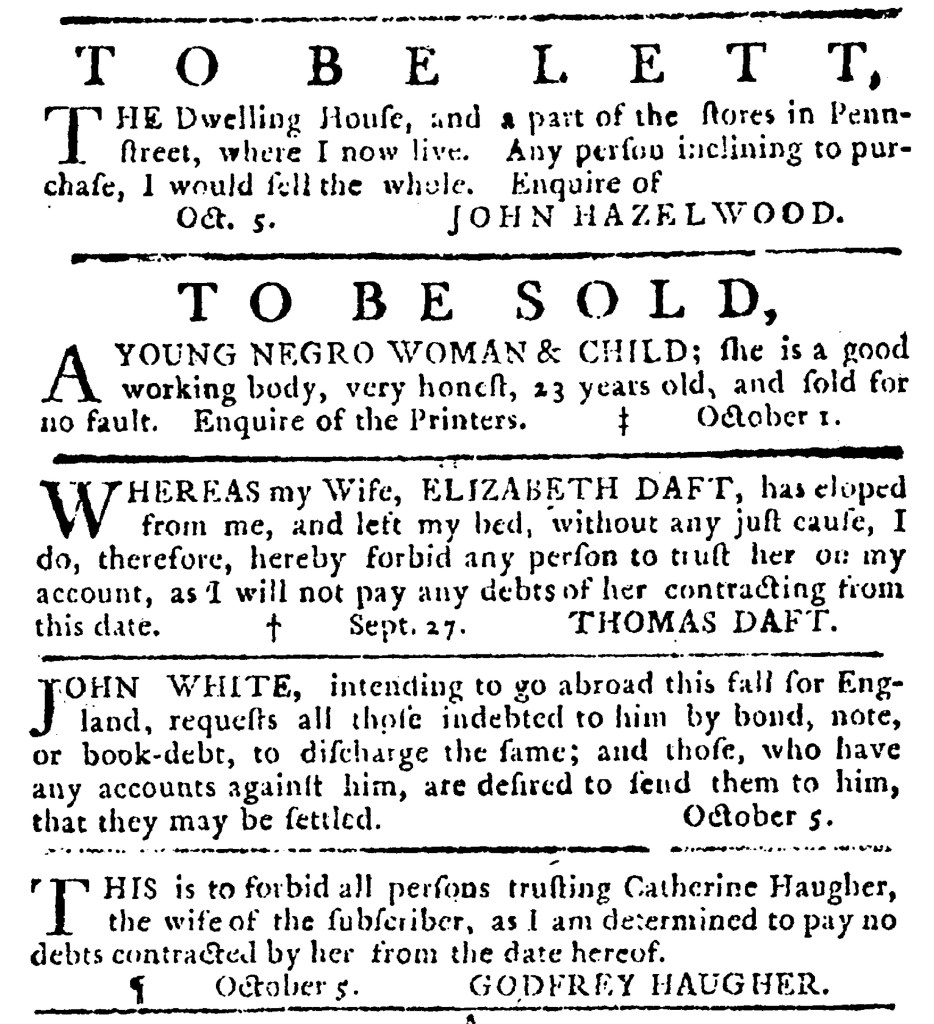
“TO BE LETT, THE Dwelling House.”
I often tell my students that doing history is like being a detective. The answers are not readily apparent. Instead, you have to sift through a lot of information, exercising good judgment in deciding what is relevant and what is not, to reconstruct what happened. Recognizing patterns can be helpful in putting together the clues you need to reach a reasonable conclusion.
I came across a mystery when working on this entry. I initially thought that I had discovered one thing, but with further investigation determined that my first conclusion was incorrect and that there was a better explanation. Let’s start with several advertisements that appeared one after the other in the October 5, 1774, edition of the Pennsylvania Journal. John Hazelwood announced a house for lease, the printers offered an enslaved woman and her child for sale on behalf of an anonymous advertiser, Thomas Daft refused to pay any debts contracted by his wife, John White sought to settle accounts before departing for England, and Godfrey Haugher also instructed the public that he would not pay any of his wife’s debts. Those same advertisements appeared in the same order in a supplement to the Pennsylvania Gazette. Furthermore, they appeared to be the same type!
I have previously encountered instances of printers in Boston seemingly sharing type for advertisements, but this was the first time that I found it happening in Philadelphia. Yet something seemed off. As much as I wanted this discovery to be real, I had doubts because it seemed so improbable. I then examined the supplement to the Pennsylvania Gazettemore closely. It did not have a masthead. Instead, the first page had a headline: “A LIST of the PRIZES drawn in the Delaware LOTTERY for the SALE of LANDS belonging to the EARL of STERLING, September 1, 1774.” That list occupied two entire pages and overflowed onto the third. The remainder of the supplement featured advertisements, including the five notices in question. A manuscript addition, just below the headline, read “Oct. 5, 1774.” At some point, someone, whether a reader, a collector, or a cataloger, had determined the date of the supplement based on the dates in the advertisements. The latest date, which appeared in several, was October 5, 1774.
This supplement reminded me of another supplement that had caused confusion when I consulted it. I used Readex’s America’s Historical Newspapers and Periodicals database to access the various newspapers published in Philadelphia in the 1770s. It includes a supplement to the Pennsylvania Journal for September 1, 1774. On closer examination, however, I determined that the two supplements are the same. The one associated with the Pennsylvania Journal had been misdated based on the headline that gave the date of the lottery, not the date of publication. All the October 5 advertisements made it impossible for the supplement to have been published on September 1. Without a masthead, separate copies of the supplement had been assigned to the newspapers that could have published them, though it is impossible to know who made those attributions and when. What was certain, however, was that the printers of the Pennsylvania Gazette and the Pennsylvania Journal had not shared type.
So, which newspaper actually published the supplement that contained the list of prizes for the lottery and the other advertisements? The October 12 edition of the Pennsylvania Journal includes the same five advertisements with identical format and in the same order. Apparently, they first appeared in the standard issue of the Pennsylvania Journal on October 5 and then the printers used them again in a supplement published no earlier than October 5 (and likely on October 5 or sometime during the week before distributing the October 12 edition), and then repeated them again on October 12. The database includes an error in dating the supplement when correctly assigning it to the Pennsylvania Journal and another error in associating it with the Pennsylvania Gazette at all, though those errors likely did not originate there. Upon unraveling this mystery, I had to alter what I planned to write about the advertisements for today’s entry. I also had to correct what I realized to be errors when compiling advertisements about enslaved people for the Slavery Adverts 250 Project. I did not make the discovery I initially thought I had, but I enjoyed solving the puzzle and achieving a better understanding of a supplement that had previously caused much confusion.