
What was advertised in a colonial American newspaper 250 years ago this week?
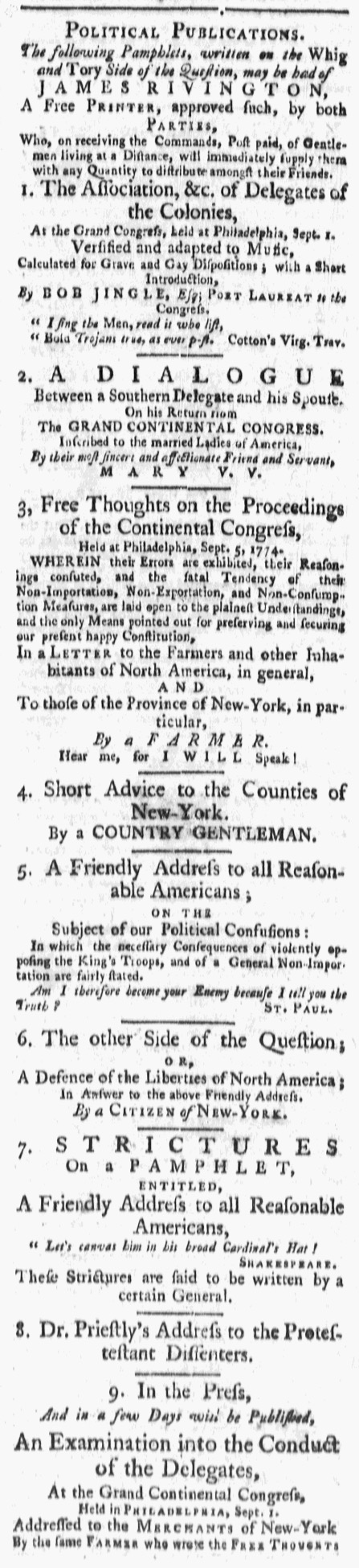
“POLITICAL PUBLICATIONS … written on the Whig and Tory Side of the Question.”
In chronicling the momentous events of 1774, the Adverts 250 Project has frequently featured advertisements for books, pamphlets, and other items related to the imperial crisis as it intensified following the Boston Tea Party and the Coercive Acts passed by Parliament in retaliation. Most printers increasingly privileged the Patriot’s perspective, both in terms of the news and editorials they selected for their newspapers and the works that they published, advertised, and sold. Yet they did not uniformly do so.
James Rivington, a Loyalist, proclaimed in the masthead of Rivington’s New-York Gazetteer that his newspaper was “PRINTED at his OPEN and UNINFLUENCED PRESS.” In Revolutionary Networks: The Business and Politics of Printing the News, 1763-1789, Joseph M. Adelman notes that “Rivington’s bookselling career was about making money rather than promoting a political ideology, so much so that he wanted to capitalize on relatively popular anti-imperial political tracts.”[1] One of his advertisements in the December 15, 1774, edition of his newspaper listed nine “POLITICAL PUBLICATIONS” that he sold. He explained that he stocked pamphlets “written on the Whig and Tory Side of the Question.” He demonstrated that was the case in the descriptions of some of those tracts. For instance, he carried “A Friendly Address to all Reasonable Americans; ON THE Subject of our Political Confusions: In which the necessary Consequences of violently opposing the King’s Troops, and of a General Non-Importation are fairly stated” and “The other Side of the Question; OR, A Defence of the Liberties of North America; In Answer to the above Friendly Address.” Debates over current events extended beyond the town common and newspaper editorials into pamphlet wars during the imperial crisis.
Those nine “POLITICAL PUBLICATIONS” included “Free Thoughts on the Proceedings of the Continental Congress,” in which “a FARMER” commented on the widely published and advertised account of the meetings held in Philadelphia in September and October. In that pamphlet, “their Errors are exhibited, their Reasonings confuted, and the fatal tendency of their Non-Importation, Non-Exportation, and Non-Consumption Measures, are laid open to the plainest Understandings, and the only Means pointed out for preserving and securing our present happy Constitution.” On the first page of the same issue, Rivington advertised “A full Vindication of the Measures of the Continental Congress, IN ANSWER TO Free Thoughts on the Proceedings of the said Congress.” The advertisement mocked “a FARMER” and his pamphlet, stating that in this response “his Sophistry is exposed, his Cavils confuted, his Artifices detected, and his Wit ridiculed.” Rivington added his own note: “The Printer, with humble Deference, presumes that this answer will meet with a gracious reception at the hands of every reader who has expressed disapprobation to the Freethoughts of Farmer.” For those who appreciated that pamphlet, however, Rivington announced that he would soon publish “THE CONGRESS CANVASSED; OR, An Examination into the Conduct of the Delegates … By the FARMER … Who wrote Free Thoughts on their Proceedings.” Rivington believed that political controversy meant business as he published, advertised, and sold works “on the Whig and Tory Side of the Question.” Seeking to maximize revenues, he suggested that “Gentlemen living at a Distance” submit orders for “any Quantity to distribute amongst their Friends.”
Rivington simultaneously asserted that he was “A Free PRINTER, approved such, by both PARTIES,” yet many observers did not care for his “OPEN and UNINFLUENCED” approach that undermined the Patriots’ perspective. Adelman explains that “Patriots eventually targeted Rivington and intended to destroy his business, by force if necessary.” In December 1774, as Rivington published these advertisements, an anonymous group of Patriots sent a letter to Stephen Ward and Stephen Hopkins in Newport. They “urged Ward and Hopkin to obtain a general agreement in Rhode Island not to purchase his New-York Gazetteer or deal with anyone advertising in it.”[2] Less than a year later, a contingent from the Sons of Liberty marched from New Haven to New York to capture Loyalist leaders and silence Rivington. They seized his types, reportedly melting them down for shot, and destroyed his press. Seeking to represent both sides (and generate revenues while doing so) came with consequences for the printer.
**********
[1] Joseph M. Adelman, Revolutionary Networks: The Business and Politics of Printing the News, 1763-1789 (Baltimore: Johns Hopkins University Press, 2019), 127.
[2] Adelman, Revolutionary Networks, 129.
[…] In chronicling the momentous events of 1774, the Adverts 250 Project has frequently featured advertisements for books, pamphlets, and other items related to the imperial crisis as it intensified following the Boston Tea Party and the Coercive Acts passed by Parliament in retaliation. Most printers increasingly privileged the Patriot’s perspective, both in terms of the news and editorials they selected for their newspapers and the works that they published, advertised, and sold. Yet they did not uniformly do so. James Rivington, a Loyalist, proclaimed in the masthead of Rivington’s New-York Gazetteer that his newspaper was “PRINTED at his OPEN and UNINFLUENCED PRESS.” In Revolutionary Networks: The Business and Politics of Printing the News, 1763-1789, Joseph M. Adelman notes that “Rivington’s bookselling career was about making money rather than promoting a political ideology, so much so that he wanted to capitalize on relatively popular anti-imperial political tracts.” One of his advertisements in the December 15, 1774, edition of his newspaper listed nine “POLITICAL PUBLICATIONS” that he sold. He explained that he stocked pamphlets “written on the Whig and Tory Side of the Question.” He demonstrated that was the case in the descriptions of some of those tracts. For instance, he carried “A Friendly Address to all Reasonable Americans; ON THE Subject of our Political Confusions: In which the necessary Consequences of violently opposing the King’s Troops, and of a General Non-Importation are fairly stated” and “The other Side of the Question; OR, A Defence of the Liberties of North America; In Answer to the above Friendly Address.” Debates over current events extended beyond the town common and newspaper editorials into pamphlet wars during the imperial crisis. Read more… […]
[…] on the Whig and Tory Side of the Question.” He inserted an advertisement similar to the “POLITICAL PUBLICATIONS” catalog that he ran on December 15. Both listed nine tracts that Rivington sold to readers or to […]
[…] edition of Rivington’s New-York Gazetteer. He previously ran a similar advertisement for “POLITICAL PAMPHLETS … on the Whig and Tory Side of the Question” and another about “The American Contest” that […]
[…] and a noted Loyalist, took the most strident approach in a series of advertisements for “POLITICAL PUBLICATIONS … written on the Whig and the Tory Side of the Question.” Sporting headlines like “The […]